









- Shopify's Third-Quarter Revenue and GMV Fall Short of Expectations, Sending Shares Tumbling Before the Market OpensNov 04, 2026View details
- Temu Sellers See a Decline in Traffic as the Platform’s Traffic Allocation ShiftsNov 04, 2026View details
- UK Regulator Requires E-Commerce Businesses to Clearly Display Total Prices Including Mandatory Delivery ChargesNov 04, 2026View details
- Amazon Reportedly Sends Exclusivity Warning Letters to Multiplatform SellersNov 03, 2026View details
- New TikTok Shop Cross-Border Returns Rules for Southeast Asia Take Effect on November 5Nov 03, 2026View details
- U.S. Tightens De Minimis Exemption Channel and Revises Section 321 Data PilotNov 03, 2026View details
How to Improve Conversion Rates on a Yandex Landing Page
Yandex Promotion Landing Page Must First Solve the Connection Problem Before Conversion Can Grow
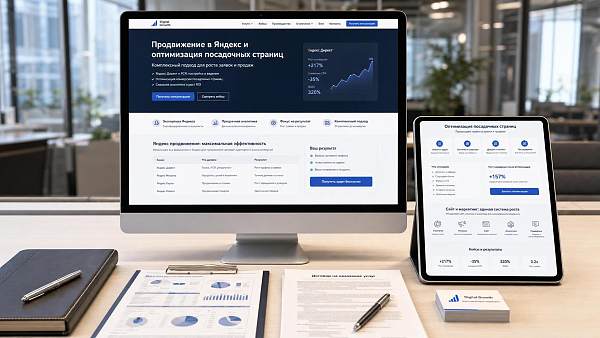
The goal of a Yandex promotion landing page is not simply to bring in clicks, but to let visitors judge in a very short time: Is this the solution I need, and is it worth continuing the conversation? Traffic quality is of course important, but what really affects inquiry rates is often whether the page’s connection is accurate.
In promotion within the Russian-speaking market, this ability to connect is even more critical. When different businesses use Yandex promotion landing pages, their focus is not the same. Some first look at price and delivery cycle, some first look at qualifications, cases, and localized wording, and others care more about whether the contact method is smooth and whether the page is trustworthy.
For a website and marketing service integrated business, a Yandex promotion landing page also takes on more complex tasks. It is not only a display page after ad clicks, but also the starting point for follow-up website building, SEO, advertising, and data accumulation. If a page only pursues good looks, it often sacrifices conversion efficiency.
A more common way to judge is to put the Yandex promotion landing page back into the real business path: what region it faces, what search intent it serves, and whether the conversion action is inquiry, request for quotation, or order placement, and then decide the page structure and content focus.
In Actual Use, Differences Often Come from Different Traffic Intentions
For the same Yandex promotion landing page, different search terms require different page design approaches. People searching brand terms usually already have some awareness, so the page is more suitable for strengthening trust and enabling quick contact. People searching generic product terms are still in a comparison stage, so the page should first answer “Why choose you.”
If the ad promotes solution-related terms, visitors are often not looking at a single product, but judging delivery capability, service scope, and long-term cooperation stability. At this point, the Yandex promotion landing page should not just pile up parameters; it should clearly explain the solution logic, service process, and implementation results.
For services such as cross-border independent sites, multilingual official websites, and advertising landing page development, the page also needs to consider regional language habits, industry terminology, and how trust is established. Yiyingbao has long focused on overseas website building and multi-channel marketing. Its value lies in integrating website building, content, advertising, and follow-up optimization, rather than treating the Yandex promotion landing page as an isolated page.
High-Intent Inquiry Traffic Cares More About Information Delivery
This kind of Yandex promotion landing page is not suitable for placing too much background introduction. The first screen should directly present the core business, differentiation advantages, and clear actions, such as submitting a request, getting a quote, or booking a consultation. The more drawn out the information is, the faster the loss.
What really affects conversion is usually not how much content there is, but the order of the content. Give the answer first, then provide supporting proof, and then give the action entry point; the path will be smoother.
For Comparative Traffic, the Key Is Whether the Reasoning Is Sufficient
If visitors are still comparing horizontally, the Yandex promotion landing page needs to provide more complete judgment basis, such as delivery scope, language support, case coverage, promotion capability, and follow-up optimization methods. The focus here is not on writing more, but on making the decision points clear.
Especially in multilingual website construction and overseas marketing service scenarios, the page needs to let visitors see “delivery capability.” It is not enough to only say you understand the Russian-speaking market; the page must also reflect whether localization, ad adaptation, and subsequent data optimization can form a closed loop.
Under Different Business Scenarios, the Judgment Focus of Yandex Promotion Landing Pages Also Differs
Before landing, it is necessary to confirm what type of business goal the current Yandex promotion landing page mainly serves. The following differences basically determine how the page content is arranged, how forms are set up, and where trust information is placed.
This is also why many Yandex promotion landing pages do not have low traffic, yet still convert only average. The problem is not a lack of content, but a mismatch between the content and search intent, which prevents visitors from finding the information they most want to confirm.
Page Structure Is Not Better When It Is Richer; It Is More Effective When It Is Closer to the Decision
A Yandex promotion landing page that can convert usually has a very clear structure. The first screen answers “Who are you, what can you solve, and what should I do next”; the middle section handles doubts; the end section completes the call to action, rather than repeating what was said before.
- Put core value on the first screen, not vague slogans.
- Add scenario pain points and solutions on the second screen.
- Add cases, data, testimonials, or service processes in the middle and later sections.
- Place forms and contact methods in segments, not only at the bottom of the page.
If it is a marketing-service-type Yandex promotion landing page, the “execution method” should also be written more specifically. For example, whether multilingual website building supports continuous iteration, whether advertising can work together with SEO, social media, and AI search optimization after launch; content like this inspires more trust than broad promises.
Yiyingbao is a platform that combines intelligent website building, advertising systems, and SEO optimization capabilities, and is suitable for emphasizing link integration in pages. Many conversion problems are not because a certain piece of copy is poorly written, but because the front-end page and back-end operations are disconnected.
Copy, Trust, and the Conversion Path Often Determine the Last Mile
The copy on a Yandex promotion landing page should not only talk about how strong the company is; it should also be written around the visitor’s decision-making process. A common effective approach is to first point out the problem, then provide the handling method, and finally add supporting evidence. This better matches the actual reading rhythm.
Trust building cannot rely on just one phrase like “many years of experience.” In promotion within the Russian-speaking market, local language quality, completeness of contact information, authenticity of cases, page loading experience, privacy statements, and form security all directly affect the conversion rate of a Yandex promotion landing page.
The conversion path should also reduce hesitation as much as possible. Inquiry-type pages should not ask for too much information at once, and order-type pages should not hide payment, logistics, and after-sales explanations too deeply. As long as visitors have to pause one more step, conversion may break.
A Few Common Misjudgments That Are Often Ignored
- Directly using the official website inner pages as a Yandex promotion landing page often makes the information hierarchy too scattered.
- Only focusing on visuals and ignoring first-screen copy and form friction leads to clicks but no conversion.
- Copying pages from other languages ignores Russian-speaking market expression habits and trust preferences.
- Only looking at ad cost and not at follow-up page optimization leads to persistently high customer acquisition costs.
Establish Adaptation Standards First, Then Optimization Will Not Be Repeated Trial and Error
If you want to improve the conversion rate of a Yandex promotion landing page, the most practical approach is not frequent redesigns, but first setting the judgment standards. These include traffic source, keyword intent, core conversion action, trust materials, form length, and mobile experience; all of these should be unified in advance.
If the page also needs to carry long-term growth tasks, it is recommended to consider website building, advertising, SEO, and data analysis together. In this way, the Yandex promotion landing page can not only capture current traffic, but also accumulate follow-up optimization basis. For businesses covering multiple regions, multiple languages, and multiple channels, this integrated approach is more stable.
The next step can be to first sort out which type of search scenario the existing Yandex promotion landing page service serves, and then, based on the first screen, trust module, contact method, and form settings, find the breakpoints that most affect conversion. Align the scenario, intent, and page actions, and conversion improvement is usually more direct than simply increasing the budget.
Related Articles
 How Long Does It Take to Get Inquiries After Launching an Electronics Components Export Website?
 How can building materials exporters reach overseas project procurement buyers?
 How Can Manufacturers Generate Qualified Inquiries Through Overseas Marketing?

Related Products
 Yiyingbao SaaS Intelligent Website Building and Marketing SystemYiyingbao SaaS Intelligent Website Building and Marketing System, AI-powered no-code website building, rapid creation of multilingual B2B international websites in 10 minutes, global server acceleration, AI-powered SEO optimization, helping businesses connect efficiently with global markets. The perfect integration of technology and operation makes building an international trade website remarkably simple
 AI+SEM Intelligent Advertising Marketing SystemAI+SEM drives intelligent ad creation, empowering full-funnel precision advertising marketing. The system automatically generates weekly/monthly reports, AI recommends keywords and target countries, monitors core metrics in real-time with intelligent alerts, and enables one-click high-conversion ad solutions to help quickly acquire customers and improve ROI.
 AI+SEO Dual-Engine System Optimization ServicesYiyingbao’s AI+SEO dual-engine optimization system helps foreign trade enterprises acquire high-quality organic traffic through AI-powered keyword research, content generation, and comprehensive technical optimization, significantly improving search rankings and conversion rates.
 AI+SNS Social Media Marketing SystemYingbao AI+SNS Social Media Marketing System - Precision social capture for the social media era. Supports one-click content synchronization across major platforms like Facebook and LinkedIn. AI intelligently rewrites posts for enhanced relevance. 24/7 AI customer service and user profiling analysis empower businesses to efficiently expand into global markets.
 AI+SEO营销解决方案易营宝AI+SEO营销解决方案,通过AI批量写作、智能生成TDK、精准关键词扩词等功能,全面优化网站SEO效果,提升流量与转化率。助力企业构建高效智能网站新生态。
 AI+SEM Advertising Marketing SolutionsAI+SEM Advertising Marketing Solution leverages AI technology to deeply empower SEM ad campaigns. It automatically generates weekly/monthly reports using AI, presenting account data across multiple dimensions for comprehensive insights into campaign performance and trends. The system precisely recommends keywords and target countries, intelligently generates high-conversion ad copy, and enables one-click activation of efficient campaign plans to help businesses rapidly acquire customers. Simultaneously, it monitors core metrics in real time, intelligently identifies abnormal fluctuations, and issues timely alerts to ensure stable, high-return advertising results.
 Domain Name ServicesEasyWin provides professional domain name services, including intelligent queries, one-stop registration, brand protection, and full lifecycle management, helping businesses build a digital brand image.
 EasyOperate B2C Cross-Border E-Commerce Platform & Independent WebsiteEasyStore B2C Cross-border E-commerce Independent Store is an intelligent website building and cross-border e-commerce integrated solution independently developed by EasyStore Information Technology (Beijing) Co., Ltd. The system is specially designed for small and medium-sized as well as large export enterprises, integrating 'website building, operation, marketing, advertising, and conversion' into one, helping enterprises quickly establish cross-border e-commerce independent stores to achieve brand globalization and global sales growth.
The platform supports multiple languages, multiple currencies, and multi-channel marketing, with built-in AI intelligent translation and SEO optimization systems, suitable for mainstream markets such as Southeast Asia, Europe and America, Latin America, and the Middle East, assisting Chinese manufacturing enterprises in efficiently deploying international e-commerce strategies. SSL证书易营宝提供专业SSL安全证书服务,包括单域名和泛域名证书,确保网站数据传输加密、身份验证和完整性保护,助力企业建立安全可信的在线业务环境。









