









- EU Plans to Raise Tax on Incoming Small Parcels to €5Oct 31, 2026View details
- Maersk Adjusts Middle East Emergency Operating Cost Recovery Surcharge to USD 2,000 per ContainerOct 30, 2026View details
- Ministry of Commerce: Online retail sales grew 4.4% in the first three quarters, while cross-border e-commerce maintained relatively rapid growthOct 29, 2026View details
- CCTV reports: AI-powered smart hardware is expanding overseas at a faster pace, with orders for some best-selling products booked through next yearOct 29, 2026View details
- Alphabet Q3 Earnings: Google Search Advertising Revenue Rises 10.5% to $82 BillionOct 29, 2026View details
- AliExpress Announces New Service Rules for Russia, Linked to Wildberries Product IntegrationOct 28, 2026View details
How Can Manufacturers Generate Qualified Inquiries Through Overseas Marketing?
For manufacturers marketing overseas, an increase in website traffic does not necessarily lead to more qualified inquiries. Buyers may be unable to find key specifications, or they may leave their contact details and then wait a long time without receiving a relevant response. To improve results, companies need to connect target customers, website content, lead-generation channels, and sales follow-up in a trackable process.
Companies with clearly defined product specifications and the ability to fulfill export orders can prioritize building a lead-generation system around key products and target markets. If products are still undergoing frequent changes or delivery requirements in target markets are not yet clear, resolving these issues first will be more valuable than increasing advertising spend.
Define a qualified inquiry before deciding where to get traffic
The same inquiry can have very different value for different manufacturers. A standard-component supplier may want to confirm the model and quantity as soon as possible, while a custom equipment manufacturer may need to understand the operating conditions, capacity requirements, budget, and purchasing timeline. Counting only form submissions can make genuine purchase inquiries difficult to distinguish from student questions, competitor inquiries, and sales pitches from suppliers.
Companies can start by having their sales and marketing teams jointly define several screening criteria: whether the customer is in a region they can serve, whether the product or process they ask about is a fit, whether the contact is a potential buyer, and whether the inquiry includes quantity, specifications, or project background. These criteria do not all need to be met during the first contact, but they should help the team determine what to ask next.
At the same time, allow for inquiries that “cannot yet be assessed.” Purchasing cycles for large equipment or custom projects may be lengthy, and customers may be unwilling to disclose their budget when they first make contact. For these leads, confirm the application and project stage first rather than discarding them solely because the information is incomplete.
Make your website answer buyers’ first-round questions
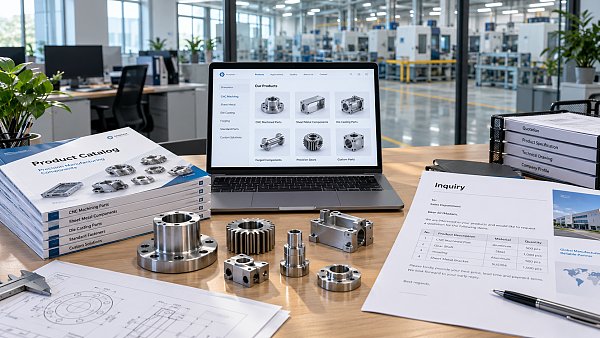
When marketing manufacturing products overseas, a website is not just for showcasing products; it also helps customers decide whether a supplier is worth contacting. Stating “professional manufacturing” and “reliable quality” on the homepage is not enough. When procurement professionals visit a specific product page, they should be able to quickly find the model, applications, key specifications, available options, and an inquiry form.
Organize content to match how the product is purchased. For standard products, provide clear specification tables, selection ranges, and related documentation. For custom products, explain which dimensions, materials, processes, or application conditions can be discussed, and specify what information customers should submit to help with the assessment. For equipment, installation requirements, the scope of after-sales support, and delivery arrangements can also influence whether customers continue the conversation.
Credible information is more useful than a pile of promotional claims. Companies can showcase their actual production capabilities, quality management processes, and testing documentation that can be made public. When referring to certifications, specify the products covered, applicable scope, and current validity to avoid giving customers the impression that every model holds the same certification. Multilingual pages also need to be checked for terminology, units, and contact details; simply translating the Chinese page word for word is not enough.
Inquiry forms should make it easy for customers to get in touch. The form can request a name, email address, and description of the requirement, then include fields such as model, quantity, or application based on the product. For complex projects, customers can also be invited to upload requirement documents. Too many fields increase the effort required to complete the form, while too few make it harder for sales to assess the inquiry. Choose the right balance based on the complexity of the product decision.
Choose channels based on purchase intent, not by dividing the budget evenly
When customers already know a product name or have a technical requirement, search channels are better suited to capturing active demand. Companies can improve pages around key products, models, and application questions to gradually build organic search traffic. They can also use search ads to test target markets and keywords, but ad clicks should lead to pages that match the search intent. For example, if a customer searches for the specifications of a particular type of component but is directed to a homepage that only introduces the company, their willingness to make an inquiry may be affected.
Social media is suitable for showcasing factory capabilities, product applications, and professional content, and can also be used to reach potential customers who have not yet entered a clearly defined purchasing stage. Interactions from these channels should not be treated as direct indicators of purchase intent. Instead, observe whether these visitors go on to view products, download materials, or initiate business discussions.
When the budget is limited, start by selecting a group of competitive products and markets the company can serve, then focus on testing one or two channels. During the test, track channel costs, visits, inquiries, and the number of qualified inquiries recognized by sales separately, then adjust based on subsequent opportunity progress. Even if a channel generates many inquiries, it may not be worth further investment if the customers’ regions cannot be served or the product fit is poor.
Track inquiry quality through to sales follow-up
Several stages between a click and a sale can affect the outcome. Decision-makers should be able to answer at least the following questions: Which channel did the customer use? Which page did they visit? Which product did they ask about? Has sales contacted them, and are they ready for a further quotation? If only the total number of inquiries is known, it is difficult to tell whether the problem lies with traffic, the page, or follow-up.
You can set up simple lead statuses, such as awaiting contact, requirements to be confirmed, quote sent, ongoing follow-up, and not a fit, and record the main reason when a lead is not a fit. At regular intervals, sales can tell the marketing team which search terms or pages brought in better-fit customers, what information customers ask about repeatedly, and which regions or products the company cannot currently serve. Marketing can then adjust advertising and page content accordingly.
It is also important to distinguish between the initial response and subsequent progress. After receiving an inquiry, promptly confirm the customer’s requirements and contact details. If a project requires technical evaluation, explain which additional specifications are needed and when the customer can expect a response. For forms and follow-up records involving personal information, also comply with applicable requirements in the target market, clearly state the purpose of collection, and restrict access.
When evaluating investment, focus on the cost of qualified inquiries and the quality of subsequent opportunities rather than simply pursuing the lowest cost per click. If a product page consistently generates well-matched purchase inquiries, it may be more worthwhile to maintain than a page that attracts high traffic but few business leads, even if its traffic is modest.
Related Articles
 How Can Manufacturers Generate Qualified Inquiries Through Overseas Marketing?
 How Should a Machinery Export Marketing Company Evaluate Lead Quality?
 How Can an IDC SaaS Platform Improve User Satisfaction by Reducing Ticket Response Times?

Related Products
 Yiyingbao SaaS Intelligent Website Building and Marketing SystemYiyingbao SaaS Intelligent Website Building and Marketing System, AI-powered no-code website building, rapid creation of multilingual B2B international websites in 10 minutes, global server acceleration, AI-powered SEO optimization, helping businesses connect efficiently with global markets. The perfect integration of technology and operation makes building an international trade website remarkably simple
 AI+SEM Intelligent Advertising Marketing SystemAI+SEM drives intelligent ad creation, empowering full-funnel precision advertising marketing. The system automatically generates weekly/monthly reports, AI recommends keywords and target countries, monitors core metrics in real-time with intelligent alerts, and enables one-click high-conversion ad solutions to help quickly acquire customers and improve ROI.
 AI+SEO Dual-Engine System Optimization ServicesYiyingbao’s AI+SEO dual-engine optimization system helps foreign trade enterprises acquire high-quality organic traffic through AI-powered keyword research, content generation, and comprehensive technical optimization, significantly improving search rankings and conversion rates.
 AI+SNS Social Media Marketing SystemYingbao AI+SNS Social Media Marketing System - Precision social capture for the social media era. Supports one-click content synchronization across major platforms like Facebook and LinkedIn. AI intelligently rewrites posts for enhanced relevance. 24/7 AI customer service and user profiling analysis empower businesses to efficiently expand into global markets.
 AI+SEO营销解决方案易营宝AI+SEO营销解决方案,通过AI批量写作、智能生成TDK、精准关键词扩词等功能,全面优化网站SEO效果,提升流量与转化率。助力企业构建高效智能网站新生态。
 AI+SEM Advertising Marketing SolutionsAI+SEM Advertising Marketing Solution leverages AI technology to deeply empower SEM ad campaigns. It automatically generates weekly/monthly reports using AI, presenting account data across multiple dimensions for comprehensive insights into campaign performance and trends. The system precisely recommends keywords and target countries, intelligently generates high-conversion ad copy, and enables one-click activation of efficient campaign plans to help businesses rapidly acquire customers. Simultaneously, it monitors core metrics in real time, intelligently identifies abnormal fluctuations, and issues timely alerts to ensure stable, high-return advertising results.
 Domain Name ServicesEasyWin provides professional domain name services, including intelligent queries, one-stop registration, brand protection, and full lifecycle management, helping businesses build a digital brand image.
 EasyOperate B2C Cross-Border E-Commerce Platform & Independent WebsiteEasyStore B2C Cross-border E-commerce Independent Store is an intelligent website building and cross-border e-commerce integrated solution independently developed by EasyStore Information Technology (Beijing) Co., Ltd. The system is specially designed for small and medium-sized as well as large export enterprises, integrating 'website building, operation, marketing, advertising, and conversion' into one, helping enterprises quickly establish cross-border e-commerce independent stores to achieve brand globalization and global sales growth.
The platform supports multiple languages, multiple currencies, and multi-channel marketing, with built-in AI intelligent translation and SEO optimization systems, suitable for mainstream markets such as Southeast Asia, Europe and America, Latin America, and the Middle East, assisting Chinese manufacturing enterprises in efficiently deploying international e-commerce strategies. SSL证书易营宝提供专业SSL安全证书服务,包括单域名和泛域名证书,确保网站数据传输加密、身份验证和完整性保护,助力企业建立安全可信的在线业务环境。









