









- Which customer acquisition channels will be affected by cross-border marketing trends in 2026?Sep 06, 2026View details
- Which homogenization risks should be considered in an analysis of the AI-powered website building industry?Aug 30, 2026View details
- How Will AI Marketing Trends 2026 Change Advertising Budget AllocationAug 28, 2026View details
- Is the EV SSL certificate market shrinking or upgrading? How should companies assess certificate procurement?Aug 11, 2026View details
- Why the old AMP SEO 2020 practices no longer work and what has changed in current optimization prioritiesAug 02, 2026View details
- How to Choose Topics for an Industry News Section to Attract More Organic Search TrafficJul 29, 2026View details
When improving Google SEO, fix these four basic issues first
Don't Rush into Tactics: Start by Checking These Four Areas
When many teams talk about improving Google SEO, their first reaction is to modify titles, stuff in keywords, and build backlinks. However, once a project is truly underway, the factors that most often hinder results are usually not a lack of optimization skills, but an unstable website foundation. Whether pages can be crawled smoothly, whether the structure is overly complicated, whether the loading speed is sufficient, and whether the content clearly communicates the business—if these basic issues are not resolved, subsequent efforts will easily be slow, scattered, and unstable, no matter how many additional tactics are applied.
If you are managing a project, the most practical approach is not to start by discussing “when rankings will improve,” but to first establish the troubleshooting order. The following four areas are essentially the underlying issues that most websites should address at the initial stage.
1. Start with the Website Structure—Don't Let Customers and Search Engines Get Lost Together
Structural problems are very common, especially on multilingual corporate websites with numerous product categories that also need to support both inquiries and product presentation. The site may appear to have many pages, but the hierarchy is actually too deep, the main navigation is unclear, and the internal linking relationships are disorganized. As a result, users cannot find the key pages, while search engines cannot determine which pages are more important.
During the review, focus on these areas first:
- Can core pages be reached within 3 clicks, such as product pages, solution pages, contact pages, and key landing pages?
- Are there multiple entry points for the same type of content? For example, “Product Center,” “Product Categories,” and “All Products” may point to similar pages, which can dilute link equity.
- Are URLs stable and readable? Avoid meaningless parameters, inconsistent capitalization, or mixed Chinese and English path rules.
- Are breadcrumbs, related-content links, and links between parent and child sections properly connected, rather than relying solely on the navigation bar to support the entire site?
The most common mistake here is not that the structure is “poor,” but that it “looks complete while lacking a clear hierarchy.” What project leaders need to promote is not a redesign of individual pages, but a clear prioritization of inquiry pages, key product pages, and brand information pages. This is especially true for B2B websites. Many corporate sites publish a great deal of news, while the product and solution pages that should actually rank are buried too deeply. Such websites are difficult to optimize at a later stage.
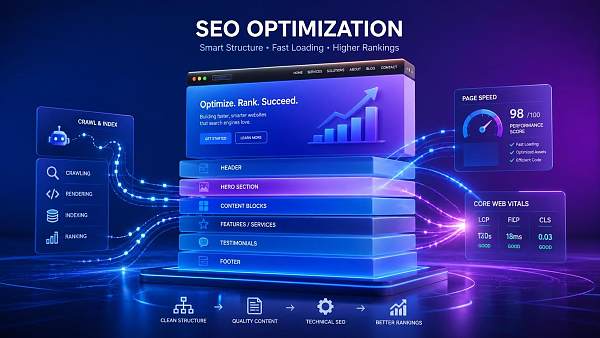
2. Page Speed Is Not a Technical Detail; It Directly Affects Indexing and Conversion
Speed is one of the factors most easily underestimated in a project. This is particularly true for websites serving overseas markets. When visitors are distributed across North America, Europe, and Southeast Asia, overly large images, excessive scripts, or slow server response can significantly degrade the user experience. Search performance will be affected, and conversions on inquiry pages will also suffer.
You do not need to pursue an extreme score from the outset, but you should at least assess these risks:
- Is the above-the-fold area overloaded with large images, videos, or autoplay animations, causing the page to lag as soon as it opens?
- Are there too many third-party scripts, such as analytics, chat, forms, pop-ups, and ad-tracking code layered one on top of another?
- Is the mobile version significantly slower than the desktop version? Many websites perform well on computers but are noticeably sluggish on mobile devices.
- Are access speeds consistent across different target markets? Do not draw conclusions after testing only on a local network.
In practice, reduce the load first, then focus on fine-tuning. Image compression, lazy loading, removing ineffective plugins, and combining unnecessary scripts often produce results faster than “changing the wording of a title.” For project scheduling, this is also one of the most cost-effective types of optimization because it improves crawl efficiency, bounce rates, and form-submission experience at the same time.
3. Don't Judge Content Quality by Word Count; Check Whether It Answers Customers' Questions
The problem with many websites is not that they “write too little,” but that they “write a lot of things that are not useful.” The pages may look lengthy, but are actually filled with empty statements: corporate strength, service philosophy, and quality assurance are repeated over and over, while the delivery scope, applicable scenarios, configuration differences, and cooperation methods that users care about most are not explained clearly. Such pages have difficulty supporting efforts to improve Google SEO because search engines find only generic information, while users see vague descriptions.
When reviewing content, project leaders can ask four direct questions:
This point is particularly important when building overseas marketing websites. If multilingual content is merely mechanically translated, inconsistent terminology and unnatural expressions can affect both indexing and conversion. A truly useful page does not necessarily have to be the longest, but it should lay out the customer's decision-making path: who you are, what problem you solve, who you serve, and how to contact you next.
4. If the Indexing Foundation Is Not in Place, the First Three Efforts Will Be Difficult to Scale
Many projects discover halfway through that the real problem is not insufficient content, but that the pages are not being properly discovered and processed at all. For example, robots settings may block important directories, the sitemap may not have been updated for a long time, canonical tags may be inconsistent, or a test site may still contain crawl-blocking directives. These issues are not obvious, but their impact is substantial.
It is recommended to check the following items in order:
- Can important pages be crawled? Start by checking robots settings and page-level directives.
- Has the sitemap been submitted, and can newly added pages be incorporated in a timely manner?
- Are there large numbers of duplicate URLs, such as parameterized pages, filtered pages, or print pages?
- Are page redirects properly configured? Do not leave old links, temporary pages, or error pages active on the site for long periods.
- Does the multilingual site clearly distinguish different language versions to prevent them from competing with or overriding one another?
If your project also includes a business website operating within China, compliance and the launch process should be included in the review checklist. Prerequisites such as server deployment, domain connection, and filing status can directly affect the website launch schedule and accessibility. When website filing is involved, services such as Domestic ICP Filing Service Number are valuable not because they add “one more procedure,” but because they streamline document pre-review, information submission, verification coordination, and regulatory review, reducing repeated rework caused by documentation issues. Especially when a website needs to change its filing information, switch its access provider, or complete a filing for a non-commercial website, the project schedule should reserve time in advance rather than waiting until development is complete to address this step.
When Advancing a Project, Implementing These Steps in Order Saves More Time
Based on practical experience, these four areas should not be pushed forward chaotically in parallel. A more reliable order is to first resolve indexing and crawling obstacles, then organize the website structure, followed by speed optimization, and finally focus on content improvements. The reason is simple: pages must first be accessible and identifiable, and content adjustments will not require repeated rework once the structure has been organized. Addressing speed issues early also makes subsequent page launches more stable.
For project managers, determining whether an SEO project is on the right track does not mean looking at how many pieces of content were published this week or whether a few short-term keywords have fluctuated in the report. Instead, check whether these four underlying issues have been addressed one by one. Once the foundation is fixed, whether you are implementing intelligent website building, SEO optimization, or advertising-assisted traffic acquisition, the site will be more likely to reach a state where it can be indexed, promoted, and converted.
If you are really going to get started, begin today by compiling a website checklist: identify the core pages, verify their crawl status, test mobile loading speed, and review the content based on whether it answers customers' questions. Once the foundation has been leveled, improving Google SEO will begin to feel much more straightforward.
Related Articles


Related Products
 Yiyingbao SaaS Intelligent Website Building and Marketing SystemYiyingbao SaaS Intelligent Website Building and Marketing System, AI-powered no-code website building, rapid creation of multilingual B2B international websites in 10 minutes, global server acceleration, AI-powered SEO optimization, helping businesses connect efficiently with global markets. The perfect integration of technology and operation makes building an international trade website remarkably simple
 AI+SEM Intelligent Advertising Marketing SystemAI+SEM drives intelligent ad creation, empowering full-funnel precision advertising marketing. The system automatically generates weekly/monthly reports, AI recommends keywords and target countries, monitors core metrics in real-time with intelligent alerts, and enables one-click high-conversion ad solutions to help quickly acquire customers and improve ROI.
 AI+SEO Dual-Engine System Optimization ServicesYiyingbao’s AI+SEO dual-engine optimization system helps foreign trade enterprises acquire high-quality organic traffic through AI-powered keyword research, content generation, and comprehensive technical optimization, significantly improving search rankings and conversion rates.
 AI+SNS Social Media Marketing SystemYingbao AI+SNS Social Media Marketing System - Precision social capture for the social media era. Supports one-click content synchronization across major platforms like Facebook and LinkedIn. AI intelligently rewrites posts for enhanced relevance. 24/7 AI customer service and user profiling analysis empower businesses to efficiently expand into global markets.
 AI+SEO营销解决方案易营宝AI+SEO营销解决方案,通过AI批量写作、智能生成TDK、精准关键词扩词等功能,全面优化网站SEO效果,提升流量与转化率。助力企业构建高效智能网站新生态。
 AI+SEM Advertising Marketing SolutionsAI+SEM Advertising Marketing Solution leverages AI technology to deeply empower SEM ad campaigns. It automatically generates weekly/monthly reports using AI, presenting account data across multiple dimensions for comprehensive insights into campaign performance and trends. The system precisely recommends keywords and target countries, intelligently generates high-conversion ad copy, and enables one-click activation of efficient campaign plans to help businesses rapidly acquire customers. Simultaneously, it monitors core metrics in real time, intelligently identifies abnormal fluctuations, and issues timely alerts to ensure stable, high-return advertising results.
 Domain Name ServicesEasyWin provides professional domain name services, including intelligent queries, one-stop registration, brand protection, and full lifecycle management, helping businesses build a digital brand image.
 EasyOperate B2C Cross-Border E-Commerce Platform & Independent WebsiteEasyStore B2C Cross-border E-commerce Independent Store is an intelligent website building and cross-border e-commerce integrated solution independently developed by EasyStore Information Technology (Beijing) Co., Ltd. The system is specially designed for small and medium-sized as well as large export enterprises, integrating 'website building, operation, marketing, advertising, and conversion' into one, helping enterprises quickly establish cross-border e-commerce independent stores to achieve brand globalization and global sales growth.
The platform supports multiple languages, multiple currencies, and multi-channel marketing, with built-in AI intelligent translation and SEO optimization systems, suitable for mainstream markets such as Southeast Asia, Europe and America, Latin America, and the Middle East, assisting Chinese manufacturing enterprises in efficiently deploying international e-commerce strategies. SSL证书易营宝提供专业SSL安全证书服务,包括单域名和泛域名证书,确保网站数据传输加密、身份验证和完整性保护,助力企业建立安全可信的在线业务环境。









