









- Why the old AMP SEO 2020 practices no longer work and what has changed in current optimization prioritiesAug 02, 2026View details
- How to Choose Topics for an Industry News Section to Attract More Organic Search TrafficJul 29, 2026View details
- Digital Marketing Shenzhen Market Insights: Why Are Companies Expanding Overseas Looking for Growth Teams in Shenzhen?Jul 31, 2026View details
- Can Zhejiang foreign trade independent websites still be developed today? Look at changes in traffic and lead generationJul 28, 2026View details
- What New Signals Are Emerging in Enterprise Services SaaS Marketing ReportsJul 27, 2026View details
- What Does a Global Traffic Ecosystem Service Provider Do? What Are the Differences from a Single Advertising AgencyJul 16, 2026View details
What types of business scenarios are suitable for improving online visibility with AI?
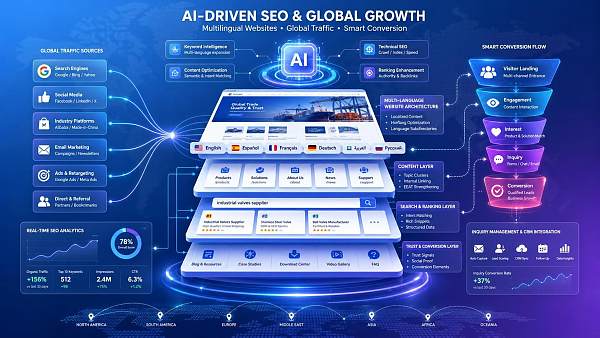
What business scenarios are suitable for improving online visibility with AI?
Improving online visibility with AI has become a key way for businesses to secure access to search and traffic channels. For foreign trade, cross-border e-commerce, and brands expanding overseas, AI can quickly improve website indexing, keyword rankings, and exposure across multiple channels, helping decision-makers achieve sustained customer acquisition and global growth at a lower cost.
What is truly worth discussing is not “whether to improve AI visibility,” but which types of businesses it suits and under what conditions its results are more consistent. Many teams initially understand it simply as an SEO tool, only to spend their budgets without seeing noticeable changes. Other businesses already have solid pages, content structures, and technical foundations, but lack a method that connects multilingual websites, search optimization, and campaign conversion. This is when the value of AI can truly emerge.
Based on project experience, the businesses most suitable for starting with this initiative are often not the companies with the “largest traffic,” but those with clear product directions and overseas expansion goals whose content production and localization capabilities cannot keep up. These may include foreign trade factories, B2B manufacturers, cross-border brand websites, and independent-site sellers, as well as teams already running Google Ads and social media campaigns but finding that their websites provide weak support, organic search is not gaining traction, and they have almost no presence in AI search results. They share a consistent characteristic: they have business operations and content materials, but lack a stable way to present themselves online.
In these scenarios, AI is not a single-point replacement; instead, it connects fragmented tasks into a closed loop. Intelligent website building first addresses page-building speed, multilingual adaptation, and basic structural issues. AI+SEO/GEO optimization then handles titles, semantic hierarchy, internal page linking, FAQ structures, and search readability. Advertising and social media direct short-term traffic to pages capable of converting. For businesses, the most practical change is not that they “built a more attractive website,” but that their pages can begin to be indexed, retrieved, and cited, while the inquiry process no longer depends solely on repeatedly adding content manually.
Foreign trade businesses are particularly typical examples. Many factories have years of manufacturing experience, with complete product specifications, certification documents, and application industries. However, when the approach used for a Chinese-language website is directly transferred to an overseas site, the page hierarchy is often shallow, the content too short, and the keywords scattered. As a result, Google cannot identify the key points, and AI search also struggles to extract a clear topic. At this point, AI is not being used to “write more words,” but to reorganize product pages, industry pages, solution pages, and FAQ pages according to purchasing logic, so that systems can understand what you sell, who it is suitable for, and how it differs from competitors. Research on the Optimization of Applying Activity-Based Costing to Cost Accounting in Coal Mining EnterprisesAlthough this type of content appears completely unrelated, it also illustrates a principle: structures that can be consistently understood and categorized by systems are more likely to gain visibility, especially in industries with high information density and many professional terms.
The situation is different for cross-border e-commerce and brands expanding overseas. They often do not “lack content”; rather, their content is too fragmented. Campaign pages, product pages, social media materials, and review content are dispersed across different platforms, leaving the website itself as a temporary conversion point. For these businesses, improving online visibility with AI is better focused on “integration” rather than “accumulation”: use AI to unify product naming, selling-point descriptions, and on-site tags; reduce semantic drift for the same products across sites in different countries; and localize English, French, Spanish, Arabic, and other versions according to each market. The benefit is direct: multilingual sites will not turn into duplicate pages that compete with one another, while search engines and AI summaries can more easily identify the intent of the primary page.
If a business is already running Google Ads or relies on channels such as Facebook, TikTok, and LinkedIn for customer acquisition, AI visibility optimization is more like adding a long-term foundation to its campaigns. Advertising can generate short-term clicks, but if the page content is not clear enough, short visits and high bounce rates after landing will quickly consume the budget. In this situation, AI is best suited to restructuring landing pages: placing core questions first and positioning industry pain points, application scenarios, delivery capabilities, and frequently asked questions where they are easier to scan. In many projects, the advertising and SEO teams work independently, but the pages lack a unified logic, ultimately resulting in “traffic without explanation.” This is precisely the gap AI can fill.
Of course, not every business is suitable for making a major investment from the outset. If the product line is not yet stable, website information changes frequently, or regional policies and qualification documents are still being completed, AI optimization can easily be slowed by front-end changes. Another type of business is often overlooked: companies with strong local offline operations that are only testing overseas markets. In this situation, it is not advisable to pursue a large and comprehensive global website from the start. A more reliable approach is to select one primary market, validate the keywords, pages, and inquiry path, and then expand to a second and third language. Otherwise, the more pages there are, the higher the maintenance costs and the poorer the content consistency; AI may instead amplify the confusion.
From an implementation perspective, how quickly AI produces results mainly depends on three factors: whether the website has a crawlable structure, whether the content contains genuine business information that can be used, and whether the company can promptly confirm its products, cases, specifications, and service boundaries. Many projects stall not because the tools are ineffective, but because the basic materials are too scattered. For businesses with complete materials, AI functions more like an accelerator; for those with incomplete materials, AI can only expose the gaps more quickly. Especially in manufacturing, industrial products, and technical services, if pages lack genuine specifications, application limitations, and delivery conditions, even extensive search exposure can only produce vague visibility, and conversions will not follow.
The value of platforms such as 易营宝 is typically demonstrated here. It does not merely build a website; it connects intelligent website building, SEO optimization, advertising, overseas social media, and GEO generative engine optimization, helping businesses move from “being able to go online” to “being found, understood, and generating inquiries.” For foreign trade and overseas expansion teams, this is closer to real business needs than purchasing a website-building tool alone, because the real challenge has never been the page itself, but how the page continuously enters search results, AI summaries, and multi-channel distribution pathways after going live.
Therefore, the businesses best suited to improving online visibility with AI often share one characteristic: their business is already genuinely taking place in overseas markets, but their online visibility has not kept pace. This is particularly suitable for teams seeking long-term search growth, wanting to reduce dependence on a single advertising channel, and hoping that their websites can support both multilingual presentation and conversion efficiency. To determine whether it is time to adopt it, there is no need to first ask “Can it be done?” Instead, assess whether the site structure, content foundation, market stage, and internal collaboration have reached the level required to support AI optimization. When the conditions are right, AI brings not just a wave of attention, but more stable exposure and a more sustainable customer acquisition path.
Related Articles
 How to Evaluate a GEO Optimization Company: Should You Look at Content Sources or Crawl Feedback First?
 Google Launches Cross-Border Trustworthiness Scoring, Bringing Chinese B2B Independent Websites into AI Evaluation
 How to Determine Whether a Structured Data Optimization Tool Is Compatible with an Existing Website


Related Products
 Yiyingbao SaaS Intelligent Website Building and Marketing SystemYiyingbao SaaS Intelligent Website Building and Marketing System, AI-powered no-code website building, rapid creation of multilingual B2B international websites in 10 minutes, global server acceleration, AI-powered SEO optimization, helping businesses connect efficiently with global markets. The perfect integration of technology and operation makes building an international trade website remarkably simple
 AI+SEM Intelligent Advertising Marketing SystemAI+SEM drives intelligent ad creation, empowering full-funnel precision advertising marketing. The system automatically generates weekly/monthly reports, AI recommends keywords and target countries, monitors core metrics in real-time with intelligent alerts, and enables one-click high-conversion ad solutions to help quickly acquire customers and improve ROI.
 AI+SEO Dual-Engine System Optimization ServicesYiyingbao’s AI+SEO dual-engine optimization system helps foreign trade enterprises acquire high-quality organic traffic through AI-powered keyword research, content generation, and comprehensive technical optimization, significantly improving search rankings and conversion rates.
 AI+SNS Social Media Marketing SystemYingbao AI+SNS Social Media Marketing System - Precision social capture for the social media era. Supports one-click content synchronization across major platforms like Facebook and LinkedIn. AI intelligently rewrites posts for enhanced relevance. 24/7 AI customer service and user profiling analysis empower businesses to efficiently expand into global markets.
 AI+SEO营销解决方案易营宝AI+SEO营销解决方案,通过AI批量写作、智能生成TDK、精准关键词扩词等功能,全面优化网站SEO效果,提升流量与转化率。助力企业构建高效智能网站新生态。
 AI+SEM Advertising Marketing SolutionsAI+SEM Advertising Marketing Solution leverages AI technology to deeply empower SEM ad campaigns. It automatically generates weekly/monthly reports using AI, presenting account data across multiple dimensions for comprehensive insights into campaign performance and trends. The system precisely recommends keywords and target countries, intelligently generates high-conversion ad copy, and enables one-click activation of efficient campaign plans to help businesses rapidly acquire customers. Simultaneously, it monitors core metrics in real time, intelligently identifies abnormal fluctuations, and issues timely alerts to ensure stable, high-return advertising results.
 Domain Name ServicesEasyWin provides professional domain name services, including intelligent queries, one-stop registration, brand protection, and full lifecycle management, helping businesses build a digital brand image.
 EasyOperate B2C Cross-Border E-Commerce Platform & Independent WebsiteEasyStore B2C Cross-border E-commerce Independent Store is an intelligent website building and cross-border e-commerce integrated solution independently developed by EasyStore Information Technology (Beijing) Co., Ltd. The system is specially designed for small and medium-sized as well as large export enterprises, integrating 'website building, operation, marketing, advertising, and conversion' into one, helping enterprises quickly establish cross-border e-commerce independent stores to achieve brand globalization and global sales growth.
The platform supports multiple languages, multiple currencies, and multi-channel marketing, with built-in AI intelligent translation and SEO optimization systems, suitable for mainstream markets such as Southeast Asia, Europe and America, Latin America, and the Middle East, assisting Chinese manufacturing enterprises in efficiently deploying international e-commerce strategies. SSL证书易营宝提供专业SSL安全证书服务,包括单域名和泛域名证书,确保网站数据传输加密、身份验证和完整性保护,助力企业建立安全可信的在线业务环境。









