









- Why the old AMP SEO 2020 practices no longer work and what has changed in current optimization prioritiesAug 02, 2026View details
- How to Choose Topics for an Industry News Section to Attract More Organic Search TrafficJul 29, 2026View details
- Digital Marketing Shenzhen Market Insights: Why Are Companies Expanding Overseas Looking for Growth Teams in Shenzhen?Jul 31, 2026View details
- Can Zhejiang foreign trade independent websites still be developed today? Look at changes in traffic and lead generationJul 28, 2026View details
- What New Signals Are Emerging in Enterprise Services SaaS Marketing ReportsJul 27, 2026View details
- What Does a Global Traffic Ecosystem Service Provider Do? What Are the Differences from a Single Advertising AgencyJul 16, 2026View details
How to Evaluate a GEO Optimization Company: Should You Look at Content Sources or Crawl Feedback First?
When evaluating a GEO optimization company, many teams immediately focus on its “content capabilities”: whether it has industry editors, whether it can handle multiple languages, and whether it can produce content at scale that is suitable for citation by AI search. These aspects are certainly important. However, if a business evaluation remains focused only on the content source, it will often overestimate the value of the solution. The reason is straightforward: GEO does not end once the content has been written. What matters is whether the content can be crawled, understood, and incorporated into the visibility chain of AI and search systems, and ultimately whether it can generate stable exposure.
For business evaluators, the real question is not what the service provider “can write,” but whether it “can make content enter effective circulation.” Therefore, when evaluating a GEO optimization company, content sources and crawling feedback are not mutually exclusive options: the former determines potential, while the latter determines the rate at which that potential is realized.
Why do many GEO projects appear to involve extensive work but produce unstable results?
The most common problem with these projects is that GEO is understood as “content publishing services for the AI era.” Service providers offer topic selection, page copy, FAQs, structured content, and case study pages, and may even emphasize compatibility with Google, Bing, and various AI search scenarios. However, if the business side looks only at deliverables, it can easily overlook a key fact: search engines and generative engines do not automatically deliver traffic simply because content exists.
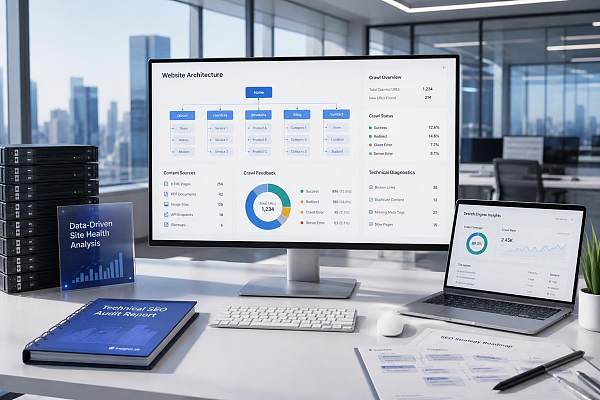
Actual results depend on several consecutive stages: whether a page can be accessed, whether its content can be crawled, whether its structure can be recognized, whether its topic can be classified, whether the site as a whole has sufficient credibility, and whether the feedback cycle after updates can be monitored. This means that the capabilities of a GEO optimization company involve more than content production. They also include technical implementation, data feedback, issue diagnosis, and an iteration mechanism.
If a service provider can only show “how many articles we have written” and “how many keyword placements we have completed,” but cannot clearly explain crawling anomalies, indexing changes, fluctuations in page visibility, and AI citation signals, it is more like a content outsourcing provider than an assessable growth service provider.
Start with the content source—but focus on whether it is a “citable content source”
When evaluating a business, the content source remains the first-level screening criterion, but it needs to be assessed in greater detail.
Many GEO optimization companies describe “high-quality content” in very broad terms. For the party making the selection, however, three aspects are truly meaningful.
First, does the content address decision-making questions rather than simply accumulating words around keywords? In particular, in B2B foreign trade, manufacturing, and cross-border services, AI search is more likely to extract question-based content that can answer questions about procurement, comparison, applicability, risks, and delivery conditions. If a service provider is still following the logic of traditional SEO articles and focuses only on “concept explanations plus benefit introductions,” the content may be indexed but still lack citation value in AI scenarios.
Second, is the content source verifiable? Information such as company cases, parameter descriptions, application boundaries, regional adaptation, service processes, delivery cycles, and common causes of failure is more likely to form credible content units. By contrast, vague promotional claims, repetitive rewriting, and unsupported opinions reduce the likelihood that a site will be recognized by systems as a reliable information source.
Third, is the content structure suitable for machine understanding? This includes clear heading hierarchies, well-organized FAQs, semantic focus, a single page topic, clear internal-linking logic, and standardized multilingual versions. GEO is not only intended for human readers; it also provides search and generative systems with an information foundation that can be extracted, categorized, and reused.
Therefore, when evaluating a content source, do not ask only “Can it be written?” Ask instead, “Can the system treat it as a source of answers?”
Then examine crawling feedback—the key to distinguishing supplier capabilities
If the content source determines the upper limit, crawling feedback determines the efficiency of implementation. For business evaluators, this aspect is often more valuable than copywriting showcases because it directly reflects whether the service provider has a practical closed loop.
Crawling feedback should cover at least four types of signals.
The first is basic crawl accessibility. Can the page be accessed normally? Are there robots restrictions, redirect confusion, incorrect canonical tags, excessive parameter pages, JavaScript rendering barriers, or mobile crawling issues? These issues may appear technical, but they directly affect whether content can enter the system’s field of view.
The second is indexing and inclusion performance. Not every crawled page is retained, and not every indexed page gains stable visibility. A mature GEO optimization company should be able to explain why certain content remains unindexed, why rankings are weak after indexing, and why performance differs between sites in different languages, rather than simply attributing the situation to “the cycle not being complete yet.”
The third is log and site feedback capabilities. High-level service providers generally place greater emphasis on server logs, search console data, page crawl frequency, abnormal status-code distributions, sitemap hit rates, and similar information. This is because a GEO project is not about publishing content and waiting. It is about using feedback to determine which pages have been seen, which have been ignored, and which structures need to be reorganized.
The fourth is AI visibility tracking. The industry does not yet have fully unified standards in this area, and data availability varies across platforms. At a minimum, however, an alternative observation mechanism should be established, such as brand coverage in Q&A results, citation rates for core topics, brand appearances in AI summaries, and changes in how content is displayed on search results pages. If a service provider has no monitoring approach at this level, it will be difficult to demonstrate that its GEO service is not simply traditional SEO packaged with a new concept.
Business evaluations should not ask only “What will you do?” but also “How will you prove it works?”
The most common information asymmetry during supplier selection is that every proposal appears complete: content strategy, technical optimization, page development, and data analysis all seem to be included. However, what business decision-makers truly need is a verifiable delivery path.
One practical evaluation method is to ask the candidate GEO optimization company the following questions:
- After content goes live, how long does it take to enter the first crawling observation cycle?
- If a page is crawled but not indexed, what issues are usually investigated first?
- How do you distinguish a content quality issue from a site structure issue?
- How do you handle duplication, primary and secondary versions, and regional signals on multilingual sites?
- When there is no unified backend for AI search visibility, how do you establish phased feedback?
- Which metrics are process metrics, and which metrics qualify as outcome metrics?
The value of these questions does not lie in obtaining standard answers, but in determining whether the other party has actually managed projects. Experienced teams usually acknowledge that the fundamentals of different sites vary significantly. They do not make easy promises of fixed results, but they can clearly explain their diagnostic logic, priorities, and iteration cycles. By contrast, service providers that emphasize only “guaranteed indexing” and “rapid growth” require greater caution from a business perspective.
How can you tell whether a service provider is a “content company” or a “growth company”?
Both types of companies may provide GEO services, but their delivery logic is different.
Content companies are strong in communication, topic selection, language localization, and page production. They are suitable for companies with weak long-term content assets and a reasonably sound site foundation. They can quickly address an enterprise’s weaknesses in overseas site content, but if they lack technical diagnosis and feedback mechanisms, subsequent growth is often unstable.
Growth companies place greater emphasis on integrated coordination across site architecture, crawling efficiency, indexing performance, content planning, and continuous monitoring. For foreign trade companies, multilingual websites, B2B inquiry sites, and cross-border independent sites, this type of capability is generally closer to actual business requirements. The ultimate need of an enterprise is not publishing volume, but the foundation for improving overseas visibility and inquiry conversion.
This is also why “website + integrated marketing services” has become more important during the GEO phase. Site architecture, page templates, technical SEO, content organization, advertising landing-page strategies, and external social media signals are increasingly no longer independent modules. If a supplier can handle only one part of the process, the business side must assess the subsequent coordination costs.
Does prioritizing crawling feedback mean that the content source can be considered later?
That is not how it should be understood.
If the site’s content source itself lacks expertise, contains no credible information units, and has confusing page topics, even normal crawling will not easily produce stable performance. This is particularly true in complex decision-making industries such as manufacturing, equipment, industrial products, and foreign trade services, where AI and search systems rely more heavily on clear, specific, and cross-verifiable information. Without a good content source, even frequent crawling only sends low-value pages into the screening process more quickly.
A more reasonable evaluation sequence is to first determine whether the content source has the foundation to become an “information asset,” then assess whether the service provider can deliver these assets into effective crawling and indexing channels, and finally determine whether it has a mechanism for continuous review and optimization.
In other words, the content source is the basic threshold, crawling feedback is the capability verification, and performance results are the final criterion.
Three misconceptions that deserve the most attention during a business evaluation
One misconception is treating GEO as a short-cycle advertising project. Unlike advertising, it cannot be evaluated using the logic of immediate clicks. From a business perspective, it is more appropriate to examine the accumulation of assets by stage, changes in page visibility, brand topic coverage, and subsequent improvements in customer acquisition costs.
Another misconception is looking only at case screenshots without examining the conditions behind the cases. Industry, language, site age, domain history, technical foundation, and content reserves all affect results. If a service provider uses a mature English-language site to demonstrate the effectiveness of a newly built multilingual foreign trade site, the reference value is actually limited.
A further misconception is interpreting “AI capabilities” as automated content writing. For enterprises, the real value of AI lies not only in generation efficiency, but also in whether it can help create a closed loop across website development, content organization, data analysis, and optimization actions. If a service provider’s AI is merely a copywriting tool, the business side should not assign it excessive premium value.
How can you ultimately determine whether a GEO optimization company is worth working with?
For business evaluators, the most reliable criterion is not to listen to concepts, but to determine whether the company possesses three capabilities at the same time: the ability to produce content sources suitable for citation, the ability to identify and resolve crawling and indexing issues, and the ability to prove through continuous feedback that optimization actions are producing results.
If a priority must be assigned between “looking at the content source first” and “looking at crawling feedback first,” the better approach is not to choose one over the other, but to evaluate them in stages: assess the content source and industry understanding during initial screening, examine crawling feedback and technical methods during secondary screening, and make the final decision based on whether the provider has a genuine monitoring closed loop and collaborative delivery capabilities.
This is also the point most easily overlooked when enterprises select a GEO optimization company today: GEO is no longer merely a content service or simply an extension of SEO. It is a visibility engineering process driven jointly by the site, content, technology, and data. The party that can connect this entire chain is the one that comes closest to being a worthwhile partner for investment.
Related Articles
 How to Evaluate a GEO Optimization Company: Should You Look at Content Sources or Crawl Feedback First?
 Google Launches Cross-Border Trustworthiness Scoring, Bringing Chinese B2B Independent Websites into AI Evaluation
 How to Determine Whether a Structured Data Optimization Tool Is Compatible with an Existing Website



Related Products
 Yiyingbao SaaS Intelligent Website Building and Marketing SystemYiyingbao SaaS Intelligent Website Building and Marketing System, AI-powered no-code website building, rapid creation of multilingual B2B international websites in 10 minutes, global server acceleration, AI-powered SEO optimization, helping businesses connect efficiently with global markets. The perfect integration of technology and operation makes building an international trade website remarkably simple
 AI+SEM Intelligent Advertising Marketing SystemAI+SEM drives intelligent ad creation, empowering full-funnel precision advertising marketing. The system automatically generates weekly/monthly reports, AI recommends keywords and target countries, monitors core metrics in real-time with intelligent alerts, and enables one-click high-conversion ad solutions to help quickly acquire customers and improve ROI.
 AI+SEO Dual-Engine System Optimization ServicesYiyingbao’s AI+SEO dual-engine optimization system helps foreign trade enterprises acquire high-quality organic traffic through AI-powered keyword research, content generation, and comprehensive technical optimization, significantly improving search rankings and conversion rates.
 AI+SNS Social Media Marketing SystemYingbao AI+SNS Social Media Marketing System - Precision social capture for the social media era. Supports one-click content synchronization across major platforms like Facebook and LinkedIn. AI intelligently rewrites posts for enhanced relevance. 24/7 AI customer service and user profiling analysis empower businesses to efficiently expand into global markets.
 AI+SEO营销解决方案易营宝AI+SEO营销解决方案,通过AI批量写作、智能生成TDK、精准关键词扩词等功能,全面优化网站SEO效果,提升流量与转化率。助力企业构建高效智能网站新生态。
 AI+SEM Advertising Marketing SolutionsAI+SEM Advertising Marketing Solution leverages AI technology to deeply empower SEM ad campaigns. It automatically generates weekly/monthly reports using AI, presenting account data across multiple dimensions for comprehensive insights into campaign performance and trends. The system precisely recommends keywords and target countries, intelligently generates high-conversion ad copy, and enables one-click activation of efficient campaign plans to help businesses rapidly acquire customers. Simultaneously, it monitors core metrics in real time, intelligently identifies abnormal fluctuations, and issues timely alerts to ensure stable, high-return advertising results.
 Domain Name ServicesEasyWin provides professional domain name services, including intelligent queries, one-stop registration, brand protection, and full lifecycle management, helping businesses build a digital brand image.
 EasyOperate B2C Cross-Border E-Commerce Platform & Independent WebsiteEasyStore B2C Cross-border E-commerce Independent Store is an intelligent website building and cross-border e-commerce integrated solution independently developed by EasyStore Information Technology (Beijing) Co., Ltd. The system is specially designed for small and medium-sized as well as large export enterprises, integrating 'website building, operation, marketing, advertising, and conversion' into one, helping enterprises quickly establish cross-border e-commerce independent stores to achieve brand globalization and global sales growth.
The platform supports multiple languages, multiple currencies, and multi-channel marketing, with built-in AI intelligent translation and SEO optimization systems, suitable for mainstream markets such as Southeast Asia, Europe and America, Latin America, and the Middle East, assisting Chinese manufacturing enterprises in efficiently deploying international e-commerce strategies. SSL证书易营宝提供专业SSL安全证书服务,包括单域名和泛域名证书,确保网站数据传输加密、身份验证和完整性保护,助力企业建立安全可信的在线业务环境。









