









- Why the old AMP SEO 2020 practices no longer work and what has changed in current optimization prioritiesAug 02, 2026View details
- How to Choose Topics for an Industry News Section to Attract More Organic Search TrafficJul 29, 2026View details
- Digital Marketing Shenzhen Market Insights: Why Are Companies Expanding Overseas Looking for Growth Teams in Shenzhen?Jul 31, 2026View details
- Can Zhejiang foreign trade independent websites still be developed today? Look at changes in traffic and lead generationJul 28, 2026View details
- What New Signals Are Emerging in Enterprise Services SaaS Marketing ReportsJul 27, 2026View details
- What Does a Global Traffic Ecosystem Service Provider Do? What Are the Differences from a Single Advertising AgencyJul 16, 2026View details
Which industries are more likely to generate effective leads with B2B social media lead generation solutions?
Not every industry is suited to the same approach. When discussing B2B social media lead generation solutions, many companies tend to frame the issue as a channel selection question such as “Should we use LinkedIn, Facebook, or YouTube?” However, what truly affects the results is often not the channel itself, but whether the characteristics of the industry are naturally suited to completing the conversion journey from “awareness—trust—inquiry” through social media.
For business decision-makers, the focus should not remain on “whether others are doing it well or making it look impressive.” Instead, they should return to more practical questions: Is your industry suitable for building reach through social media? Are your customers willing to conduct initial screening on social platforms? Can your product’s value be clearly explained through content? If these basic conditions are not met, even high-frequency campaigns may not generate effective leads.
Which industries are more likely to generate effective leads through social media
From the perspective of actual business logic, industries that tend to achieve better results through social media usually share several characteristics: a relatively well-defined target customer group, a lengthy information-gathering phase before the purchasing decision, products or services that can be understood through content, and customers who are willing to establish initial trust online.
Within this framework, several types of industries are generally more likely to achieve results.
The first is manufacturing and export-oriented factories. This is particularly true for machinery and equipment, industrial components, building materials, packaging, electronic accessories, automotive aftermarket products, furniture, and customized products. What these industries have in common is that overseas buyers often go through stages such as supplier searches, sample comparisons, evaluations of factory capabilities, and case verification before submitting a formal inquiry. The value of social media here is not to replace the official website or search engines, but to supplement “credibility presentation.” Production sites, manufacturing processes, delivery cases, trade show updates, certifications, and application videos can all help buyers reduce uncertainty about unfamiliar suppliers.
The second is SaaS, software, and digital services. These industries are highly suitable for generating leads through educational content. Software products usually need to educate the market, as customers rarely make a quick purchase based solely on an advertising landing page. Whether the offering involves enterprise management software, marketing tools, industry-specific systems, or data-, AI-, and automation-related services, social media can take on the role of “continuously explaining value.” Compared with one-time hard selling, case analysis, scenario demonstrations, and answers to common questions are more likely to turn cold traffic into sales opportunities.
The third is overseas expansion services. These include overseas brand expansion consulting, marketing services, supply chain services, cross-border payments, overseas compliance, logistics, and localization services. The reason is simple: purchasing decisions for these services depend heavily on trust and professional judgment. Before placing an order, customers generally need to assess whether the service provider understands the target market, has relevant industry experience, and is capable of executing across different regions. Public communication on social media directly affects how customers perceive the provider’s professionalism.
The fourth is high-value, low-frequency decision-making industries. Although transactions in these industries take longer, that does not mean they are unsuitable for social media. On the contrary, as long as the purchasing process is lengthy, involves multiple decision-makers, and requires substantial preliminary research, social media has the opportunity to enter the customer screening stage. Industrial equipment, automated production lines, engineering materials, and supporting products related to healthcare are often not purchased impulsively, but through continuous engagement and long-term trust building.
Why are these industries more likely to generate “effective leads” rather than just traffic
Many companies fail at social media not because they fail to obtain exposure, but because the leads they obtain cannot enter the sales process. An effective lead is not simply someone who leaves an email address or sends a direct message. The key is whether the lead is relevant to the need, has purchasing potential, and is worth following up on.
Manufacturing, export-oriented, SaaS, and overseas expansion service industries are more likely to generate effective leads for several key reasons.
First, customers actively conduct preliminary information verification. B2B purchasing is inherently cautious, especially in cross-border business. When engaging with an unfamiliar supplier, customers do not only look at the official website. They also check whether the social media account is updated regularly, whether the content is professional, whether the team genuinely exists, and whether the cases are credible. For these industries, social media is not merely a single lead-generation entry point; it is more like a trust verification layer.
Second, there is room for content to communicate value. If a product is difficult to explain clearly through images, text, short videos, cases, or demonstrations, social media efficiency will decline significantly. However, manufacturing equipment, software functions, delivery processes, and industry solutions all have strong potential for content-based communication. Once the content is done well, it can continue to generate compounding value rather than merely purchasing traffic once.
Third, the purchasing decision chain is sufficiently long. As long as customers do not “see it today and place an order tomorrow,” social media can play a role at different stages: reaching customers during the awareness stage, providing professional explanations during the evaluation stage, demonstrating differentiation during the comparison stage, and reinforcing trust during the decision-making stage. In contrast, for industries that depend heavily on offline relationships, regional resources, or immediate price-based transactions, social media is unlikely to become a primary source of leads.
Which industries may generate excitement on social media but struggle to convert
When setting budgets, corporate decision-makers often need to understand where the boundaries of unsuitable applications lie.
Some industries may appear to generate good performance data, but it is difficult for them to accumulate high-quality business opportunities. Typical situations include:
Industries that depend excessively on local relationships and offline resources. For example, in certain strongly regional engineering support sectors, or industries whose business relies heavily on agent networks or government resources, social media may attract attention without necessarily bringing customers into the actual purchasing chain.
Low-barrier industries with highly standardized products and extreme price sensitivity. In these industries, buyers are more accustomed to comparing prices directly on platforms, so social media content has limited influence on decisions. Unless a company has clear differentiation capabilities, it can easily end up with “traffic but no inquiries” or “inquiries but no transactions.”
Companies with weak internal response capabilities. This is not actually an industry issue, but it is very common in practice. Social media leads are highly time-sensitive. If a company has no English-speaking response team, no unified lead management, and no coordination mechanism between content and sales, even a suitable industry may fail to achieve results. Many projects fail not because the channel lacks value, but because the company treats social media as a publishing platform rather than a lead management system.
When choosing social media lead generation, companies should focus not on the platform, but on the decision chain
Companies often simplify the question into “Should we use LinkedIn or Facebook?” or “Should we run ads or create content?” However, from a management perspective, they should first map out the customer decision-making process.
If your customers are mainly overseas purchasing managers, business owners, or technical decision-makers, and they actively research supplier backgrounds, LinkedIn, YouTube, and industry-focused content distribution will be more valuable. If your product is suitable for attracting distributors, project contractors, or brand customers through visual presentation, Facebook, Instagram, and even short-video platforms may be more effective. If the product decision is complex, the official website, SEO, social media, and advertising cannot be viewed separately; they should be designed as one conversion path.
This is also where many companies tend to misjudge the situation: social media itself may not directly generate transactions, but it affects search click-through rates, time spent on the official website, form conversion rates, and the efficiency of sales follow-up. For B2B businesses, channels are often not substitutes for one another; instead, they validate and reinforce one another.
A more practical way to assess whether your industry is suitable for increased social media investment
Instead of asking whether social media is useful, consider four more actionable assessment dimensions.
See whether customers conduct research online. If overseas customers search for suppliers, review cases, and follow industry trends before purchasing, social media is worth investing in. If customers rely heavily on established relationships, face-to-face trade shows, or closed procurement systems, the value of social media should be discounted.
See whether the product can be explained through content. Industries that can demonstrate production processes, technical differences, application cases, after-sales support, and team capabilities are more suitable for content-driven lead generation. For industries where the offering cannot be explained clearly and price is the only selling point, social media will have difficulty creating a competitive barrier.
See whether the sales cycle allows for ongoing nurturing. The longer the cycle, the more obvious the value of social media. It can support customers’ repeated verification at different stages. For quick, highly price-driven transactions, social media is usually less effective than search advertising or platform traffic.
See whether the company has the ability to operate continuously. This point is often underestimated. A B2B social media lead generation solution cannot consistently generate orders simply by publishing a few pieces of content or running several advertising campaigns. It requires the coordinated efforts of materials, content, landing pages, data transmission, and sales follow-up. For companies without the necessary infrastructure, improving the process is more important than rushing to increase the budget.
For export-oriented and overseas expansion companies, social media is generally not best used as a “standalone effort”
Based on actual trends over the past two years, it has become more difficult to consistently acquire high-quality B2B leads through a single social media platform. Changes in platform traffic costs, intensifying content competition, and fragmented user attention can all affect the results. A more reliable approach is to integrate social media into the entire chain of an independent website, SEO, advertising, and customer management.
For export-oriented companies, social media is suitable for three tasks: reaching potential customers, strengthening brand and factory credibility, and supporting the official website in completing conversions. For SaaS and overseas expansion service companies, social media is more like a “professional image amplifier.” By continuously sharing scenario insights and case experience, it can screen for better-matched customers.
This is why the “integrated website and marketing services” model is attracting increasing attention. The reason is not complicated: without landing pages, search visibility, multilingual content, and subsequent data tracking, social media leads are often difficult to retain and continuously optimize. The ultimate competition among companies is no longer about whether they know how to publish content, but whether they can connect content, traffic, and sales actions.
For decision-makers, what deserves greater investment is not whether the company has a social media account, but whether it can establish a verifiable lead generation mechanism: which industry terms can bring high-quality visits, which content can drive inquiries, which platforms are closer to the target customers, and which markets require localized communication. When this assessment is done correctly, social media can become a growth asset rather than a cost item.
Returning to the question in the title, the answer is not that certain industries are “naturally suitable,” but that industries such as manufacturing, export trade, SaaS, and overseas expansion services are more likely to meet the conditions for generating effective leads: customers conduct research, products can be explained, decision cycles are long, and trust building is important. Companies that meet these conditions are worth investing in social media systematically. Those that do not should first improve their lead generation process rather than blindly pursue channel trends.
Related Articles
 Which industries are more likely to generate effective leads with B2B social media lead generation solutions?
 Overseas Social Media Operations Data Analysis: Should You Focus on Engagement Rate or Conversion Rate First?
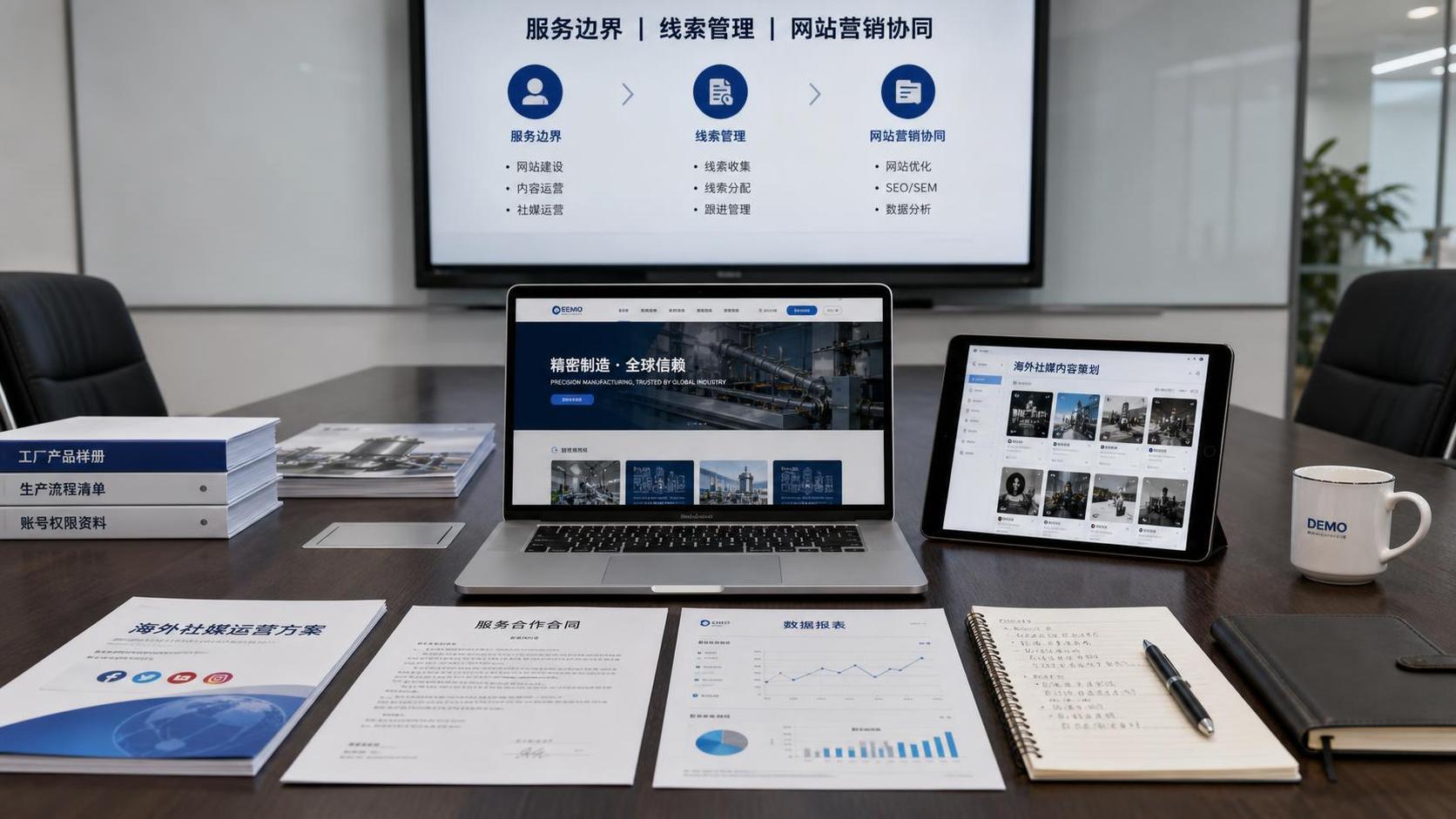
 How Should Manufacturing Companies Define the Service Scope of Overseas Social Media Operations?

Related Products
 Yiyingbao SaaS Intelligent Website Building and Marketing SystemYiyingbao SaaS Intelligent Website Building and Marketing System, AI-powered no-code website building, rapid creation of multilingual B2B international websites in 10 minutes, global server acceleration, AI-powered SEO optimization, helping businesses connect efficiently with global markets. The perfect integration of technology and operation makes building an international trade website remarkably simple
 AI+SEM Intelligent Advertising Marketing SystemAI+SEM drives intelligent ad creation, empowering full-funnel precision advertising marketing. The system automatically generates weekly/monthly reports, AI recommends keywords and target countries, monitors core metrics in real-time with intelligent alerts, and enables one-click high-conversion ad solutions to help quickly acquire customers and improve ROI.
 AI+SEO Dual-Engine System Optimization ServicesYiyingbao’s AI+SEO dual-engine optimization system helps foreign trade enterprises acquire high-quality organic traffic through AI-powered keyword research, content generation, and comprehensive technical optimization, significantly improving search rankings and conversion rates.
 AI+SNS Social Media Marketing SystemYingbao AI+SNS Social Media Marketing System - Precision social capture for the social media era. Supports one-click content synchronization across major platforms like Facebook and LinkedIn. AI intelligently rewrites posts for enhanced relevance. 24/7 AI customer service and user profiling analysis empower businesses to efficiently expand into global markets.
 AI+SEO营销解决方案易营宝AI+SEO营销解决方案,通过AI批量写作、智能生成TDK、精准关键词扩词等功能,全面优化网站SEO效果,提升流量与转化率。助力企业构建高效智能网站新生态。
 AI+SEM Advertising Marketing SolutionsAI+SEM Advertising Marketing Solution leverages AI technology to deeply empower SEM ad campaigns. It automatically generates weekly/monthly reports using AI, presenting account data across multiple dimensions for comprehensive insights into campaign performance and trends. The system precisely recommends keywords and target countries, intelligently generates high-conversion ad copy, and enables one-click activation of efficient campaign plans to help businesses rapidly acquire customers. Simultaneously, it monitors core metrics in real time, intelligently identifies abnormal fluctuations, and issues timely alerts to ensure stable, high-return advertising results.
 Domain Name ServicesEasyWin provides professional domain name services, including intelligent queries, one-stop registration, brand protection, and full lifecycle management, helping businesses build a digital brand image.
 EasyOperate B2C Cross-Border E-Commerce Platform & Independent WebsiteEasyStore B2C Cross-border E-commerce Independent Store is an intelligent website building and cross-border e-commerce integrated solution independently developed by EasyStore Information Technology (Beijing) Co., Ltd. The system is specially designed for small and medium-sized as well as large export enterprises, integrating 'website building, operation, marketing, advertising, and conversion' into one, helping enterprises quickly establish cross-border e-commerce independent stores to achieve brand globalization and global sales growth.
The platform supports multiple languages, multiple currencies, and multi-channel marketing, with built-in AI intelligent translation and SEO optimization systems, suitable for mainstream markets such as Southeast Asia, Europe and America, Latin America, and the Middle East, assisting Chinese manufacturing enterprises in efficiently deploying international e-commerce strategies. SSL证书易营宝提供专业SSL安全证书服务,包括单域名和泛域名证书,确保网站数据传输加密、身份验证和完整性保护,助力企业建立安全可信的在线业务环境。









