









- Which customer acquisition channels will be affected by cross-border marketing trends in 2026?Sep 06, 2026View details
- Which homogenization risks should be considered in an analysis of the AI-powered website building industry?Aug 30, 2026View details
- How Will AI Marketing Trends 2026 Change Advertising Budget AllocationAug 28, 2026View details
- Is the EV SSL certificate market shrinking or upgrading? How should companies assess certificate procurement?Aug 11, 2026View details
- Why the old AMP SEO 2020 practices no longer work and what has changed in current optimization prioritiesAug 02, 2026View details
- How to Choose Topics for an Industry News Section to Attract More Organic Search TrafficJul 29, 2026View details
How Should Manufacturing Companies Define the Service Scope of Overseas Social Media Operations?
Clarify the Boundaries First to Avoid Pitfalls When Purchasing Overseas Social Media Operations Services for Manufacturing
When manufacturing companies select overseas social media operations services, the first questions should not be “Can you increase our followers?” or “How soon can we generate orders?” What really matters is understanding exactly how far the service provider’s responsibilities extend. When the boundaries are unclear, the most common outcome is not that the service is left undone, but that the internal team assumes “the provider should handle it,” while the provider believes “that is outside the contract.” As the project drags on, the budget, content, and lead follow-up can all become disorganized.
In particular, overseas social media operations services for manufacturing are different from those for consumer products. Your product sales cycle is long, the technical information is complex, and decision-makers do not place an order simply because they happen to see a post while browsing. Social media is more like an early-stage touchpoint in the customer acquisition chain. It is responsible for brand exposure while also directing traffic to the website, generating inquiries, and supporting sales follow-up. Therefore, when making a purchase, the boundaries should be assessed according to the business process rather than based solely on whether the quotation says “account operation services.”
First Determine: Are You Buying “Content Publishing” or “One Stage of the Customer Acquisition Process”?
This step is crucial. When many manufacturing companies purchase overseas social media services, they assume that the provider should create content, generate inquiries, and also manage the website, advertising, and direct-message responses. The problem is that these stages require different capabilities.
You can ask the service provider about the following points first. Their answers will generally reveal whether the service boundaries are clear:
- Which platforms are covered, and is the scope clearly defined at the account level—for example, LinkedIn only, or Facebook, Instagram, and YouTube as well?
- How deeply is the content process covered? Does it include only scheduling and publishing, or also topic selection, asset organization, copywriting, and basic visual design?
- Does the provider handle engagement and direct-message responses? If so, to what extent, and can the responses involve quotations, delivery times, or technical specifications?
- Does the service include coordination with website landing pages, forms, tracking codes, and data transmission?
- Does the provider conduct correlation analysis between social media data and inquiry results, or only provide screenshots of platform back-end data?
If the provider puts all of these items under a single phrase such as “full-service operations,” you should be more cautious during the purchasing stage. Manufacturing projects are particularly vulnerable to broad concepts and vague deliverables. In the end, you may receive a report each month that appears busy, while no one actually handles the actions that support sales.
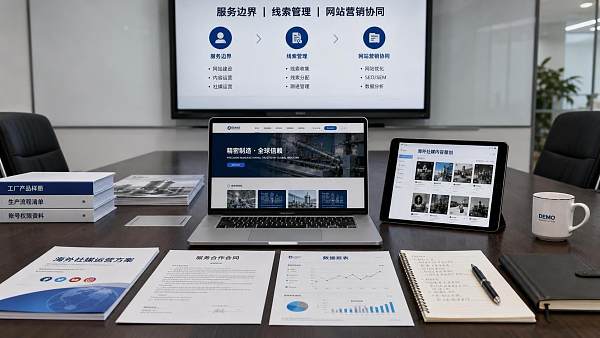
Content Boundaries: The Key Question Is Not How Many Posts Are Published, but Who Provides the Industry Information
Manufacturing social media content can rarely be handled through “generic creativity” alone. Equipment, materials, processes, application scenarios, and delivery methods all need to be explained clearly. Without that information, even frequent publishing will only create activity without substance. When purchasing the service, directly confirm which parts of content production the provider is responsible for and which materials the company itself must provide.
A practical way to ask is to divide content into four layers:
Purchasing personnel need to understand one point: the service provider can handle editing, planning, packaging, and schedule management, but the source of product knowledge is often still within the company. If a provider promises that it “does not need any professional materials from your company and can still continuously produce high-quality manufacturing content,” that claim is usually not sufficiently reliable. A genuinely executable approach is to include the company’s cooperation checklist in the project kickoff requirements, such as providing new product information, case-study materials, trade show plans, factory updates, and technical review availability each month.
Account Ownership Must Be Clearly Defined, or Changing Service Providers Later Will Be Difficult
Many companies have suffered losses because of this issue. Who registered the account, which email address is linked to it, who holds administrator permissions, and whether the advertising account and business page are registered under the company’s legal entity—if these matters are not handled properly at the beginning, switching teams or bringing operations back in-house later can be costly.
At a minimum, confirm the following three points during procurement:
- The primary permissions for the accounts, pages, and Business Manager platform belong to the company, not to an individual or the service provider’s shared account.
- The service provider operates through authorized roles rather than using the company founder’s or an individual salesperson’s account for long-term management.
- The contract specifies the handover mechanism, including how materials, historical data, account permissions, advertising pixels, and form assets will be transferred.
This is not excessive caution. Manufacturing projects have long cycles, and the accumulation of content and audience data takes time. If the account assets cannot be recovered, the loss will involve more than just the number of followers—it will also include the market entry points established previously.
Engagement and Lead Handling Are Most Likely to Create the Assumption That “Someone Is Taking Care of It”
In overseas social media operations projects for manufacturing, it must be clearly specified in writing who handles direct messages, comments, and form submissions. Manufacturing inquiries often involve specifications, minimum order quantities, delivery times, certifications, samples, and regional distribution restrictions. These are not matters that ordinary operations personnel can decide on behalf of the company.
A generally reasonable division of responsibilities is for the service provider to handle initial screening, tagging and classification, basic communication in English, and lead routing, while the company’s sales or technical personnel handle quotations, solutions, and substantive business negotiations. During procurement, continue asking the following questions:
- Is a response time for comments and direct messages specified?
- Which questions can the service provider answer directly, and which must be transferred to the internal team?
- Which system will receive the leads—a spreadsheet, email, or CRM?
- How will invalid leads, duplicate leads, distributor leads, and after-sales issues be labeled separately?
If this area is not defined, two extremes can easily occur later: either the service provider is afraid to respond and valuable opportunities are missed, or the provider makes commitments beyond its authority in an attempt to appear proactive.
Do Not Mistake “Operations Services” for a “Results Guarantee”
A common misconception during procurement is the hope that the broader the service boundaries, the better—ideally, exposure, followers, inquiries, and conversions would all be guaranteed as a package. However, the results of overseas social media for manufacturing are affected by multiple factors, including product competitiveness, website conversion capabilities, target markets, sales response speed, and sample processes. An operations team alone cannot determine these results independently.
A more reliable way to evaluate a provider is to examine how it defines its deliverable results. Credible descriptions usually focus on the following aspects:
- The number of pieces of content produced monthly, the platforms covered, and the engagement activities carried out.
- The data-tracking items established, such as clicks, direct messages, form sources, and audience growth trends.
- The optimization actions taken based on operational performance, rather than simply providing static reports.
When a provider makes full promises regarding revenue, order volume, and follower growth without explaining the prerequisites and the company’s cooperation requirements, ask several more questions during procurement. Vague commitments are most likely to become points of dispute later.
Whether Websites, Advertising, and Social Media Are Priced Separately Must Be Clarified Before Project Initiation
For manufacturing companies, overseas social media can rarely operate independently of the official website and landing pages. Where users go after viewing content, whether they can submit an inquiry after entering the site, and whether the source of form submissions can be tracked all determine whether social media is generating effective traffic.
If the service provider also offers website development, SEO, advertising, and social media services, integrated coordination will generally be smoother. However, this makes it even more important to define the boundaries in detail during procurement. You need to clarify whether the social media quotation includes landing page adjustments, tracking code deployment, reuse of advertising materials, and the transmission of remarketing audiences. Do not assume that these items are automatically included simply because they are provided by the same supplier.
This is especially important for procurement because budget overruns are often caused not by the main service being expensive, but by the continuous addition of ancillary coordination items. Clarifying the scope at the beginning makes it easier to determine which items are social media operations fees, which are website modifications, and which have entered the scope of advertising support.
Do Not Look Only at Surface-Level Activity in Data Reports; Check Whether They Support Decision-Making
Many monthly reports appear to contain a great deal of information, but when it is time for a review, they cannot answer two basic questions: Which types of content are more effective in the target market, and which platforms are worth continuing to invest in? During procurement, you can directly ask the provider to explain the report structure instead of waiting until after cooperation begins to review a sample.
For manufacturing companies, a report should contain at least three levels: platform performance, content performance, and lead performance. Reporting only exposure and engagement without examining traffic and inquiry quality has limited value. Reporting only the number of leads without distinguishing countries, industries, and product-interest areas also makes it difficult to guide subsequent advertising and content adjustments.
Include These Points Before Signing the Contract to Avoid Problems Later
When you reach the quotation-comparison stage, do not focus only on the monthly fee. The terms that truly determine the cooperation experience are often the seemingly insignificant clauses in the contract. It is recommended to focus on the following items:
- Deliverables: content volume, platform scope, review process, publishing schedule, and reporting frequency.
- Cooperation items for both parties: material submission, technical review, sales feedback, and the timeframe for account authorization.
- Additional fees: filming, expedited design, multilingual expansion, travel expenses, and advertising placement support.
- Data and asset ownership: usage and handover rights for accounts, materials, historical reports, lead data, and tracking assets.
- Exit mechanism: how remaining work, the handover date, and permission recovery will be handled in the event of early termination.
The more specifically these items are written, the more effectively disputes caused by assumptions about what is “included by default” can be avoided.
A Practical Evaluation Sequence for Procurement
If you are currently screening suppliers, it is recommended to proceed in this order: first determine whether the platforms match your target markets, then ask about content production and material responsibilities, next verify account ownership and data permissions, then confirm lead routing, and only compare quotations at the end. Do not reverse this order. Many projects begin by discussing price, only to discover later that the service boundaries are inconsistent. The cheapest option is not necessarily the most economical.
Ultimately, when a manufacturing company purchases overseas social media operations services, it is not buying someone to “help publish posts,” but rather an execution capability that can be integrated into its existing customer acquisition process. Clear boundaries make team collaboration smoother and budgets easier to control. The most suitable service provider is often not the one that makes the most promises, but the one that explains most clearly “what I am responsible for, what your company needs to support, and how the results will be measured.”
Related Articles



Related Products
 Yiyingbao SaaS Intelligent Website Building and Marketing SystemYiyingbao SaaS Intelligent Website Building and Marketing System, AI-powered no-code website building, rapid creation of multilingual B2B international websites in 10 minutes, global server acceleration, AI-powered SEO optimization, helping businesses connect efficiently with global markets. The perfect integration of technology and operation makes building an international trade website remarkably simple
 AI+SEM Intelligent Advertising Marketing SystemAI+SEM drives intelligent ad creation, empowering full-funnel precision advertising marketing. The system automatically generates weekly/monthly reports, AI recommends keywords and target countries, monitors core metrics in real-time with intelligent alerts, and enables one-click high-conversion ad solutions to help quickly acquire customers and improve ROI.
 AI+SEO Dual-Engine System Optimization ServicesYiyingbao’s AI+SEO dual-engine optimization system helps foreign trade enterprises acquire high-quality organic traffic through AI-powered keyword research, content generation, and comprehensive technical optimization, significantly improving search rankings and conversion rates.
 AI+SNS Social Media Marketing SystemYingbao AI+SNS Social Media Marketing System - Precision social capture for the social media era. Supports one-click content synchronization across major platforms like Facebook and LinkedIn. AI intelligently rewrites posts for enhanced relevance. 24/7 AI customer service and user profiling analysis empower businesses to efficiently expand into global markets.
 AI+SEO营销解决方案易营宝AI+SEO营销解决方案,通过AI批量写作、智能生成TDK、精准关键词扩词等功能,全面优化网站SEO效果,提升流量与转化率。助力企业构建高效智能网站新生态。
 AI+SEM Advertising Marketing SolutionsAI+SEM Advertising Marketing Solution leverages AI technology to deeply empower SEM ad campaigns. It automatically generates weekly/monthly reports using AI, presenting account data across multiple dimensions for comprehensive insights into campaign performance and trends. The system precisely recommends keywords and target countries, intelligently generates high-conversion ad copy, and enables one-click activation of efficient campaign plans to help businesses rapidly acquire customers. Simultaneously, it monitors core metrics in real time, intelligently identifies abnormal fluctuations, and issues timely alerts to ensure stable, high-return advertising results.
 Domain Name ServicesEasyWin provides professional domain name services, including intelligent queries, one-stop registration, brand protection, and full lifecycle management, helping businesses build a digital brand image.
 EasyOperate B2C Cross-Border E-Commerce Platform & Independent WebsiteEasyStore B2C Cross-border E-commerce Independent Store is an intelligent website building and cross-border e-commerce integrated solution independently developed by EasyStore Information Technology (Beijing) Co., Ltd. The system is specially designed for small and medium-sized as well as large export enterprises, integrating 'website building, operation, marketing, advertising, and conversion' into one, helping enterprises quickly establish cross-border e-commerce independent stores to achieve brand globalization and global sales growth.
The platform supports multiple languages, multiple currencies, and multi-channel marketing, with built-in AI intelligent translation and SEO optimization systems, suitable for mainstream markets such as Southeast Asia, Europe and America, Latin America, and the Middle East, assisting Chinese manufacturing enterprises in efficiently deploying international e-commerce strategies. SSL证书易营宝提供专业SSL安全证书服务,包括单域名和泛域名证书,确保网站数据传输加密、身份验证和完整性保护,助力企业建立安全可信的在线业务环境。









