









- Which customer acquisition channels will be affected by cross-border marketing trends in 2026?Sep 06, 2026View details
- Which homogenization risks should be considered in an analysis of the AI-powered website building industry?Aug 30, 2026View details
- How Will AI Marketing Trends 2026 Change Advertising Budget AllocationAug 28, 2026View details
- Is the EV SSL certificate market shrinking or upgrading? How should companies assess certificate procurement?Aug 11, 2026View details
- Why the old AMP SEO 2020 practices no longer work and what has changed in current optimization prioritiesAug 02, 2026View details
- How to Choose Topics for an Industry News Section to Attract More Organic Search TrafficJul 29, 2026View details
Which social media platforms should manufacturing companies entering overseas markets start with for a more reliable approach?
For many manufacturing companies, the biggest mistake when first starting overseas social media is not producing too little content, but choosing the wrong platform. When conducting preliminary research for overseas social media operations in the manufacturing industry, the key considerations are actually simple: Where do your customers usually obtain industry information? Are they willing to leave their contact details? Can they accept a relatively long decision-making cycle? More platforms are not necessarily better. At the initial stage, running two or three channels effectively is often more reliable than opening accounts on every platform.
This is especially true for businesses involving factories, equipment, components, and raw materials. Social media is usually not intended to close a deal immediately, but to help customers see you first, remember you, and then visit your website or inquiry page for further information. Therefore, before choosing a platform, first clarify one question: Are you looking for distributors, end buyers, engineers, or brand partners? The most suitable starting platforms can differ significantly depending on the audience.
First determine whether your product is “understood at a glance” or “requires explanation to understand”
This is the dividing line for platform selection.
- If your products are relatively intuitive, such as finished goods, home furnishings, consumer electronics accessories, or packaging products, images and short videos can quickly convey their selling points. In this case, visual platforms are more suitable for getting started.
- If your products involve industrial equipment, precision components, process solutions, or customized production lines, customers will care about specifications, application scenarios, delivery capabilities, and after-sales support. Content of this kind cannot rely on simply “looking good”; it is more suitable to begin with platforms that support professional networking and content delivery.
Many teams start by producing short videos, only to receive views but no inquiries. The reason is often not poor content, but that the product itself requires more explanation. For these businesses, it is more important to first coordinate the platform with the website, multilingual pages, and inquiry channels than to chase popularity.
The three types of platform combinations that are usually more reliable for getting started
Based on actual customer-acquisition paths, overseas social media operations in the manufacturing industry rarely complete every step through a single platform. A more reliable approach is to select platforms according to three functions: building trust, demonstrating capabilities, and capturing leads.
If you can choose only one platform now and operate in B2B manufacturing, prioritize LinkedIn. If your product requires demonstrations, include YouTube among the first platforms. If your target market relies more on social sharing or you plan to run advertising at the same time, Facebook is usually difficult to avoid.
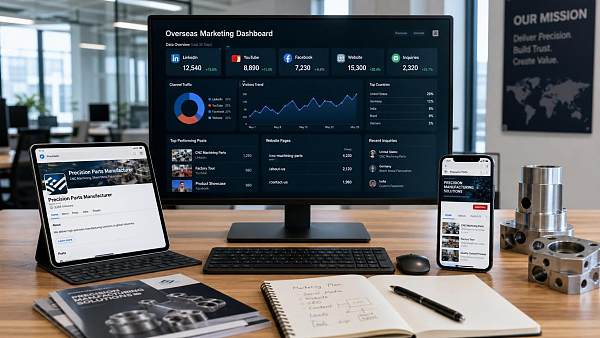
Whether LinkedIn is suitable as your starting platform depends on these four factors
Many manufacturing companies treat LinkedIn as “a place to post company news,” which misses its real value. It is more like a combination of overseas business development and professional credibility building.
- Are your customers professionals with clearly defined roles? If your target customers are purchasing managers, supply chain leaders, technical managers, or channel managers, LinkedIn is worth prioritizing.
- Can your company profile support a professional image? At a minimum, the page should clearly present your business scope, core products, service regions, and contact details, as well as content that demonstrates your delivery capabilities, such as factories, production lines, inspection procedures, and application scenarios.
- Does your team have someone who can consistently produce content? Posting three updates on LinkedIn will not automatically generate inquiries. It is more effective when the company page and sales personnel work together. The company page builds credibility, while personal profiles connect with potential customers.
- Do you have a website to receive traffic? Without an independent website or landing page, incoming traffic cannot be effectively handled. Manufacturing customers will click into your profile to review details. If they drop off at this stage, most of the previous exposure will be wasted.
A common mistake is turning LinkedIn into a corporate bulletin board that only posts trade shows, team-building activities, and holiday greetings. More effective content is often information customers use to evaluate supplier capabilities: how products are applied, how to choose between different models, what control points exist in the production process, and how well delivery coordination is handled.
YouTube may not generate traction quickly, but it is well suited to “explanation-based products”
Many factories underestimate the value of YouTube because they believe video production is expensive and results take time. However, manufacturing customers do not place orders based on a single poster. They need to see operating conditions, structural details, process stability, and sometimes even installation procedures. YouTube is particularly well suited to explaining these aspects clearly.
Situations that are generally suitable for prioritizing YouTube include products that require operational demonstrations, products whose selling points are hidden in the details, products for which customers often ask “What is the difference compared with other suppliers?”, and products whose pre-sales communication repeatedly requires an explanation of operating procedures. If at least two of these conditions apply, YouTube is worth developing.
However, do not immediately pursue the production quality of a brand film. At the initial stage, more practical content includes prototype operation, function comparisons, installation demonstrations, answers to frequently asked questions, factory footage, and breakdowns of application scenarios. Stable images, clear sound, and complete information are more important than elaborate editing.
Whether Facebook should be a starting platform depends on whether you need “reach”
If your company mainly provides OEM or ODM services and serves brand owners, trading companies, or regional distributors, Facebook can usually be one of the starting platforms. Its advantage lies not in professional depth, but in broad reach, lightweight interaction, and convenient integration with advertising.
However, make sure you assess the situation clearly: Do people in your target market habitually use Facebook to obtain information about brands and suppliers? Is your content suitable for frequent posting? Are you prepared to use advertising to amplify exposure? If none of these conditions apply, simply posting organic updates is likely to produce limited results.
There is also a practical issue: Content on the Facebook home page has a relatively short lifespan. Therefore, Facebook is more suitable for coordinated use with a website, landing page, and form collection system than for independently handling inquiry conversion.
Not every popular platform is suitable for manufacturing companies to adopt first
During the information-gathering stage, the biggest risk is being misled by the idea that “everyone else is doing it.” Platforms such as Instagram and TikTok are not impossible choices, but their suitability depends on the product and team conditions.
- If the product has a strong visual appeal, is suitable for visual presentation, and is aimed at brand buyers or end consumers, Instagram offers more room for development.
- If your team can update content quickly, is strong at video communication, and your target market has a high level of acceptance of short videos, TikTok can be tested.
- If your content depends on professional explanations, the sales cycle is long, and customers need multiple rounds of evaluation, these two platforms are more suitable as follow-up additions and may not be the most reliable first choice.
The evaluation standard is straightforward: Can the platform help you identify people who are closer to making purchasing decisions, rather than merely bringing generic traffic?
Complete these basic preparations before getting started
Choosing the right platform does not mean you can achieve results immediately. The actions that truly affect the outcome of overseas social media operations in the manufacturing industry are often these basic preparations:
- Make sure the website or landing page can properly receive traffic and clearly explain at least the product categories, application industries, and contact methods.
- Prepare a content library in advance, including factory environments, equipment operation, product details, packaging and shipping, and testing procedures.
- Keep external communications consistent. The company descriptions, core business, and contact information on different platforms should not contradict one another.
- Do not make the inquiry form overly burdensome. Manufacturing customers may be willing to provide an email address, company name, and area of interest, but they may not want to complete a long form the first time.
This step may not appear to be directly related to “social media,” but it is actually the most important. The platform is only the entry point; the real conversion path still depends on the website, content, and sales follow-up capabilities.
Which launch sequence is suitable for most manufacturing companies?
If you do not have a mature team, the more reliable sequence is usually as follows: Start with LinkedIn to establish the professional image of the company and key personnel; then add YouTube to explain complex products clearly; when you need to expand reach or support promotional campaigns, integrate Facebook. The advantage of this approach is that each platform has a clear role, preventing content-related internal strain from the very beginning.
If your company already has foundational assets such as a multilingual website, SEO pages, and advertising landing pages, getting started with social media will be much easier. Content does not need to be created from scratch; instead, it can be broken down and amplified around existing pages. For teams seeking to integrate website development, search, and social media, this integrated approach is more suitable for long-term customer acquisition in the manufacturing industry and helps avoid a disconnect in which “the platform is updated but the website provides no follow-through.”
If you need one practical recommendation, do not rush to ask “Which platform is the most popular?” First, check in this order: Who are your customers? Does the product require a demonstration? Can the website capture leads? Can the team produce content consistently? Once these four questions have been answered, the appropriate starting platform will generally become clear. For most manufacturing companies seeking a stable start, it is usually a sound decision to first establish a working connection between LinkedIn and the website, and then decide whether to add YouTube and Facebook.
Related Articles


Related Products
 Yiyingbao SaaS Intelligent Website Building and Marketing SystemYiyingbao SaaS Intelligent Website Building and Marketing System, AI-powered no-code website building, rapid creation of multilingual B2B international websites in 10 minutes, global server acceleration, AI-powered SEO optimization, helping businesses connect efficiently with global markets. The perfect integration of technology and operation makes building an international trade website remarkably simple
 AI+SEM Intelligent Advertising Marketing SystemAI+SEM drives intelligent ad creation, empowering full-funnel precision advertising marketing. The system automatically generates weekly/monthly reports, AI recommends keywords and target countries, monitors core metrics in real-time with intelligent alerts, and enables one-click high-conversion ad solutions to help quickly acquire customers and improve ROI.
 AI+SEO Dual-Engine System Optimization ServicesYiyingbao’s AI+SEO dual-engine optimization system helps foreign trade enterprises acquire high-quality organic traffic through AI-powered keyword research, content generation, and comprehensive technical optimization, significantly improving search rankings and conversion rates.
 AI+SNS Social Media Marketing SystemYingbao AI+SNS Social Media Marketing System - Precision social capture for the social media era. Supports one-click content synchronization across major platforms like Facebook and LinkedIn. AI intelligently rewrites posts for enhanced relevance. 24/7 AI customer service and user profiling analysis empower businesses to efficiently expand into global markets.
 AI+SEO营销解决方案易营宝AI+SEO营销解决方案,通过AI批量写作、智能生成TDK、精准关键词扩词等功能,全面优化网站SEO效果,提升流量与转化率。助力企业构建高效智能网站新生态。
 AI+SEM Advertising Marketing SolutionsAI+SEM Advertising Marketing Solution leverages AI technology to deeply empower SEM ad campaigns. It automatically generates weekly/monthly reports using AI, presenting account data across multiple dimensions for comprehensive insights into campaign performance and trends. The system precisely recommends keywords and target countries, intelligently generates high-conversion ad copy, and enables one-click activation of efficient campaign plans to help businesses rapidly acquire customers. Simultaneously, it monitors core metrics in real time, intelligently identifies abnormal fluctuations, and issues timely alerts to ensure stable, high-return advertising results.
 Domain Name ServicesEasyWin provides professional domain name services, including intelligent queries, one-stop registration, brand protection, and full lifecycle management, helping businesses build a digital brand image.
 EasyOperate B2C Cross-Border E-Commerce Platform & Independent WebsiteEasyStore B2C Cross-border E-commerce Independent Store is an intelligent website building and cross-border e-commerce integrated solution independently developed by EasyStore Information Technology (Beijing) Co., Ltd. The system is specially designed for small and medium-sized as well as large export enterprises, integrating 'website building, operation, marketing, advertising, and conversion' into one, helping enterprises quickly establish cross-border e-commerce independent stores to achieve brand globalization and global sales growth.
The platform supports multiple languages, multiple currencies, and multi-channel marketing, with built-in AI intelligent translation and SEO optimization systems, suitable for mainstream markets such as Southeast Asia, Europe and America, Latin America, and the Middle East, assisting Chinese manufacturing enterprises in efficiently deploying international e-commerce strategies. SSL证书易营宝提供专业SSL安全证书服务,包括单域名和泛域名证书,确保网站数据传输加密、身份验证和完整性保护,助力企业建立安全可信的在线业务环境。









