









- Can the average annual growth rate reflect real opportunities in overseas markets?Oct 07, 2026View details
- Which customer acquisition channels will be affected by cross-border marketing trends in 2026?Sep 06, 2026View details
- Which homogenization risks should be considered in an analysis of the AI-powered website building industry?Aug 30, 2026View details
- How Will AI Marketing Trends 2026 Change Advertising Budget AllocationAug 28, 2026View details
- Is the EV SSL certificate market shrinking or upgrading? How should companies assess certificate procurement?Aug 11, 2026View details
- Why the old AMP SEO 2020 practices no longer work and what has changed in current optimization prioritiesAug 02, 2026View details
Is Google indexing optimization really useful for new websites?
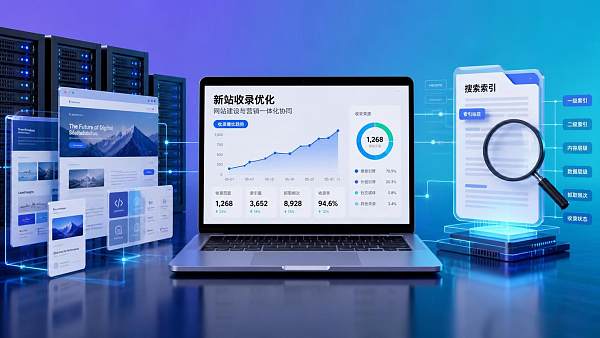
For many companies, the most common concern after launching a new website is not “Does the page look good?” but “Why is Google taking so long to index it?” This is also the real motivation behind the question, “Is Google indexing optimization really useful for a new website?” Companies want to know whether indexing optimization is a decisive task or merely a set of standard actions commonly promoted by marketing service providers; whether it is worth doing now; and where it should rank in priority if the budget is limited.
Here is the conclusion first: it is useful, but its role is often misunderstood. For a new website, indexing optimization is not a “quick fix” that can directly bring rankings and inquiries. Instead, it is foundational work that determines whether the website can enter Google’s visibility ecosystem. Without indexing, subsequent SEO, content growth, advertising traffic conversion, and brand-keyword accumulation are almost impossible. However, doing indexing optimization alone does not mean that organic traffic will grow automatically.
What a new website really needs to solve is more than simply “being seen by Google”
Many companies understand “indexing” as an isolated action, such as submitting a sitemap, requesting indexing in Search Console, publishing a few articles, and then waiting for Google to crawl the site. This understanding is too narrow. Whether Google is willing to index a new website essentially depends on whether the site is accessible, understandable, worth crawling continuously, and has sufficiently clear topics and business value.
This is especially true for B2B companies. For new websites of foreign trade factories, equipment manufacturers, raw material suppliers, and cross-border brands, the problem is usually not insufficient content volume. Instead, website structure, language versions, duplicate pages, technical details, and commercial signals are mixed together, making it difficult for search engines to quickly determine “what problem this website solves, whom it serves, and whether it is trustworthy.” Therefore, indexing optimization is certainly useful for a new website, but it solves the problem of “entering the candidate pool,” not “closing deals directly.”
Why do some new websites still show no improvement after indexing actions are taken?
A common misunderstanding in the industry is treating “indexing” as an isolated metric. A page being indexed does not mean it will receive impressions; impressions do not mean clicks; and clicks do not mean conversions. When a new website remains inactive after being indexed, the reason is usually not that Google is “unfriendly,” but that the preliminary work only addressed the surface level.
There are several common situations.
- The website is technically accessible, but crawling efficiency is poor, for example, because the hierarchy is too deep, URLs are disorganized, redirect chains are too long, or the mobile experience is poor.
- The content exists, but many pages merely replace the product name or regional keyword while providing essentially duplicate information, making it difficult for Google to determine which page is worth indexing.
- The multilingual website was developed quickly, but hreflang, language switching, and regional-version logic are unclear, causing multiple pages to compete with one another.
- The company pursues a “large and comprehensive” website immediately after launch, pushing dozens of sections and hundreds of product pages at once. As a result, every page is thin and the overall signals become fragmented.
- The company treats indexing as an SEO problem, while the root cause may lie in the website development stage—for example, the template may not support structured output, or the backend may be unable to generate sitemaps, canonical tags, and metadata consistently.
This is why, in an integrated “website + marketing services” context, discussing indexing techniques alone is often insufficient. Whether a new website can be indexed effectively often depends on whether the website system, content organization, basic SEO configuration, and subsequent promotional activities are connected.
Which types of new websites particularly benefit from early indexing optimization?
Not every new website needs to receive the same level of investment from the outset. However, for the following types of businesses, the earlier the indexing foundation is addressed, the lower the cost of later rework will be.
B2B inquiry-focused corporate websites
These websites usually carry information about corporate qualifications, product capabilities, industry solutions, and contact conversion, making them long-term customer acquisition assets. Their search value lies not only in product keywords, but also in a large number of mid- and long-tail scenario terms, application terms, and question-based terms. If the indexing framework is not established properly at an early stage, newly added content will continue to be affected by existing problems.
Multilingual websites for international expansion
Multilingual websites are a typical high-risk scenario. The more language versions there are, the higher the probability of duplicate content, incorrect mapping, and wasted crawl budget. Many companies believe that “completing the translation means covering multiple markets,” but without an appropriate indexing strategy, multilingual pages may simply accumulate on the server while remaining almost invisible in search results.
Brands or sellers moving from platforms to independent websites
These companies are usually familiar with paid advertising, but they tend to underestimate the time required to build organic search visibility. Advertising can generate immediate visits, while indexing optimization determines whether content assets can accumulate over time. For B2C cross-border websites in particular, if the indexing relationships among category pages, brand pages, and content pages are disorganized, the proportion of free traffic will be directly affected later.
“Useful” does not mean that every technique is worth doing
If we examine the question further, what is really worth discussing is not “Is indexing optimization useful?” but “Which practices are effective for a new website, and which merely look busy?”
During the new-website stage, genuinely valuable indexing optimization usually focuses on four areas:
- First, ensure technical crawlability: robots, sitemaps, canonical tags, status codes, redirects, and mobile accessibility are foundational conditions.
- Keep the website focused: clarify the core product lines, target audiences, and page hierarchy, and avoid spreading the content too thin at the beginning.
- Control page quality rather than simply increasing quantity: it is better to first create a limited number of core pages that can be clearly understood than to launch a large number of low-quality pages at once.
- Establish basic trust signals: company information, contact details, case studies, delivery capabilities, and service regions are crucial for B2B websites. They affect not only user judgment but also how search engines understand the website’s credibility.
Conversely, some so-called “techniques” that are frequently promoted have limited value in real business scenarios and may even slow down evaluation.
- Frequently submitting URLs manually will not replace the need to improve the overall quality of the website.
- Massly scraping or machine-generating content within a short period can easily create low-quality indexing if it lacks editorial review and supplementary business information.
- Pursuing the quantity of backlinks from the very beginning may result in spending the budget on ineffective resources.
- Using the “number of indexed pages” as the core KPI can cause the team to overlook the development of pages with genuine commercial value.
What should companies look at when purchasing or evaluating services?
If a company is preparing to find a website development or SEO service provider, the evaluation should not stop at the basic question of whether the provider “knows how to submit pages for indexing.” Instead, it should assess whether the provider understands the entire process of building and promoting a new website.
For B2B companies, a more practical evaluation approach is to determine whether the following questions can be answered clearly:
This is also why integrated “website + marketing services” solutions have become more readily accepted by companies in recent years. Many problems do not originate from a single page, but from the separation of website development, content, promotion, and analytics tools. In scenarios such as foreign trade manufacturing, cross-border stores, and multilingual corporate websites, if the front end is the website and the back end is marketing, the service chain becomes disconnected, and indexing optimization can easily turn into a collection of scattered actions.
From this perspective, platform-based service providers with website development systems, SEO capabilities, advertising expertise, and multilingual operations experience may have greater advantages. The prerequisite is not simply having “many features,” but whether these modules can work together. For example, when a company builds an overseas independent website, if the system itself supports indexable page generation, SEO field management, multi-region deployment, and subsequent advertising conversion, the implementation cost of indexing optimization will be significantly lower than that of pure custom development followed by piecemeal additions. Service providers such as Yiyingbao, which focus on the integration of AI website development, SEO/GEO optimization, and overseas marketing, can serve as reference examples for this type of integrated solution. However, companies should ultimately return to their own business scenarios to determine whether the solution truly matches their business complexity and operational capabilities.
During the new-website stage, the most easily overlooked risk is not “lack of indexing,” but “incorrect indexing”
Many people worry that Google will not index their pages. In the long term, however, the more troublesome situation is often that incorrect pages are indexed while key pages fail to receive sufficient authority. For example, filter pages, parameter pages, duplicate language pages, and thin pages with no conversion value may enter the index first, while core product pages and solution pages continue to struggle to gain visibility.
These problems are often not obvious during the early stage of a new website because the site has few pages and little data. It may appear that “having pages indexed is already good.” However, once the website enters a content expansion phase, index pollution will gradually reduce overall crawling efficiency, and cleaning it up later will take more time than planning properly at the beginning.
Therefore, a new website should not aim to submit all pages for indexing as quickly as possible. Instead, it should selectively establish a presence for pages that are genuinely worth discovering through search. This is especially important for B2B websites, because B2B traffic does not primarily depend on massive volumes of broad keywords. It relies on a small number of high-intent pages that continuously build trust and generate leads.
What deserves more attention next is not only Google SEO, but also visibility in AI search
In the past, new-website indexing optimization was mainly intended to create opportunities for visibility on traditional search results pages. In the past two years, however, companies have also needed to consider another layer: whether their pages can be easily understood, cited, and summarized by AI search systems. This area is changing rapidly, and many standards remain unstable. Nevertheless, one point is relatively clear: websites with clear structures, credible information, focused topics, and clear page relationships are more likely to gain visibility in new search interactions.
In other words, indexing optimization is not outdated; it has instead become an even more fundamental capability. Whether the system is a traditional search engine or AI-driven information distribution, it first needs to identify and understand your pages. Practices that rely on keyword stuffing, quantity, and short-term tactics will only deliver decreasing marginal value.
Whether it should be done ultimately depends on the business objectives
If a company is only creating a brochure-style corporate website, does not plan to update it over the long term, and does not expect to generate inquiries through organic search, indexing optimization can be assigned a lower priority, with basic accessibility as the main requirement. However, as long as the company has any of the following objectives, indexing optimization is not an optional add-on. It is foundational work that should be included during the website development stage:
- Generate stable inquiries through Google
- Cover multiple language markets
- Gradually consolidate advertising traffic into independent website assets
- Develop a long-term SEO content strategy
- Improve brand visibility in overseas search and AI search
Therefore, the answer to “Is Google indexing optimization really useful for a new website?” is not a simple yes or no. It is useful, provided that you understand it in the context of real business objectives: it is not a magic solution that makes a new website grow immediately, but a way to give the website the qualification to be discovered, understood, and continuously utilized. For companies that truly treat an independent website as a growth asset, the earlier this step is done correctly, the smoother the path ahead will be. If it is done incorrectly at the beginning, many subsequent marketing investments will become more expensive.
Related Articles



Related Products
 Yiyingbao SaaS Intelligent Website Building and Marketing SystemYiyingbao SaaS Intelligent Website Building and Marketing System, AI-powered no-code website building, rapid creation of multilingual B2B international websites in 10 minutes, global server acceleration, AI-powered SEO optimization, helping businesses connect efficiently with global markets. The perfect integration of technology and operation makes building an international trade website remarkably simple
 AI+SEM Intelligent Advertising Marketing SystemAI+SEM drives intelligent ad creation, empowering full-funnel precision advertising marketing. The system automatically generates weekly/monthly reports, AI recommends keywords and target countries, monitors core metrics in real-time with intelligent alerts, and enables one-click high-conversion ad solutions to help quickly acquire customers and improve ROI.
 AI+SEO Dual-Engine System Optimization ServicesYiyingbao’s AI+SEO dual-engine optimization system helps foreign trade enterprises acquire high-quality organic traffic through AI-powered keyword research, content generation, and comprehensive technical optimization, significantly improving search rankings and conversion rates.
 AI+SNS Social Media Marketing SystemYingbao AI+SNS Social Media Marketing System - Precision social capture for the social media era. Supports one-click content synchronization across major platforms like Facebook and LinkedIn. AI intelligently rewrites posts for enhanced relevance. 24/7 AI customer service and user profiling analysis empower businesses to efficiently expand into global markets.
 AI+SEO营销解决方案易营宝AI+SEO营销解决方案,通过AI批量写作、智能生成TDK、精准关键词扩词等功能,全面优化网站SEO效果,提升流量与转化率。助力企业构建高效智能网站新生态。
 AI+SEM Advertising Marketing SolutionsAI+SEM Advertising Marketing Solution leverages AI technology to deeply empower SEM ad campaigns. It automatically generates weekly/monthly reports using AI, presenting account data across multiple dimensions for comprehensive insights into campaign performance and trends. The system precisely recommends keywords and target countries, intelligently generates high-conversion ad copy, and enables one-click activation of efficient campaign plans to help businesses rapidly acquire customers. Simultaneously, it monitors core metrics in real time, intelligently identifies abnormal fluctuations, and issues timely alerts to ensure stable, high-return advertising results.
 Domain Name ServicesEasyWin provides professional domain name services, including intelligent queries, one-stop registration, brand protection, and full lifecycle management, helping businesses build a digital brand image.
 EasyOperate B2C Cross-Border E-Commerce Platform & Independent WebsiteEasyStore B2C Cross-border E-commerce Independent Store is an intelligent website building and cross-border e-commerce integrated solution independently developed by EasyStore Information Technology (Beijing) Co., Ltd. The system is specially designed for small and medium-sized as well as large export enterprises, integrating 'website building, operation, marketing, advertising, and conversion' into one, helping enterprises quickly establish cross-border e-commerce independent stores to achieve brand globalization and global sales growth.
The platform supports multiple languages, multiple currencies, and multi-channel marketing, with built-in AI intelligent translation and SEO optimization systems, suitable for mainstream markets such as Southeast Asia, Europe and America, Latin America, and the Middle East, assisting Chinese manufacturing enterprises in efficiently deploying international e-commerce strategies. SSL证书易营宝提供专业SSL安全证书服务,包括单域名和泛域名证书,确保网站数据传输加密、身份验证和完整性保护,助力企业建立安全可信的在线业务环境。









