









- Which customer acquisition channels will be affected by cross-border marketing trends in 2026?Sep 06, 2026View details
- Which homogenization risks should be considered in an analysis of the AI-powered website building industry?Aug 30, 2026View details
- How Will AI Marketing Trends 2026 Change Advertising Budget AllocationAug 28, 2026View details
- Is the EV SSL certificate market shrinking or upgrading? How should companies assess certificate procurement?Aug 11, 2026View details
- Why the old AMP SEO 2020 practices no longer work and what has changed in current optimization prioritiesAug 02, 2026View details
- How to Choose Topics for an Industry News Section to Attract More Organic Search TrafficJul 29, 2026View details
How to Restore Indexing After a B2B Foreign Trade Website Is Deindexed by Google
How can you recover a B2B foreign trade website after it has been penalized by search engines? Don't rush to rebuild the website. Identify the cause of the penalty and systematically investigate content, technical, backlinks, and crawling issues to restore indexing and rankings as quickly as possible and regain a stable flow of overseas inquiries.
For foreign trade companies, a website penalty is not merely a fluctuation in traffic. It puts the inquiry channel, brand credibility, and overseas customer acquisition costs under pressure at the same time. Many companies rush to redesign the website, change the domain name, or delete pages as soon as they see a sharp decline in indexed pages, causing the recovery period to extend from 2 weeks to more than 3 months.
If you are searching for “how to recover a B2B foreign trade website after it has been penalized,” the most important thing is not to take immediate action, but to establish an executable recovery process: first determine whether the problem affects the entire website or only certain directories, language sites, or product pages, and then make targeted repairs across four dimensions: content, technology, backlinks, and crawling.
First determine the extent of the website penalty to avoid secondary damage caused by misjudgment
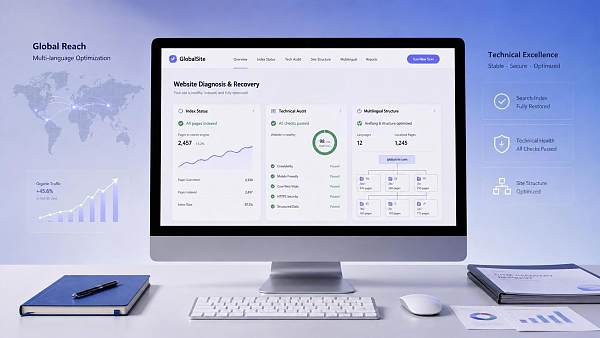
Many companies directly interpret a “keyword decline” as a penalty, but this is not necessarily accurate. What needs to be confirmed first is whether indexed pages have declined significantly across the entire website or only core keyword rankings have been lost; whether the homepage has lost authority or a particular directory or country-language site has been restricted from crawling.
3 common signs of a website penalty
The first is a sharp decline in indexed pages: the number of indexed pages drops from several hundred to several dozen within 7 days, which is usually related to crawling abnormalities, duplicate content, or a sudden increase in low-quality pages. The second is indexed pages without rankings: the pages remain in the index, but the rankings of their primary keywords fall from the top 3 pages to beyond position 50.
The third is a cliff-like drop in traffic, especially when industry keywords, product keywords, and long-tail inquiry keywords outside of brand terms disappear at the same time. This is often not a problem with a single page, but a systematic deviation in the overall site quality signals, backlink structure, or technical configuration.
4 basic signals to check first
- Whether the indexing curve has continued to decline over the past 30 days rather than showing a short-term fluctuation
- Whether core directories contain a large number of pages marked as “Crawled - currently not indexed”
- Whether the server underwent a migration, redesign, or certificate issue within the past 14 days
- Whether the number of backlinks suddenly increased or a large number of backlinks became invalid within 1 month
Only after the type of penalty has been clearly identified can subsequent recovery actions avoid heading in the wrong direction. B2B foreign trade websites usually contain product pages, industry solution pages, multilingual pages, and landing pages. Once the structure becomes complex, accidental deletion, blocking, or redirects can magnify the losses.
The table below can help companies quickly determine which type of problem they are facing and arrange a recovery schedule at the level of 1 week, 2 weeks, or 4 weeks accordingly.
In terms of recovery efficiency, technical issues are usually handled the fastest, while content- and authority-related issues take the longest to recover. Therefore, when determining how to recover a B2B foreign trade website after it has been penalized, companies must diagnose first and repair second instead of making random changes simultaneously.
Systematically restore indexing from the 3 core aspects of content, technology, and backlinks
The key to restoring indexing is not simply submitting URLs, but allowing search engines to reconfirm that your website is worth crawling, indexing, and ranking. For B2B foreign trade websites, the most common recovery approach is “technical repairs first, content restructuring in parallel, and backlink cleanup afterward.”
I. Content: address low-quality and duplicate pages first
Many foreign trade websites are penalized not because they publish too few articles, but because their pages are too similar. For example, a company may create 8 country versions of the same product but only replace the regional terms; or use the same template for 100 product pages, with nearly identical specifications, application scenarios, and purchasing recommendations. Such pages are most likely to be judged as having insufficient value.
It is recommended to identify 3 types of pages first: product pages with a high degree of duplication, thin-content pages with no traffic or conversions, and automatically generated multilingual pages that have not been manually reviewed. In general, cleaning up 20%—40% of low-value pages first and then strengthening core directories will produce more stable recovery results.
4 content-repair actions
- Add authentic specifications, application industries, FAQs, and delivery information to the top 20—50 core product pages
- Merge highly similar pages to prevent multiple weak pages targeting the same keyword from competing with one another
- Rewrite titles and descriptions so that product terms, scenario terms, and purchasing terms match search intent more clearly
- Localize multilingual pages instead of relying on mechanical translation
II. Technology: investigate crawling and indexing barriers first
If you want to know how to recover a B2B foreign trade website after it has been penalized, the technical aspect is often the first to produce results. Typical issues include accidental blocking by robots, canonical tags incorrectly pointing to the homepage, overly long 301 redirect chains, mobile pages taking more than 3 seconds to load, sitemaps not being updated in time, and a large number of 404 pages.
For foreign trade marketing websites, it is recommended to divide the technical investigation into 5 areas: crawling permissions, status codes, redirect logic, indexing tags, and page speed. Within 30 days after a redesign in particular, changes to URL rules can easily cause old pages to become invalid while new pages fail to inherit authority.
Technical investigation priority table
If team resources are limited, issues can be handled according to their impact level. The table below is suitable for coordinated execution by foreign trade companies, website development providers, and SEO service providers.
For websites deployed across multiple languages and regions, technical repairs should also include checking the relationships among hreflang, subdirectories, and subdomains. Many companies experience a decline in indexed pages not because their content is poor, but because language versions conflict with one another, making it difficult for search engines to determine which version should rank.
III. Backlinks: clean up abnormal growth and rebuild credible references
Backlink issues are often the most difficult to detect. Some foreign trade companies purchase large numbers of directory links, forum links, or link-farm links to improve rankings in the short term. Adding hundreds of seemingly active links in 1 month can instead damage the overall site signals once the source sites are low quality or thematically irrelevant.
The correct approach is not to delete all backlinks indiscriminately, but to classify them first: retain links related to the industry that can be accessed normally; handle obviously spammy links; and then gradually rebuild natural references through content marketing, industry media, supply-chain partnerships, and social media distribution. It generally takes 4—8 weeks to see a stable recovery.
How to prevent another penalty after recovery and build a sustainable foreign trade customer acquisition system
A truly mature recovery process does not end when indexed pages return. It enables the website to regain the long-term capabilities of being “promotable, indexable, and convertible.” Otherwise, the same problems may reappear during the next redesign, site expansion, or increase in advertising volume.
Establishing a monthly monitoring mechanism is more important than fixing problems after they occur
Companies are advised to conduct a website health inspection at least every 30 days, focusing on 6 indicators: indexing trends, crawling anomalies, core keyword rankings, the number of 404 pages, page loading speed, and the performance of pages generating valid inquiries. For websites with many SKUs or multiple languages, it is best to shorten the interval to once every 14 days.
This type of monitoring is not merely technical work; it also directly affects marketing ROI. Once a high-conversion product page loses authority, the quality score of advertising landing pages, organic search exposure, and social media conversion efficiency will all be affected, and customer acquisition costs may increase by 20%—50% within 1—2 months.
Integrate website development, SEO, and advertising
Restoring indexing for a foreign trade website cannot rely solely on isolated SEO fixes. Website structure, content planning, conversion paths, advertising landing pages, and social media traffic acquisition should ideally be designed in a coordinated manner from the beginning. This allows the website to retain stable content assets and customer acquisition paths even when algorithms change.
From the perspective of integrated website and marketing services, companies are better suited to choose service providers that understand both website development systems and overseas promotion strategies. For example, forming a closed loop among intelligent website development, multilingual deployment, Google SEO, advertising, overseas social media, and AI search visibility optimization generally delivers higher recovery efficiency than outsourcing each function separately.
Execution recommendations during the recovery period
- Week 1: Complete the technical health check and create a list of high-risk pages
- Week 2: Fix crawling, indexing, redirects, and sitemap issues
- Weeks 3—4: Rewrite core page content and merge duplicate pages
- Weeks 4—8: Clean up abnormal backlinks and add highly relevant content distribution
- From Month 2 onward: Continuously validate the performance of conversion pages through SEO, advertising, and social media
If your team is repeatedly searching for an executable solution to recover a B2B foreign trade website after it has been penalized, the focus should not be on fixing a few errors once, but on rebuilding the site foundation, content quality, and marketing chain together. Only in this way can rankings and inquiries remain truly stable after indexing is restored.
Yingyingbao has focused on overseas digital marketing and intelligent website development for many years. Centered on AI-powered intelligent website development, multilingual website construction, B2B foreign trade marketing websites, Google SEO optimization, advertising, and GEO generative engine optimization, Yingyingbao can provide companies with more systematic diagnostic and implementation support.
If your website is experiencing declining indexed pages, lost rankings, or shrinking inquiries, it is recommended to conduct a site diagnosis as soon as possible to clarify the problem level and recovery priorities. Contact us now to obtain a customized recovery plan and learn about integrated website development and overseas marketing solutions more suitable for foreign trade companies.
Related Articles


Related Products
 Yiyingbao SaaS Intelligent Website Building and Marketing SystemYiyingbao SaaS Intelligent Website Building and Marketing System, AI-powered no-code website building, rapid creation of multilingual B2B international websites in 10 minutes, global server acceleration, AI-powered SEO optimization, helping businesses connect efficiently with global markets. The perfect integration of technology and operation makes building an international trade website remarkably simple
 AI+SEM Intelligent Advertising Marketing SystemAI+SEM drives intelligent ad creation, empowering full-funnel precision advertising marketing. The system automatically generates weekly/monthly reports, AI recommends keywords and target countries, monitors core metrics in real-time with intelligent alerts, and enables one-click high-conversion ad solutions to help quickly acquire customers and improve ROI.
 AI+SEO Dual-Engine System Optimization ServicesYiyingbao’s AI+SEO dual-engine optimization system helps foreign trade enterprises acquire high-quality organic traffic through AI-powered keyword research, content generation, and comprehensive technical optimization, significantly improving search rankings and conversion rates.
 AI+SNS Social Media Marketing SystemYingbao AI+SNS Social Media Marketing System - Precision social capture for the social media era. Supports one-click content synchronization across major platforms like Facebook and LinkedIn. AI intelligently rewrites posts for enhanced relevance. 24/7 AI customer service and user profiling analysis empower businesses to efficiently expand into global markets.
 AI+SEO营销解决方案易营宝AI+SEO营销解决方案,通过AI批量写作、智能生成TDK、精准关键词扩词等功能,全面优化网站SEO效果,提升流量与转化率。助力企业构建高效智能网站新生态。
 AI+SEM Advertising Marketing SolutionsAI+SEM Advertising Marketing Solution leverages AI technology to deeply empower SEM ad campaigns. It automatically generates weekly/monthly reports using AI, presenting account data across multiple dimensions for comprehensive insights into campaign performance and trends. The system precisely recommends keywords and target countries, intelligently generates high-conversion ad copy, and enables one-click activation of efficient campaign plans to help businesses rapidly acquire customers. Simultaneously, it monitors core metrics in real time, intelligently identifies abnormal fluctuations, and issues timely alerts to ensure stable, high-return advertising results.
 Domain Name ServicesEasyWin provides professional domain name services, including intelligent queries, one-stop registration, brand protection, and full lifecycle management, helping businesses build a digital brand image.
 EasyOperate B2C Cross-Border E-Commerce Platform & Independent WebsiteEasyStore B2C Cross-border E-commerce Independent Store is an intelligent website building and cross-border e-commerce integrated solution independently developed by EasyStore Information Technology (Beijing) Co., Ltd. The system is specially designed for small and medium-sized as well as large export enterprises, integrating 'website building, operation, marketing, advertising, and conversion' into one, helping enterprises quickly establish cross-border e-commerce independent stores to achieve brand globalization and global sales growth.
The platform supports multiple languages, multiple currencies, and multi-channel marketing, with built-in AI intelligent translation and SEO optimization systems, suitable for mainstream markets such as Southeast Asia, Europe and America, Latin America, and the Middle East, assisting Chinese manufacturing enterprises in efficiently deploying international e-commerce strategies. SSL证书易营宝提供专业SSL安全证书服务,包括单域名和泛域名证书,确保网站数据传输加密、身份验证和完整性保护,助力企业建立安全可信的在线业务环境。









