









- Which customer acquisition channels will be affected by cross-border marketing trends in 2026?Sep 06, 2026View details
- Which homogenization risks should be considered in an analysis of the AI-powered website building industry?Aug 30, 2026View details
- How Will AI Marketing Trends 2026 Change Advertising Budget AllocationAug 28, 2026View details
- Is the EV SSL certificate market shrinking or upgrading? How should companies assess certificate procurement?Aug 11, 2026View details
- Why the old AMP SEO 2020 practices no longer work and what has changed in current optimization prioritiesAug 02, 2026View details
- How to Choose Topics for an Industry News Section to Attract More Organic Search TrafficJul 29, 2026View details
What to check first when inquiries are scarce after launching a brand website
What should you do if inquiries are still scarce after launching a brand website? Don't rush to increase your budget. Instead, systematically investigate traffic quality, page conversion, inquiry paths, and content relevance to identify the key factor that is actually blocking lead generation.
For foreign trade companies, manufacturing factories, cross-border sellers, and brands expanding overseas, launching an independent website is only the first step. During the first 2—8 weeks, many companies fall into a common misconception: if the website is accessible and ads are running, customer acquisition will naturally increase.
In reality, the opposite is often true. A low number of inquiries does not necessarily mean the budget is insufficient. More commonly, the site foundation, channel strategy, content presentation, and conversion design have not formed a closed loop. Especially under an integrated website and marketing service model, website development, SEO, advertising, and social media must work together. If any 1 link fails, both the quantity and quality of leads will be directly affected.
First, check whether you have “traffic without business opportunities”: prioritize traffic quality
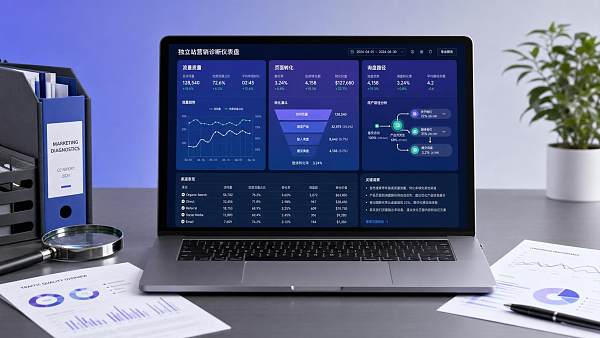
When many companies encounter the problem of “what to do if inquiries are still scarce after launching a brand website,” their first reaction is to continue advertising. However, if the people entering the website are not well targeted, even if the number of visitors increases from 50 to 300 per day, inquiries may not increase accordingly.
It is generally recommended to start by reviewing 3 groups of basic data: traffic sources, bounce behavior, and time on site. If a channel has a long-term bounce rate above 70%, an average session duration below 40 seconds, or a core-page visit share below 20%, this usually indicates a mismatch between the traffic and product demand.
4 key dimensions for evaluating traffic quality
- Is keyword intent accurate: Are the proportions of brand keywords, product keywords, and solution keywords reasonable?
- Do the target regions match: Are target markets such as North America, Europe, and Southeast Asia configured separately?
- Does the landing page correspond to the ad content: If the ad discusses price while the page only tells the brand story, conversion will decline significantly.
- Is device performance normal: If mobile traffic exceeds 60% but the mobile form is difficult to submit, leads will also be lost.
Which traffic sources look large but have low actual value?
Common sources of low-quality traffic include SEO traffic from broad keywords, ad clicks from non-target countries, browsing traffic generated by social media content, and informational visits unrelated to purchasing decisions. These users may browse 1—2 pages, but they will not enter the quotation, contact, or catalog download pages.
The table below can help companies quickly determine whether traffic from different sources has a foundation for conversion, helping them avoid continuously consuming budget on the wrong channels.
If a company finds that the main problem lies in a mismatch between channels and intent, it should not simply continue increasing the budget. Instead, it should first restructure keywords, refine regional targeting, and reconfigure landing pages. For overseas business, the value of 1 qualified inquiry is often much higher than that of 100 invalid clicks.
Next, check whether the page is persuasive: a low conversion rate is the core bottleneck
Once traffic is sufficiently targeted, if inquiries are still scarce after launching a brand website, the second step is to examine page conversion. Many independent websites have the problem of being “viewable but not convertible”: the visual design is attractive, but the page does not clearly explain the parameters, lead times, MOQ, application scenarios, and trust credentials that buyers care about.
B2B procurement websites are different from showcase-oriented corporate websites. Purchasing decisions generally involve at least 3 types of information: product capabilities, fulfillment capabilities, and cooperation risks. If a page only discusses brand philosophy while lacking specifications, processes, case studies, and service procedures, it is difficult for buyers to form an initial judgment within 3 minutes.
5 elements commonly found on high-inquiry pages
- The first screen clearly states who the product or service is suitable for and what problem it solves.
- The product page provides key parameters, materials, application industries, delivery cycles, and other information.
- Comparative advantages are presented in the middle of the page instead of using vague descriptions such as “high quality.”
- FAQs, certification types, and service procedures are included to lower the communication barrier.
- 2—3 contact options are retained at the bottom, such as a form, WhatsApp, email, or consultation appointment.
Where are the easiest places to lose orders on the first screen and product pages?
Common first-screen problems include vague headlines, unclear buttons, no core selling points, and a lack of language adaptation for the target market. Common product-page problems include too many images and too little text, or technical terms without explanations from a procurement perspective, leaving visitors unsure what to ask next.
To quickly diagnose whether a page has conversion potential, you can check each item against the framework below. In most cases, the main weaknesses can be identified within 1—2 working days.
The focus of page optimization is not to make the page “more attractive,” but to make it “easier for customers to understand and take action.” For manufacturing and foreign trade companies, the clarity of product structure, application cases, and inquiry channels is often more important than flashy design.
Is the inquiry path too long? Don't let customers drop off at the final step
For many companies, the problem with their website lies neither in traffic nor in content, but in the final submission action. Customers may have purchase intent, but a complicated contact process, an overly long form, or slow mobile loading can all cause inquiries to be lost during the final 10 seconds.
It is generally recommended to shorten the inquiry path to within 2 steps: visitors see the entry point after entering the page and can submit directly after clicking it. If they need to log in, verify an email address, or download something before making contact, this multi-step process can cause significant conversion losses in overseas traffic scenarios.
3 common path obstacles
- The form contains more than 8 fields and requires too much unnecessary information.
- Contact buttons are positioned inconsistently, and the entry-point style differs across the homepage, product pages, and blog pages.
- Pages open too slowly. If the mobile first screen takes more than 3 seconds to load, users are likely to close the page directly.
Hidden technical losses should not be overlooked
After a website goes live, at least 6 basic checks should be performed: whether forms can be submitted normally, whether emails reach the inbox, whether the CRM is synchronized, whether buttons are functional, whether the mobile layout is misaligned, and whether GA4 and advertising conversion events are being sent back correctly. Many cases of “zero inquiries” are essentially caused by problems in the tracking or receiving chain.
Are content and markets misaligned? Multilingual and localized messaging directly affects conversion
If a company targets markets in North America, Europe, the Middle East, or Latin America, its content cannot rely on literal translation alone. When inquiries remain scarce after launching a brand website, the real problem is often that the content does not align with local purchasing habits. Users may understand what they read but still be unwilling to make contact.
For example, B2B buyers are more concerned with delivery times, customization scope, after-sales response, certification compatibility, and minimum order conditions, while B2C users care more about reviews, delivery times, payment convenience, and return policies. Different markets and business models require at least 2 distinct page logic systems; one uniform template should not be applied to all of them.
4 key items to check on a multilingual website
- Is a separate language version configured for the target market instead of relying on automatic browser translation?
- Do the currency, time, and measurement units conform to local conventions?
- Do the case studies, application scenarios, and FAQs use terminology relevant to the local industry?
- Are different SEO pages and advertising landing pages configured for different regions?
The value of an integrated website and marketing service model is especially clear in this regard. If the website development team does not understand advertising, SEO, and content strategy, the website may remain merely “launch-ready.” A website with genuine lead-generation capabilities needs to reserve search-indexing structures, conversion components, and the ability to expand content for multiple markets from the website development stage.
Establish a continuous optimization mechanism: not a one-time redesign, but a 4-step growth loop
For an independent website with few inquiries, the most serious problem is not a temporary lack of results, but the absence of a diagnostic method. Companies are advised to conduct weekly optimization through 4 steps—“data collection—problem identification—page adjustment—channel review”—and continue for at least 4—6 weeks before evaluating whether to increase the budget.
An optimization schedule suitable for B2B companies
- Week 1: Check tracking, forms, page speed, and basic SEO indexing.
- Week 2: Optimize the homepage first screen, core product pages, and contact entry points.
- Weeks 3—4: Adjust ad keyword groups, negative keywords, regional targeting, and landing pages.
- Weeks 5—6: Add case study pages, FAQ pages, and industry solution pages to improve organic traffic and credibility.
Why are integrated services more suitable for companies expanding overseas?
Yiyingbao has provided long-term services to foreign trade companies, manufacturing factories, cross-border e-commerce sellers, and brands expanding overseas. Its core advantage is not merely building websites, but connecting the data and execution chain across AI-powered website development, multilingual websites, Google SEO, advertising, social media operations, and GEO optimization.
For companies that want to balance indexing, promotion, and conversion, this model helps reduce the fragmentation caused by “the website company only manages the launch while the marketing team starts from scratch with another system.” Especially when target markets cover North America, Europe, Southeast Asia, Japan and South Korea, the Middle East, Russian-speaking regions, and Latin America, unified planning is often more efficient than optimizing individual points.
If you are also considering what to do if inquiries remain scarce after launching a brand website, it is recommended that you first systematically investigate 4 dimensions: traffic quality, page conversion, inquiry paths, and content localization, and then decide where to allocate your budget. The true competitiveness of an independent website is not that it has “gone live,” but whether it can consistently obtain qualified inquiries and continue to improve.
If you want to identify the root cause more quickly or need an integrated solution covering website development, SEO, advertising, and overseas marketing, please contact Yiyingbao to obtain customized diagnostic recommendations and actionable growth solutions, and learn more about the solution path suitable for your current business stage.
Related Articles
Related Products
 Yiyingbao SaaS Intelligent Website Building and Marketing SystemYiyingbao SaaS Intelligent Website Building and Marketing System, AI-powered no-code website building, rapid creation of multilingual B2B international websites in 10 minutes, global server acceleration, AI-powered SEO optimization, helping businesses connect efficiently with global markets. The perfect integration of technology and operation makes building an international trade website remarkably simple
 AI+SEM Intelligent Advertising Marketing SystemAI+SEM drives intelligent ad creation, empowering full-funnel precision advertising marketing. The system automatically generates weekly/monthly reports, AI recommends keywords and target countries, monitors core metrics in real-time with intelligent alerts, and enables one-click high-conversion ad solutions to help quickly acquire customers and improve ROI.
 AI+SEO Dual-Engine System Optimization ServicesYiyingbao’s AI+SEO dual-engine optimization system helps foreign trade enterprises acquire high-quality organic traffic through AI-powered keyword research, content generation, and comprehensive technical optimization, significantly improving search rankings and conversion rates.
 AI+SNS Social Media Marketing SystemYingbao AI+SNS Social Media Marketing System - Precision social capture for the social media era. Supports one-click content synchronization across major platforms like Facebook and LinkedIn. AI intelligently rewrites posts for enhanced relevance. 24/7 AI customer service and user profiling analysis empower businesses to efficiently expand into global markets.
 AI+SEO营销解决方案易营宝AI+SEO营销解决方案,通过AI批量写作、智能生成TDK、精准关键词扩词等功能,全面优化网站SEO效果,提升流量与转化率。助力企业构建高效智能网站新生态。
 AI+SEM Advertising Marketing SolutionsAI+SEM Advertising Marketing Solution leverages AI technology to deeply empower SEM ad campaigns. It automatically generates weekly/monthly reports using AI, presenting account data across multiple dimensions for comprehensive insights into campaign performance and trends. The system precisely recommends keywords and target countries, intelligently generates high-conversion ad copy, and enables one-click activation of efficient campaign plans to help businesses rapidly acquire customers. Simultaneously, it monitors core metrics in real time, intelligently identifies abnormal fluctuations, and issues timely alerts to ensure stable, high-return advertising results.
 Domain Name ServicesEasyWin provides professional domain name services, including intelligent queries, one-stop registration, brand protection, and full lifecycle management, helping businesses build a digital brand image.
 EasyOperate B2C Cross-Border E-Commerce Platform & Independent WebsiteEasyStore B2C Cross-border E-commerce Independent Store is an intelligent website building and cross-border e-commerce integrated solution independently developed by EasyStore Information Technology (Beijing) Co., Ltd. The system is specially designed for small and medium-sized as well as large export enterprises, integrating 'website building, operation, marketing, advertising, and conversion' into one, helping enterprises quickly establish cross-border e-commerce independent stores to achieve brand globalization and global sales growth.
The platform supports multiple languages, multiple currencies, and multi-channel marketing, with built-in AI intelligent translation and SEO optimization systems, suitable for mainstream markets such as Southeast Asia, Europe and America, Latin America, and the Middle East, assisting Chinese manufacturing enterprises in efficiently deploying international e-commerce strategies. SSL证书易营宝提供专业SSL安全证书服务,包括单域名和泛域名证书,确保网站数据传输加密、身份验证和完整性保护,助力企业建立安全可信的在线业务环境。









