









- Which customer acquisition channels will be affected by cross-border marketing trends in 2026?Sep 06, 2026View details
- Which homogenization risks should be considered in an analysis of the AI-powered website building industry?Aug 30, 2026View details
- How Will AI Marketing Trends 2026 Change Advertising Budget AllocationAug 28, 2026View details
- Is the EV SSL certificate market shrinking or upgrading? How should companies assess certificate procurement?Aug 11, 2026View details
- Why the old AMP SEO 2020 practices no longer work and what has changed in current optimization prioritiesAug 02, 2026View details
- How to Choose Topics for an Industry News Section to Attract More Organic Search TrafficJul 29, 2026View details
No Reply After Sending an Inquiry Email? What Should Be Changed?
What should be changed when an inquiry email gets no reply? In many cases, the problem is not that the product is inadequate, but that the subject line, opening, selling points, or follow-up timing needs improvement. This article analyzes the key areas for modification from the customer's perspective to help improve response rates and conversion opportunities.
Why is the problem often not the product itself when an inquiry email receives no reply?
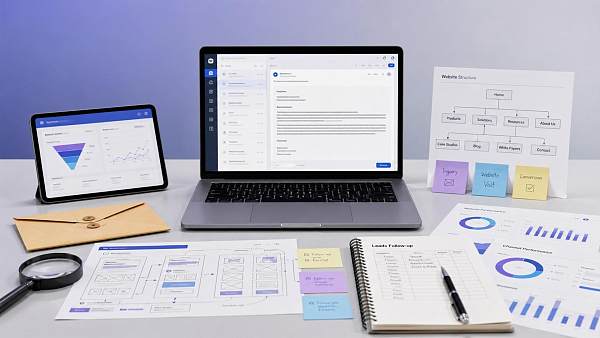
Many foreign trade companies assume that customers do not reply because the price is high, the brand is weak, or market competition is intense. In fact, when considering what to change if an inquiry email receives no reply, the first step is to assess whether the email encourages the customer to continue reading and whether they can determine within a few seconds whether your company is relevant to them.
In an integrated website and marketing services scenario, email is not an isolated action, but part of the process of receiving traffic, screening leads, and converting trust. If the content on the front-end website is weak, the landing page is unconvincing, and the company introduction is vague, even an excellent outreach email can easily go unanswered.
This is especially common among manufacturing factories, cross-border sellers, and brands expanding overseas. The issue is often not an inability to send emails, but treating all customers as if they were the same when communicating with them. Customers at different purchasing stages have different priorities, so the email content should be adjusted accordingly.
- Customers in the cold-start stage are more concerned with who you are, whether you are trustworthy, and whether you understand their business context.
- Customers in the price-comparison stage focus more on pricing structure, delivery times, risk control, and alternative solutions.
- Repeat customers care more about efficiency, stability, service responsiveness, and the potential for further cooperation.
What should be changed when an inquiry email receives no reply? Start with these five key areas
1. Do not use only the company name and product name as the subject line
Many emails lose the customer's interest right from the subject line. If the subject is simply “Manufacturer Supply,” “Cooperation Inquiry,” or “Product Quotation,” it is difficult for the customer to identify the value or find a reason to open the email. A more effective approach is to include the customer's desired outcome, use case, or differentiating point.
2. Do not make the opening self-introduction too long
Customers do not want to read your development history first. They want to know how the email relates to them. The opening should address the customer's business scenario directly, such as channel expansion, declining website lead generation, rising advertising costs, or slow SEO indexing.
3. Do not list features in the selling points; explain the results
If an email is filled with statements such as “we offer website development, SEO, advertising, social media, and AI systems,” customers will not automatically understand the value. Instead, express the results, such as “helping overseas websites go live faster,” “increasing the proportion of organic inquiries,” or “shortening the advertising testing cycle.”
4. Do not end with only “looking forward to your reply”
An ending without a call to action makes it easy for customers to postpone responding. A more effective approach is to offer clear options, such as asking them to reply with their target market, target language, or product category, or to indicate whether they need a website diagnosis, advertising recommendations, or inquiry conversion analysis.
5. Do not follow up with mechanical reminders
A follow-up email should not simply repeat “please check.” Each follow-up should add new value, such as explaining the logic behind a case, providing page optimization suggestions, identifying common issues with multilingual websites, or offering customer acquisition recommendations for different markets.
The table below can help determine which area should be prioritized when deciding what to change if an inquiry email receives no reply.
If you do not know what to change when an inquiry email receives no reply, prioritize the subject line, opening, and closing. These changes usually produce results faster than extensively rewriting the entire email because these three areas directly determine the open rate, reading completion rate, and initial interaction rate.
How should email content be adjusted for different customer scenarios?
The same sentence can produce completely different results with trading companies, manufacturing factories, cross-border e-commerce brands, and overseas distributors. Email should be designed around the stage the customer is in, rather than around what you want to introduce.
For manufacturing factory customers
Focus on lead generation through an independent website, inquiry quality, sample communication efficiency, and multilingual presentation capabilities. Manufacturing companies care more about stable, long-term inquiry generation than one-time advertising traffic.
For cross-border brand customers
It is more appropriate to emphasize brand website engagement, advertising landing page conversion, closed-loop social media traffic generation, and content consistency. Brand customers typically focus on page experience, advertising coordination, and the pace of market expansion.
For customers focused on channel development
The email should highlight regional market support, multilingual pages, localized content, target-market advertising recommendations, and subsequent lead management capabilities. These customers are more concerned with the efficiency of information matching when entering new markets.
If your company handles website development, SEO, advertising, and social media at the same time, it is recommended not to cover everything in the first email. Instead, organize the message according to the customer's scenario. The table below can help you quickly select the key content.
When email content is matched to the customer scenario, the response rate is usually more stable than with a standardized template. Regarding what to change when an inquiry email receives no reply, the real key is not writing style, but relevance.
Why is it not enough to modify the email alone? Why should the website and marketing process also be checked?
After receiving an email, customers often do not reply immediately. Instead, they first search for your brand, visit your website, and assess your industry experience and page credibility. If the website loads slowly, the content is outdated, or the mobile experience is poor, even a well-written email may be abandoned.
This is why integrated website and marketing services are more effective than optimizing email alone. Email is only the entry point. Behind it, there must be a multilingual website that builds trust, clear product pages, a content structure adapted for search, and a trackable inquiry system.
- Can the official website quickly explain which industries and markets you serve and what problems you solve?
- Does the page have clear consultation channels, form fields, and call-to-action buttons, rather than only an email address?
- Are multilingual versions available, with content that is adapted to local purchasing contexts rather than simply translated word for word?
- Can customers find further evidence and detailed explanations of the selling points mentioned in the email on the official website?
Yiyingbao has long served foreign trade companies, manufacturing factories, cross-border e-commerce sellers, and brands expanding overseas. It has developed integrated solutions covering AI-powered website development, multilingual website construction, Google SEO optimization, advertising placement, and overseas social media operations, making it better suited to solving process-related issues where customers do not trust, understand, or respond after receiving an email.
How should the follow-up schedule be adjusted to avoid annoying customers?
When considering what to change if an inquiry email receives no reply, you should modify not only the content but also the timing. Many teams either give up after sending only once or send follow-ups too frequently, causing customers to ignore them entirely. A reasonable schedule should be based on progressively delivered value.
- First email: Focus on relevance and open the conversation with a single scenario-based question. Do not overload it with information.
- Second follow-up: Add one specific suggestion, such as website structure, keyword layout, or landing page conversion points.
- Third follow-up: Offer a lower-barrier action, such as asking whether the customer needs free diagnostic guidance or regional market recommendations.
- Subsequent outreach: Use a different content angle instead of repeating the original message to avoid creating a sense of mechanical reminders.
If the company itself has capabilities in AI website development, AI advertising marketing, and AI+SEO/GEO optimization, follow-up content can also be presented as a concise analysis summary, allowing customers to see professional insights within a short time rather than feeling only sales pressure.
Common mistakes and FAQs: What are the areas companies are most likely to get wrong?
Does a longer email make it appear more professional?
No. Professionalism does not mean piling up information. For initial outreach, customers only need to quickly understand whether you understand their business. In most cases, a concise and precise structure is more likely to generate a first response than a lengthy introduction.
If the customer does not reply, is continuing to lower the price the only option?
Not necessarily. Many non-responses are unrelated to price; the value simply has not been understood. For services such as website development, SEO optimization, and advertising placement, customers care more about performance logic, execution capabilities, delivery schedules, and risk control.
When an inquiry email receives no reply, should I modify the template first or the contact list?
Both should be reviewed, but generally you should first modify the subject line, opening, and call to action in the template, and then check whether the contact list is accurate. If the industries on the list do not match, even an excellent email will produce limited results. If the list is accurate but the content is not relevant, the response rate will also be low.
Should I include the official website link and case study page in the email?
You can, but make sure the landing page can support the promise made in the email. If the official website lacks multilingual support, has a confusing structure, or provides a poor mobile experience, including the link may instead increase the customer's doubts.
Why choose us
If you are assessing what to change when an inquiry email receives no reply, do not focus only on the email copy itself. Instead, evaluate together whether the website engagement, content presentation, SEO foundation, advertising landing page, and subsequent conversion process work together effectively.
As an AI-driven enterprise SaaS platform for intelligent website development and overseas digital marketing services, Yiyingbao provides one-stop support for foreign trade companies, manufacturing factories, cross-border e-commerce sellers, and brands expanding overseas, covering AI-powered website development, multilingual website construction, B2B marketing websites, Google SEO optimization, Google advertising placement, Facebook advertising marketing, and GEO generative engine optimization.
If you wish to improve email response rates and the quality of overseas inquiry conversions, you can further consult us about specific services including existing outreach email diagnosis, target-market language strategy, official website landing page optimization, inquiry form design, SEO content planning, advertising landing page redesign recommendations, delivery timeline assessment, and customized overseas marketing solutions.
When email, website, and marketing systems are truly integrated, what customers see is no longer an ordinary outreach email, but a complete business entry point that is more credible, easier to communicate through, and more conducive to cooperation.
Related Articles

Related Products
 Yiyingbao SaaS Intelligent Website Building and Marketing SystemYiyingbao SaaS Intelligent Website Building and Marketing System, AI-powered no-code website building, rapid creation of multilingual B2B international websites in 10 minutes, global server acceleration, AI-powered SEO optimization, helping businesses connect efficiently with global markets. The perfect integration of technology and operation makes building an international trade website remarkably simple
 AI+SEM Intelligent Advertising Marketing SystemAI+SEM drives intelligent ad creation, empowering full-funnel precision advertising marketing. The system automatically generates weekly/monthly reports, AI recommends keywords and target countries, monitors core metrics in real-time with intelligent alerts, and enables one-click high-conversion ad solutions to help quickly acquire customers and improve ROI.
 AI+SEO Dual-Engine System Optimization ServicesYiyingbao’s AI+SEO dual-engine optimization system helps foreign trade enterprises acquire high-quality organic traffic through AI-powered keyword research, content generation, and comprehensive technical optimization, significantly improving search rankings and conversion rates.
 AI+SNS Social Media Marketing SystemYingbao AI+SNS Social Media Marketing System - Precision social capture for the social media era. Supports one-click content synchronization across major platforms like Facebook and LinkedIn. AI intelligently rewrites posts for enhanced relevance. 24/7 AI customer service and user profiling analysis empower businesses to efficiently expand into global markets.
 AI+SEO营销解决方案易营宝AI+SEO营销解决方案,通过AI批量写作、智能生成TDK、精准关键词扩词等功能,全面优化网站SEO效果,提升流量与转化率。助力企业构建高效智能网站新生态。
 AI+SEM Advertising Marketing SolutionsAI+SEM Advertising Marketing Solution leverages AI technology to deeply empower SEM ad campaigns. It automatically generates weekly/monthly reports using AI, presenting account data across multiple dimensions for comprehensive insights into campaign performance and trends. The system precisely recommends keywords and target countries, intelligently generates high-conversion ad copy, and enables one-click activation of efficient campaign plans to help businesses rapidly acquire customers. Simultaneously, it monitors core metrics in real time, intelligently identifies abnormal fluctuations, and issues timely alerts to ensure stable, high-return advertising results.
 Domain Name ServicesEasyWin provides professional domain name services, including intelligent queries, one-stop registration, brand protection, and full lifecycle management, helping businesses build a digital brand image.
 EasyOperate B2C Cross-Border E-Commerce Platform & Independent WebsiteEasyStore B2C Cross-border E-commerce Independent Store is an intelligent website building and cross-border e-commerce integrated solution independently developed by EasyStore Information Technology (Beijing) Co., Ltd. The system is specially designed for small and medium-sized as well as large export enterprises, integrating 'website building, operation, marketing, advertising, and conversion' into one, helping enterprises quickly establish cross-border e-commerce independent stores to achieve brand globalization and global sales growth.
The platform supports multiple languages, multiple currencies, and multi-channel marketing, with built-in AI intelligent translation and SEO optimization systems, suitable for mainstream markets such as Southeast Asia, Europe and America, Latin America, and the Middle East, assisting Chinese manufacturing enterprises in efficiently deploying international e-commerce strategies. SSL证书易营宝提供专业SSL安全证书服务,包括单域名和泛域名证书,确保网站数据传输加密、身份验证和完整性保护,助力企业建立安全可信的在线业务环境。









