









- Can the average annual growth rate reflect real opportunities in overseas markets?Oct 07, 2026View details
- Which customer acquisition channels will be affected by cross-border marketing trends in 2026?Sep 06, 2026View details
- Which homogenization risks should be considered in an analysis of the AI-powered website building industry?Aug 30, 2026View details
- How Will AI Marketing Trends 2026 Change Advertising Budget AllocationAug 28, 2026View details
- Is the EV SSL certificate market shrinking or upgrading? How should companies assess certificate procurement?Aug 11, 2026View details
- Why the old AMP SEO 2020 practices no longer work and what has changed in current optimization prioritiesAug 02, 2026View details
What Are the Practical Tips for Google Indexing Optimization in 2026?
Many people search for “Latest Google Indexing Optimization Tips for 2026”. What they are really anxious about is not the theory, but why Google still does not index their website even after it has gone live and content has been published, or why indexed pages later disappear. Here is the conclusion first: by 2026, indexing efficiency will no longer be determined by a single tactic, but by the coordination of technical structure, content credibility, page value, and the website’s update rhythm. Simply focusing on submitting URLs or publishing a sitemap usually does not solve the underlying problem.
One obvious change in the past two years is that Google has drawn a clearer distinction between whether a page can be crawled and whether it is worth indexing. In the past, many websites could gradually enter the index as long as their structure was acceptable and they had enough pages. Now things are different: crawl budgets are being handled more cautiously, and low-value pages are more likely to be ignored. Multilingual websites, international trade websites, bulk product pages, and AI-generated content in particular are most likely to become stuck at “Discovered - currently not indexed” or “Crawled - currently not indexed”.
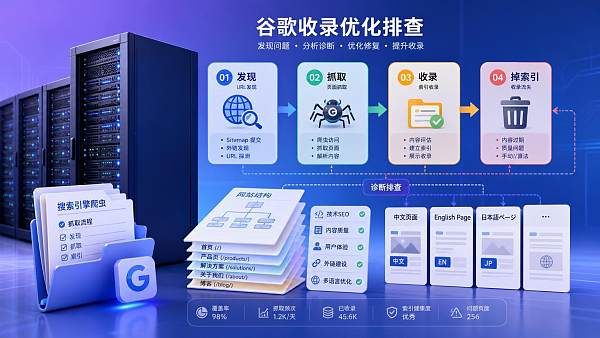
Before Changing Content, First Determine Which Stage Is Blocking You
Indexing issues are often discussed as if they were the same problem, but the solutions are completely different. A simple breakdown will make it easier to identify the key issue:
- Pages have not been discovered: This is mostly related to weak internal linking, shallow site structure, or incomplete submission mechanisms.
- Pages have been discovered but not crawled: Common causes include slow server responses, too many duplicate pages, and excessive parameter pages.
- Pages have been crawled but not indexed: This is usually not because they were not submitted, but because of content value, page similarity, or excessive templating.
- Pages were indexed and later dropped: This is often related to outdated content, unstable page quality, or a decline in the overall site evaluation.
If you can remember only one sentence, remember this: For indexing optimization, check logs and Search Console first, then decide whether to improve the technology or the content. Without identifying the stage first, many subsequent actions are likely to be wasted.
What Practical Google Indexing Optimization Tips Are Available for 2026? The Focus Is Not on “Publishing More,” but on “Publishing Less and More Precisely”
A common misconception among many corporate websites is treating the number of pages as the opportunity for indexing. In reality, having more pages does not necessarily make it easier to enter the index. If a large number of pages have similar content, identical fields, and vague descriptions, they may instead reduce the indexability of the entire website.
I recommend viewing optimization in two categories: one is “making it easier for Google to crawl,” and the other is “giving Google a reason to keep the page.” Both are indispensable.
1. Clean Up the Technical Foundation First
This part may not look impressive, but it has a significant impact on results. This is especially true for international trade independent websites, B2B corporate websites, and multilingual stores. If the technical layer is disorganized, even carefully prepared content will be held back.
Focus on checking the following items:
- Whether robots.txt is mistakenly blocking important directories.
- Whether canonical points incorrectly to the homepage or an incorrect aggregated page.
- Whether multilingual hreflang tags correspond correctly to one another, preventing Chinese and English pages from competing with each other.
- Whether the XML sitemap contains only indexable pages, rather than also including 404 pages, redirect pages, and filter pages.
- Whether mobile accessibility is normal and whether there are issues such as an excessively slow above-the-fold area or missing content after JS rendering.
In 2026, the requirements for JavaScript-rendered websites will only become more demanding. This does not mean that JS websites cannot be indexed, but if the core body content, product information, and internal links rely heavily on front-end rendering, crawling and understanding will both become slower. For inquiry-oriented websites, important pages should ideally make the main content available to Google during the initial crawl.
2. Pages Need a “Reason to Be Indexed”
Many pages are not indexed not because they contain too little content, but because they are indistinguishable from other pages on the site. For example, dozens of product pages may change only the model, size, and color while using exactly the same body structure; or an industry article may have a different title while still containing only generic common knowledge. Google will not automatically assume that all 200 articles deserve to enter the index simply because you worked hard to publish them.
A more effective approach is to differentiate page value:
- Product pages should clearly explain applicable industries, purchasing scenarios, frequently asked questions, and delivery methods, rather than listing specifications alone.
- Category pages should add filtering logic, selection advice, and typical applications.
- Article pages should solve one real problem instead of trying to cover everything in a single article.
- Case study pages should add the region, industry, and background of the requirement so that the page contains unique information.
If you are in manufacturing, operate an international trade factory, or manage a cross-border brand, this step is particularly important. Since competing websites in the same category usually offer similar products, the party that makes its pages more closely aligned with purchasing decisions is more likely to retain indexing.
Why Do Some Websites Submit URLs Every Day but Still Get Indexed Slowly?
Because “submission” is only a notification, not an admission notice. Google will not change its assessment of page quality simply because you manually submit the same page many times.
I have seen many websites spend all their time on the following tasks: repeatedly submitting URLs, frequently updating dates, publishing articles in bulk within a short period, and building low-quality backlinks everywhere. There may appear to be a lot of activity, but the improvement in indexing is often insignificant. The reason is simple: most of these actions only increase the chance of being seen; they do not increase the reason for being retained.
What is truly useful is increasing the probability that a page will be judged as independent, useful, and sustainably maintained. For example:
- Place important pages within the linking paths of the homepage, navigation, topic pages, and related articles instead of leaving them isolated.
- Remove thin pages that have had no traffic, no conversions, and duplicate content for a long time to reduce site noise.
- Supplement and update old pages instead of endlessly adding similar content.
- Make sure the same topic is not split into many very thin pages.
This is also a form of “comparative thinking”: you are not fighting against Google’s system; you are competing with the low-quality pages on your own website. Many websites do not have too few good pages, but too many poor ones.
The Most Common Content Optimization Pitfalls in 2026
The first pitfall is treating AI as the end point of content production. AI can help you outline, organize semantics, and improve wording, but if all the content on a website remains at the level of “an average answer that anyone could write,” it will be difficult to maintain stable indexing and rankings. Google does not reject the use of AI, but it will continue to reduce the space available to content that offers no added experience and no contextual judgment.
The second pitfall is launching a multilingual website through direct machine translation. Many companies expanding overseas follow a common path: after completing their Chinese website, they quickly replicate English, Spanish, and Arabic pages. However, if the language is unnatural, professional terms are mistranslated, or regional expressions are inconsistent, Google will take a conservative view of page quality. Multilingual content is not simply about switching the text to another language; it must preserve search intent and local language conventions.
The third pitfall is developing blogs and product pages separately without connecting them. The idea that articles are responsible for traffic and product pages are responsible for conversions is not wrong. However, if articles do not link to solution pages and product pages lack supporting educational content, both Google and users will find it difficult to understand the depth of your topic coverage.
What Kind of Websites Are Better Suited to Systematic Google Indexing Optimization?
If your website has any of the following characteristics, scattered fixes are usually not enough:
- A large number of pages and complex product and category hierarchies.
- Multiple language and regional versions.
- The website needs not only indexing, but also advertising landing pages, social media traffic acquisition, and inquiry conversion.
- The operations team wants to update the site continuously but has insufficient technical resources.
These websites are better suited to an integrated approach combining “website structure + SEO + content updates + data monitoring,” rather than treating indexing as an isolated project. Platforms such as Yiyingbao, which provide long-term services for companies expanding overseas, are suitable for this type of scenario: they address multilingual website development, technical structure, and indexability while connecting SEO, advertising, social media, and subsequent content operations. They may not necessarily be suitable for small websites that only need a few single-page showcases, but they are more practically valuable for companies that need to expand overseas search traffic over the long term.
Here is a very practical criterion: if your website will later need to continuously expand its content, run campaigns in multiple regions, and integrate AI search visibility optimization, building the underlying site structure correctly from the start will save much more effort than repeatedly reworking it later.
Set Priorities Before Performing Indexing Optimization
Many people initially want to get every page indexed. A more reasonable approach is to organize pages into levels:
- Level 1: Core product pages, primary category pages, and core country or language version pages.
- Level 2: High-conversion articles, case study pages, and solution pages.
- Level 3: News pages, secondary explanatory pages, and supporting content pages.
Stabilize Level 1 first and then expand Level 2. This is usually more efficient because Google’s assessment of a website often begins with whether its core pages are clear, credible, and stable. If the core pages are thin, indexing more peripheral pages will not create much practical value.
Another point that is often overlooked is that indexing is not the end point. Once a page enters the index, it will continue to undergo performance evaluation. Low click-through rates, weak engagement, poor topic relevance, and outdated content can all affect subsequent stability. Therefore, the truly useful part of “Latest Google Indexing Optimization Tips for 2026” is not a mysterious button, but making the website consistently resemble a real business site that is operated normally, maintained continuously, and provides clear information.
A More Practical Assessment at the End
If your website has not yet been indexed, do not rush to pursue rankings. If some pages have already been indexed, do not rush to compete on quantity. In 2026, it is more worthwhile to reduce low-quality pages, increase the unique value of core pages, and streamline the technical structure and update mechanism. Only then will indexing, rankings, and inquiry conversions move in the same direction.
Ultimately, Latest Google Indexing Optimization Tips for 2026 are not mysterious. They are more like a website health check: examining whether the structure contains obstacles, whether the content provides additional information, and whether the site is genuinely serving its target users. Doing these three things well is more reliable than chasing short-term tactics.
Frequently Asked Questions
How long does it take for a new website to be indexed by Google?
There is no fixed timeframe. A new website with sound technology, a clear structure, and adequate content quality will usually be discovered more quickly. If the pages are thin and internal linking is weak, the process will take longer.
If a page is not indexed, should I change the title or the body content first?
Prioritize the body content and page positioning. Many pages have a problem not with the title, but with being too similar to other pages on the site and lacking independent value.
Will submitting the sitemap several more times make indexing more likely?
The benefit is limited. A sitemap mainly informs Google that pages exist; it cannot replace quality assessment. What truly affects indexing is still page value and crawl efficiency.
Can AI-generated content still be used for SEO?
It can be used, but it should not be published unchanged in large quantities. Human input is needed to add industry judgment, contextual information, product details, and localized language.
Why do I still have no traffic after being indexed?
Indexing only means entering the candidate pool; it does not mean achieving a high ranking. Topic relevance, page quality, the strength of search demand, and the level of competition all affect subsequent traffic.
Image Placeholder List
Suggested position: Place it after “Before Changing Content, First Determine Which Stage Is Blocking You”
Image content: A flowchart for troubleshooting Google indexing issues, distinguishing the four stages of discovery, crawling, indexing, and dropping from the index
alt text: Illustration of the Google indexing optimization troubleshooting process
Internal Link Anchor Text Suggestions
- Google SEO optimization solutions: Suggested link to the SEO services page
- Multilingual website development: Suggested link to the multilingual website development solutions page
- Troubleshooting indexing issues on international trade independent websites: Suggested link to the industry knowledge article page
- B2B marketing website development: Suggested link to the B2B website development services page
- GEO Generative Engine Optimization: Suggested link to the AI search visibility optimization page
Suggested External Authoritative Sources
- Official technical documentation from search engines
- Help center pages for official brand webmaster tools
- Research materials from industry research institutions or academic institutions on search quality and website experience
Related Articles



Related Products
 Yiyingbao SaaS Intelligent Website Building and Marketing SystemYiyingbao SaaS Intelligent Website Building and Marketing System, AI-powered no-code website building, rapid creation of multilingual B2B international websites in 10 minutes, global server acceleration, AI-powered SEO optimization, helping businesses connect efficiently with global markets. The perfect integration of technology and operation makes building an international trade website remarkably simple
 AI+SEM Intelligent Advertising Marketing SystemAI+SEM drives intelligent ad creation, empowering full-funnel precision advertising marketing. The system automatically generates weekly/monthly reports, AI recommends keywords and target countries, monitors core metrics in real-time with intelligent alerts, and enables one-click high-conversion ad solutions to help quickly acquire customers and improve ROI.
 AI+SEO Dual-Engine System Optimization ServicesYiyingbao’s AI+SEO dual-engine optimization system helps foreign trade enterprises acquire high-quality organic traffic through AI-powered keyword research, content generation, and comprehensive technical optimization, significantly improving search rankings and conversion rates.
 AI+SNS Social Media Marketing SystemYingbao AI+SNS Social Media Marketing System - Precision social capture for the social media era. Supports one-click content synchronization across major platforms like Facebook and LinkedIn. AI intelligently rewrites posts for enhanced relevance. 24/7 AI customer service and user profiling analysis empower businesses to efficiently expand into global markets.
 AI+SEO营销解决方案易营宝AI+SEO营销解决方案,通过AI批量写作、智能生成TDK、精准关键词扩词等功能,全面优化网站SEO效果,提升流量与转化率。助力企业构建高效智能网站新生态。
 AI+SEM Advertising Marketing SolutionsAI+SEM Advertising Marketing Solution leverages AI technology to deeply empower SEM ad campaigns. It automatically generates weekly/monthly reports using AI, presenting account data across multiple dimensions for comprehensive insights into campaign performance and trends. The system precisely recommends keywords and target countries, intelligently generates high-conversion ad copy, and enables one-click activation of efficient campaign plans to help businesses rapidly acquire customers. Simultaneously, it monitors core metrics in real time, intelligently identifies abnormal fluctuations, and issues timely alerts to ensure stable, high-return advertising results.
 Domain Name ServicesEasyWin provides professional domain name services, including intelligent queries, one-stop registration, brand protection, and full lifecycle management, helping businesses build a digital brand image.
 EasyOperate B2C Cross-Border E-Commerce Platform & Independent WebsiteEasyStore B2C Cross-border E-commerce Independent Store is an intelligent website building and cross-border e-commerce integrated solution independently developed by EasyStore Information Technology (Beijing) Co., Ltd. The system is specially designed for small and medium-sized as well as large export enterprises, integrating 'website building, operation, marketing, advertising, and conversion' into one, helping enterprises quickly establish cross-border e-commerce independent stores to achieve brand globalization and global sales growth.
The platform supports multiple languages, multiple currencies, and multi-channel marketing, with built-in AI intelligent translation and SEO optimization systems, suitable for mainstream markets such as Southeast Asia, Europe and America, Latin America, and the Middle East, assisting Chinese manufacturing enterprises in efficiently deploying international e-commerce strategies. SSL证书易营宝提供专业SSL安全证书服务,包括单域名和泛域名证书,确保网站数据传输加密、身份验证和完整性保护,助力企业建立安全可信的在线业务环境。









