









- Shopify's Third-Quarter Revenue and GMV Fall Short of Expectations, Sending Shares Tumbling Before the Market OpensNov 04, 2026View details
- Temu Sellers See a Decline in Traffic as the Platform’s Traffic Allocation ShiftsNov 04, 2026View details
- UK Regulator Requires E-Commerce Businesses to Clearly Display Total Prices Including Mandatory Delivery ChargesNov 04, 2026View details
- Amazon Reportedly Sends Exclusivity Warning Letters to Multiplatform SellersNov 03, 2026View details
- New TikTok Shop Cross-Border Returns Rules for Southeast Asia Take Effect on November 5Nov 03, 2026View details
- U.S. Tightens De Minimis Exemption Channel and Revises Section 321 Data PilotNov 03, 2026View details
How can you verify whether a multilingual website is cited in AI-generated answers?
How can you verify whether a multilingual website has been cited in AI answers?
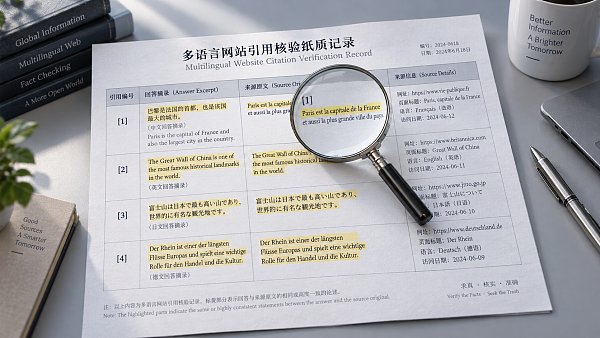
To verify whether a multilingual website has been cited in AI answers, searching for your company name once is not enough, nor does a product description appearing in an answer count as success. A more reliable approach is to ask questions in the language of the target market, check the source links associated with the answer, and then confirm which language version and page each link leads to, as well as whether the page supports the specific claims in the answer.
For export-oriented businesses, it is worth tracking “being mentioned” and “being cited” separately. The former means the brand appears in an answer; the latter means the answer displays a traceable website source. Neither necessarily means that the answer has generated a visit or an inquiry.
Does a company name appearing in an answer count as an official website citation?
Not necessarily. Brand information may come from an industry directory, a distributor’s website, or a news report, or the answer may not display any source. If an answer mentions your company but the cited link points to a third-party website, record it as “brand mention, third-party source,” not “official website cited.”
You can classify the results into three levels: a name appearing on its own counts as a brand mention; the official website appearing in the source list counts as an official website source being displayed; and a specific statement being linked to the official website, with the page content supporting that statement, provides stronger evidence of a citation. Even then, you can only confirm the citation status of that specific visible answer; you cannot infer the model’s training sources from it.
How should you test a multilingual website with questions?
Start with your main markets; there is no need to test every language at once. Prepare three types of questions for each market: brand verification, product selection, and purchasing questions. For example, a manufacturer of industrial pumps should test both “What pumps does [brand] offer?” and “How do you select a pump for conveying media containing particles?” and “Which sealing parameters should be confirmed before purchasing?” The latter two are closer to the searches buyers make before choosing a supplier.
Have someone familiar with the local business context review the questions instead of translating them word for word from Chinese. The same product may be called by different names in different markets, and buyers’ concerns about delivery, maintenance, and certifications also vary. Getting good results with Chinese questions does not mean equivalent content will be found with questions in German or Spanish.
During testing, record the platform, date, model or mode used, question language, and any region settings you can confirm, and use a new session whenever possible. Keep branded and non-branded queries separate. Asking the platform to “cite our website” can only be used to check whether a page can be accessed; it should not be counted as an organically earned citation.
What else should you check after finding a source link?
Do not just capture the part of the answer that mentions your brand. Open the citation marker or source list and check each destination link, paying particular attention to the final page after any redirects.
- Does the domain belong to the company, or is it a distributor, directory, or reposting site?
- Which language is the landing page in? Does it redirect to the default-language homepage?
- Does the page actually state the parameters, service scope, or delivery terms mentioned in the answer?
- Is the link working, and has the page content been updated or contradicted by the answer?
For example, if a Spanish-language answer cites an English product page, you can record it as “Spanish-language answer citing the official website’s English page,” but not as “the Spanish-language site has been cited.” This kind of cross-language citation is not inherently a problem, but it indicates that the coverage, discoverability, or completeness of the local-language pages may be worth reviewing.
Can one unsuccessful check establish that your site has not been cited?
No. Answers are affected by question wording, retrieval mode, context, and timing, and some platforms do not display sources for every answer. A single result with no citation only means that no citation was observed under the conditions of that test.
A more practical approach is to maintain a set of fixed questions, retest them regularly, and keep the original questions, screenshots of the answers, source URLs, and the language of each landing page. You can calculate “the number of answers with official website citations ÷ the number of valid tests,” but always specify the platform, language, and sample scope. This ratio is an internal tracking metric, not the AI citation rate for the entire market.
Can traffic analytics and server logs prove that a citation occurred?
They are supporting evidence, not a substitute for checking the answers. AI platform referral traffic in analytics shows that someone reached the site through a related entry point, but it does not necessarily correspond to a particular saved answer. Likewise, no traffic does not mean there was no citation: users may not click, and referral information may be lost.
Similarly, related crawlers appearing in server logs only indicate that a visit occurred; they do not prove that a page was used in an answer. Reviewing answer evidence, visit records, and inquiry sources separately helps prevent reporting “was crawled” as “generated leads.”
If a language version receives no citations over time, what should you fix first?
First check whether the page is accessible, whether indexing restrictions have been set inadvertently, whether the main text is easy to read, and whether multilingual URLs, canonical links, and language annotations are configured appropriately. Language annotations help search engines understand the relationships between versions, but do not guarantee AI citations. Once technical issues have been ruled out, check whether the content directly answers local buyers’ questions instead of consisting only of translated company information.
For platforms such as Yiyingbao that provide multilingual website development, SEO, and GEO services, citation checks can be incorporated into the page maintenance workflow: marketing staff save the questions and citation evidence, technical staff handle accessibility and language settings, and business staff verify specifications and local phrasing. Service acceptance should also be based on original links and question samples, not just a screenshot showing “improved visibility.”
As a next step, choose one priority language and a few genuine purchasing questions, then start keeping records. First establish “which answer cited which page,” and then decide whether to add content or fix technical issues. This is more useful for making informed decisions than repeatedly asking AI, “Do you know our company?”
Related Articles
 ChatGPT has 1.2 billion weekly active users, with one-fifth of Google’s search volume
 How do you mark up product information with a Schema-enabled website builder?
 Industry standard for large language model platforms takes effect on November 1, with implications for GEO compliance


Related Products
 Yiyingbao SaaS Intelligent Website Building and Marketing SystemYiyingbao SaaS Intelligent Website Building and Marketing System, AI-powered no-code website building, rapid creation of multilingual B2B international websites in 10 minutes, global server acceleration, AI-powered SEO optimization, helping businesses connect efficiently with global markets. The perfect integration of technology and operation makes building an international trade website remarkably simple
 AI+SEM Intelligent Advertising Marketing SystemAI+SEM drives intelligent ad creation, empowering full-funnel precision advertising marketing. The system automatically generates weekly/monthly reports, AI recommends keywords and target countries, monitors core metrics in real-time with intelligent alerts, and enables one-click high-conversion ad solutions to help quickly acquire customers and improve ROI.
 AI+SEO Dual-Engine System Optimization ServicesYiyingbao’s AI+SEO dual-engine optimization system helps foreign trade enterprises acquire high-quality organic traffic through AI-powered keyword research, content generation, and comprehensive technical optimization, significantly improving search rankings and conversion rates.
 AI+SNS Social Media Marketing SystemYingbao AI+SNS Social Media Marketing System - Precision social capture for the social media era. Supports one-click content synchronization across major platforms like Facebook and LinkedIn. AI intelligently rewrites posts for enhanced relevance. 24/7 AI customer service and user profiling analysis empower businesses to efficiently expand into global markets.
 AI+SEO营销解决方案易营宝AI+SEO营销解决方案,通过AI批量写作、智能生成TDK、精准关键词扩词等功能,全面优化网站SEO效果,提升流量与转化率。助力企业构建高效智能网站新生态。
 AI+SEM Advertising Marketing SolutionsAI+SEM Advertising Marketing Solution leverages AI technology to deeply empower SEM ad campaigns. It automatically generates weekly/monthly reports using AI, presenting account data across multiple dimensions for comprehensive insights into campaign performance and trends. The system precisely recommends keywords and target countries, intelligently generates high-conversion ad copy, and enables one-click activation of efficient campaign plans to help businesses rapidly acquire customers. Simultaneously, it monitors core metrics in real time, intelligently identifies abnormal fluctuations, and issues timely alerts to ensure stable, high-return advertising results.
 Domain Name ServicesEasyWin provides professional domain name services, including intelligent queries, one-stop registration, brand protection, and full lifecycle management, helping businesses build a digital brand image.
 EasyOperate B2C Cross-Border E-Commerce Platform & Independent WebsiteEasyStore B2C Cross-border E-commerce Independent Store is an intelligent website building and cross-border e-commerce integrated solution independently developed by EasyStore Information Technology (Beijing) Co., Ltd. The system is specially designed for small and medium-sized as well as large export enterprises, integrating 'website building, operation, marketing, advertising, and conversion' into one, helping enterprises quickly establish cross-border e-commerce independent stores to achieve brand globalization and global sales growth.
The platform supports multiple languages, multiple currencies, and multi-channel marketing, with built-in AI intelligent translation and SEO optimization systems, suitable for mainstream markets such as Southeast Asia, Europe and America, Latin America, and the Middle East, assisting Chinese manufacturing enterprises in efficiently deploying international e-commerce strategies. SSL证书易营宝提供专业SSL安全证书服务,包括单域名和泛域名证书,确保网站数据传输加密、身份验证和完整性保护,助力企业建立安全可信的在线业务环境。









