









- Which customer acquisition channels will be affected by cross-border marketing trends in 2026?Sep 06, 2026View details
- Which homogenization risks should be considered in an analysis of the AI-powered website building industry?Aug 30, 2026View details
- How Will AI Marketing Trends 2026 Change Advertising Budget AllocationAug 28, 2026View details
- Is the EV SSL certificate market shrinking or upgrading? How should companies assess certificate procurement?Aug 11, 2026View details
- Why the old AMP SEO 2020 practices no longer work and what has changed in current optimization prioritiesAug 02, 2026View details
- How to Choose Topics for an Industry News Section to Attract More Organic Search TrafficJul 29, 2026View details
Where Do the Cost Differences Lie Between Data-Driven Advertising and Experience-Based Campaigns?
The cost difference between data-driven advertising and experience-based advertising is usually not reflected in the apparent price of a single click or ad group. Rather, it lies in whether ineffective spending can be identified and stopped, and whether effective investment can be replicated consistently. With the same monthly budget for acquiring overseas customers, experience-based advertising may show a decent number of clicks in the platform dashboard, yet fail to explain which countries, search terms, creatives, audiences, or landing pages actually generated follow-up-worthy inquiries. Data-driven advertising, by contrast, requires connecting budget, traffic, lead quality, and conversion results into an accountable chain.
Therefore, there is no fixed percentage that applies to every business when asking, “How much does data-driven advertising differ in cost from experience-based advertising?” Product unit price, sales cycle, target market, conversion actions, and data foundation can all change the outcome. However, from a budget approval perspective, the most fundamental difference is this: experience-based advertising manages ad spend, while data-driven advertising manages verifiable customer acquisition costs and returns on marginal investment.
The Cost Difference Is Not Limited to Ad Spend, but Also Includes Four Commonly Overlooked Expenses
Experience-based advertising does not mean advertising without experience. The judgment of experienced media buyers regarding industry keywords, creative messaging, and platform rules remains important. The issue is that when advertising decisions rely primarily on personal judgment, historical habits, or click data in the dashboard, while lacking unified attribution and conversion feedback, budget losses are often dispersed across multiple stages and difficult to fully identify in monthly reports.
Among these, lead handling costs are often the most underestimated. B2B foreign trade businesses generally have long sales cycles, and an ad-generated form submission does not necessarily represent a sales opportunity. If the advertising team uses the number of forms as its sole objective, it may exchange a lower cost per lead for a higher sales screening cost, ultimately increasing the actual customer acquisition cost for each qualified opportunity and each order.
For example, the form costs of two channels are RMB 300 and RMB 500 respectively. The former appears cheaper on the surface. However, if only a small number of leads from the former enter the quotation or sample stage, while inquiries generated by the latter have a higher degree of demand fit, it is meaningless to compare advertising performance solely based on RMB 300 and RMB 500. What should actually be compared is how much media spend, operating cost, and sales follow-up resources are required to obtain one qualified lead that can enter the sales process.
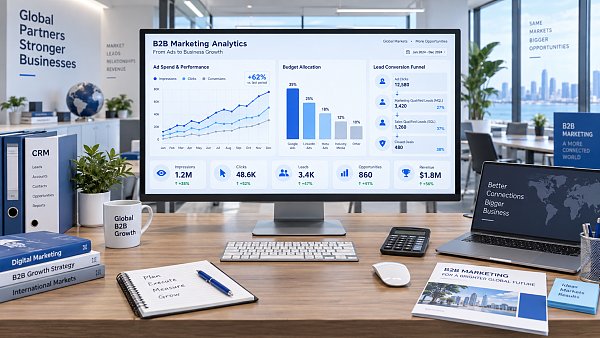
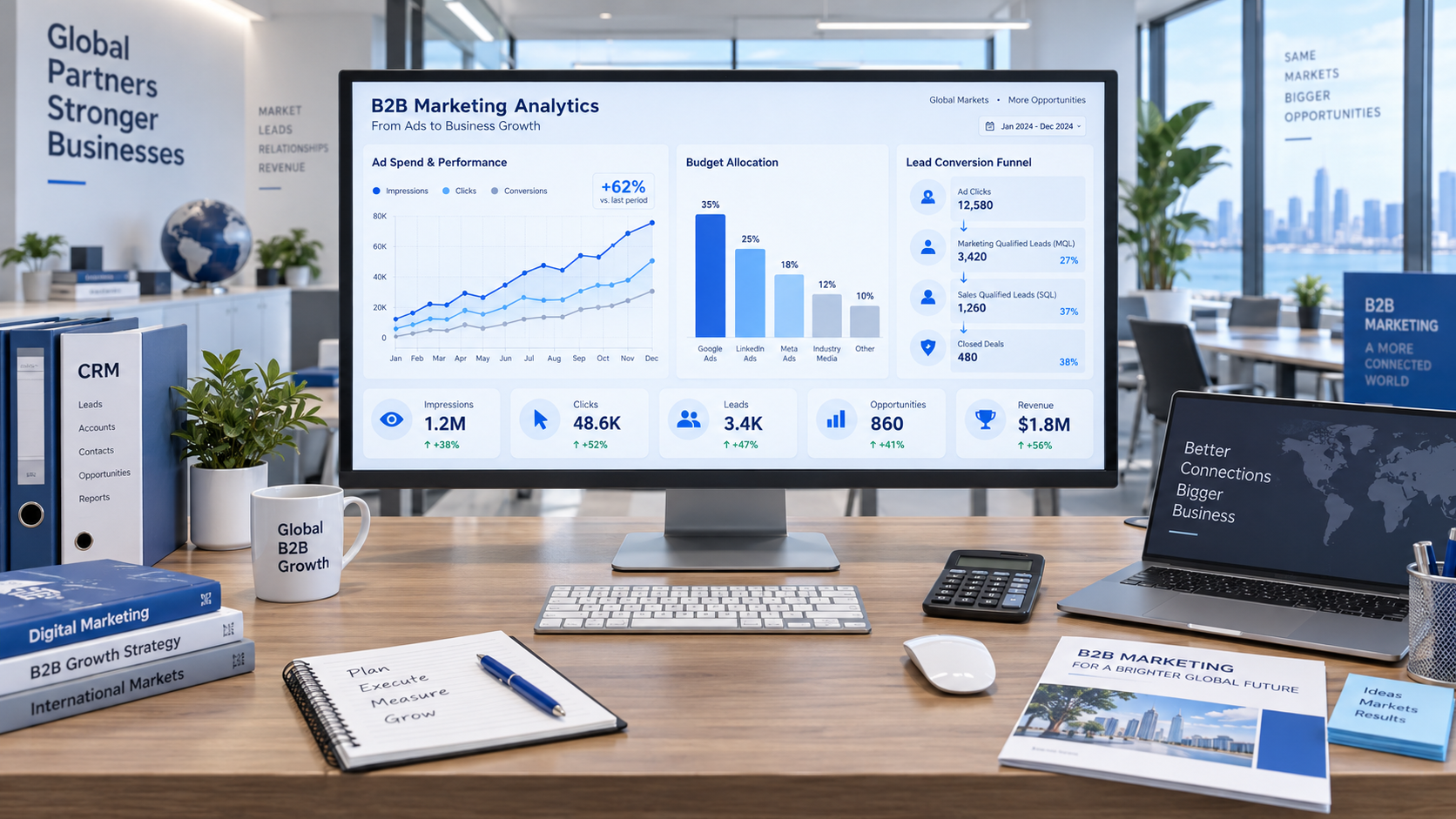
Data-Driven Advertising Is Not About “Viewing More Reports,” but About Establishing Attribution That Can Support Budget Decisions
Advertising platforms provide data such as impressions, clicks, and conversions, but this data is designed by default to support optimization within the platform and may not answer a company's internal cost questions. Especially when Google Ads, Facebook Ads, social media content traffic generation, and organic traffic to an independent website operate in parallel, the same customer may interact with multiple channels several times before ultimately submitting an inquiry through a branded keyword search or a direct visit. If only the last click is credited to a certain channel, budget efficiency can easily be misjudged.
An attribution system that can be used for cost approval does not need to pursue complex modeling from the outset, but it must at least standardize several definitions: what constitutes an advertising conversion, what constitutes a valid inquiry, what constitutes a sales-confirmed qualified opportunity, which orders can be traced back to customer acquisition channels, and who is responsible for maintaining the status at each stage. Without these definitions, so-called “data-driven” advertising can easily degrade into more screenshots and more metrics, without being able to support budget increases or reductions.
For overseas B2B websites, conversion events should not be limited to “form submission.” Downloading a catalog, viewing contact details, initiating a WhatsApp conversation, scheduling a meeting, submitting an RFQ, or revisiting after viewing a key product page may all have different business value. They can be recorded, but they should not be calculated with equal weight. If low-threshold actions are mixed with formal inquiries, the system may automatically allocate the budget toward actions that are easiest to obtain but do not necessarily have the greatest commercial value.
Budget Differences Often Do Not Become Evident Until Three Months into Advertising
Experience-based advertising is not necessarily worse in the short term. For new product testing, short-term exposure before a trade show, or situations with an extremely narrow audience where the sales team can quickly screen leads manually, rapid launch based on industry judgment may be more efficient than waiting for a complete data system. However, the prerequisite for this approach is that the test budget has a clear upper limit and that the test period and stop conditions have been agreed in advance.
Once advertising enters a continuous delivery stage, the cost of lacking a data closed loop gradually accumulates. The reason is not that platforms cannot optimize automatically, but that platforms can only learn from the conversion signals provided to them. If the system receives low-quality forms, general inquiries, or invalid clicks, it will become increasingly proficient at obtaining these “cheap conversions”; only when it receives valid opportunities confirmed by sales can its optimization direction move closer to actual business objectives.
This is also why service fees alone should not be compared. Data collection, tracking configuration, CRM field standardization, lead feedback, landing page testing, and regular reviews all require additional investment. Their value is not in making advertising appear more advanced, but in reducing the risk of the budget being guided by the wrong objectives over the long term. For projects with a small monthly budget or channels that have not yet been validated, complex data implementation may create a management burden; for businesses advertising continuously across multiple markets and product lines, lacking this infrastructure can instead leave subsequent budget expansion without a basis.
What Should Be Verified During Approval Is Not “Whether AI Is Used,” but Whether Cost Definitions Form a Closed Loop
Current advertising service proposals often promote automated bidding, AI-generated creatives, or intelligent optimization as selling points, but these capabilities cannot replace business data. Automation tools can increase the speed of adjustments, but they cannot independently determine whether an inquiry has a purchasing budget, whether it matches the target industry, or identify the actual gross profit level of an order. If input data quality is insufficient, automation may amplify the wrong direction more quickly.
A more practical method of assessment is to require the service proposal to clearly answer several questions: How are conversion events in the advertising account defined? Can sources be matched among the website, advertising platform, and customer management system? Within what time frame will sales feedback be returned? Which metrics are used to decide whether to increase the budget, and which metrics trigger a pause? Which parts of the service fee are for one-time setup, and which are for ongoing optimization? Who retains the account, pixels, creatives, and historical data if the business relationship changes?
The final item often affects long-term costs. If account assets, website analytics access, or conversion data cannot be independently controlled by the business, the value of data accumulated earlier may not be fully retained when changing service providers, adjusting market strategies, or taking over advertising internally. A seemingly lower execution fee may consequently result in higher migration and relearning costs.
Work Backward from “Acceptable Customer Acquisition Cost” Rather Than Evaluating Results by Spend
A more prudent budget assessment should work backward from the business side. First determine the acceptable cost of a qualified opportunity, then calculate the tolerable range of inquiry costs based on the conversion relationship from lead to opportunity and from opportunity to order. Thresholds should also be set separately for product lines with different gross margins and repurchase potential. In this way, advertising expense is no longer an isolated cost, but can be linked to sales capacity, profit margin, and the cash recovery cycle.
The cost advantage of data-driven advertising does not mean promising lower click prices at every stage. Rather, it transforms “how much was spent” into “why it was spent, where it was spent, what business results it produced, and whether spending should continue.” Experience still determines the starting point of a strategy, but only traceable data can determine whether the budget should be expanded, whether a channel should be retained, and whether a particular advertising initiative is truly creating growth or merely generating traffic that appears busy.
Related Articles


Related Products
 Yiyingbao SaaS Intelligent Website Building and Marketing SystemYiyingbao SaaS Intelligent Website Building and Marketing System, AI-powered no-code website building, rapid creation of multilingual B2B international websites in 10 minutes, global server acceleration, AI-powered SEO optimization, helping businesses connect efficiently with global markets. The perfect integration of technology and operation makes building an international trade website remarkably simple
 AI+SEM Intelligent Advertising Marketing SystemAI+SEM drives intelligent ad creation, empowering full-funnel precision advertising marketing. The system automatically generates weekly/monthly reports, AI recommends keywords and target countries, monitors core metrics in real-time with intelligent alerts, and enables one-click high-conversion ad solutions to help quickly acquire customers and improve ROI.
 AI+SEO Dual-Engine System Optimization ServicesYiyingbao’s AI+SEO dual-engine optimization system helps foreign trade enterprises acquire high-quality organic traffic through AI-powered keyword research, content generation, and comprehensive technical optimization, significantly improving search rankings and conversion rates.
 AI+SNS Social Media Marketing SystemYingbao AI+SNS Social Media Marketing System - Precision social capture for the social media era. Supports one-click content synchronization across major platforms like Facebook and LinkedIn. AI intelligently rewrites posts for enhanced relevance. 24/7 AI customer service and user profiling analysis empower businesses to efficiently expand into global markets.
 AI+SEO营销解决方案易营宝AI+SEO营销解决方案,通过AI批量写作、智能生成TDK、精准关键词扩词等功能,全面优化网站SEO效果,提升流量与转化率。助力企业构建高效智能网站新生态。
 AI+SEM Advertising Marketing SolutionsAI+SEM Advertising Marketing Solution leverages AI technology to deeply empower SEM ad campaigns. It automatically generates weekly/monthly reports using AI, presenting account data across multiple dimensions for comprehensive insights into campaign performance and trends. The system precisely recommends keywords and target countries, intelligently generates high-conversion ad copy, and enables one-click activation of efficient campaign plans to help businesses rapidly acquire customers. Simultaneously, it monitors core metrics in real time, intelligently identifies abnormal fluctuations, and issues timely alerts to ensure stable, high-return advertising results.
 Domain Name ServicesEasyWin provides professional domain name services, including intelligent queries, one-stop registration, brand protection, and full lifecycle management, helping businesses build a digital brand image.
 EasyOperate B2C Cross-Border E-Commerce Platform & Independent WebsiteEasyStore B2C Cross-border E-commerce Independent Store is an intelligent website building and cross-border e-commerce integrated solution independently developed by EasyStore Information Technology (Beijing) Co., Ltd. The system is specially designed for small and medium-sized as well as large export enterprises, integrating 'website building, operation, marketing, advertising, and conversion' into one, helping enterprises quickly establish cross-border e-commerce independent stores to achieve brand globalization and global sales growth.
The platform supports multiple languages, multiple currencies, and multi-channel marketing, with built-in AI intelligent translation and SEO optimization systems, suitable for mainstream markets such as Southeast Asia, Europe and America, Latin America, and the Middle East, assisting Chinese manufacturing enterprises in efficiently deploying international e-commerce strategies. SSL证书易营宝提供专业SSL安全证书服务,包括单域名和泛域名证书,确保网站数据传输加密、身份验证和完整性保护,助力企业建立安全可信的在线业务环境。









