









- China’s Ministry of Commerce Responds to Additional Charges on Low-Value Imports Imposed by the EUNov 06, 2026View details
- Two Internet Development Reports Released at the 2026 World Internet ConferenceNov 05, 2026View details
- Internet Business Revenue of Enterprises Above the Designated Size Reached RMB 1.716 Trillion in the First Three Quarters, with Profits Up 17.6%Nov 05, 2026View details
- Shopify's Third-Quarter Revenue and GMV Fall Short of Expectations, Sending Shares Tumbling Before the Market OpensNov 04, 2026View details
- Temu Sellers See a Decline in Traffic as the Platform’s Traffic Allocation ShiftsNov 04, 2026View details
- UK Regulator Requires E-Commerce Businesses to Clearly Display Total Prices Including Mandatory Delivery ChargesNov 04, 2026View details
How can you optimize Facebook ads to reduce customer acquisition costs?
Are your Facebook advertising costs per lead still too high? Learn the key methods for facebook werbeanzeigen optimieren and improve your campaigns step by step—from audiences and creative to landing pages—so every advertising dollar delivers more value.
For export businesses, low-cost leads shown in the ad dashboard do not necessarily mean that customer acquisition is truly inexpensive: some people submit a form on a whim, some are in regions you do not serve, and others leave their contact details and never respond again. To assess whether your ads are effective, do not focus only on the cost per click. Consider ad spend, inquiry quality, and follow-up together.
First, identify where costs are rising
Break the customer acquisition process into “impressions—clicks—landing page visits—inquiry submissions—effective follow-up,” then assess the drop-off at each step. If you are getting impressions but few clicks, first review your audience, creative, and how you present your offer. If you are getting plenty of clicks but noticeably fewer landing page visits, check page load times, redirects, and tracking. If visits are normal but few people submit inquiries, review the page content and form.
We recommend tracking two figures at the same time: cost per lead = ad spend ÷ number of leads; cost per qualified lead = ad spend ÷ number of qualified leads. Sales and advertising teams should agree in advance on what counts as a qualified lead—for example, the contact details are valid, the buyer’s region is within your service area, and there is a clear need for your product. Sales cycles vary by business, so a single standard should not be applied across the board.
For example, if two ad campaigns have the same spend, the first may generate more form submissions, while the second brings fewer inquiries but more prospects who meet your minimum order quantity and delivery-area requirements. In that case, the first campaign is not necessarily where you should allocate your budget. For businesses with longer purchasing cycles, such as equipment and raw materials, continue tracking quotes and opportunities to avoid judging short-term advertising performance too early based on closed deals.
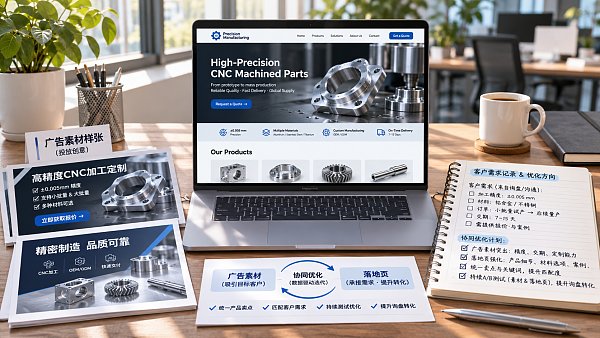
Do not keep narrowing your audience—validate purchasing scenarios first
Advertising teams often layer region, age, interests, and job title targeting in hopes of reaching purchasing decision-makers. The problem is that an overly narrow audience can limit the system’s ability to find potential customers, while a person’s job title or interests do not prove that they have purchasing authority. When budgets are limited, splitting campaigns into too many ad sets can also leave each set with too little data to evaluate.
A more practical approach is to build tests around business boundaries: separate markets with clear differences in supply conditions, language, or purchasing needs, then compare broader audiences with lookalike audiences based on existing customer data. Before using customer lists, confirm the data source, customer consent, and applicable privacy requirements in the relevant regions. If the list is not of sufficient quality, there is no need to force its use.
Retargeting is useful for reaching people who have visited product pages or interacted with your ads, but do not assume they are all ready to buy. You can distinguish between people who viewed product details and those who only browsed the home page, and monitor audience size and ad frequency. If the same people keep seeing the same creative, increasing the budget may not bring in more qualified inquiries.
Each creative test should answer a specific question
An ad creative is not meaningfully tested just by changing the background of a product image. Manufacturers can show equipment in operation, products in their intended settings, or quality inspections. For products that require customization, explain the use cases, available specifications, and information needed for a quote. The goal is to help potential customers quickly determine whether you are the supplier they need.
For each round of testing, compare one main variable whenever possible—for example, test different selling points with the same audience, or compare video with images using the same selling point. Track clicks, landing page conversions, and qualified leads together instead of choosing a version solely because it has the highest click-through rate. Creative that attracts many users outside your target market can increase downstream screening costs, even if its clicks are inexpensive.
Your ad copy must also match the promise made on the page. If an ad emphasizes bulk customization but the landing page only offers a generic company introduction, visitors may have little reason to take the next step. For claims about pricing, lead times, certifications, or delivery areas, state only what can be verified. Explain any conditions on the page to avoid attracting inquiries that are not a good fit.
The landing page determines whether clicks become inquiries
Mobile visitors are often unwilling to spend time searching for contact information. The landing page should quickly show the product’s applications, key specifications, target markets, and inquiry form. For customized products, you can also provide details about the customization process and the drawings or specifications required. The page language should match the ad and target market, and someone familiar with the product should review the technical terminology.
Choose form fields carefully. Email addresses and descriptions of requirements usually help with follow-up. Fields such as order quantity and purchasing region can help qualify leads, but too many fields may cause visitors to abandon the form. Test different forms by comparing submission volume and lead quality rather than simply making the form shorter or longer. After a successful submission, clearly tell visitors what to expect next to avoid duplicate submissions.
Website forms and platform instant forms each have trade-offs: the former make it easier to present product details and business requirements, while the latter usually reduce the number of steps. When choosing between them, compare qualified lead costs and the effort required for sales follow-up, not just the number of form submissions. For complex products that require technical specifications, a short form alone may not be enough to qualify prospects.
Close the loop between data feedback and sales feedback
Before adjusting your budget, confirm that your data is reliable. In your advertising management tools, check that the pixel and relevant conversion events are firing correctly, and test the form by submitting it yourself. If you use the Conversions API, also check the deduplication settings for browser events. If figures differ across the ad platform, website analytics, and customer management system, review attribution definitions, time zones, and reporting periods instead of assuming that the discrepancy is an error.
At a minimum, the sales team should record the lead source, follow-up status, and reason a lead is invalid. If many inquiries come from regions you do not serve, review your geographic targeting and ad copy. If customers repeatedly ask about specifications that are not covered on the page, update the landing page. If qualified leads are not receiving timely responses, first check the assignment and follow-up process. Ad optimization should not be used as a substitute for fixing the sales process.
Keep a testing log of changes, including the date, budget, audience, creative, and rationale. If you change several variables at once, it is difficult to know what caused a cost reduction. Be especially cautious when data volumes are low: give tests enough time to gather observations and assess them in light of your business cycle, rather than frequently switching ads on and off in response to short-term fluctuations.
Review your website and advertising as a single project
When one team manages advertising and another maintains the website, problems can lead to finger-pointing over “poor-quality traffic” or “a difficult-to-use page.” A more effective way to collaborate is to agree on conversion events, page content, form fields, lead assignment, and review cycles, and to clarify who is responsible for addressing each issue.
Yingyingbao provides services including intelligent website building, multilingual websites, Facebook advertising, and SEO. Its integrated website and marketing capabilities can help coordinate landing pages, advertising, and data tracking. However, platform tools cannot replace business judgment: before a project begins, you still need to confirm the target market, product selling points, acceptable order requirements, and how leads will be handled once they enter the sales process.
Before your next round of optimization, consider auditing recent leads: Which ones did not meet your purchasing requirements, and which met the requirements but were not followed up promptly? Map the reasons to the audience, creative, page, or sales process, then test the most obvious area. This is usually a better way to identify the real source of costs than blindly lowering bids.
Related Articles
 How can you optimize Facebook ads to reduce customer acquisition costs?
 How Can Overseas Advertising and Social Media Work Together? An Integrated Approach from Audience Reach to Lead Conversion
 How Can Ad Landing Page Design Reduce Form Abandonment?

Related Products
 Yiyingbao SaaS Intelligent Website Building and Marketing SystemYiyingbao SaaS Intelligent Website Building and Marketing System, AI-powered no-code website building, rapid creation of multilingual B2B international websites in 10 minutes, global server acceleration, AI-powered SEO optimization, helping businesses connect efficiently with global markets. The perfect integration of technology and operation makes building an international trade website remarkably simple
 AI+SEM Intelligent Advertising Marketing SystemAI+SEM drives intelligent ad creation, empowering full-funnel precision advertising marketing. The system automatically generates weekly/monthly reports, AI recommends keywords and target countries, monitors core metrics in real-time with intelligent alerts, and enables one-click high-conversion ad solutions to help quickly acquire customers and improve ROI.
 AI+SEO Dual-Engine System Optimization ServicesYiyingbao’s AI+SEO dual-engine optimization system helps foreign trade enterprises acquire high-quality organic traffic through AI-powered keyword research, content generation, and comprehensive technical optimization, significantly improving search rankings and conversion rates.
 AI+SNS Social Media Marketing SystemYingbao AI+SNS Social Media Marketing System - Precision social capture for the social media era. Supports one-click content synchronization across major platforms like Facebook and LinkedIn. AI intelligently rewrites posts for enhanced relevance. 24/7 AI customer service and user profiling analysis empower businesses to efficiently expand into global markets.
 AI+SEO营销解决方案易营宝AI+SEO营销解决方案,通过AI批量写作、智能生成TDK、精准关键词扩词等功能,全面优化网站SEO效果,提升流量与转化率。助力企业构建高效智能网站新生态。
 AI+SEM Advertising Marketing SolutionsAI+SEM Advertising Marketing Solution leverages AI technology to deeply empower SEM ad campaigns. It automatically generates weekly/monthly reports using AI, presenting account data across multiple dimensions for comprehensive insights into campaign performance and trends. The system precisely recommends keywords and target countries, intelligently generates high-conversion ad copy, and enables one-click activation of efficient campaign plans to help businesses rapidly acquire customers. Simultaneously, it monitors core metrics in real time, intelligently identifies abnormal fluctuations, and issues timely alerts to ensure stable, high-return advertising results.
 Domain Name ServicesEasyWin provides professional domain name services, including intelligent queries, one-stop registration, brand protection, and full lifecycle management, helping businesses build a digital brand image.
 EasyOperate B2C Cross-Border E-Commerce Platform & Independent WebsiteEasyStore B2C Cross-border E-commerce Independent Store is an intelligent website building and cross-border e-commerce integrated solution independently developed by EasyStore Information Technology (Beijing) Co., Ltd. The system is specially designed for small and medium-sized as well as large export enterprises, integrating 'website building, operation, marketing, advertising, and conversion' into one, helping enterprises quickly establish cross-border e-commerce independent stores to achieve brand globalization and global sales growth.
The platform supports multiple languages, multiple currencies, and multi-channel marketing, with built-in AI intelligent translation and SEO optimization systems, suitable for mainstream markets such as Southeast Asia, Europe and America, Latin America, and the Middle East, assisting Chinese manufacturing enterprises in efficiently deploying international e-commerce strategies. SSL证书易营宝提供专业SSL安全证书服务,包括单域名和泛域名证书,确保网站数据传输加密、身份验证和完整性保护,助力企业建立安全可信的在线业务环境。









