









- Which customer acquisition channels will be affected by cross-border marketing trends in 2026?Sep 06, 2026View details
- Which homogenization risks should be considered in an analysis of the AI-powered website building industry?Aug 30, 2026View details
- How Will AI Marketing Trends 2026 Change Advertising Budget AllocationAug 28, 2026View details
- Is the EV SSL certificate market shrinking or upgrading? How should companies assess certificate procurement?Aug 11, 2026View details
- Why the old AMP SEO 2020 practices no longer work and what has changed in current optimization prioritiesAug 02, 2026View details
- How to Choose Topics for an Industry News Section to Attract More Organic Search TrafficJul 29, 2026View details
Which Has a Higher ROI: Overseas Social Media or Google Ads?
Which delivers a higher ROI: overseas social media or Google Ads? The answer is not a simple either-or choice. For companies expanding internationally, ROI depends on factors such as average order value, decision-making cycle, target market, and lead conversion path. For acquiring high-intent inquiries, Google Ads is usually more direct; for brand awareness, user engagement, and long-term influence, overseas social media often has greater advantages.
What many companies really need is not to determine which channel is “absolutely more profitable,” but to find the advertising mix that best suits their current stage. Especially for foreign trade manufacturers, cross-border sellers, and brands expanding overseas, ROI evaluation is meaningful only when traffic sources, customer acquisition costs, and conversion efficiency are assessed within the same framework.
Why “Which Has a Higher ROI, Overseas Social Media or Google Ads?” Cannot Be Determined by Looking Only at Single Conversions
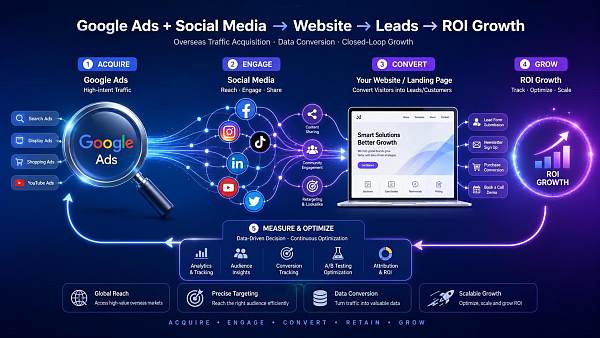
When comparing overseas social media with Google Ads, the most common mistake companies make is focusing only on the apparent cost per click or cost per inquiry. In fact, ROI is not limited to upfront advertising costs; it must also take into account subsequent closing rates, repurchase rates, and customer lifetime value.
For example, with the same budget of 100,000 yuan, Google Ads may generate more precise search traffic. The number of inquiries may not be the highest, but purchase intent is stronger. Overseas social media, on the other hand, may generate more exposure and engagement. Although early-stage conversions may be slower, it can continue influencing customer decisions later.
Therefore, if a company makes judgments based only on short-term reports, it may misjudge the value of each channel. This is especially true for B2B foreign trade, customized manufacturing, and products with medium-to-high order values. Customers often go through multiple touchpoints from seeing information to completing a purchase, so attribution cannot be based solely on the last click.
Which Companies Are Better Suited to Google Ads, and Why Does Its ROI Often Appear Higher?
The core advantage of Google Ads is that it captures users with “existing demand.” When overseas buyers actively search for product terms, solution-related terms, or supplier-related terms, companies can use search ads to appear directly in the decision-making process of high-intent customers, so the conversion path is generally shorter.
This is particularly important for companies focused on generating B2B inquiries. For example, in industries such as machinery and equipment, industrial components, building materials, and electronic components, customers have clear needs and well-defined purchasing objectives. Google Ads is therefore more likely to generate genuine sales leads that can be followed up.
From an ROI perspective, Google Ads often performs better because it is closer to the point of purchase. Users enter search with an existing need, while companies capture traffic through keywords, landing pages, and form design. As long as website quality and the conversion path are properly optimized, the return on investment is usually relatively controllable.
However, Google Ads does not automatically guarantee high returns. If keywords are too broad, the landing-page experience is poor, form requirements are too demanding, or the website lacks trust signals, the advertising budget can be quickly depleted, resulting in many clicks but few inquiries.
Why Overseas Social Media Does Not Necessarily Convert Slowly: The Key Lies in Advertising Objectives and Content Formats
Many companies believe that overseas social media is “lively but does not generate sales.” In reality, the problem is usually not the channel itself, but the way it is used. Platforms such as Facebook, Instagram, LinkedIn, and TikTok are essentially better at influencing demand, building awareness, and moving potential customers into the consideration stage.
If a company sells standardized products, highly visual consumer goods, or services that rely on brand perception and content-based trust, the ROI of overseas social media is not low. Especially during new-product launches, the early stages of international brand expansion, and private-domain audience development, social media can often amplify communication more effectively than Google Ads.
For example, users may not immediately search for the name of a cross-border independent-site brand, but they may develop purchase interest because of short videos, user reviews, or scenario-based advertisements. Such conversions may not be completed during the first interaction, but they can significantly increase the likelihood of subsequent searches, return visits, and orders.
In other words, overseas social media is more like a tool for educating users and building trust at the top of the funnel. It provides strong value for accumulating brand equity, developing user profiles, and conducting remarketing. If a company measures social media ROI only by final sales, it will often underestimate the channel’s actual contribution throughout the marketing journey.
Which Channel Is More Likely to Deliver Higher ROI in Different Business Scenarios?
If a company primarily seeks B2B inquiries, with clear customer search behavior and relatively rational purchasing decisions, Google Ads is generally more likely to deliver clear short-term returns. These users already have defined needs, so the primary role of advertising is to capture them precisely and convert them quickly.
If a company operates a cross-border e-commerce independent site, a retail brand, or a new-product launch, overseas social media is often better suited to amplifying product discovery and stimulating interest. Especially among users who have not yet developed an active search habit, social media advertising can open up new markets more effectively than search advertising.
If a company sells products with long decision-making cycles, high prices, and a need for repeated comparison, the best approach is usually not to invest in only one channel. Google Ads can capture high-intent traffic, while overseas social media can support repeated touchpoints and remarketing, creating a mutually reinforcing effect.
In practice, the more complex the product and the more geographically diverse the market, the less suitable it is to rely on a single channel to solve all growth challenges. Truly high-ROI marketing often does not come from betting on one platform, but from building a complete closed loop of search capture, social media influence, and website conversion.
How Should Companies Determine Whether Overseas Social Media or Google Ads Is More Suitable for Them?
First, determine whether customer demand already exists. If overseas buyers actively search for products, solutions, or suppliers, Google Ads should have a higher priority. If demand needs to be stimulated, customers need to be educated, or trust needs to be built, social media is more worth prioritizing.
Second, consider the sales cycle and average order value. For high-value businesses with long decision-making processes, it is usually not enough to look only at immediate conversions; the contribution of multiple touchpoints must also be evaluated. Social media is suitable for building awareness, while Google Ads is suitable for capturing final demand. Working together, the two are often more stable than either channel alone.
Third, evaluate the company’s own capabilities. If the website has weak lead-capture capabilities, limited page content, or poorly designed forms, even Google Ads may fail to achieve an ideal ROI. Likewise, if a company lacks the ability to produce content, the effectiveness of social media advertising will also be significantly limited.
Fourth, establish a unified data-monitoring system. Do not focus only on click-through rates and impressions. Track inquiry costs, qualified lead rates, conversion rates, and customer lifetime value. ROI comparisons become genuinely reliable only when front-end traffic is connected with back-end sales results.
To Truly Improve ROI, the Key Is Not Choosing One Channel but Optimizing the Website and Marketing Journey
Regardless of whether a company chooses overseas social media or Google Ads, achieving a high ROI ultimately depends not only on the advertising platform, but also on whether the company has an independent website that can be indexed, promoted, and converted, as well as content and data-operation capabilities suited to its target market.
Many companies achieve poor advertising results not because they chose the wrong channel, but because their websites load slowly, their content lacks localization, their landing pages lack trust elements, or they have not designed differentiated conversion paths for different countries and audiences. Even when traffic is purchased, it is difficult to generate actual sales under these conditions.
For companies expanding internationally, a more mature approach is to build a full-funnel growth system around the official website. By coordinating multilingual websites, SEO optimization, Google Ads, overseas social media operations, and remarketing, traffic can be properly captured after arrival, leads can be followed up after generation, and brand exposure can be continuously accumulated.
Platforms such as 易营宝, which integrate AI-powered website building, Google Ads management, Facebook advertising, overseas social media operations, and SEO/GEO optimization, are more suitable for companies seeking systematic international growth. This is because channel performance ultimately depends on the entire journey rather than on isolated advertising activities.
Conclusion: The Highest ROI Comes Not from a Fixed Channel but from a Strategy That Matches the Company’s Stage
Returning to the original question, which has a higher ROI: overseas social media or Google Ads? If the goal is to acquire customers with clearly defined needs, Google Ads is generally more direct. If the goal is to enter a market, build brand influence, and maintain continuous contact with potential users, overseas social media often offers greater long-term value.
A genuinely rational approach is not to fixate on which channel is “stronger,” but to first consider the business model, customer decision-making path, and current growth objectives, then match them with the appropriate channel strategy. For most companies expanding internationally, the best solution is often not to choose one over the other, but to let both channels play their respective roles at different stages.
Once a company has a suitable website conversion system, clear data attribution, and localized content capabilities, both overseas social media and Google Ads can become high-ROI channels. The key is not the platform name, but whether the right methods are used to allocate every unit of budget to activities that can genuinely generate growth.
Related Articles

Related Products
 Yiyingbao SaaS Intelligent Website Building and Marketing SystemYiyingbao SaaS Intelligent Website Building and Marketing System, AI-powered no-code website building, rapid creation of multilingual B2B international websites in 10 minutes, global server acceleration, AI-powered SEO optimization, helping businesses connect efficiently with global markets. The perfect integration of technology and operation makes building an international trade website remarkably simple
 AI+SEM Intelligent Advertising Marketing SystemAI+SEM drives intelligent ad creation, empowering full-funnel precision advertising marketing. The system automatically generates weekly/monthly reports, AI recommends keywords and target countries, monitors core metrics in real-time with intelligent alerts, and enables one-click high-conversion ad solutions to help quickly acquire customers and improve ROI.
 AI+SEO Dual-Engine System Optimization ServicesYiyingbao’s AI+SEO dual-engine optimization system helps foreign trade enterprises acquire high-quality organic traffic through AI-powered keyword research, content generation, and comprehensive technical optimization, significantly improving search rankings and conversion rates.
 AI+SNS Social Media Marketing SystemYingbao AI+SNS Social Media Marketing System - Precision social capture for the social media era. Supports one-click content synchronization across major platforms like Facebook and LinkedIn. AI intelligently rewrites posts for enhanced relevance. 24/7 AI customer service and user profiling analysis empower businesses to efficiently expand into global markets.
 AI+SEO营销解决方案易营宝AI+SEO营销解决方案,通过AI批量写作、智能生成TDK、精准关键词扩词等功能,全面优化网站SEO效果,提升流量与转化率。助力企业构建高效智能网站新生态。
 AI+SEM Advertising Marketing SolutionsAI+SEM Advertising Marketing Solution leverages AI technology to deeply empower SEM ad campaigns. It automatically generates weekly/monthly reports using AI, presenting account data across multiple dimensions for comprehensive insights into campaign performance and trends. The system precisely recommends keywords and target countries, intelligently generates high-conversion ad copy, and enables one-click activation of efficient campaign plans to help businesses rapidly acquire customers. Simultaneously, it monitors core metrics in real time, intelligently identifies abnormal fluctuations, and issues timely alerts to ensure stable, high-return advertising results.
 Domain Name ServicesEasyWin provides professional domain name services, including intelligent queries, one-stop registration, brand protection, and full lifecycle management, helping businesses build a digital brand image.
 EasyOperate B2C Cross-Border E-Commerce Platform & Independent WebsiteEasyStore B2C Cross-border E-commerce Independent Store is an intelligent website building and cross-border e-commerce integrated solution independently developed by EasyStore Information Technology (Beijing) Co., Ltd. The system is specially designed for small and medium-sized as well as large export enterprises, integrating 'website building, operation, marketing, advertising, and conversion' into one, helping enterprises quickly establish cross-border e-commerce independent stores to achieve brand globalization and global sales growth.
The platform supports multiple languages, multiple currencies, and multi-channel marketing, with built-in AI intelligent translation and SEO optimization systems, suitable for mainstream markets such as Southeast Asia, Europe and America, Latin America, and the Middle East, assisting Chinese manufacturing enterprises in efficiently deploying international e-commerce strategies. SSL证书易营宝提供专业SSL安全证书服务,包括单域名和泛域名证书,确保网站数据传输加密、身份验证和完整性保护,助力企业建立安全可信的在线业务环境。









