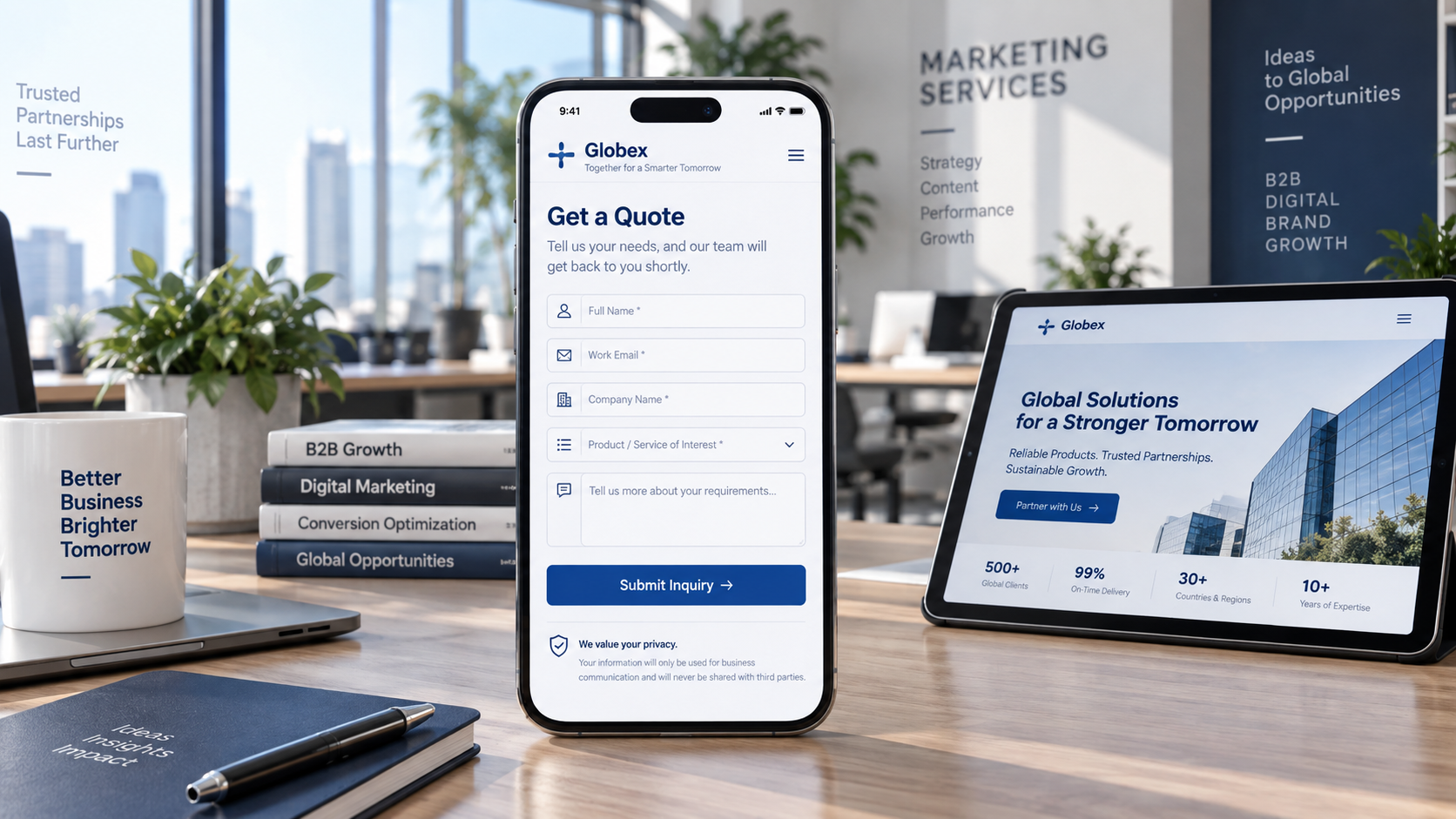
When a conversion landing page has a low conversion rate, do not rush to redesign the page. First determine whether the above-the-fold section clearly communicates the value and whether the form creates friction, so that data can identify where users are actually dropping off.
For most advertising landing pages and foreign trade inquiry pages, the answer is not a fixed choice of “optimize the above-the-fold section first” or “optimize the form first.” First examine at which step visitors leave in large numbers, then prioritize issues according to their scope of impact.
If users do not understand the product value, target customers, or the benefit of taking the next step, even a very short form will struggle to generate inquiries. Conversely, if above-the-fold clicks and dwell time perform normally but the submission rate is low, the form is often the priority.
The most common mistake operators make is modifying multiple modules immediately after looking only at the overall conversion rate. Even if the data improves, it becomes impossible to determine which change was effective, making subsequent page optimization difficult to replicate.
A conversion landing page that can be optimized continuously requires visits, understanding, clicks, form completion, and submissions to be observed separately. Confirming the funnel drop-off point first and then testing a single hypothesis is usually more effective than redesigning based on experience.
Use Funnel Data First to Determine Whether the Issue Is in the Above-the-Fold Section or the Form

It is recommended to first establish the most basic page events: entry from an ad click, above-the-fold primary button clicks, form-start events, field errors, and successful form submissions. Without this data, it is difficult to make an accurate judgment by looking only at the total number of inquiries.
If the page bounce rate is high, above-the-fold dwell time is short, and the primary call-to-action button click-through rate is low, inspect the above-the-fold section first. Users may fail to find information matching their search terms within seconds and leave the page directly.
If the primary button click-through rate is not poor but the form-start rate is low, users are willing to learn more but are being blocked by the form placement, completion effort, or concerns about information security. At this point, the focus should not be on visual redesign.
If a high proportion of users start filling out the form but the final submission rate is low, focus on the number of fields, required-field rules, verification codes, mobile input experience, and error messages. This is often where the most direct conversion losses are hidden.
What Signals Indicate That the Above-the-Fold Section Should Be Optimized First
The purpose of the above-the-fold section is not to fully introduce the company, but to answer three questions within seconds after an ad click: What do you offer? Is it right for me? Why should I take action next? The order of information is more important than page decoration.
When the advertising keyword is “industrial valve supplier,” but the above-the-fold section uses a generic slogan such as “building a globally leading brand,” visitors cannot confirm the page’s relevance. The headline should directly address the search demand, product category, and purchasing scenario.
For B2B foreign trade lead generation pages, the above-the-fold section should clearly state the product or solution, target customers, verifiable advantages, and a call to action. For example, customization capabilities, lead times, certifications, market coverage, or sample support are more persuasive than vague promotional claims.
Above-the-fold optimization should also examine whether the call-to-action button is sufficiently clear. The button text does not have to be limited to “Submit Now”; depending on user intent, use options such as “Get a Quote,” “Request a Catalog,” or “Consult Us on a Customized Solution” to set expectations for the next step.
On mobile devices in particular, it is necessary to control the information density of the above-the-fold section. The headline, core proof points, and call-to-action button must be visible without excessive scrolling; oversized banners, autoplay videos, and obstructive pop-ups can all dilute the conversion path.
What Signals Indicate That the Form Is the Conversion Bottleneck
When above-the-fold buttons and form exposure are normal but submissions are insufficient, first remove fields that do not affect lead qualification. An initial inquiry usually requires only a name, email address or phone number, and a description of requirements; more complex qualifications can be collected later by the sales team.
Many companies make company name, purchase quantity, budget, country, job title, and product model all required fields in order to screen leads, but this can cause high-intent visitors who have not yet prepared complete information to leave prematurely.
The form should let visitors know what will happen after submission. For example, stating “Reply within 1 business day,” “Receive the relevant product catalog,” or “A local market consultant will contact you” can reduce uncertainty after submitting information.
The technical status of the form should also be checked: whether the submit button is obscured on mobile devices, whether international dialing codes can be selected, whether email validation is overly strict, whether content is retained after a failure, and whether the thank-you page correctly triggers the conversion event.
For traffic from Google Ads or Facebook Ads, form data can be reviewed separately by channel. Users from different sources have different levels of intent, so a low submission rate from one channel does not mean that the form design of the entire conversion landing page has failed.
Execute Tests by Priority and Avoid Changing Too Much at Once
It is recommended to follow the sequence of “high impact, low cost, and verifiable.” First test the match between the above-the-fold headline and ad copy, the primary button text, and the number of form fields, then consider high-cost solutions such as videos, layouts, colors, or a full-page rebuild.
Keep only one core variable in each test round. For example, change only “Contact Us” to “Get a Quote,” or reduce only the number of required fields from eight to four. This makes it possible to attribute results to a specific change rather than random fluctuation.
When the sample size is insufficient, do not draw conclusions simply because a few more inquiries appear over several days. Observe results together with traffic source, device type, country or region, and conversion quality, and especially avoid allowing low-quality submissions to conceal a real decline in lead generation efficiency.
When evaluating results, do not focus solely on the number of form submissions. For foreign trade companies, inquiry validity, sales follow-up rate, quotation rate, and sales opportunities are more important. Low-threshold forms should be paired with lead scoring rather than relaxed without limits.
A Practical Checklist for Overseas Marketing Pages
First check whether the ad copy, search terms, and above-the-fold headline are consistent; then confirm whether product images, certifications, customer cases, or delivery capabilities are sufficient to establish basic trust. Without credible evidence in the above-the-fold section, even a strong call-to-action button will struggle to drive decisions.
Next, check whether the form provides reasonable alternative contact options, such as WhatsApp, phone, email, or consultation booking. For overseas buyers who are still in the comparison stage, multiple contact paths can lower the psychological barrier to initial communication.
Finally, confirm that data feedback is complete. Only by connecting advertising platform conversions, website analytics events, and CRM lead statuses can you determine which pages, countries, and keywords truly generate business opportunities, and continuously adjust budgets and content.
If above-the-fold clicks are low, first optimize value communication and intent alignment; if clicks are normal but submissions are low, first reduce form friction. Using funnel data to determine priorities will make every conversion landing page optimization more likely to generate effective leads.