









- Hengqin Cooperation Zone Shares Cross-Border E-Commerce Developments, Focusing on Macao-Hengqin Collaboration and International MarketsOct 24, 2026View details
- A Shenyang study highlights the development of the “cross-border e-commerce + industrial cluster” modelOct 24, 2026View details
- Three China Advertising Association GEO group standards take effect on October 23Oct 24, 2026View details
- Amazon Raises Fulfillment Fees Twice, Yet the Median Platform Fee Remains Around 40%Oct 22, 2026View details
- AliExpress and YouTube Partner to Expand Marketing Opportunities for Chinese Brands Going GlobalOct 22, 2026View details
- Publicis says AI marketing is developing at two speeds, with agentic AI helping win clientsOct 21, 2026View details
How is the performance of an ad click-through rate optimization service evaluated?
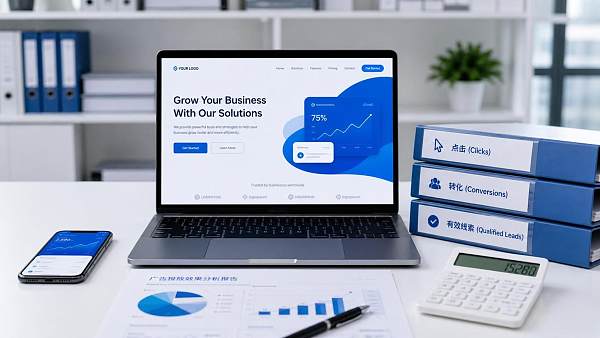
When procuring ad click-through rate optimization services, the evaluation focus should be on whether clicks lead to verifiable business actions, rather than comparing click-through rates alone. Click-through rate reflects how attractive ad creatives, keywords, or audience targeting are to the people who see the ads, but it cannot directly prove that the budget is being used effectively. If increases in clicks are not accompanied by improvements in form submissions, phone inquiries, quote requests, or orders, a high click-through rate may simply mean that traffic is easier to trigger, rather than that demand is more accurately targeted.
A more prudent evaluation method is to assess click-through rate across a complete journey: whether impressions match the target market, whether clicks lead to the correct landing page, whether visitors complete key actions, whether the information they leave can be verified, and whether valid business opportunities are ultimately generated. If the service provider reports only impressions, clicks, and click-through rate, the data dimensions are still insufficient to support decisions on renewal, budget adjustments, or expansion of advertising spend.
First clarify which part of the click-through rate process the service optimizes
Click-through rate is calculated by dividing the number of clicks by the number of impressions. This metric is suitable for assessing an ad's relevance in its current display environment, but increases in click-through rate resulting from different optimization actions do not carry the same business significance.
For example, after tightening keyword matching and adding negative keywords, impressions may decrease while click-through rate increases, indicating that irrelevant searches have been reduced. If the share of qualified inquiries also increases, this represents an improvement in quality. Conversely, broader and more curiosity-driven copy may also increase click-through rate, but if visitors spend little time on the page, bounce quickly, and submit inquiries unrelated to the core business, it should be suspected that traffic intent has been amplified rather than filtered.
Changes in ad position also affect the assessment. When rankings are higher, click-through rate often increases, but cost per click may rise at the same time. If additional clicks do not generate more qualified leads, the higher ranking merely purchases visits of similar quality at a higher budget. Therefore, the scope of service should clearly specify whether it optimizes search terms, creatives, audiences, geographic regions, devices, time periods, or also handles landing pages and conversion tracking; acceptance criteria for different scopes must not be mixed.
Four types of results that should be jointly accepted
Among these, “cost per qualified lead” is more suitable for procurement evaluation than “cost per form submission.” A visitor who completes a form but provides invalid contact details can technically be counted as a conversion, but should not be considered equivalent to an inquiry with a clear product requirement, purchasing timeline, and complete contact information. Before the service begins, rules for identifying qualified leads should be agreed upon, such as whether they are from the target country or region, fall within the target product scope, have verifiable contact information, and exclude supplier solicitations and irrelevant inquiries. If the rules are unclear, any subsequent cost comparison can easily be distorted.
Do not directly compare click-through rates under different traffic conditions
Click-through rates for brand terms, product terms, competitor terms, and broad industry terms usually differ significantly. People searching for a brand name often already have strong awareness, so a high click-through rate does not indicate strong optimization capabilities; broader industry terms serve to uncover new demand and may have lower click-through rates, but they still have value if they consistently generate qualified inquiries. Acceptance reports should present results at least by campaign, keyword intent, or audience group, rather than aggregating all traffic into a single average.
Geography, language, device type, and delivery time periods also change the benchmark. When targeting multiple overseas markets, inconsistencies between the ad language and landing page language often result in acceptable click-through rates but low conversion rates; mobile clicks are convenient, but parameter confirmation, file downloads, or completion of long forms for complex products may not be smooth. Applying the same conversion expectations to mobile and desktop traffic can easily lead to page adaptation issues being mistaken for ad quality issues.
For businesses with longer inquiry cycles, service results cannot be judged solely by orders generated during the week of delivery. A more practical approach is to set both immediate and delayed indicators: the former focuses on changes in search term refinement, click-through rate, and form completion rate, while the latter tracks initial lead responses, requirement confirmation, quote progression, and subsequent follow-up. Both types of data should retain the same source identifiers; otherwise, once ad leads enter the sales process, they cannot be traced back, disconnecting click optimization from actual business opportunities.
Evidence of work that should be required in contracts or quotations
Ad click-through rate optimization services should not use “improving click-through rate” as the sole delivery description. More valuable process evidence includes initial account diagnostics, records of keyword or audience adjustments, negative keyword handling logic, creative testing content, landing page issue lists, conversion event definitions, and explanations of abnormal traffic. This makes it possible both to verify whether optimization actually occurred and to identify whether result changes came from seasonal demand, budget increases or decreases, promotional activities, or actual operational actions.
- Tests should retain a sufficient observation period. Drawing conclusions from a small number of clicks immediately after replacing a creative can easily mistake random fluctuations for results.
- Each major adjustment should preferably be implemented in batches. If keywords, regions, bids, and pages are all substantially changed at the same time, it will be difficult to determine which change produced the result.
- Conversion tracking code must be verified first. Repeated triggers, test submissions being counted, and phone clicks being mixed with actual calls can all artificially inflate conversion rates.
- Search term reports should not display only well-performing terms; they should also show excluded irrelevant terms and their spend, so it is possible to see whether wasted budget has been reduced.
Use cost changes to determine whether continued investment is worthwhile
During evaluation, results before and after optimization can be compared under similar budgets, markets, and business cycles. First assess changes in clicks generated per thousand impressions, then examine how many qualified leads are generated per hundred clicks, and finally compare the cost per qualified lead. If click-through rate declines slightly but invalid clicks decrease and the cost per qualified lead falls, this result is often better than a higher click-through rate accompanied by poorer lead quality.
It is also necessary to monitor marginal performance after budget expansion. At lower budget levels, ads may focus on the most relevant searches and audiences; after the budget increases, the system may reach people with weaker intent, and click-through rate, conversion rate, and lead quality may all decline. In this case, the service should not simply be considered ineffective. Instead, it should be confirmed whether scaling was an established objective, and core traffic and exploratory traffic should be accounted for separately. Only comparisons made within the same business objectives and traffic scope make the results of ad click-through rate optimization services meaningful for procurement and review.
Related Articles
 How Can You Exclude Existing Customers from Facebook Ad Retargeting?
 How can you evaluate a landing page agency's conversion tracking capabilities?
 How much does it cost to run Google paid ads in Japan?



Related Products
 Yiyingbao SaaS Intelligent Website Building and Marketing SystemYiyingbao SaaS Intelligent Website Building and Marketing System, AI-powered no-code website building, rapid creation of multilingual B2B international websites in 10 minutes, global server acceleration, AI-powered SEO optimization, helping businesses connect efficiently with global markets. The perfect integration of technology and operation makes building an international trade website remarkably simple
 AI+SEM Intelligent Advertising Marketing SystemAI+SEM drives intelligent ad creation, empowering full-funnel precision advertising marketing. The system automatically generates weekly/monthly reports, AI recommends keywords and target countries, monitors core metrics in real-time with intelligent alerts, and enables one-click high-conversion ad solutions to help quickly acquire customers and improve ROI.
 AI+SEO Dual-Engine System Optimization ServicesYiyingbao’s AI+SEO dual-engine optimization system helps foreign trade enterprises acquire high-quality organic traffic through AI-powered keyword research, content generation, and comprehensive technical optimization, significantly improving search rankings and conversion rates.
 AI+SNS Social Media Marketing SystemYingbao AI+SNS Social Media Marketing System - Precision social capture for the social media era. Supports one-click content synchronization across major platforms like Facebook and LinkedIn. AI intelligently rewrites posts for enhanced relevance. 24/7 AI customer service and user profiling analysis empower businesses to efficiently expand into global markets.
 AI+SEO营销解决方案易营宝AI+SEO营销解决方案,通过AI批量写作、智能生成TDK、精准关键词扩词等功能,全面优化网站SEO效果,提升流量与转化率。助力企业构建高效智能网站新生态。
 AI+SEM Advertising Marketing SolutionsAI+SEM Advertising Marketing Solution leverages AI technology to deeply empower SEM ad campaigns. It automatically generates weekly/monthly reports using AI, presenting account data across multiple dimensions for comprehensive insights into campaign performance and trends. The system precisely recommends keywords and target countries, intelligently generates high-conversion ad copy, and enables one-click activation of efficient campaign plans to help businesses rapidly acquire customers. Simultaneously, it monitors core metrics in real time, intelligently identifies abnormal fluctuations, and issues timely alerts to ensure stable, high-return advertising results.
 Domain Name ServicesEasyWin provides professional domain name services, including intelligent queries, one-stop registration, brand protection, and full lifecycle management, helping businesses build a digital brand image.
 EasyOperate B2C Cross-Border E-Commerce Platform & Independent WebsiteEasyStore B2C Cross-border E-commerce Independent Store is an intelligent website building and cross-border e-commerce integrated solution independently developed by EasyStore Information Technology (Beijing) Co., Ltd. The system is specially designed for small and medium-sized as well as large export enterprises, integrating 'website building, operation, marketing, advertising, and conversion' into one, helping enterprises quickly establish cross-border e-commerce independent stores to achieve brand globalization and global sales growth.
The platform supports multiple languages, multiple currencies, and multi-channel marketing, with built-in AI intelligent translation and SEO optimization systems, suitable for mainstream markets such as Southeast Asia, Europe and America, Latin America, and the Middle East, assisting Chinese manufacturing enterprises in efficiently deploying international e-commerce strategies. SSL证书易营宝提供专业SSL安全证书服务,包括单域名和泛域名证书,确保网站数据传输加密、身份验证和完整性保护,助力企业建立安全可信的在线业务环境。









