









- Amazon Raises Fulfillment Fees Twice, Yet the Median Platform Fee Remains Around 40%Oct 22, 2026View details
- AliExpress and YouTube Partner to Expand Marketing Opportunities for Chinese Brands Going GlobalOct 22, 2026View details
- Publicis says AI marketing is developing at two speeds, with agentic AI helping win clientsOct 21, 2026View details
- Salesforce Plans to Acquire Braze for $5.66 Billion to Enhance AI Marketing CapabilitiesOct 21, 2026View details
- Levanta’s Inaugural China Summit Held in Shenzhen, Focusing on AI and Cross-Border Brand GrowthOct 20, 2026View details
- The October Edition of the 2026 GGE Shenzhen Cross-Border E-Commerce Expo OpensOct 20, 2026View details
Why are conversion rates so different between French and English ads, and how can you identify the cause?
If conversion rates for French ads are noticeably lower than for English ads, don’t rush to rewrite the copy or cut the budget. First, confirm that the two sets of data are measuring the same thing: the same conversion goal, measurement method, observation period, and similar traffic conditions. Only when these conditions are broadly consistent can the gap help identify issues with language, market, or website experience.
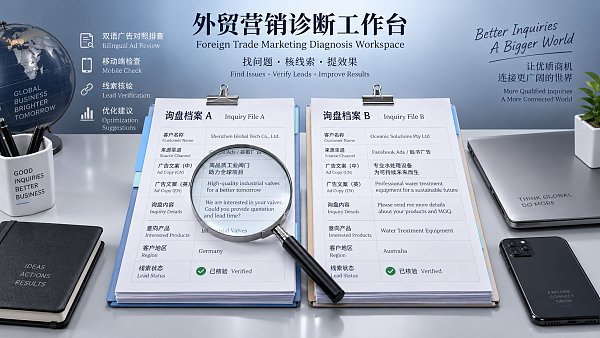
For export businesses, the analysis should also extend to qualified inquiries. A high number of form submissions may include job applications, retail inquiries, or spam leads; a lower number may still include customers with clearer purchasing intent. To identify the cause, examine each stage of the funnel—“ad click—page visit—inquiry initiated—successful submission—qualified inquiry”—and find where the gap first appears.
Rule out measurement discrepancies first and confirm the gap is worth investigating
Compare the conversion definitions for French and English ads side by side. If the English campaign counts successful form submissions while the French campaign counts button clicks, or one includes inquiries via chat tools while the other counts only inquiry forms, their conversion rates cannot be directly compared. Also check conversion counting methods, attribution windows, and whether the same event has been imported more than once.
Go through the actual inquiry journey in both languages, including on mobile: follow the ad link to the page, fill in the form, then check whether the lead appears in the backend and whether the analytics tool records the event. In particular, check whether tracking code is missing from the French page, source parameters are lost when switching languages, or the event fails to fire on the submission confirmation page.
If the two groups have different regional settings or consent-banner configurations, tracking visibility may also differ. In that case, compare the website backend, ad platform, and customer relationship management system to determine whether the discrepancy occurs in actual submissions or in the recording process. Do not automatically treat inquiries present in the backend but unrecorded by the ad platform as failed page conversions.
Also consider sample size and conversion lag. A small number of clicks and one or two occasional submissions can cause percentages to fluctuate sharply; B2B customers may also visit and inquire several days later. Where possible, compare the same time periods and allow an observation window that reflects the business decision cycle. If the gap is mainly due to a single day, first check that day’s traffic and website status.
Break down traffic conditions instead of attributing market differences to language
If English ads cover multiple countries while French ads focus on one region, their overall conversion rates also reflect differences in markets, devices, channels, and purchasing needs. French speakers are not necessarily customers in France, and ad language cannot stand in for country or actual search intent.
First, segment by country, device, ad channel, and branded versus non-branded keywords. Then compare similar combinations with sufficient traffic. If English traffic mainly comes from branded searches while French traffic mainly comes from generic product terms, it is no surprise that the former converts more readily. Search ads and social media ads should also be analyzed separately to avoid grouping users actively searching to buy with those browsing for information.
For search ads, review actual search terms to determine whether users are looking for suppliers, specifications, pricing, tutorials, repairs, or employment information. Even when translated keywords are literally correct, they may not match how local buyers express their needs. For social media ads, check the creative’s claims and audience settings: content emphasizing low prices may attract people whose needs do not match your minimum order quantities or customization terms.
If the gap is concentrated in a particular country or on mobile, you can narrow the scope of your investigation. If French performance is lower across all comparable combinations, focus more attention on the French copy and page experience.
Follow the page funnel to find where users drop off
If ad clicks are not turning into valid page visits, first check page load speed, redirects, and landing page URLs. Are French ads leading to English pages? Is automatic language detection causing repeated redirects? Are pop-ups blocking the page on mobile? These issues occur before users read the content, so rewriting the value proposition is unlikely to solve them.
If page visits are normal but few users initiate an inquiry, check whether the ad promise matches the above-the-fold content. An ad may emphasize custom manufacturing while the page contains only a company profile; it may highlight a particular material while the landing page provides no specifications, processing capabilities, or inquiry option. The information users need is not being addressed.
When reviewing French pages, look beyond grammar. Do product terms match local buyers’ language? Are dimensions and units clear? Are minimum order quantities, delivery scope, certification applicability, and after-sales support boundaries easy to find? All of these can affect users’ willingness to inquire. Even an accurately translated page may not answer the questions buyers need answered before deciding whether to contact a supplier.
If users start filling out the form but few submit it, check the form first: Are there too many required fields? Does phone number validation accept local numbers? Do accented characters trigger errors? Are error messages in French? Do the CAPTCHA and submit button work properly on mobile? Requiring extensive company information before buyers have confirmed the value of working with you also increases the likelihood that they will abandon the form.
If submission volume is normal but the number of qualified inquiries is low, focus on traffic intent, how clearly the page explains cooperation terms, and follow-up. Also check the language used by the sales team, response times, and lead assignment. Successful submissions recorded by an ad platform cannot replace the sales team’s assessment of purchasing needs.
Turn the diagnosis into an adjustment that can produce interpretable results
Before each adjustment, document the problem, the evidence, and the expected change. For example, if the French mobile form start rate is close to the English rate but the completion rate is lower, and you find that phone number validation is failing, fix the validation first, then monitor the completion rate and qualified inquiries. There is no need to change the audience, bids, and entire page at the same time.
For copy and page content, run comparative tests in the same market under similar traffic conditions. Make one change at a time to address a clearly defined issue, keep the original version as a reference, and decide on the metrics in advance. A higher click-through rate only shows that the ad is more appealing; to determine whether customer acquisition has improved, also look at the cost per qualified inquiry and lead quality.
Those responsible for advertising, website development, and sales should share a single investigation log that records where the gap occurs, the source of the evidence, who is responsible for the change, and when it will be reviewed. If the French conversion rate is lower but the cost per qualified inquiry remains acceptable, you can continue testing. If performance remains weak over time after tracking and page issues have been fixed, reassess local demand, product competitiveness, and campaign scope. Do not expect the two ad groups to achieve identical results based solely on their language labels.
Related Articles
 How can you evaluate a landing page agency's conversion tracking capabilities?
 How much does it cost to run Google paid ads in Japan?
 ChatGPT Ads expands to 26 countries and regions, with over 100,000 advertisers



Related Products
 Yiyingbao SaaS Intelligent Website Building and Marketing SystemYiyingbao SaaS Intelligent Website Building and Marketing System, AI-powered no-code website building, rapid creation of multilingual B2B international websites in 10 minutes, global server acceleration, AI-powered SEO optimization, helping businesses connect efficiently with global markets. The perfect integration of technology and operation makes building an international trade website remarkably simple
 AI+SEM Intelligent Advertising Marketing SystemAI+SEM drives intelligent ad creation, empowering full-funnel precision advertising marketing. The system automatically generates weekly/monthly reports, AI recommends keywords and target countries, monitors core metrics in real-time with intelligent alerts, and enables one-click high-conversion ad solutions to help quickly acquire customers and improve ROI.
 AI+SEO Dual-Engine System Optimization ServicesYiyingbao’s AI+SEO dual-engine optimization system helps foreign trade enterprises acquire high-quality organic traffic through AI-powered keyword research, content generation, and comprehensive technical optimization, significantly improving search rankings and conversion rates.
 AI+SNS Social Media Marketing SystemYingbao AI+SNS Social Media Marketing System - Precision social capture for the social media era. Supports one-click content synchronization across major platforms like Facebook and LinkedIn. AI intelligently rewrites posts for enhanced relevance. 24/7 AI customer service and user profiling analysis empower businesses to efficiently expand into global markets.
 AI+SEO营销解决方案易营宝AI+SEO营销解决方案,通过AI批量写作、智能生成TDK、精准关键词扩词等功能,全面优化网站SEO效果,提升流量与转化率。助力企业构建高效智能网站新生态。
 AI+SEM Advertising Marketing SolutionsAI+SEM Advertising Marketing Solution leverages AI technology to deeply empower SEM ad campaigns. It automatically generates weekly/monthly reports using AI, presenting account data across multiple dimensions for comprehensive insights into campaign performance and trends. The system precisely recommends keywords and target countries, intelligently generates high-conversion ad copy, and enables one-click activation of efficient campaign plans to help businesses rapidly acquire customers. Simultaneously, it monitors core metrics in real time, intelligently identifies abnormal fluctuations, and issues timely alerts to ensure stable, high-return advertising results.
 Domain Name ServicesEasyWin provides professional domain name services, including intelligent queries, one-stop registration, brand protection, and full lifecycle management, helping businesses build a digital brand image.
 EasyOperate B2C Cross-Border E-Commerce Platform & Independent WebsiteEasyStore B2C Cross-border E-commerce Independent Store is an intelligent website building and cross-border e-commerce integrated solution independently developed by EasyStore Information Technology (Beijing) Co., Ltd. The system is specially designed for small and medium-sized as well as large export enterprises, integrating 'website building, operation, marketing, advertising, and conversion' into one, helping enterprises quickly establish cross-border e-commerce independent stores to achieve brand globalization and global sales growth.
The platform supports multiple languages, multiple currencies, and multi-channel marketing, with built-in AI intelligent translation and SEO optimization systems, suitable for mainstream markets such as Southeast Asia, Europe and America, Latin America, and the Middle East, assisting Chinese manufacturing enterprises in efficiently deploying international e-commerce strategies. SSL证书易营宝提供专业SSL安全证书服务,包括单域名和泛域名证书,确保网站数据传输加密、身份验证和完整性保护,助力企业建立安全可信的在线业务环境。









