









- Amazon Raises Fulfillment Fees Twice, Yet the Median Platform Fee Remains Around 40%Oct 22, 2026View details
- AliExpress and YouTube Partner to Expand Marketing Opportunities for Chinese Brands Going GlobalOct 22, 2026View details
- Publicis says AI marketing is developing at two speeds, with agentic AI helping win clientsOct 21, 2026View details
- Salesforce Plans to Acquire Braze for $5.66 Billion to Enhance AI Marketing CapabilitiesOct 21, 2026View details
- Levanta’s Inaugural China Summit Held in Shenzhen, Focusing on AI and Cross-Border Brand GrowthOct 20, 2026View details
- The October Edition of the 2026 GGE Shenzhen Cross-Border E-Commerce Expo OpensOct 20, 2026View details
Is a 3.2% CTR considered good for advertising in Germany?
A 3.2% CTR for ads in Germany cannot automatically be considered a good result. It only means that every 100 ad impressions generated approximately 3.2 clicks; it does not indicate whether those clicks came from potential customers, resulted in qualified inquiries, or made the ads profitable. To assess this figure, you need to consider the advertising channel, how clicks are counted, traffic intent, and conversion costs at the same time.
If the 3.2% comes from branded search terms, it should be evaluated differently from non-branded product terms. If it comes from Facebook or Instagram, you also need to distinguish between “all clicks” and “link clicks.” Ads worth keeping or increasing the budget for are those that attract relevant traffic and generate qualified inquiries or orders at an acceptable cost.
First, confirm exactly what the 3.2% measures
CTR is calculated by dividing the number of clicks by the number of impressions. The same percentage can mean different things in different advertising contexts.
- Google Search ads: Users actively search, but the strength of demand differs between branded terms, product terms, and informational queries. Clicks on a company name do not, by themselves, demonstrate the ability to generate leads for its products.
- Display ads: Ads appear on pages or in apps that users browse. Check placements, devices, and post-click behavior to avoid treating accidental clicks or low-relevance traffic as interest.
- Social media ads: All clicks may include actions such as expanding an image or interacting with the ad. If the goal is to generate website leads, focus on link clicks, outbound clicks, and landing page views, and do not mix these metrics.
Germany does not have a single, universal CTR benchmark either. The buying journeys for industrial equipment, consumer goods, and professional services differ, and German- and English-language ads may not reach the same audiences. A “German average click-through rate” without details about the channel, industry, ad type, and measurement method is not a suitable basis for budget decisions.
A more useful benchmark is the historical performance of similar ads within the account: under comparable keywords, locations, devices, and ad schedules, has CTR improved while the cost per qualified inquiry has fallen? Comparisons should also separate branded and non-branded terms to prevent branded traffic from inflating overall results.
Connect CTR to the cost per qualified inquiry
CTR shows whether an ad can attract clicks, the conversion rate shows whether the website can meet users’ needs, and lead quality determines whether those conversions have business value. All three must be considered together.
Suppose a set of ads receives 10,000 impressions and 320 clicks, for a CTR of 3.2%. At an average cost per click of 1.5 euros, total spend is 480 euros. If the ads generate 8 inquiries, the apparent cost per inquiry is 60 euros. If only 4 of them match the product, location, and purchasing requirements, the cost per qualified inquiry is 120 euros. These figures are for illustrating the calculation only and are not a benchmark for the German market.
Another set of ads may be a better investment even with a CTR of just 2%, as long as its cost per qualified inquiry is lower and its sales quality is better. Conversely, ads that attract many clicks but no qualified prospects cannot be considered successful simply because their CTR looks good.
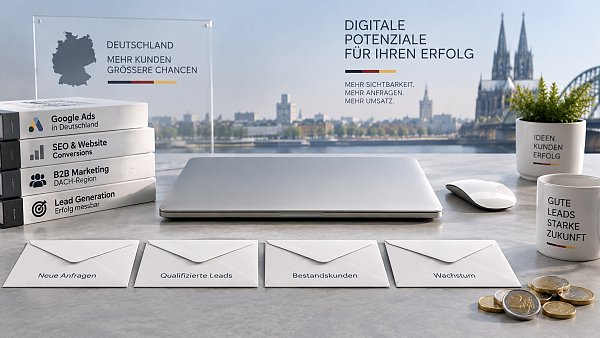
You can use three direct metrics in your calculations:
- Click-to-inquiry conversion rate: Number of inquiries ÷ number of clicks.
- Qualified inquiry rate: Number of qualified inquiries ÷ total number of inquiries.
- Cost per qualified inquiry: Ad spend ÷ number of qualified inquiries.
Use a consistent definition of “qualified,” such as whether the product requirement is a match, the contact details are valid, and there is clear purchasing intent. Spam submissions, job inquiries, and duplicate inquiries should be handled separately; otherwise, the ad platform and sales team may reach different conclusions about performance.
Assess whether costs are acceptable based on what the business can afford
An acceptable cost per qualified inquiry depends on the probability of closing a sale and the contribution from an order, not on a universal rate for the German market. You can estimate the maximum cost per inquiry by multiplying the “close rate per qualified inquiry by the contribution from each order available for customer acquisition.”
For example, suppose the close rate for qualified inquiries is 20% and the contribution from each order available for customer acquisition is 1,000 euros. The budget limit per qualified inquiry would be approximately 200 euros. You should still leave a safety margin below this limit. If you also pay for agency management, sales follow-up, or other services, include those costs in your calculations; do not treat the cost shown in the ad platform as the total customer acquisition cost.
When the sales cycle is long, do not use orders placed in the current month to evaluate clicks from that same month. Track leads from the time they come in through subsequent quotes, sales, and contribution, using a consistent attribution period. It is reasonable to defer a decision only when conversions have not yet matured—not when it has been confirmed that no conversions occurred.
What should you change if CTR reaches 3.2% but there are no inquiries?
First, check whether the traffic is relevant. For search ads, review actual search terms, not just the keywords you have set. Searches for tutorials, jobs, free resources, or product models you do not supply can all generate clicks. Also check your location settings to confirm they target users in Germany, rather than including traffic from people interested in Germany who are outside your business scope.
Next, check that the ad promise matches the landing page. If the ad highlights a specific piece of equipment, specification, or delivery time but the click leads to a generic homepage, users have to search for the information again, which can hinder conversions. The page linked to a German-language ad should clearly explain the product’s applications, key specifications, supply conditions, and contact options—not just translate the menu.
Check the form and user experience. Slow mobile loading, form errors, and too many required fields can all drive away interested users. Test the complete submission process on the main devices and check whether there is a significant gap between ad clicks and actual page visits.
Rule out tracking issues. A button click is not the same as a successfully submitted inquiry, and a page refresh should not be counted as a new lead. Cross-check website analytics, the ad platform, and business records. When consent and privacy settings affect tracking, understand the extent of measurement coverage to avoid interpreting missing data as a lack of demand.
When can you use this to justify increasing the budget?
A 3.2% CTR can be a signal to keep monitoring performance, but it is not, on its own, a reason to increase the budget. Make sure the data comes from a sufficiently stable sample: one or two inquiries from a small number of clicks do not prove that costs will remain consistent over time, and a high CTR on a single day may simply reflect a change in traffic composition.
If the cost per qualified inquiry is within an acceptable range, lead quality is consistent, and quality can be maintained as you increase spend, you can gradually expand the budget. If CTR rises while inquiry quality falls, prioritize tightening traffic targeting instead of continuing to pursue clicks. If the landing page needs improvement, keep the ad conditions relatively stable so you can identify the cause of any change; avoid changing keywords, creative, and forms all at once.
Ultimately, the performance of ads in Germany should be assessed in terms of how much you spent and how many viable business opportunities you gained. A 3.2% CTR shows that the ads generated some click response; the figure has business value only if those clicks turn into qualified prospects at a reasonable cost.
Related Articles
 How can you evaluate a landing page agency's conversion tracking capabilities?
 How much does it cost to run Google paid ads in Japan?
 ChatGPT Ads expands to 26 countries and regions, with over 100,000 advertisers


Related Products
 Yiyingbao SaaS Intelligent Website Building and Marketing SystemYiyingbao SaaS Intelligent Website Building and Marketing System, AI-powered no-code website building, rapid creation of multilingual B2B international websites in 10 minutes, global server acceleration, AI-powered SEO optimization, helping businesses connect efficiently with global markets. The perfect integration of technology and operation makes building an international trade website remarkably simple
 AI+SEM Intelligent Advertising Marketing SystemAI+SEM drives intelligent ad creation, empowering full-funnel precision advertising marketing. The system automatically generates weekly/monthly reports, AI recommends keywords and target countries, monitors core metrics in real-time with intelligent alerts, and enables one-click high-conversion ad solutions to help quickly acquire customers and improve ROI.
 AI+SEO Dual-Engine System Optimization ServicesYiyingbao’s AI+SEO dual-engine optimization system helps foreign trade enterprises acquire high-quality organic traffic through AI-powered keyword research, content generation, and comprehensive technical optimization, significantly improving search rankings and conversion rates.
 AI+SNS Social Media Marketing SystemYingbao AI+SNS Social Media Marketing System - Precision social capture for the social media era. Supports one-click content synchronization across major platforms like Facebook and LinkedIn. AI intelligently rewrites posts for enhanced relevance. 24/7 AI customer service and user profiling analysis empower businesses to efficiently expand into global markets.
 AI+SEO营销解决方案易营宝AI+SEO营销解决方案,通过AI批量写作、智能生成TDK、精准关键词扩词等功能,全面优化网站SEO效果,提升流量与转化率。助力企业构建高效智能网站新生态。
 AI+SEM Advertising Marketing SolutionsAI+SEM Advertising Marketing Solution leverages AI technology to deeply empower SEM ad campaigns. It automatically generates weekly/monthly reports using AI, presenting account data across multiple dimensions for comprehensive insights into campaign performance and trends. The system precisely recommends keywords and target countries, intelligently generates high-conversion ad copy, and enables one-click activation of efficient campaign plans to help businesses rapidly acquire customers. Simultaneously, it monitors core metrics in real time, intelligently identifies abnormal fluctuations, and issues timely alerts to ensure stable, high-return advertising results.
 Domain Name ServicesEasyWin provides professional domain name services, including intelligent queries, one-stop registration, brand protection, and full lifecycle management, helping businesses build a digital brand image.
 EasyOperate B2C Cross-Border E-Commerce Platform & Independent WebsiteEasyStore B2C Cross-border E-commerce Independent Store is an intelligent website building and cross-border e-commerce integrated solution independently developed by EasyStore Information Technology (Beijing) Co., Ltd. The system is specially designed for small and medium-sized as well as large export enterprises, integrating 'website building, operation, marketing, advertising, and conversion' into one, helping enterprises quickly establish cross-border e-commerce independent stores to achieve brand globalization and global sales growth.
The platform supports multiple languages, multiple currencies, and multi-channel marketing, with built-in AI intelligent translation and SEO optimization systems, suitable for mainstream markets such as Southeast Asia, Europe and America, Latin America, and the Middle East, assisting Chinese manufacturing enterprises in efficiently deploying international e-commerce strategies. SSL证书易营宝提供专业SSL安全证书服务,包括单域名和泛域名证书,确保网站数据传输加密、身份验证和完整性保护,助力企业建立安全可信的在线业务环境。









