









- Which customer acquisition channels will be affected by cross-border marketing trends in 2026?Sep 06, 2026View details
- Which homogenization risks should be considered in an analysis of the AI-powered website building industry?Aug 30, 2026View details
- How Will AI Marketing Trends 2026 Change Advertising Budget AllocationAug 28, 2026View details
- Is the EV SSL certificate market shrinking or upgrading? How should companies assess certificate procurement?Aug 11, 2026View details
- Why the old AMP SEO 2020 practices no longer work and what has changed in current optimization prioritiesAug 02, 2026View details
- How to Choose Topics for an Industry News Section to Attract More Organic Search TrafficJul 29, 2026View details
What are the common channels for overseas advertising in Germany? Budget allocation analysis for B2B enterprises
Why Overseas Advertising in Germany Is Not Just About Traffic
German overseas advertising may seem to involve many channels, but the real challenge is not opening accounts; it is placing the budget where it can bring in effective business opportunities. For B2B companies, Germany has a long decision-making cycle and a more rational procurement chain, so exposure alone cannot solve lead generation problems.
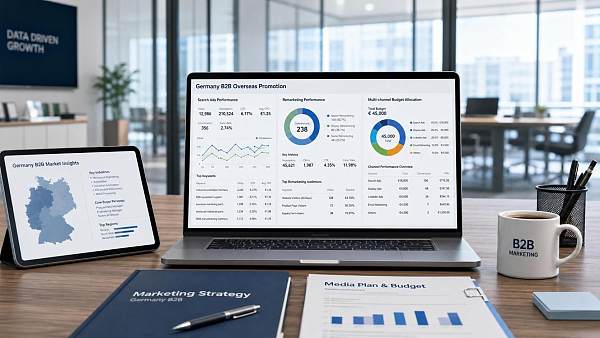
Recent changes show that German overseas advertising is placing more and more emphasis on lead quality, landing page professionalism, and follow-up efficiency. This is especially true for industries such as industrial equipment, components, materials, and software services, where customers usually search first, compare next, request quotes later, and only then enter business communication.
This also means that when companies run overseas advertising in Germany, they should not only ask which platform is cheaper, but also determine which channel is closer to purchasing behavior and which channel is more suitable for brand awareness, demand activation, and inquiry conversion.
If the website, content, advertising, and data return are fragmented, the budget may be spent quickly, but leads will remain unstable. The value of integrating website and marketing services lies in connecting the front end of acquisition with the back end of conversion, thereby reducing invalid clicks and low-quality inquiries.
What Are the Common Channels for Overseas Advertising in Germany
In actual business operations, German overseas advertising is usually not a single-platform strategy, but a combination centered on search, display, social media, and retargeting. Different channels carry different tasks, so budget logic should also be viewed separately.
1. Google Search Ads
This is one of the channels closest to inquiries in German overseas advertising. Users are already searching with clear intent, and their conversion intent is obvious. It is especially suitable for coverage of industry terms, product terms, application terms, and problem terms.
For B2B companies, the key is not simply expanding keywords, but breaking down the purchasing stage. For example, brand keywords carry awareness, product keywords carry comparison, solution keywords carry project needs, and competitor keywords carry replacement opportunities.
2. Google Display Ads and Retargeting
Display ads are more suitable for expanding reach and helping German overseas advertising touch potential buyers. In terms of direct conversion, they are usually not as strong as search ads, but they play an obvious role in brand building and repeated exposure.
Retargeting is even more important. Many German customers do not make an inquiry immediately on their first visit to the website. Retargeting can bring back people who have visited product pages, case pages, and quotation pages, improving the secondary conversion rate.
3. YouTube Video Ads
For technology-driven, equipment-driven, and process-driven companies, video makes it easier than text to explain value. If German overseas advertising involves complex products, YouTube can help customers quickly understand structure, application scenarios, and delivery capabilities.
However, this type of channel is more suitable for working together with search and retargeting, and is not ideal for carrying inquiry KPIs on its own. It is more of a tool for strengthening trust than a direct replacement for search-based lead generation.
4. LinkedIn Ads
If the target customers are clear industry roles such as procurement managers, technical directors, and operations leaders, LinkedIn is a classic B2B channel in German overseas advertising. Its advantage lies in precise targeting, making it suitable for generating high-value leads.
But its click cost is usually higher than search ads, so it is better suited to companies with a clear customer profile, complete page content, and mature sales follow-up. If the landing page is weak, the budget can be consumed quickly.
5. Industry Media and Local Portal Advertising
In some industries such as manufacturing, medical devices, automation, and software services, Germany has vertical media and professional portals. If German overseas advertising can enter these scenarios, it is often easier to build professional recognition.
This type of channel is suitable for brand exposure, content collaboration, or form collection, but the premise is that the target industry is concentrated enough; otherwise, the placement scope will be too narrow to form scale.
How Should B2B Companies Allocate Budgets for German Overseas Advertising
There is no single answer to budget allocation, but one guideline is very clear: first ensure stable volume from high-intent channels, then use part of the budget for brand touchpoints and conversion amplification. This is more in line with the actual B2B purchasing path.
If you are just entering the German market, it is recommended to structure German overseas advertising into three layers:
- Allocate 50% to 60% to Google search ads, prioritizing high-intent keyword traffic.
- Allocate 20% to 25% to retargeting and display ads to nurture undecided audiences.
- Allocate 15% to 25% to LinkedIn, YouTube, or industry media to strengthen industry awareness.
If you already have a stable inquiry foundation, German overseas advertising can be further refined. For example, the budget can be allocated by country, product line, inquiry cost, and conversion cycle rather than simply by platform.
A More Practical Allocation Approach
- First estimate the target inquiry cost and work backward to determine the monthly budget you can bear.
- Then divide budgets among three channel types: high-intent, nurturing, and brand.
- Review keyword performance, page bounce rate, and lead retention rate every two weeks.
- Remove low-quality keywords, low-conversion placements, and underperforming times to avoid budget drain.
The core of this method is not to invest in every platform once, but to make German overseas advertising operate around a real conversion chain. Once the structure is right, budget efficiency is usually more stable than simply increasing spend.
Three Key Factors Affecting the Results of German Overseas Advertising
Many companies feel the platform choice is fine, but the results of German overseas advertising are still average. The problem is often not at the acquisition entry point, but in the middle and later stages of the conversion chain.
Is the Website Landing Page Professional Enough
A B2B website is not just a brochure. German customers pay close attention to product parameters, delivery capabilities, certification qualifications, case studies, and contact methods. If the page information is too shallow, it is difficult to improve the inquiry rate even if German overseas advertising is highly precise.
Is the Localized Content in Place
Some companies use English pages directly as landing pages for the German market, which affects comprehension efficiency and trust. At minimum, the ad copy, core pages, form prompts, and case expressions should be closer to local usage habits.
Is the Data Return Complete
German overseas advertising should not only look at clicks and form counts, but also at valid inquiries, follow-up status, and source of deals. If the advertising system, website forms, and sales management data are not connected, optimization directions can easily go off track.
Execution Suggestions for Long-Term Growth
For companies that want to turn German overseas advertising into a stable customer acquisition system, short-term placement and long-term development must move forward together. If you only run ads without improving the website and content, subsequent costs will often keep rising.
A more stable approach is to integrate intelligent website building, SEO optimization, advertising placement, and retargeting. Advertising is responsible for initial demand capture, the website is responsible for conversion, SEO is responsible for accumulated organic traffic, and the data system is responsible for continuous optimization.
Platforms like 易营宝, an AI-driven integrated website building and overseas marketing platform, derive their value from connecting multilingual websites, advertising placement, SEO/GEO optimization, and data operations into a closed loop, helping companies reduce waste caused by channel fragmentation.
If you are currently evaluating German overseas advertising, you can start with three things: first sort out the target customer search path, then check the landing page conversion capability, and finally rebuild the budget structure according to the principle of prioritizing high-intent channels. This makes it easier to turn investment into a continuously reusable growth asset.
Related Articles


Related Products
 Yiyingbao SaaS Intelligent Website Building and Marketing SystemYiyingbao SaaS Intelligent Website Building and Marketing System, AI-powered no-code website building, rapid creation of multilingual B2B international websites in 10 minutes, global server acceleration, AI-powered SEO optimization, helping businesses connect efficiently with global markets. The perfect integration of technology and operation makes building an international trade website remarkably simple
 AI+SEM Intelligent Advertising Marketing SystemAI+SEM drives intelligent ad creation, empowering full-funnel precision advertising marketing. The system automatically generates weekly/monthly reports, AI recommends keywords and target countries, monitors core metrics in real-time with intelligent alerts, and enables one-click high-conversion ad solutions to help quickly acquire customers and improve ROI.
 AI+SEO Dual-Engine System Optimization ServicesYiyingbao’s AI+SEO dual-engine optimization system helps foreign trade enterprises acquire high-quality organic traffic through AI-powered keyword research, content generation, and comprehensive technical optimization, significantly improving search rankings and conversion rates.
 AI+SNS Social Media Marketing SystemYingbao AI+SNS Social Media Marketing System - Precision social capture for the social media era. Supports one-click content synchronization across major platforms like Facebook and LinkedIn. AI intelligently rewrites posts for enhanced relevance. 24/7 AI customer service and user profiling analysis empower businesses to efficiently expand into global markets.
 AI+SEO营销解决方案易营宝AI+SEO营销解决方案,通过AI批量写作、智能生成TDK、精准关键词扩词等功能,全面优化网站SEO效果,提升流量与转化率。助力企业构建高效智能网站新生态。
 AI+SEM Advertising Marketing SolutionsAI+SEM Advertising Marketing Solution leverages AI technology to deeply empower SEM ad campaigns. It automatically generates weekly/monthly reports using AI, presenting account data across multiple dimensions for comprehensive insights into campaign performance and trends. The system precisely recommends keywords and target countries, intelligently generates high-conversion ad copy, and enables one-click activation of efficient campaign plans to help businesses rapidly acquire customers. Simultaneously, it monitors core metrics in real time, intelligently identifies abnormal fluctuations, and issues timely alerts to ensure stable, high-return advertising results.
 Domain Name ServicesEasyWin provides professional domain name services, including intelligent queries, one-stop registration, brand protection, and full lifecycle management, helping businesses build a digital brand image.
 EasyOperate B2C Cross-Border E-Commerce Platform & Independent WebsiteEasyStore B2C Cross-border E-commerce Independent Store is an intelligent website building and cross-border e-commerce integrated solution independently developed by EasyStore Information Technology (Beijing) Co., Ltd. The system is specially designed for small and medium-sized as well as large export enterprises, integrating 'website building, operation, marketing, advertising, and conversion' into one, helping enterprises quickly establish cross-border e-commerce independent stores to achieve brand globalization and global sales growth.
The platform supports multiple languages, multiple currencies, and multi-channel marketing, with built-in AI intelligent translation and SEO optimization systems, suitable for mainstream markets such as Southeast Asia, Europe and America, Latin America, and the Middle East, assisting Chinese manufacturing enterprises in efficiently deploying international e-commerce strategies. SSL证书易营宝提供专业SSL安全证书服务,包括单域名和泛域名证书,确保网站数据传输加密、身份验证和完整性保护,助力企业建立安全可信的在线业务环境。









