









- Which customer acquisition channels will be affected by cross-border marketing trends in 2026?Sep 06, 2026View details
- Which homogenization risks should be considered in an analysis of the AI-powered website building industry?Aug 30, 2026View details
- How Will AI Marketing Trends 2026 Change Advertising Budget AllocationAug 28, 2026View details
- Is the EV SSL certificate market shrinking or upgrading? How should companies assess certificate procurement?Aug 11, 2026View details
- Why the old AMP SEO 2020 practices no longer work and what has changed in current optimization prioritiesAug 02, 2026View details
- How to Choose Topics for an Industry News Section to Attract More Organic Search TrafficJul 29, 2026View details
Are 20 monthly inquiries from a foreign trade website considered low?
Is 20 monthly inquiries from a foreign trade website considered too few? There is no one-size-fits-all answer. The key is to look at the industry, traffic quality, conversion path, and customer order value. This article will help you determine whether your inquiry performance meets expectations from the perspectives of data, channels, and optimization strategies.
For companies developing overseas markets, the real factors behind 20 inquiries are not just the quantity, but also the proportion of valid inquiries, source channels, response speed, sales cycle, and potential order value of each customer. For B2B manufacturers with high order values and long decision-making cycles, 20 monthly inquiries may not be few. However, for businesses selling standardized products with sufficient advertising budgets and stable website traffic, there may still be considerable room for improvement.
Especially under an integrated “website + marketing services” model, companies cannot attribute inquiry results solely to the website itself. Website structure, SEO indexing, Google advertising, social media traffic generation, landing page design, multilingual content, and lead follow-up mechanisms all jointly determine the final monthly inquiry performance.
To determine whether 20 inquiries are many or few, first look at 4 core metrics
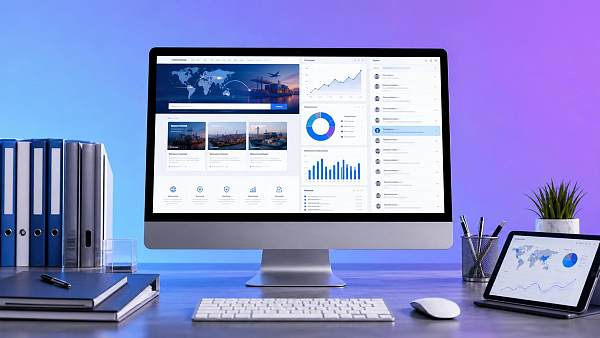
When discussing whether 20 monthly inquiries from a foreign trade website are too few, many companies tend to focus only on the surface number while overlooking the evaluation criteria. A more scientific approach is to break inquiries down into 4 dimensions: traffic volume, inquiry quality, conversion rate, and customer value. If any 2 of these areas are significantly weak, 20 inquiries may not be an ideal result.
1. Look at the traffic base first instead of viewing the inquiry count in isolation
If a foreign trade website receives only 300 to 500 visitors per month but generates 20 inquiries, its overall conversion rate is likely not low. Conversely, if the website already receives more than 5000 visits per month but still generates only 20 inquiries, this indicates low traffic utilization efficiency and potential problems with page engagement or customer matching.
Common reference ranges
The common inquiry conversion rate for B2B foreign trade independent websites is approximately 0.5% to 3%. For websites selling industrial equipment, customized components, or engineering projects, around 1% is relatively common. For products with a high degree of standardization, strong landing pages, and precisely targeted advertising traffic, conversion rates of 2% to 5% are also not unusual.
2. Then examine the proportion of valid inquiries
If only 3 to 5 of the 20 inquiries show genuine purchasing intent and can enter the quotation or sample stage, the valid inquiry rate is only 15% to 25%. In this case, the inquiry count may not appear too low, but its actual business value is limited. Conversely, if more than 10 of the 20 inquiries come from target countries, target industries, and target purchasing roles, the result is highly valuable.
3. Customer order value determines the commercial value of inquiries
If you sell standardized consumer products with individual order values ranging from 300 to 1000 USD, 20 inquiries are usually not many. However, if you provide machinery, engineering materials, or OEM customization services with individual order values of 50,000 to 200,000 USD, even only 10 to 20 high-quality inquiries per month may support strong annual performance.
4. Also examine whether the channel structure is healthy
If all 20 inquiries depend on advertising, leads will decline quickly once the budget is reduced. If 30% come from SEO, 20% from social media, 40% from advertising, and 10% from referrals from existing customers, this structure is generally more stable. For foreign trade companies, a healthy customer acquisition system should avoid allowing any single channel to account for more than 70% whenever possible.
The table below can help companies quickly determine how to analyze whether 20 monthly inquiries from a foreign trade website are too few in different business contexts.
As the table shows, there is no uniform answer to whether 20 monthly inquiries from a foreign trade website are too few. The truly effective approach is to evaluate the number within the context of the business model rather than making horizontal comparisons based on an absolute figure.
Why do many foreign trade websites have traffic but not enough inquiries?
In actual projects, many companies have already implemented SEO and invested in Google advertising, and some even receive more than 2000 visits per month, yet inquiry growth remains slow. Such problems are usually not caused by a single point of failure. Instead, the website and marketing funnel have not been properly connected, resulting in “exposure without conversion.”
Website structure problems: visible but unable to convert
Many foreign trade websites are designed mainly for presentation. The homepage contains a large amount of information, but purchasers cannot see the core products, delivery capabilities, certification documents, application scenarios, and contact information within 30 seconds. B2B buyers usually make an initial judgment within 1 to 3 minutes. If key information cannot be accessed quickly, the bounce rate will rise significantly.
Common shortcomings include
- Product pages lack purchasing information such as specifications, MOQ, lead time, and packaging methods
- Inquiry forms contain too many fields, and the submission process takes more than 2 steps
- Mobile pages take more than 3 seconds to load, affecting advertising traffic conversion
- Pages lack trust elements such as factory photos, certificates, case studies, and FAQs
Untargeted traffic: misalignment between keywords and audiences
If most visitors brought by the website are looking for reference materials, comparing prices, or checking technical definitions, inquiries will not increase significantly even when traffic rises. For example, if a company producing industrial customized parts focuses only on broad terms for a long time without targeting purchase-intent keywords such as “supplier,” “manufacturer,” “OEM,” and “bulk order,” lead quality will often be low.
Delayed follow-up: responding after 24 hours reduces the conversion rate
A foreign trade inquiry does not end when a form is submitted; it marks the beginning of the sales engagement stage. Generally speaking, an initial response within 2 hours is more likely to maintain customer interest. When the response comes after more than 24 hours, the customer may already have contacted 3 to 5 suppliers. Even if the website, advertising, and SEO are performing well, slow sales responses make it difficult to convert 20 monthly inquiries into orders.
How to increase 20 inquiries to a more valuable growth range
If a company already has a certain level of basic traffic and initial inquiries, the next priority should not be to blindly pursue a doubling of quantity. Instead, it should optimize the website and marketing as an integrated system to improve inquiry quality, stability, and closing probability simultaneously. This can usually be implemented in 3 stages, with each stage lasting 4 to 8 weeks for more reliable results.
Stage 1: Improve the website’s lead-conversion capabilities first
For a foreign trade company, a website that can be promoted, indexed, and converted should at least have clear navigation, multilingual pages, focused product collection pages, application scenario pages, case study pages, FAQ pages, and a quick inquiry entry. In particular, product pages should include 6 categories of information: specifications, materials, applications, lead time, customization capabilities, and contact actions.
Page modules recommended for priority optimization
- Core value proposition section on the homepage: clearly explain what you do, whom you serve, and what your advantages are within 3 seconds
- Product detail pages: complete the specifications, downloadable materials, application images, and forms
- Country- or language-specific landing pages: in addition to English, expand into Spanish, Russian, Arabic, and other languages
- Conversion components: WhatsApp, email buttons, floating inquiry forms, and sample request entries
Stage 2: Rebuild the customer acquisition channel mix
If nearly all 20 inquiries come from a single advertising channel, the risk is high. A more reasonable approach is to build a combination of “long-term SEO growth + rapid customer acquisition through advertising + assisted reach through social media.” SEO is generally recommended to provide 30% to 50% of ongoing exposure, Google advertising to generate 20% to 40% of immediate leads, and social media and content outreach to supplement brand awareness.
The table below can be used to evaluate the role of different channels in acquiring customers through a foreign trade website and help determine where inquiry growth should begin.
For most foreign trade companies, truly stable inquiry growth usually does not come from a sudden surge in a single channel, but from the combined effects of multiple channels. This ensures that even if advertising fluctuates in a given month, overall inquiries do not rise and fall sharply.
Stage 3: Use a data feedback loop to identify high-value leads
If a company only tracks “how many emails were received,” it is difficult to genuinely improve results. It is recommended to establish at least 5 basic data points: channel source, page entry point, inquiry country, response time, and whether the lead entered the quotation stage. After continuous tracking for 8 to 12 weeks, it is usually possible to identify which types of keywords, pages, and countries are more likely to generate high-quality customers.
Actionable optimization measures
- Prioritize restructuring the content of core pages with bounce rates above 70%
- Create dedicated landing pages for advertising keywords with conversion rates above 2%
- Keep response times within 2 hours to improve the success rate of initial interactions
- Configure dedicated language pages, logistics information, and case study content for high-value countries
A suitable standard for foreign trade companies: not whether 20 are enough, but whether growth can continue
Rather than focusing on whether 20 monthly inquiries from a foreign trade website are too few, companies should pay more attention to two questions: First, how many of these 20 can become genuine business opportunities? Second, can the number remain stable or increase to 25 or 30 next month? Only sustained growth indicates that the website and marketing system are healthy.
For companies with limited budgets that are just beginning to develop an overseas independent website, 20 inquiries may already be a good starting point. For companies with mature product lines, advertising budgets, and multilingual market strategies, 20 inquiries are usually only a passing score. The key is not the absolute number, but whether a replicable customer acquisition model has been established.
Yingbao has long served foreign trade companies, manufacturing factories, cross-border sellers, and brands expanding overseas. Relying on its self-developed cloud intelligent website-building system, AI advertising marketing system, and AI+SEO/GEO optimization capabilities, Yingbao can coordinate website development, promotion, indexing, and conversion within a single process, helping companies reduce the common problem of having invested significantly in a website while inquiries fail to increase.
If you are evaluating the inquiry performance of a foreign trade website or hoping to further improve lead quality and sales efficiency from 20 inquiries, you can develop a more suitable independent website growth plan based on your industry, target markets, and budget structure. If you would like more specific diagnosis and implementation recommendations, please contact us now to obtain a customized solution and learn more about integrated website development and overseas marketing solutions suitable for foreign trade companies.
Related Articles
Related Products
 Yiyingbao SaaS Intelligent Website Building and Marketing SystemYiyingbao SaaS Intelligent Website Building and Marketing System, AI-powered no-code website building, rapid creation of multilingual B2B international websites in 10 minutes, global server acceleration, AI-powered SEO optimization, helping businesses connect efficiently with global markets. The perfect integration of technology and operation makes building an international trade website remarkably simple
 AI+SEM Intelligent Advertising Marketing SystemAI+SEM drives intelligent ad creation, empowering full-funnel precision advertising marketing. The system automatically generates weekly/monthly reports, AI recommends keywords and target countries, monitors core metrics in real-time with intelligent alerts, and enables one-click high-conversion ad solutions to help quickly acquire customers and improve ROI.
 AI+SEO Dual-Engine System Optimization ServicesYiyingbao’s AI+SEO dual-engine optimization system helps foreign trade enterprises acquire high-quality organic traffic through AI-powered keyword research, content generation, and comprehensive technical optimization, significantly improving search rankings and conversion rates.
 AI+SNS Social Media Marketing SystemYingbao AI+SNS Social Media Marketing System - Precision social capture for the social media era. Supports one-click content synchronization across major platforms like Facebook and LinkedIn. AI intelligently rewrites posts for enhanced relevance. 24/7 AI customer service and user profiling analysis empower businesses to efficiently expand into global markets.
 AI+SEO营销解决方案易营宝AI+SEO营销解决方案,通过AI批量写作、智能生成TDK、精准关键词扩词等功能,全面优化网站SEO效果,提升流量与转化率。助力企业构建高效智能网站新生态。
 AI+SEM Advertising Marketing SolutionsAI+SEM Advertising Marketing Solution leverages AI technology to deeply empower SEM ad campaigns. It automatically generates weekly/monthly reports using AI, presenting account data across multiple dimensions for comprehensive insights into campaign performance and trends. The system precisely recommends keywords and target countries, intelligently generates high-conversion ad copy, and enables one-click activation of efficient campaign plans to help businesses rapidly acquire customers. Simultaneously, it monitors core metrics in real time, intelligently identifies abnormal fluctuations, and issues timely alerts to ensure stable, high-return advertising results.
 Domain Name ServicesEasyWin provides professional domain name services, including intelligent queries, one-stop registration, brand protection, and full lifecycle management, helping businesses build a digital brand image.
 EasyOperate B2C Cross-Border E-Commerce Platform & Independent WebsiteEasyStore B2C Cross-border E-commerce Independent Store is an intelligent website building and cross-border e-commerce integrated solution independently developed by EasyStore Information Technology (Beijing) Co., Ltd. The system is specially designed for small and medium-sized as well as large export enterprises, integrating 'website building, operation, marketing, advertising, and conversion' into one, helping enterprises quickly establish cross-border e-commerce independent stores to achieve brand globalization and global sales growth.
The platform supports multiple languages, multiple currencies, and multi-channel marketing, with built-in AI intelligent translation and SEO optimization systems, suitable for mainstream markets such as Southeast Asia, Europe and America, Latin America, and the Middle East, assisting Chinese manufacturing enterprises in efficiently deploying international e-commerce strategies. SSL证书易营宝提供专业SSL安全证书服务,包括单域名和泛域名证书,确保网站数据传输加密、身份验证和完整性保护,助力企业建立安全可信的在线业务环境。









