









- Which customer acquisition channels will be affected by cross-border marketing trends in 2026?Sep 06, 2026View details
- Which homogenization risks should be considered in an analysis of the AI-powered website building industry?Aug 30, 2026View details
- How Will AI Marketing Trends 2026 Change Advertising Budget AllocationAug 28, 2026View details
- Is the EV SSL certificate market shrinking or upgrading? How should companies assess certificate procurement?Aug 11, 2026View details
- Why the old AMP SEO 2020 practices no longer work and what has changed in current optimization prioritiesAug 02, 2026View details
- How to Choose Topics for an Industry News Section to Attract More Organic Search TrafficJul 29, 2026View details
How to Use the Yiyingbao Smart Website Audit Tool to Identify Broken Links
Broken links do not always appear as “pages that cannot be opened.” For foreign trade websites, multilingual corporate websites, or cross-border online stores, more common situations include old links remaining on category pages after products are discontinued; navigation still pointing to the original address after the English version changes its directory; and social media posts and on-site recommendation placements not being updated after a landing page campaign ends. Visitors see a 404 page after clicking, while search engine crawlers repeatedly encounter invalid addresses. Once link issues accumulate to a certain extent, indexing efficiency, user browsing paths, and inquiry conversions will all be affected.
When using the Yiyingbao Intelligent Website Detection Tool, the key to identifying broken links is not simply to “find URLs that return 404,” but to determine where the link comes from, whether the original page still has value, and whether it should be restored, redirected, or removed. If operators only process error URLs in batches, they can easily leave behind incorrect redirects or redirect loops, or even directly delete important pages that could otherwise receive traffic.
First, distinguish which links are truly broken links that need to be addressed
In the detection results, an abnormal status does not mean that every link should be fixed in the same way. Usually, priority should be given to reviewing the HTTP status code, source page, target address, and crawl time. The most typical case is 404, which means the server cannot find the corresponding resource; 410 indicates that the resource has been permanently removed. Another type deserves attention: a page appears to return 200, but its actual content is a blank page, a generic notification page, or a “product does not exist” page. These “soft 404s” are not intuitive to users, yet they may prevent both search engines and visitors from obtaining valid content.
In addition, redirect anomalies should also be included in the investigation. There is no issue with an old URL redirecting to a new URL itself, but if it passes through multiple redirects in succession, or if A redirects to B and B redirects back to A, both user experience and crawling efficiency will deteriorate. For overseas marketing websites, with numerous language switches, regional directories, and product filter parameters, redirect chains often occur after redesigns, migrations, or bulk URL rule adjustments, so it is not enough to focus only on the 404 list.
Use detection results to establish an actionable investigation path
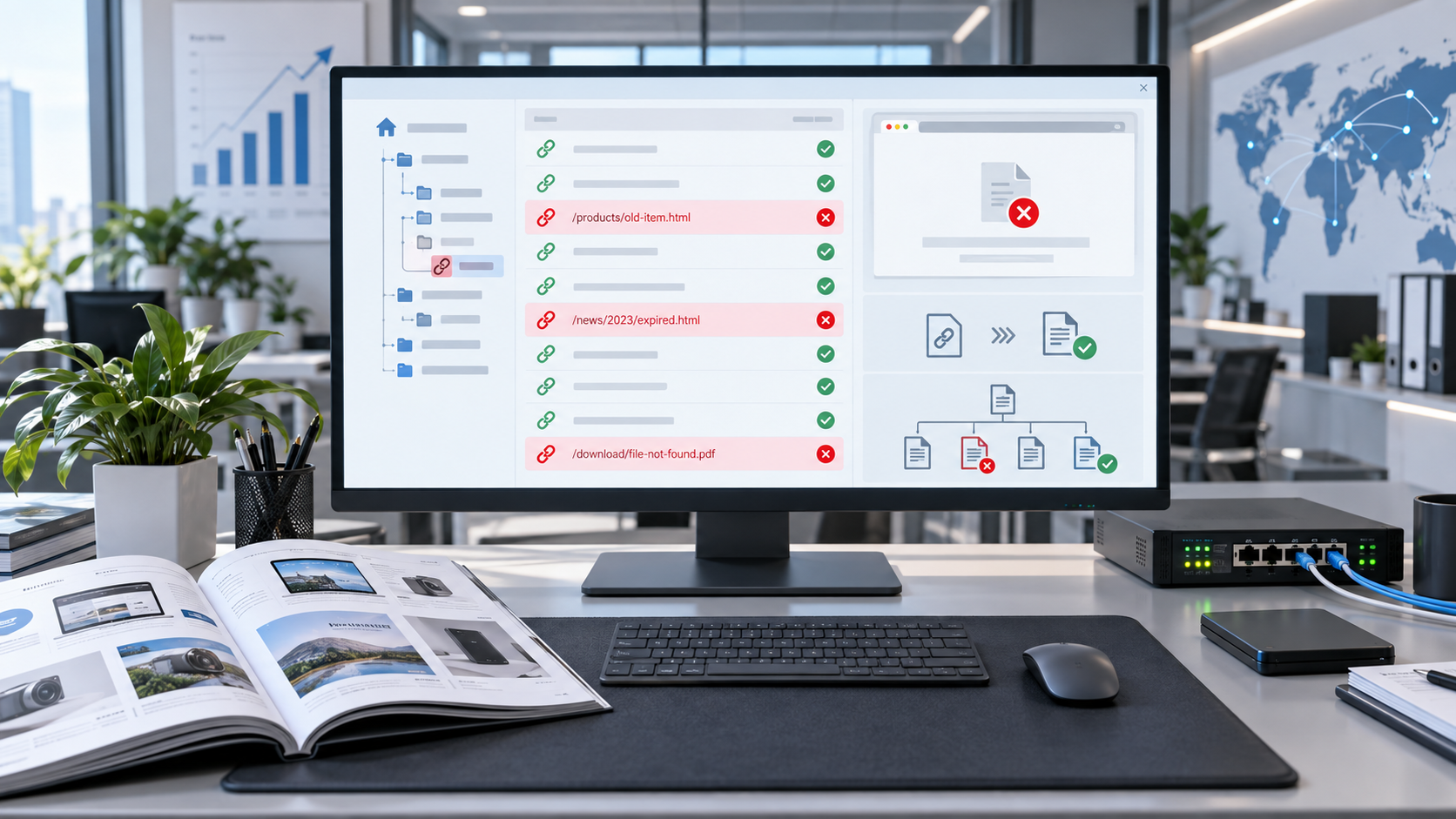
In actual operation, you can first initiate a website scan in the Yiyingbao Intelligent Website Detection Tool and enter the results page for link issues or broken links. Do not rush to export the results and make changes one by one. It is recommended to first sort by scope of impact: important on-site pages, main navigation, category pages, product detail pages, blog articles, landing pages, followed by images, attachments, and historical content links. Broken links appearing on the homepage, header navigation, footer, or high-traffic pages should generally be handled first, because more users and crawlers will repeatedly access them.
When reviewing each record, confirm at least four things: whether the target URL has indeed become invalid; which page or module links to it; what content the invalid page previously carried; and whether there is an alternative page with a similar topic and intent. For example, if a certain model has been discontinued but the company already has an upgraded model with a similar purpose, consider using a 301 redirect from the old page to the new model page. If the old product has no replacement and no external traffic or ranking value, removing internal entry points and retaining a clear 404 message is often more appropriate than forcibly redirecting it to the homepage.
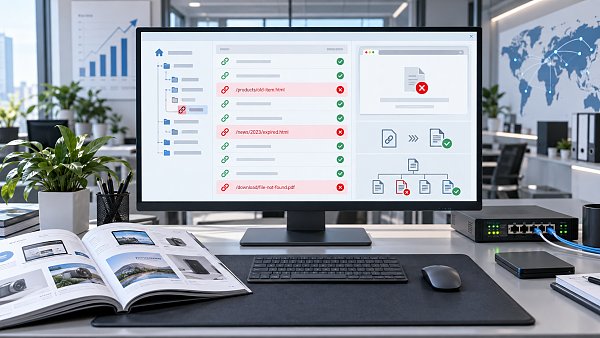
A practical principle is that redirects should serve user expectations rather than simply eliminate errors. Redirecting an old link for “industrial pump model-a” to the main pump category page is usually acceptable; if it redirects to the corporate homepage, a news page, or even an unrelated product page, visitors will leave immediately, and search engines may not recognize the relevance of such a connection. The number of broken links on many websites may appear to decline, but the actual issue has merely changed from 404 errors to low-quality redirects.
Broken links from different sources require different repair methods
Internal links are the easiest type to fix. After the detection tool identifies the source page, you can directly return to the website builder backend to check body anchor text, product recommendations, menus, footers, breadcrumbs, and multilingual versions. Especially when pages are copied in batches, editors often retain old-language links or test links; the page may appear normal, but problems are exposed only after clicking deeper into it. For B2B websites, PDF catalogs, specification sheets, and download buttons are also frequently overlooked, and it is not uncommon for original addresses to become invalid after file migration.
External links require a different approach. Old URLs linked from other websites, social media content, advertising materials, or emails cannot have their source modified directly on the website. If the page still has traffic value, create a new page that is closest to the original topic and set up a 301 redirect; if the old campaign page no longer has business significance, create an appropriate expired-content feedback page to guide users back to relevant category or contact pages. Broken links in advertising campaigns in particular should be handled as quickly as possible, as they directly waste click budgets and also distort subsequent conversion data.
Multilingual websites also need additional checks on language correspondence. After a Chinese page is redesigned, the English, German, or Spanish pages may not necessarily be updated at the same time; URL rules for the same product may also differ across languages. Do not redirect all invalid foreign-language pages to the English homepage. A more prudent approach is to first match an alternative page in the same language and product category; if no corresponding content truly exists, then evaluate whether the language entry should be retained.
After repairs, do not only check whether the “scan passes”; also recheck the link path
After completing changes, run the scan again to confirm that the original source pages have been updated, the target URLs are accessible, and redirects have not formed chains or loops. For important product pages, inquiry pages, and advertising landing pages, it is recommended to actually click through them in a browser rather than relying only on backend status. The menu structures on desktop, mobile, and different language versions may not be completely consistent, and certain link issues may appear only on specific devices.
You should also check the sitemap, canonical links, and related recommendation modules within pages at the same time. A URL may have been removed from the body content, but if it still appears in the XML sitemap or automated recommendation areas, crawlers will continue to request it. For corporate websites with a large volume of content, broken link management is not a one-time cleanup but part of the website operation process: a review should be arranged whenever products are discontinued, URLs are adjusted, languages are added, campaigns end, or store inventory changes.
Integrate broken link detection into the coordinated website building and marketing process
Yiyingbao provides website building, SEO, advertising, social media, and other services for foreign trade companies, manufacturing factories, cross-border sellers, and brands expanding overseas. The value of website link detection also lies in connecting these processes. Website builders are responsible for ensuring the structure is correct, content personnel maintain references in products and articles, advertising personnel need to ensure landing pages are accessible, and SEO operations teams need to focus on historical URLs, indexed pages, and redirect strategies. If any part becomes disconnected, broken links may reappear.
A relatively mature practice is to retain a URL change list for every redesign and large-scale content update, and conduct a scan both before and after launch. Before launch, the main purpose is to identify test links, links left over from templates, and language redirect errors; after launch, the focus is on actual page paths, historical addresses, and external entry points. For websites that are continuously conducting Google SEO, advertising campaigns, or overseas social media traffic acquisition, this step should not wait until traffic declines before remediation begins.
Broken links themselves are not the most difficult problem to handle; the difficult part is not knowing the content destination and visitor intent behind them. By making good use of the Yiyingbao Intelligent Website Detection Tool, first identify anomalies, then determine a repair solution based on page value, and finally review the entire link path, you can avoid situations where “there are fewer errors, but users still cannot find the content.” For overseas independent websites under long-term operation, this kind of meticulous maintenance is more reliable than a one-time batch repair.
Related Articles

Related Products
 Yiyingbao SaaS Intelligent Website Building and Marketing SystemYiyingbao SaaS Intelligent Website Building and Marketing System, AI-powered no-code website building, rapid creation of multilingual B2B international websites in 10 minutes, global server acceleration, AI-powered SEO optimization, helping businesses connect efficiently with global markets. The perfect integration of technology and operation makes building an international trade website remarkably simple
 AI+SEM Intelligent Advertising Marketing SystemAI+SEM drives intelligent ad creation, empowering full-funnel precision advertising marketing. The system automatically generates weekly/monthly reports, AI recommends keywords and target countries, monitors core metrics in real-time with intelligent alerts, and enables one-click high-conversion ad solutions to help quickly acquire customers and improve ROI.
 AI+SEO Dual-Engine System Optimization ServicesYiyingbao’s AI+SEO dual-engine optimization system helps foreign trade enterprises acquire high-quality organic traffic through AI-powered keyword research, content generation, and comprehensive technical optimization, significantly improving search rankings and conversion rates.
 AI+SNS Social Media Marketing SystemYingbao AI+SNS Social Media Marketing System - Precision social capture for the social media era. Supports one-click content synchronization across major platforms like Facebook and LinkedIn. AI intelligently rewrites posts for enhanced relevance. 24/7 AI customer service and user profiling analysis empower businesses to efficiently expand into global markets.
 AI+SEO营销解决方案易营宝AI+SEO营销解决方案,通过AI批量写作、智能生成TDK、精准关键词扩词等功能,全面优化网站SEO效果,提升流量与转化率。助力企业构建高效智能网站新生态。
 AI+SEM Advertising Marketing SolutionsAI+SEM Advertising Marketing Solution leverages AI technology to deeply empower SEM ad campaigns. It automatically generates weekly/monthly reports using AI, presenting account data across multiple dimensions for comprehensive insights into campaign performance and trends. The system precisely recommends keywords and target countries, intelligently generates high-conversion ad copy, and enables one-click activation of efficient campaign plans to help businesses rapidly acquire customers. Simultaneously, it monitors core metrics in real time, intelligently identifies abnormal fluctuations, and issues timely alerts to ensure stable, high-return advertising results.
 Domain Name ServicesEasyWin provides professional domain name services, including intelligent queries, one-stop registration, brand protection, and full lifecycle management, helping businesses build a digital brand image.
 EasyOperate B2C Cross-Border E-Commerce Platform & Independent WebsiteEasyStore B2C Cross-border E-commerce Independent Store is an intelligent website building and cross-border e-commerce integrated solution independently developed by EasyStore Information Technology (Beijing) Co., Ltd. The system is specially designed for small and medium-sized as well as large export enterprises, integrating 'website building, operation, marketing, advertising, and conversion' into one, helping enterprises quickly establish cross-border e-commerce independent stores to achieve brand globalization and global sales growth.
The platform supports multiple languages, multiple currencies, and multi-channel marketing, with built-in AI intelligent translation and SEO optimization systems, suitable for mainstream markets such as Southeast Asia, Europe and America, Latin America, and the Middle East, assisting Chinese manufacturing enterprises in efficiently deploying international e-commerce strategies. SSL证书易营宝提供专业SSL安全证书服务,包括单域名和泛域名证书,确保网站数据传输加密、身份验证和完整性保护,助力企业建立安全可信的在线业务环境。









