









- Can the average annual growth rate reflect real opportunities in overseas markets?Oct 07, 2026View details
- Which customer acquisition channels will be affected by cross-border marketing trends in 2026?Sep 06, 2026View details
- Which homogenization risks should be considered in an analysis of the AI-powered website building industry?Aug 30, 2026View details
- How Will AI Marketing Trends 2026 Change Advertising Budget AllocationAug 28, 2026View details
- Is the EV SSL certificate market shrinking or upgrading? How should companies assess certificate procurement?Aug 11, 2026View details
- Why the old AMP SEO 2020 practices no longer work and what has changed in current optimization prioritiesAug 02, 2026View details
How long does it generally take to build an independent website for a beauty brand?
How long does it usually take to build an independent website for a beauty brand? If product materials, visual direction, and target markets are already clear, a standard brand website can usually go live within 3 to 6 weeks. Projects with an online store, multiple languages, membership systems, subscriptions, or complex marketing configurations generally require 6 to 10 weeks. What truly extends the timeline is often not “building pages,” but repeated adjustments to content preparation, confirmation of brand messaging, payment and logistics, and localization details.
Many people initially ask only, “How soon can it go live?” But the more important question is whether the website can receive advertising traffic upon launch, communicate the brand’s value, and make overseas users feel confident enough to place an order. This is especially true for beauty brands. Skincare, cosmetics, and personal care products rely heavily on visuals, ingredient information, usage instructions, and trust. A website that focuses solely on speed often requires rework later.
How Long It Takes to Build an Independent Website for a Beauty Brand Depends on the Type of Website
Even if they are both called independent websites, the workload can vary significantly. Using a mature template to display only the brand and a dozen products is not comparable, in terms of timeline, to developing brand visuals from scratch, building a cross-border online store, and adapting it for multiple national markets.
The timelines mentioned here assume normal cooperation from both parties. If the brand can confirm pages only once a week, product photography has not been completed, or ingredient lists and compliance copy remain undecided, the project may take two or three months even if the technical team is fully prepared. Conversely, brands that already have established packaging visuals, product images, English materials, and clear competitor references can often launch their first version much faster than expected.
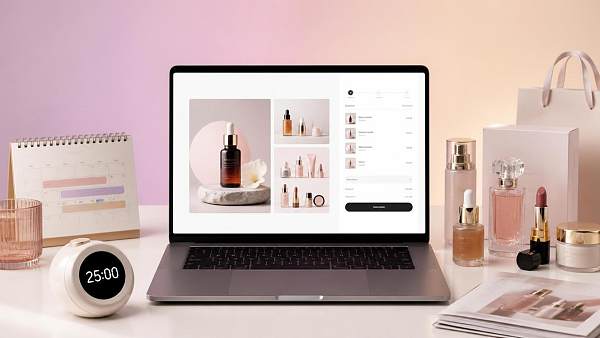
Do Not Attribute All Website Development Time to Design and Development
In actual projects, initial positioning usually takes 3 to 7 days. This is not about creating an attractive brand introduction; it is about first determining what the website will sell, who it will sell to, and why customers should make a purchase. For example, for a brand focused on sensitive skin repair, the homepage may emphasize formulation rationale, suitable skin types, and real usage scenarios. A brand focused on fragrance and emotional experiences, on the other hand, needs to connect scent profiles, longevity, gifting occasions, and brand stories.
Only then do page design and website development begin. The challenge for a beauty website is not simply to make it “look good,” but to make visuals support conversion: product pages need to help users understand volume, key ingredients, texture, application order, suitable users, and delivery and return policies. Purchase buttons, variant selection, and review access on mobile devices must also be easy to use. Many first-round designs require one or two rounds of revisions, which is normal, provided that revisions focus on user decision-making rather than overturning the visual direction every time.
The final stage is often underestimated: payment, logistics, tax notices, site emails, analytics tools, advertising pixels, basic search indexing settings, and launch testing. A page that appears complete does not mean advertising can begin immediately. Failed payments, discount code conflicts, unsynchronized inventory, and mobile checkout issues can all cause previously acquired traffic to be wasted.
A practical approach is this: if the goal is only to validate overseas demand first, start with a lightweight store for one market, one language, and core SKUs. If there are already stable orders, an advertising team, and plans for multiple regions, then design the multilingual setup, regional pricing, and content system at once. Establishing a complete transaction loop first is more valuable than adding numerous features from the beginning.
Where Does the Timeline Difference Lie Between Beauty Websites and Standard Foreign Trade Websites?
B2B foreign trade websites typically place greater emphasis on product specifications, factory capabilities, certification materials, and inquiry forms. Independent beauty brand websites, however, must achieve both brand awareness building and purchase conversion. They require more images, videos, shade or scent descriptions, bundle recommendations, user reviews, and clearer after-sales commitments. As a result, organizing product information often takes more time than for more standardized categories such as hardware and packaging.
Some also wonder whether AI translation is sufficient for product pages. AI can produce a first draft, particularly for processing specifications, volume, and standard descriptions in bulk, but it cannot directly replace human review. Beauty copy involves efficacy claims, sensory descriptions, ingredient names, and usage reminders. Literal translation can easily sound unnatural or even create inappropriate claims. For different markets, language localization also includes units of measurement, currencies, delivery times, holiday gifting habits, and common user expressions.
What localization work is required for an independent website for a fragrance brand expanding overseas is also a question that is often postponed. Scent classifications, top, middle, and base notes, diffusion range, suitable spaces, and gift packaging presentation can all influence purchase decisions. Simply translating Chinese content into English is usually insufficient to build understanding and trust among overseas consumers.
To Shorten the Timeline, Prepare These Materials First
A website development provider can handle structure, technology, and marketing configurations, but the brand understands its products best. Before launch, it is best to confirm: brand visual guidelines and Logo source files; SKU lists, prices, volumes, and inventory logic; high-resolution white-background and lifestyle images; ingredients, instructions for use, and precautions; delivery, return, and customer service policies; target countries, languages, currencies, and planned payment methods.
It is also important to decide early where traffic will come from. Whether overseas buyer acquisition should rely mainly on the website or social media advertising is not an either-or question. For DTC beauty brands, social media and advertising often drive initial reach, while the independent website handles traffic reception, explanation, and conversion. SEO is more suitable for building long-term search demand around ingredients, skincare concerns, and product categories. If Google SEO is planned for the future, the website development stage should already include category hierarchy, product URLs, title descriptions, internal links, and image information, rather than making major changes several months after launch.
Website redesigns require particular caution. Will SEO authority decline after redesigning an automotive parts foreign trade website? The same applies to beauty websites: as long as old pages already have indexing and organic traffic, URLs should not be deleted casually during a redesign. How can URLs be migrated after a multilingual foreign trade website redesign without losing indexing? The key is to retain valuable pages, establish accurate 301 redirects, verify the correspondence between language versions, and continuously monitor crawling and indexing status after launch. A redesign is not as simple as redoing the visuals.
When Choosing Website Development Services, Do Not Compare Only Quotes and Promised Timelines
Low-priced solutions promising to go live within one week are suitable for situations that require only a temporary campaign page or a simple presentation page. However, if the goal is ongoing advertising, brand asset accumulation, and repeat purchase management, it is necessary to assess whether the provider can connect website development with subsequent marketing. Server regions, website speed, payment capabilities, data tracking, SEO foundations, and content maintenance will all affect actual website performance after launch.
For example, how to choose an overseas server for a photovoltaic new energy foreign trade website depends more on access speed and stability in target regions. A beauty online store also needs additional attention to the checkout process, image loading, and third-party application compatibility. Whether construction and renovation companies should build multilingual foreign trade websites may depend on the local project coverage. Whether a beauty brand should offer multiple languages also depends on whether local consumers accept an English website and whether customer service and after-sales support can keep up. More languages are not always better; it is more practical to develop key markets in depth first.
Platforms like Yiyingbao, which cover intelligent website building, cross-border online stores, SEO, advertising, and social media operations, are suitable for brands that want to plan website development and subsequent customer acquisition within the same growth process. When choosing, it is still recommended to first confirm target markets, product quantity, content readiness, and promotional budget, then match the appropriate solution rather than adding complexity merely for a feature list.
Frequently Asked Questions
Can a website be built first without professional product images?
The website structure, copy framework, and some pages can be completed first, but images for core SKUs should be added before official advertising begins. Beauty consumers are highly sensitive to visuals, and low-quality images directly weaken product quality perception and trust.
Will it be troublesome to launch an English website first and add other languages later?
Not necessarily. As long as multilingual URLs, content fields, and regional settings are reserved in the first phase, subsequent expansion will be relatively smooth. The troublesome situation is building it casually at first and then changing page hierarchy and link structures later.
How long after an independent website goes live can it start receiving orders?
Going live does not mean orders will come naturally. Brands with existing social media followers, advertising budgets, or established channels may validate conversions quickly. New websites that rely on SEO require a longer period for content accumulation and indexing, and actual performance needs to be assessed based on the market, products, and promotional execution.
Returning to the initial question, how long does it usually take to build an independent website for a beauty brand? A reasonable expectation is 3 to 10 weeks, rather than simply asking, “How many days will it take?” By focusing on material preparation, initial markets, transaction configuration, and traffic reception, a website is more likely to become a genuinely operational and conversion-oriented overseas brand presence after launch.
Related Articles


Related Products
 Yiyingbao SaaS Intelligent Website Building and Marketing SystemYiyingbao SaaS Intelligent Website Building and Marketing System, AI-powered no-code website building, rapid creation of multilingual B2B international websites in 10 minutes, global server acceleration, AI-powered SEO optimization, helping businesses connect efficiently with global markets. The perfect integration of technology and operation makes building an international trade website remarkably simple
 AI+SEM Intelligent Advertising Marketing SystemAI+SEM drives intelligent ad creation, empowering full-funnel precision advertising marketing. The system automatically generates weekly/monthly reports, AI recommends keywords and target countries, monitors core metrics in real-time with intelligent alerts, and enables one-click high-conversion ad solutions to help quickly acquire customers and improve ROI.
 AI+SEO Dual-Engine System Optimization ServicesYiyingbao’s AI+SEO dual-engine optimization system helps foreign trade enterprises acquire high-quality organic traffic through AI-powered keyword research, content generation, and comprehensive technical optimization, significantly improving search rankings and conversion rates.
 AI+SNS Social Media Marketing SystemYingbao AI+SNS Social Media Marketing System - Precision social capture for the social media era. Supports one-click content synchronization across major platforms like Facebook and LinkedIn. AI intelligently rewrites posts for enhanced relevance. 24/7 AI customer service and user profiling analysis empower businesses to efficiently expand into global markets.
 AI+SEO营销解决方案易营宝AI+SEO营销解决方案,通过AI批量写作、智能生成TDK、精准关键词扩词等功能,全面优化网站SEO效果,提升流量与转化率。助力企业构建高效智能网站新生态。
 AI+SEM Advertising Marketing SolutionsAI+SEM Advertising Marketing Solution leverages AI technology to deeply empower SEM ad campaigns. It automatically generates weekly/monthly reports using AI, presenting account data across multiple dimensions for comprehensive insights into campaign performance and trends. The system precisely recommends keywords and target countries, intelligently generates high-conversion ad copy, and enables one-click activation of efficient campaign plans to help businesses rapidly acquire customers. Simultaneously, it monitors core metrics in real time, intelligently identifies abnormal fluctuations, and issues timely alerts to ensure stable, high-return advertising results.
 Domain Name ServicesEasyWin provides professional domain name services, including intelligent queries, one-stop registration, brand protection, and full lifecycle management, helping businesses build a digital brand image.
 EasyOperate B2C Cross-Border E-Commerce Platform & Independent WebsiteEasyStore B2C Cross-border E-commerce Independent Store is an intelligent website building and cross-border e-commerce integrated solution independently developed by EasyStore Information Technology (Beijing) Co., Ltd. The system is specially designed for small and medium-sized as well as large export enterprises, integrating 'website building, operation, marketing, advertising, and conversion' into one, helping enterprises quickly establish cross-border e-commerce independent stores to achieve brand globalization and global sales growth.
The platform supports multiple languages, multiple currencies, and multi-channel marketing, with built-in AI intelligent translation and SEO optimization systems, suitable for mainstream markets such as Southeast Asia, Europe and America, Latin America, and the Middle East, assisting Chinese manufacturing enterprises in efficiently deploying international e-commerce strategies. SSL证书易营宝提供专业SSL安全证书服务,包括单域名和泛域名证书,确保网站数据传输加密、身份验证和完整性保护,助力企业建立安全可信的在线业务环境。









