









- Which customer acquisition channels will be affected by cross-border marketing trends in 2026?Sep 06, 2026View details
- Which homogenization risks should be considered in an analysis of the AI-powered website building industry?Aug 30, 2026View details
- How Will AI Marketing Trends 2026 Change Advertising Budget AllocationAug 28, 2026View details
- Is the EV SSL certificate market shrinking or upgrading? How should companies assess certificate procurement?Aug 11, 2026View details
- Why the old AMP SEO 2020 practices no longer work and what has changed in current optimization prioritiesAug 02, 2026View details
- How to Choose Topics for an Industry News Section to Attract More Organic Search TrafficJul 29, 2026View details
- Digital Marketing Shenzhen Market Insights: Why Are Companies Expanding Overseas Looking for Growth Teams in Shenzhen?Jul 31, 2026View details
- Can Zhejiang foreign trade independent websites still be developed today? Look at changes in traffic and lead generationJul 28, 2026View details
Can European inquiries recover and grow after a redesign
Can European inquiry volume recover and grow after a website redesign? The key is not only a design update, but also how to reduce the hreflang error rate of multilingual websites, how to keep global node access latency within 100ms, and how to coordinate SEO and Google Ads for foreign trade customer acquisition.
Why do European inquiries often decline first after many companies redesign their websites?
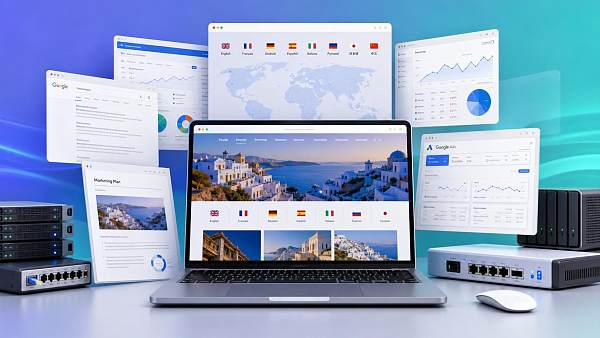
The European market has more detailed requirements for website quality than many companies expect. A visual page upgrade is only a surface-level change. What truly affects inquiry recovery is indexation stability, language version matching, access speed, conversion paths, and whether advertising and organic traffic are aligned for consistent lead capture.
The core issues many foreign trade companies encounter after a redesign are: the authority of old pages is lost, the semantic reconstruction of new pages is insufficient, and multilingual directory structures are adjusted too quickly. As a result, when users from Germany, France, Italy, and other regions enter the site, the content they see does not fully match their search intent.
If, at this point, the issue of how to reduce the hreflang error rate of multilingual websites is not handled properly, search engines may show German pages to English-speaking searchers, or incorrectly distribute the main site's language pages to local markets. In that case, a decline in inquiries is not accidental, but a systematic result.
- After the redesign, URLs changed too much, but 301 redirects did not provide full coverage, so the value of old ranking pages could not be inherited smoothly.
- Multilingual content was only translated, without being rewritten according to procurement terms, industry terms, and local expressions used in different European languages.
- Server nodes were too limited, and there was no plan for how to keep global node access latency within 100ms, resulting in a higher bounce rate.
- Ads continued to use old creatives or old landing pages, while the question of how to coordinate multilingual overseas ad creatives was not updated at the same time.
First, determine: is there still room to recover European inquiries after the redesign?
There is room for recovery, but you must first identify which layer the loss occurred in. If traffic is still there but inquiries have declined, the problem is most likely page trust, form flow, or the mobile experience. If both traffic and inquiries have declined, it is more likely that the technical structure, indexation, and advertising coordination have all been affected at the same time.
For integrated website + marketing service projects, the most effective way to evaluate performance is not to look only at total visits, but to diagnose the seven stages one by one: crawling, indexation, ranking, clicks, on-site visits, dwell time, and conversion.
The table below is suitable for quickly determining whether European inquiry volume can recover and grow after a redesign, and how the priority order for fixes should be arranged.
If at least two items in the table apply, it means the issue is not whether to continue targeting Europe, but whether to use a more systematic approach to rebuild the coordination mechanism between the website, SEO, and advertising.
How should a multilingual website be fixed so European traffic gets back on track?
How to reduce the hreflang error rate of multilingual websites is the first step in restoring European inquiries after a redesign. Many teams only know that tags need to be added, but ignore details such as language-region mapping, bidirectional references, consistent URL status codes, and conflicts with canonical tags.
What should be done first for technical fixes
- Confirm that every language page returns a normal status code, and avoid overly long redirect chains or incorrect redirects to the homepage.
- Ensure that German, French, and Italian pages declare their corresponding relationships with one another, while retaining a default language version.
- Unify URL structures, breadcrumbs, and sitemaps to avoid old directories and new directories coexisting after the redesign.
- Create localized metadata separately for high-value pages instead of copying one template across the entire site.
Content recovery cannot rely on translation alone
The European market places particular emphasis on terminology accuracy and the completeness of procurement information. Can the multilingual content production cycle be shortened from 7 days to 2 days? Yes, but the prerequisite is not reducing proofreading. Instead, use AI to generate first drafts, unify terminology through a termbase, and reuse page modules, then have localization editors refine industry expressions and calls to action.
易营宝 is more suitable for this type of scenario in the coordination of multilingual website development and AI+SEO/GEO optimization: site structure, page templates, content production, language distribution, and subsequent promotion are no longer separated, reducing the problem that content cannot keep up with the pace of traffic recovery after a redesign.
For foreign trade customer acquisition, should you use SEO or Google Ads, and how should the European market be allocated?
For foreign trade customer acquisition, the question of whether SEO or Google Ads is better should not be treated as an either-or choice. During the recovery period after a redesign, advertising is responsible for stopping losses and rapid testing, while SEO is responsible for rebuilding long-term exposure and the inquiry cost structure. Coordination between the two is more suitable for Europe's multilingual markets.
If a company only does SEO, the recovery cycle may be relatively long. If it only runs ads, budget waste can easily be amplified when page delivery is unstable. Especially in the German market, ad click quality, landing page relevance, and local semantic consistency directly affect conversion efficiency.
The comparison table below is suitable for companies to determine whether Google Ads managed operation or self-managed advertising is more cost-effective, and how to arrange phased strategies after a redesign.
In most cases, whether Google Ads managed operation or self-managed advertising is more cost-effective depends on whether the internal team has multilingual account management, creative testing, landing page coordination, and data attribution capabilities. If the team has significant gaps, handing the work over to a platform with integrated website + marketing service capabilities usually helps reduce trial-and-error costs.
How can Google Ads CTR in the German market reach 3%, and how should multilingual ad creatives be coordinated?
To achieve a 3% CTR for Google Ads in the German market, the key is not simply raising bids, but aligning keywords, ad copy, assets, and landing page titles within the same semantic chain. Before clicking, European users pay more attention to professionalism, parameter transparency, delivery credibility, and the naturalness of the local language.
Core actions for multilingual advertising coordination
- First split ad groups by country and language. Do not mix German, English, and French intent into the same set of creatives.
- Write headlines separately around industry terms, procurement terms, and pain-point terms, and avoid only emphasizing the brand name or generic functions.
- How should multilingual overseas ad creatives be coordinated? Website titles, selling point modules, and form questions should all be included in a unified script.
- Continuously test different promise angles, such as delivery cycle, customization capability, sample support, and quotation response speed.
Can an AI advertising system automatically optimize multilingual ads? In scenarios with large creative volumes, many language versions, and a fast testing rhythm, AI can significantly improve efficiency. It is especially suitable for automatically allocating budgets, identifying low-efficiency keywords, generating copy variants, and synchronizing landing page testing directions.
Can an AI advertising system reduce the manpower required for multilingual ad campaigns? The answer is usually yes, but the prerequisite is that the system can not only generate ads, but also connect website building, page updates, conversion tracking, and multi-market data feedback. Otherwise, it merely shifts people from writing copy to filling in data and fixing structures.
What technical metrics should also be monitored: speed, nodes, and delivery efficiency
How to keep global node access latency within 100ms is an often underestimated part of European inquiry recovery. For multilingual official websites, advertising landing pages, and cross-border e-commerce stores, slow loading not only affects user experience, but also drags down ad quality, organic ranking performance, and form submission rates.
When selecting a solution, companies are advised to evaluate the website building system and marketing system together, rather than building the website first and adding promotion later. This is because page caching strategies, resource compression, regional node distribution, and script loading order all directly affect SEO and advertising conversion.
For companies hoping to restore European inquiries faster, the tighter the coordination between website building, SEO, advertising, and content, the shorter the recovery cycle usually is. The value of 易营宝 is reflected exactly in this point: it is not a single-point service, but unified management of intelligent website building, multilingual operations, SEO optimization, Google Ads, and AI tools within one growth chain.
FAQ: the recovery rhythm and investment decisions companies care about most
Can European inquiry volume recover and grow after a redesign, and how long does it usually take?
If it is only a page style update and the structure has not been fundamentally changed, recovery may be relatively fast. If it involves URL restructuring, multilingual directory adjustments, content rewriting, and advertising handoff changes, recovery usually needs to be advanced in stages. Stabilizing advertising leads first, then restoring organic exposure, is a more realistic rhythm.
Which is more cost-effective: Google Ads managed operation or self-managed advertising?
If a company already has mature media buyers, designers, data analysts, and multilingual support internally, self-managed advertising is more flexible. If what is currently lacking is practical execution capabilities such as how to achieve a 3% CTR for Google Ads in the German market, multilingual creative coordination, and rapid landing page redesign, managed operation often saves more trial-and-error costs.
Can an AI advertising system automatically optimize multilingual ads?
It can improve efficiency, but it cannot completely replace strategy. AI is better at batch generation, automatic grouping, budget shifting, eliminating low-efficiency keywords, and creative testing. What truly determines performance is still market positioning, website conversion capability, and the quality of content localization.
For foreign trade customer acquisition, is SEO or Google Ads better?
If a company's goal is to steadily acquire European inquiries rather than generate short-term volume, it is recommended to use SEO as the foundation and advertising as the accelerator. Especially after a redesign, coordination between the two can more quickly verify keyword directions and whether page information is compelling enough for buyers.
Why choose us: from website to marketing, an executable solution for recovering European inquiries
易营宝 has been deeply engaged in global digital marketing and intelligent website building for many years. Focusing on the needs of foreign trade companies, manufacturing factories, cross-border sellers, and globalizing brands, it provides integrated services from AI intelligent website building and multilingual website development to Google SEO optimization, Google Ads placement, overseas social media operations, and GEO generative engine optimization.
If you are evaluating whether European inquiry volume can recover and grow after a redesign, we can help you prioritize these key matters:
- Diagnose how to reduce the hreflang error rate of multilingual websites, and sort out indexation and redirect issues for language pages.
- Evaluate how to keep global node access latency within 100ms, and optimize loading speed in target European markets.
- Based on budget and team capabilities, analyze whether SEO or Google Ads is better for foreign trade customer acquisition, and how to allocate the coordination ratio.
- Develop an execution plan for how multilingual overseas ad creatives should be coordinated, including copy, pages, and conversion components.
- Clarify whether Google Ads managed operation or self-managed advertising is more cost-effective, and provide recommendations on delivery cycles, testing rhythm, and quotation communication.
If you need parameter confirmation, product selection, delivery cycle evaluation, customized solution design, or multilingual advertising planning for the European market, you can communicate with us now based on your existing website, target countries, and budget range. Compared with a simple redesign, what matters more is turning the site, traffic, and inquiry recovery into a truly closed-loop growth chain.
Related Articles
Related Products
 Yiyingbao SaaS Intelligent Website Building and Marketing SystemYiyingbao SaaS Intelligent Website Building and Marketing System, AI-powered no-code website building, rapid creation of multilingual B2B international websites in 10 minutes, global server acceleration, AI-powered SEO optimization, helping businesses connect efficiently with global markets. The perfect integration of technology and operation makes building an international trade website remarkably simple
 AI+SEM Intelligent Advertising Marketing SystemAI+SEM drives intelligent ad creation, empowering full-funnel precision advertising marketing. The system automatically generates weekly/monthly reports, AI recommends keywords and target countries, monitors core metrics in real-time with intelligent alerts, and enables one-click high-conversion ad solutions to help quickly acquire customers and improve ROI.
 AI+SEO Dual-Engine System Optimization ServicesYiyingbao’s AI+SEO dual-engine optimization system helps foreign trade enterprises acquire high-quality organic traffic through AI-powered keyword research, content generation, and comprehensive technical optimization, significantly improving search rankings and conversion rates.
 AI+SNS Social Media Marketing SystemYingbao AI+SNS Social Media Marketing System - Precision social capture for the social media era. Supports one-click content synchronization across major platforms like Facebook and LinkedIn. AI intelligently rewrites posts for enhanced relevance. 24/7 AI customer service and user profiling analysis empower businesses to efficiently expand into global markets.
 AI+SEO营销解决方案易营宝AI+SEO营销解决方案,通过AI批量写作、智能生成TDK、精准关键词扩词等功能,全面优化网站SEO效果,提升流量与转化率。助力企业构建高效智能网站新生态。
 AI+SEM Advertising Marketing SolutionsAI+SEM Advertising Marketing Solution leverages AI technology to deeply empower SEM ad campaigns. It automatically generates weekly/monthly reports using AI, presenting account data across multiple dimensions for comprehensive insights into campaign performance and trends. The system precisely recommends keywords and target countries, intelligently generates high-conversion ad copy, and enables one-click activation of efficient campaign plans to help businesses rapidly acquire customers. Simultaneously, it monitors core metrics in real time, intelligently identifies abnormal fluctuations, and issues timely alerts to ensure stable, high-return advertising results.
 Domain Name ServicesEasyWin provides professional domain name services, including intelligent queries, one-stop registration, brand protection, and full lifecycle management, helping businesses build a digital brand image.
 EasyOperate B2C Cross-Border E-Commerce Platform & Independent WebsiteEasyStore B2C Cross-border E-commerce Independent Store is an intelligent website building and cross-border e-commerce integrated solution independently developed by EasyStore Information Technology (Beijing) Co., Ltd. The system is specially designed for small and medium-sized as well as large export enterprises, integrating 'website building, operation, marketing, advertising, and conversion' into one, helping enterprises quickly establish cross-border e-commerce independent stores to achieve brand globalization and global sales growth.
The platform supports multiple languages, multiple currencies, and multi-channel marketing, with built-in AI intelligent translation and SEO optimization systems, suitable for mainstream markets such as Southeast Asia, Europe and America, Latin America, and the Middle East, assisting Chinese manufacturing enterprises in efficiently deploying international e-commerce strategies. SSL证书易营宝提供专业SSL安全证书服务,包括单域名和泛域名证书,确保网站数据传输加密、身份验证和完整性保护,助力企业建立安全可信的在线业务环境。









