









- Which customer acquisition channels will be affected by cross-border marketing trends in 2026?Sep 06, 2026View details
- Which homogenization risks should be considered in an analysis of the AI-powered website building industry?Aug 30, 2026View details
- How Will AI Marketing Trends 2026 Change Advertising Budget AllocationAug 28, 2026View details
- Is the EV SSL certificate market shrinking or upgrading? How should companies assess certificate procurement?Aug 11, 2026View details
- Why the old AMP SEO 2020 practices no longer work and what has changed in current optimization prioritiesAug 02, 2026View details
- How to Choose Topics for an Industry News Section to Attract More Organic Search TrafficJul 29, 2026View details
After the website revamp, which signals should you look at to see whether European inquiry volume is recovering and growing
After a website redesign, can European inquiry volume recover and grow? Do not focus only on traffic first. Pay closer attention to key indicators such as how the hreflang error rate of multilingual sites decreases, page indexing, access speed in Europe, and the quality of high-intent leads.
For foreign trade companies, manufacturing factories, and global brand expansion teams, a website redesign is often not just a simple interface refresh. It is a systematic project involving search visibility, ad traffic reception, content restructuring, and conversion funnel optimization. Especially in the European market, language, region, compliance, and user experience all affect the pace of inquiry recovery, so it is usually necessary to observe signal changes across three stages: 2 weeks, 4 weeks, and 8 weeks.
If a company is running Google SEO, Google Ads, and multilingual official website operations at the same time, judging whether the redesign is successful should not be based only on whether total visits have rebounded. More importantly, it is necessary to check whether key pages in German, French, Italian, and other languages are correctly indexed, whether ad landing pages work in synergy with organic traffic pages, and whether the lead quality received by the sales team is more stable than before the redesign.
Look at the core signals of recovery and growth first, instead of only watching total traffic
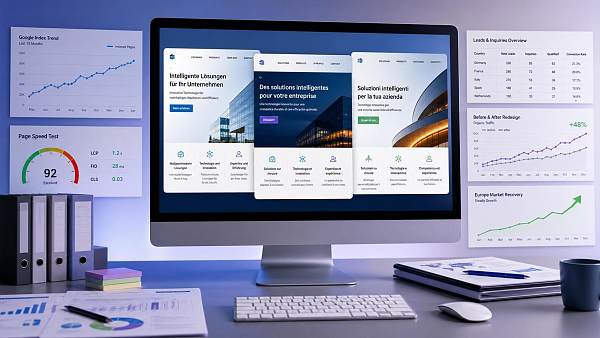
Recovery in European inquiries is usually slower than traffic recovery. The reason is straightforward: search engines need time to re-understand the site structure, ad accounts also need to relearn conversion data, and B2B buyers often go through a decision-making cycle of 7 days to 30 days from visit to lead submission. Therefore, if there is no obvious inquiry growth in the first 14 days after the redesign, it does not necessarily mean the direction is wrong.
Signal 1: Whether multilingual indexing and hreflang are stable
For many companies, once a redesign starts, the first problem is often not design, but how to reduce the hreflang error rate of multilingual sites. If a German page points to the English version, or German users are mistakenly sent to the global site, Google will reduce page matching efficiency, directly affecting European organic traffic and inquiry quality.
In practice, it is recommended to focus on checking 4 items: whether the language codes are correct, whether the region codes are consistent, whether bidirectional annotations are complete, and whether canonical tags conflict with hreflang. Generally speaking, the error rate of key language pages should be kept below 5% as much as possible. If it exceeds 10%, indexing and ranking fluctuations after the redesign are usually significantly amplified.
Technical indicators to monitor first
- Whether the indexing rate of core language pages returns to more than 80% of the pre-redesign level within 2 to 4 weeks
- Whether the proportion of pages with hreflang annotation errors, omissions, or conflicts continues to decline
- Whether the 301 coverage rate from old URLs to new URLs reaches more than 90%
- Whether important product pages still retain the original keyword themes and content relevance
The table below is more suitable for judging the early signals behind the question “Can European inquiry volume recover and grow after a website redesign?” rather than simply looking at the number of visits.
Based on execution experience, what truly deserves attention is not short-term inquiry fluctuation, but the simultaneous occurrence of three issues: “indexing does not recover, redirects are incomplete, and language versions are confused.” Once these three types of problems overlap, traffic may recover after the redesign, but European inquiries will not grow in sync.
Signal 2: Whether the access experience for European users is acceptable
Many companies focus on how attractive pages look but ignore local access speed in Europe. For a B2B official website, if product pages, case study pages, and inquiry form pages take more than 3 seconds to load, the bounce rate usually rises significantly. Especially in markets such as Germany, France, and the Netherlands, access stability directly affects ad quality scores and organic conversion rates.
Therefore, how to keep global node access latency within 100ms is not only a technical team issue, but also a marketing results issue. Reasonable approaches include European node distribution, WebP image compression, JS script simplification, localized loading of form components, and mobile-first optimization for core landing pages.
SEO, ads, and content synergy determine whether inquiries can truly rebound
Many companies ask after a redesign: is SEO or Google Ads better for foreign trade customer acquisition? In fact, in the European market, the recovery period after a website redesign is more suitable for a combination of “SEO as the foundation, ads to supplement volume, and content to improve conversion.” Relying on a single channel alone often leads to slower recovery and greater volatility.
Why ads and SEO must be aligned at the same time
If SEO pages have already changed their URL structure but ads still point to old landing pages, budget will be wasted. If ad creatives emphasize local service in Germany but the German landing page is still a direct English translation, conversion rates will also be reduced. During the first 30 days after the redesign, it is best to verify ad links, conversion events, page language consistency, and form submission paths once a week.
This is also why many companies begin comparing whether Google Ads managed services or running ads by themselves is more cost-effective. If the internal team lacks multilingual ad experience, conversion tracking configuration capability, and landing page coordination resources, the value of managed services is not in “helping you spend money,” but in “reducing the number of weeks spent on trial and error.” For inquiry-dependent companies, avoiding 1 to 2 months of detours is often more important than saving account service fees.
4 key points for ad coordination after a redesign
- Update all ad links to valid pages on the new site to avoid 404 errors and multiple redirects
- Re-verify conversion events such as form submissions, WhatsApp, and phone clicks
- Use corresponding language creatives for different countries and avoid broadly targeting multiple European countries with English ads
- Keep ad keywords, titles, and page selling points consistent to reduce post-click expectation gaps
In multilingual advertising, how to make overseas multilingual ad creatives work in synergy is also key to recovery efficiency after a redesign. The most common problem is that “translation is completed, but the message is not localized.” For example, the German market values parameters, certifications, delivery times, and after-sales response more than general brand slogans.
The table below can help companies quickly determine whether SEO, advertising, and content teams are aligned around the same goal, especially during the 4-week recovery period after a redesign.
As the table shows, recovery after a redesign cannot be completed by any single team alone. Truly effective growth comes from simultaneous alignment across 4 links: website, content, advertising, and sales. Only after at least 2 to 6 consecutive weeks of execution will the data show a stable trend.
Can AI systems shorten the recovery cycle?
When a corporate website involves more than 3 languages, such as English, German, French, and Spanish, manual spreadsheet-based management often struggles to keep up with the pace of version updates. At this point, whether AI advertising systems can automatically optimize multilingual ads and whether AI advertising systems can reduce the manpower required for multilingual delivery become practical questions. The answer is that they can reduce part of the repetitive workload, but only if the underlying data structure and page assets are sufficiently standardized.
For example, after a redesign, an AI system can help identify invalid links in batches, synchronize title templates across different languages, split creative versions by country, and automatically alert for low-CTR ads. However, landing page strategy, core selling point expression, and budget allocation for key countries still require human decision-making. For medium and large global expansion teams, a common approach is to let AI handle 30% to 50% of repetitive execution, while operations teams focus on high-value optimization.
Why the German market deserves separate attention
In Europe, Germany is often a key market for industrial products, equipment categories, and B2B manufacturing companies. Many teams ask how to achieve a 3% Google Ads CTR in the German market. The common approach is not simply to raise bids, but to adjust four areas in sync: search intent segmentation, title localization, placing parameters upfront, and landing page consistency.
If keywords are too broad, creatives are overly brand-oriented, and pages lack specification parameters or certification information, both CTR and conversion rate will be affected. German users usually place greater emphasis on verifiable information, so pages should clearly display product parameter ranges, delivery cycles, supported languages, after-sales methods, and contact paths.
From lead quality to sales follow-up, this is the final standard for judging recovery
Many companies understand “inquiry volume recovery” as a rebound in the number of forms submitted, but a more practical evaluation standard is: whether high-intent leads increase, whether the proportion of target countries rises, and whether sales can advance opportunities more easily. If form submissions increase by 20% after the redesign but invalid leads increase by 50%, this cannot be considered true recovery.
High-quality inquiries usually have these 3 characteristics
- The source countries are concentrated in target markets, such as key regions including Germany, France, Italy, and the Netherlands
- The inquiry content includes clear product models, purchase quantities, project timelines, or certification requirements
- The on-site path is clearer, commonly from product pages, solution pages, or case study pages, rather than random blog pages
Therefore, after a redesign, at least 3 dashboards should be established: an SEO recovery dashboard, an ad conversion dashboard, and a sales lead quality dashboard. The first looks at page indexing and rankings, the second looks at clicks and conversions, and the last looks at the proportion of valid business opportunities. Only when all three improve at the same time can the question “Can European inquiry volume recover and grow after a website redesign?” be answered.
Recommended recovery pace for B2B companies
In week 1, fix technical issues first, including 301 redirects, sitemaps, hreflang, and form tracking. From weeks 2 to 4, focus on restoring core language pages and ad landing pages. From weeks 5 to 8, begin strengthening content expansion and country-targeted advertising. If core European language pages still show no obvious recovery after 8 weeks, the URL structure, content depth, and country-version strategy should be reviewed again.
For companies that need integrated multilingual website development, SEO, and advertising operations, a platform like 易营宝, which covers AI intelligent website building, Google SEO optimization, Google Ads, multilingual content production, and AI advertising systems, is more suitable for handling post-redesign linkage issues. When website structure, content assets, and advertising data are coordinated under the same methodology, the recovery cycle is usually more controllable and execution costs are lower.
Whether European inquiries can recover and grow does not mainly depend on “whether there is traffic after the redesign,” but on “whether multilingual versions are correctly understood, whether access is fast enough, whether ads and content work in synergy, and whether leads are closer to real purchasing needs.” If you are evaluating whether SEO or Google Ads is better for foreign trade customer acquisition, or want to solve issues such as how to reduce the hreflang error rate of multilingual sites and how to make overseas multilingual ad creatives work in synergy, a more reliable approach is to plan website development, SEO, advertising, and data tracking together.
易营宝 has long served foreign trade companies, manufacturing factories, cross-border e-commerce businesses, and global brand expansion teams, providing integrated solutions for the European market covering website redesign assessment, multilingual site optimization, AI advertising, and inquiry conversion improvement. If you want to assess the recovery potential after a redesign more quickly, contact us now for a customized plan and learn about an overseas growth solution better suited to your current business stage.
Related Articles


Related Products
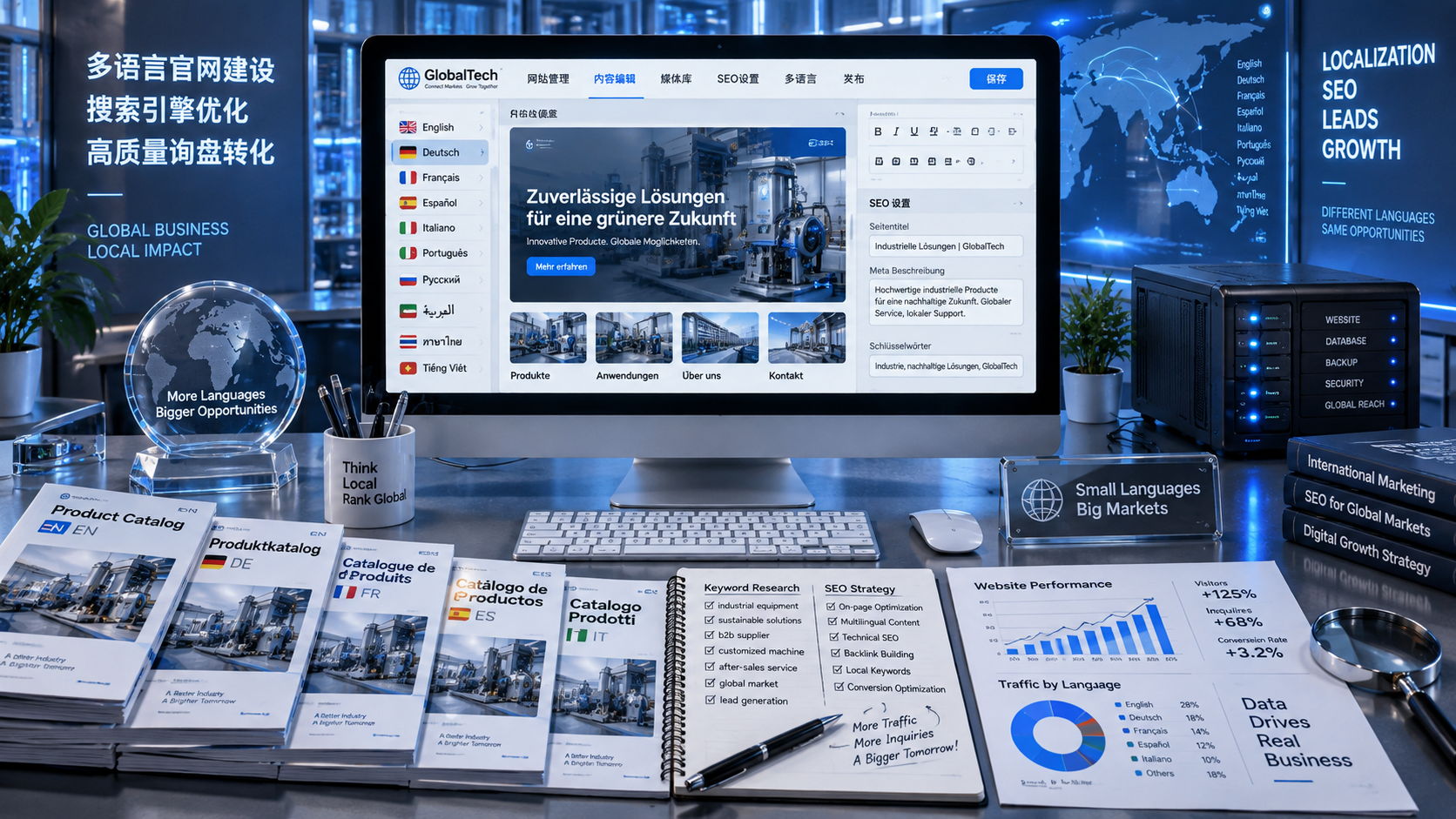
 Yiyingbao SaaS Intelligent Website Building and Marketing SystemYiyingbao SaaS Intelligent Website Building and Marketing System, AI-powered no-code website building, rapid creation of multilingual B2B international websites in 10 minutes, global server acceleration, AI-powered SEO optimization, helping businesses connect efficiently with global markets. The perfect integration of technology and operation makes building an international trade website remarkably simple
 AI+SEM Intelligent Advertising Marketing SystemAI+SEM drives intelligent ad creation, empowering full-funnel precision advertising marketing. The system automatically generates weekly/monthly reports, AI recommends keywords and target countries, monitors core metrics in real-time with intelligent alerts, and enables one-click high-conversion ad solutions to help quickly acquire customers and improve ROI.
 AI+SEO Dual-Engine System Optimization ServicesYiyingbao’s AI+SEO dual-engine optimization system helps foreign trade enterprises acquire high-quality organic traffic through AI-powered keyword research, content generation, and comprehensive technical optimization, significantly improving search rankings and conversion rates.
 AI+SNS Social Media Marketing SystemYingbao AI+SNS Social Media Marketing System - Precision social capture for the social media era. Supports one-click content synchronization across major platforms like Facebook and LinkedIn. AI intelligently rewrites posts for enhanced relevance. 24/7 AI customer service and user profiling analysis empower businesses to efficiently expand into global markets.
 AI+SEO营销解决方案易营宝AI+SEO营销解决方案,通过AI批量写作、智能生成TDK、精准关键词扩词等功能,全面优化网站SEO效果,提升流量与转化率。助力企业构建高效智能网站新生态。
 AI+SEM Advertising Marketing SolutionsAI+SEM Advertising Marketing Solution leverages AI technology to deeply empower SEM ad campaigns. It automatically generates weekly/monthly reports using AI, presenting account data across multiple dimensions for comprehensive insights into campaign performance and trends. The system precisely recommends keywords and target countries, intelligently generates high-conversion ad copy, and enables one-click activation of efficient campaign plans to help businesses rapidly acquire customers. Simultaneously, it monitors core metrics in real time, intelligently identifies abnormal fluctuations, and issues timely alerts to ensure stable, high-return advertising results.
 Domain Name ServicesEasyWin provides professional domain name services, including intelligent queries, one-stop registration, brand protection, and full lifecycle management, helping businesses build a digital brand image.
 EasyOperate B2C Cross-Border E-Commerce Platform & Independent WebsiteEasyStore B2C Cross-border E-commerce Independent Store is an intelligent website building and cross-border e-commerce integrated solution independently developed by EasyStore Information Technology (Beijing) Co., Ltd. The system is specially designed for small and medium-sized as well as large export enterprises, integrating 'website building, operation, marketing, advertising, and conversion' into one, helping enterprises quickly establish cross-border e-commerce independent stores to achieve brand globalization and global sales growth.
The platform supports multiple languages, multiple currencies, and multi-channel marketing, with built-in AI intelligent translation and SEO optimization systems, suitable for mainstream markets such as Southeast Asia, Europe and America, Latin America, and the Middle East, assisting Chinese manufacturing enterprises in efficiently deploying international e-commerce strategies. SSL证书易营宝提供专业SSL安全证书服务,包括单域名和泛域名证书,确保网站数据传输加密、身份验证和完整性保护,助力企业建立安全可信的在线业务环境。









