









- Which customer acquisition channels will be affected by cross-border marketing trends in 2026?Sep 06, 2026View details
- Which homogenization risks should be considered in an analysis of the AI-powered website building industry?Aug 30, 2026View details
- How Will AI Marketing Trends 2026 Change Advertising Budget AllocationAug 28, 2026View details
- Is the EV SSL certificate market shrinking or upgrading? How should companies assess certificate procurement?Aug 11, 2026View details
- Why the old AMP SEO 2020 practices no longer work and what has changed in current optimization prioritiesAug 02, 2026View details
- How to Choose Topics for an Industry News Section to Attract More Organic Search TrafficJul 29, 2026View details
- Digital Marketing Shenzhen Market Insights: Why Are Companies Expanding Overseas Looking for Growth Teams in Shenzhen?Jul 31, 2026View details
- Can Zhejiang foreign trade independent websites still be developed today? Look at changes in traffic and lead generationJul 28, 2026View details
Labor Costs for Multilingual Ad Campaigns: How Much Can an AI System Save?
As multilingual ad campaigns continue to scale up, what teams care about most is no longer just budget, but whether an AI advertising system can reduce the manpower required for multilingual media buying. Especially when overseas multilingual ad creatives need to stay coordinated while content cycles and conversion efficiency are both under pressure, systematic efficiency improvement is becoming critical.
Here is the conclusion first: yes, it can save manpower, and often not just a little. For teams covering multiple countries, multiple languages, and multiple channels at the same time, AI systems can usually reduce repetitive labor by 30% to 60%, and shortening the multilingual content production cycle from 7 days to 2 days is not an exaggeration.
But the prerequisite is that the system is not merely ‘able to translate’, but can connect website building, creatives, media buying, data feedback, and localization review into one workflow. What truly determines the outcome is not whether AI is used, but whether AI enters the main workflow of advertising collaboration.
What businesses really want to know is not how many people can be saved, but whether performance will decline after saving them
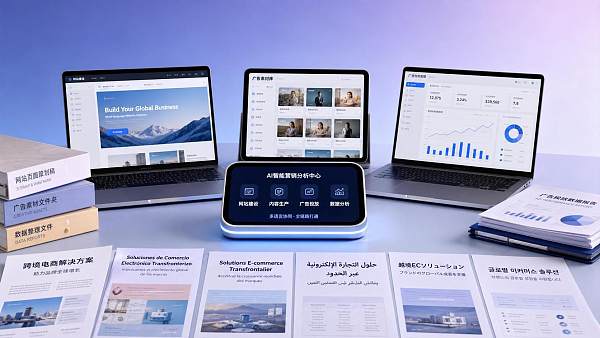
Readers searching for ‘how much labor cost can an AI system save in multilingual advertising’ usually have a very direct intent: they want to judge whether an AI advertising system is worth adopting, whether it can replace part of manual collaboration, and whether it will sacrifice conversion quality.
Most of these readers come from foreign trade companies, cross-border brands, manufacturing factories, and marketing leadership roles. They are not concerned with technical concepts, but with three things: whether manpower is genuinely reduced, whether campaign efficiency is clearly improved, and whether the results are controllable.
Especially after a team has started expanding into markets such as Germany, France, Spain, Japan, or the Middle East, multilingual advertising is no longer just translation work, but a cross-department collaboration issue. Creatives, pages, keywords, budgets, and data reviews all become more complex at the same time.
Therefore, when evaluating the value of an AI system, you should not only look at ‘how much copy it generated’, but whether it reduces communication rounds, lowers the rework rate, and enables media buyers to complete testing, scaling, and optimization faster. This is the most practical cost calculation for businesses.
The labor cost of multilingual advertising is often high because of collaboration and rework, not just production itself
Many companies underestimate the manpower consumed by multilingual advertising because they only count translation costs and ignore hidden costs. The truly expensive parts often appear in repeated requirement confirmation, adjustments for market differences, account structure splitting, and synchronized changes to landing pages.
Take a Google Ads project covering 5 countries as an example. A single new launch may involve keyword grouping, headline and description writing, image and video revisions, landing page adaptation, conversion tracking checks, and local review. Every step requires manual coordination, so the cycle naturally becomes longer.
If Facebook advertising or social media traffic acquisition is added on top of that, the number of creative versions will expand further. How to coordinate multilingual creatives for overseas advertising is no longer a question for the copywriting department, but a question of whether the entire marketing system has standardized output capabilities.
This is also why many teams still feel they cannot move fast even after adding more people. Their manpower is consumed by repetitive transfer work and inefficient communication, rather than by higher-value actions such as selecting markets, adjusting strategies, and filtering high-conversion traffic.
How much manpower an AI advertising system can save depends on which stages it takes over
If AI is only responsible for first-draft translation, the labor savings are limited, usually only reducing part of the copywriting time. A system with truly visible value should at least take over five types of actions: content generation, language adaptation, creative splitting, campaign recommendations, and data feedback.
The first type is batch generation. When facing multiple countries and product lines, AI can quickly generate multiple versions of headlines, descriptions, and calls to action based on keywords, audiences, and page information, shortening the preparation cycle. This is also an important basis for reducing the multilingual content production cycle from 7 days to 2 days.
The second type is localization adaptation. Different markets vary greatly in expression habits, selling point priorities, and price sensitivity. How to bring Google Ads CTR in the German market to 3% is often not about writing longer copy, but about making the copy better match the decision-making logic of local users.
The third type is creative coordination. A good system should not only generate a piece of text, but should unify website pages, ad copy, remarketing creatives, and short video scripts under the same selling point framework, reducing the disconnect where ‘the ad says one thing and the landing page says another’.
The fourth type is optimization recommendations. Can an AI advertising system automatically optimize multilingual ads? At the account level, it can help identify low-click headlines, low-conversion pages, and budget waste points, but whether to scale in the end still requires experienced media buyers to set boundaries and strategies.
The fifth type is error interception. For example, how to reduce the hreflang error rate of multilingual sites, whether page redirects lead to the wrong language, and whether landing pages time out during loading. If these problems are not handled in advance, even the best ad copy will struggle to convert, and manual rework costs will be higher.
Which roles are most likely to be freed up, and which roles become more important instead
The work that AI systems can most easily replace is highly repetitive, rule-based, and large in version volume, such as basic translation, first-draft copy, headline expansion, creative size adaptation, tag organization, and simple data classification. This part usually takes up a large amount of fragmented time for teams.
However, market judgment, budget allocation, conversion path design, and anomaly analysis will not only not be replaced, but will become more important. The manpower freed up by AI should ultimately be invested in higher-value work, rather than continuing to pile up at the repetitive execution layer.
So for managers, a more reasonable goal is not ‘hiring a few fewer people’, but enabling a team of the same size to run more markets, more products, and more test versions at the same time. Improving productivity per person is essentially more commercially meaningful than simple headcount reduction.
This also explains why, when comparing whether Google Ads managed operation or in-house media buying is more cost-effective, you cannot only compare service fees. If a company does not have mature multilingual collaboration capabilities internally, running campaigns in-house may not necessarily be cheaper, and may instead create higher opportunity costs due to low efficiency and slow trial and error.
How to judge whether your business is suitable for adopting an AI multilingual advertising system first
The first suitable scenario is when you have already entered more than two overseas markets and launch new ads frequently each month. As long as the account has multiple languages, multiple landing pages, and multiple test versions over the long term, the savings brought by an AI system are usually more direct and easier to quantify.
The second suitable scenario is when the website, SEO, and advertising already need to work together. For example, when asking whether SEO or Google Ads is better for foreign trade lead generation, in real practice this is often not an either-or choice. Ads validate the market, SEO accumulates traffic, and both need to share content assets.
The third suitable scenario is during website redesign or market expansion. Many companies ask whether European inquiry volume can recover and grow after a redesign. The answer usually depends on whether page structure, language matching, access speed, and ad reception are synchronized, while an AI system can improve overall coordination efficiency.
If your business is still advertising in only one country with one product, and creative updates are not frequent, then AI will have value, but not necessarily enough. At this stage, it is better to first stabilize the account structure, page quality, and conversion tracking before deciding whether to upgrade the system.
Do not understand ‘saving people’ as ‘automatically winning’. What truly determines results is process design
Many companies see average results after adopting a system, not because AI is useless, but because the workflow has not been rebuilt. For example, if input creative quality is poor, site information is incomplete, or language goals are unclear, then no matter how fast the system generates content, it is only producing imprecise content faster.
The correct approach is to first define a unified source of information, including product selling points, target countries, audience tags, landing page structure, and conversion goals, and then let AI perform batch generation, automatic distribution, and continuous optimization within this framework. Only in this way can output become stable and reusable.
At the same time, the technical foundation cannot be ignored. Multilingual advertising ultimately depends on page experience, such as how to keep global node access latency within 100ms, whether forms are smooth, and whether the mobile experience is stable. All of these directly affect campaign results.
For companies that need long-term overseas growth, it is more suitable to choose a platform that connects AI-powered website building, multilingual website development, SEO optimization, and ad placement, rather than purchasing a collection of fragmented tools. Only when the workflow is connected can savings truly happen.
From a cost perspective, the most worthwhile value of an AI system is accelerating the pace of growth
Looking only at labor cost, AI can certainly help companies reduce investment in basic execution, but its greater value is actually shortening the trial-and-error cycle. In the past, it might take one week for a country to go from page creation to launch; now the first round of testing can be completed within two days, making the growth rhythm noticeably different.
For cross-border e-commerce and foreign trade lead generation, speed itself is competitiveness. Whoever can complete multilingual launches faster, obtain CTR and conversion data faster, and iterate creatives faster is more likely to gain a first-mover advantage in the target market, instead of passively catching up.
Therefore, can an AI advertising system reduce the manpower required for multilingual media buying? The answer is yes. But more accurately, it reduces the proportion of inefficient labor and improves the team’s ability to invest energy in growth decisions. This is the ROI that businesses should pay attention to.
For companies expanding into global markets, the evaluation standard can be simple: if your team has already been slowed down by multilingual creatives, cross-regional collaboration, and page rework, then the question to consider is not whether to use AI, but how to use a truly implementable system as soon as possible to get the workflow running smoothly.
Related Articles
Related Products
 Yiyingbao SaaS Intelligent Website Building and Marketing SystemYiyingbao SaaS Intelligent Website Building and Marketing System, AI-powered no-code website building, rapid creation of multilingual B2B international websites in 10 minutes, global server acceleration, AI-powered SEO optimization, helping businesses connect efficiently with global markets. The perfect integration of technology and operation makes building an international trade website remarkably simple
 AI+SEM Intelligent Advertising Marketing SystemAI+SEM drives intelligent ad creation, empowering full-funnel precision advertising marketing. The system automatically generates weekly/monthly reports, AI recommends keywords and target countries, monitors core metrics in real-time with intelligent alerts, and enables one-click high-conversion ad solutions to help quickly acquire customers and improve ROI.
 AI+SEO Dual-Engine System Optimization ServicesYiyingbao’s AI+SEO dual-engine optimization system helps foreign trade enterprises acquire high-quality organic traffic through AI-powered keyword research, content generation, and comprehensive technical optimization, significantly improving search rankings and conversion rates.
 AI+SNS Social Media Marketing SystemYingbao AI+SNS Social Media Marketing System - Precision social capture for the social media era. Supports one-click content synchronization across major platforms like Facebook and LinkedIn. AI intelligently rewrites posts for enhanced relevance. 24/7 AI customer service and user profiling analysis empower businesses to efficiently expand into global markets.
 AI+SEO营销解决方案易营宝AI+SEO营销解决方案,通过AI批量写作、智能生成TDK、精准关键词扩词等功能,全面优化网站SEO效果,提升流量与转化率。助力企业构建高效智能网站新生态。
 AI+SEM Advertising Marketing SolutionsAI+SEM Advertising Marketing Solution leverages AI technology to deeply empower SEM ad campaigns. It automatically generates weekly/monthly reports using AI, presenting account data across multiple dimensions for comprehensive insights into campaign performance and trends. The system precisely recommends keywords and target countries, intelligently generates high-conversion ad copy, and enables one-click activation of efficient campaign plans to help businesses rapidly acquire customers. Simultaneously, it monitors core metrics in real time, intelligently identifies abnormal fluctuations, and issues timely alerts to ensure stable, high-return advertising results.
 Domain Name ServicesEasyWin provides professional domain name services, including intelligent queries, one-stop registration, brand protection, and full lifecycle management, helping businesses build a digital brand image.
 EasyOperate B2C Cross-Border E-Commerce Platform & Independent WebsiteEasyStore B2C Cross-border E-commerce Independent Store is an intelligent website building and cross-border e-commerce integrated solution independently developed by EasyStore Information Technology (Beijing) Co., Ltd. The system is specially designed for small and medium-sized as well as large export enterprises, integrating 'website building, operation, marketing, advertising, and conversion' into one, helping enterprises quickly establish cross-border e-commerce independent stores to achieve brand globalization and global sales growth.
The platform supports multiple languages, multiple currencies, and multi-channel marketing, with built-in AI intelligent translation and SEO optimization systems, suitable for mainstream markets such as Southeast Asia, Europe and America, Latin America, and the Middle East, assisting Chinese manufacturing enterprises in efficiently deploying international e-commerce strategies. SSL证书易营宝提供专业SSL安全证书服务,包括单域名和泛域名证书,确保网站数据传输加密、身份验证和完整性保护,助力企业建立安全可信的在线业务环境。









