









- Which customer acquisition channels will be affected by cross-border marketing trends in 2026?Sep 06, 2026View details
- Which homogenization risks should be considered in an analysis of the AI-powered website building industry?Aug 30, 2026View details
- How Will AI Marketing Trends 2026 Change Advertising Budget AllocationAug 28, 2026View details
- Is the EV SSL certificate market shrinking or upgrading? How should companies assess certificate procurement?Aug 11, 2026View details
- Why the old AMP SEO 2020 practices no longer work and what has changed in current optimization prioritiesAug 02, 2026View details
- How to Choose Topics for an Industry News Section to Attract More Organic Search TrafficJul 29, 2026View details
Can an AI advertising system reduce manpower for multilingual ad campaigns
Can an AI advertising system reduce the manpower required for multilingual ad campaigns? For companies expanding overseas, the answer is not only about efficiency, but also affects customer acquisition costs and growth speed. This article will combine multilingual content production, ad optimization, and landing-page conversion to explain how AI reshapes global advertising collaboration.
For foreign trade companies, manufacturing factories, cross-border sellers, and brands going global, multilingual advertising has never been simple translation. It is a systematic project that includes keyword adaptation, creative localization, landing-page consistency, data feedback, and continuous optimization. When one team runs campaigns in 5 or more languages such as English, German, French, Japanese, and Spanish at the same time, it often encounters problems such as scattered manpower, overly long workflows, and delayed advertising feedback.
In an integrated website + marketing service scenario, the value of an AI advertising system is not only reflected in “saving headcount”, but also in connecting website building, content, advertising, SEO, and conversion data. Especially when companies start to care about questions such as how to reduce the hreflang error rate of multilingual websites, how to coordinate multilingual creatives for overseas advertising, and whether SEO or Google Ads is better for foreign trade lead generation, traditional segmented manual collaboration can no longer easily support scalable growth.
Where Is Manpower Mainly Consumed in Multilingual Advertising?
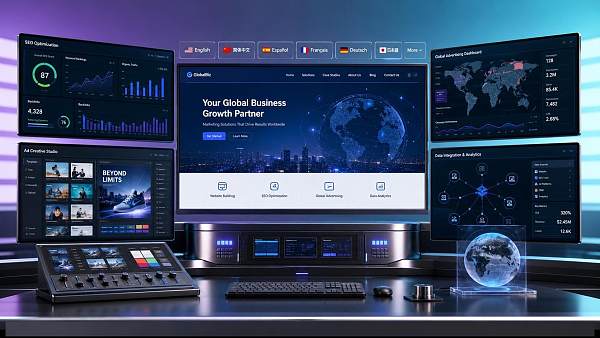
Many companies mistakenly believe that the manpower cost of multilingual advertising is concentrated on translation. In fact, the greater consumption occurs across the collaboration chain. A complete advertising project usually includes 4 modules: account structure setup, creative and copy production, landing-page adaptation, and data monitoring and iteration. As long as 1 node is disconnected, overall conversion efficiency will drop significantly.
4 Common Types of High-Frequency Losses in Manual Multilingual Advertising
The first type is repeated content production. When advertising the same product in 6 languages, titles, descriptions, selling points, image captions, and landing-page copy often need to be repeatedly rewritten for more than 3 rounds. It is not uncommon for the production cycle to stretch from 2 days to 7 days. This is also the fundamental reason why many companies ask whether the multilingual content production cycle can be shortened from 7 days to 2 days.
The second type is localization deviation. Search habits for German ads, the politeness levels in Japanese ad expressions, and pricing communication styles in the Latin American market are all different. Relying only on literal translation makes it difficult to stabilize CTR and conversion rates. For example, how to achieve a 3% CTR for Google Ads in the German market is often not a budget issue, but a mismatch between keyword intent and copy context.
The third type is data disconnection between on-site and off-site channels. The advertising team adjusts keywords, the website team modifies pages, and the SEO team handles indexing and structure issues. Without a unified system, problems may occur, such as ads leading to old pages, missing form tracking data, and conflicts in hreflang settings, ultimately affecting the speed of inquiry recovery in regions such as Europe and North America.
The fourth type is delayed optimization actions. Manually checking multiple accounts, multiple time zones, and multiple language versions every day can easily delay effective adjustments by 24 to 72 hours. For industries with obvious fluctuations in cost per click, this delay will directly drive up customer acquisition costs.
What Repetitive Work Can an AI Advertising System Replace?
The first thing an AI advertising system replaces is not strategic judgment, but standardized, repetitive, and time-consuming execution tasks. These include generating first drafts of multilingual copy, expanding keywords, splitting creative versions, reminding teams about campaign pacing, warning about abnormal fluctuations, and suggesting budget allocation. For small and medium-sized overseas expansion teams, this type of automation can usually reduce basic execution hours by 30% to 50%.
If the system is further connected with the independent website backend, form leads, and SEO page structure, it can also reduce secondary communication costs. For example, if the bounce rate of a German landing page is higher than 70%, the system can simultaneously remind the advertising side to reduce the weight of traffic entry to that page, and feed back to the website side to adjust the title, above-the-fold content, and form position.
The table below shows more intuitively the differences between manual advertising and AI-assisted advertising in typical multilingual scenarios.
From the execution perspective, the answer to whether an AI advertising system can reduce manpower for multilingual advertising is yes. However, the prerequisite is that the system must not only “generate copy”, but also have the ability to connect websites, content, advertising, and monitoring. Otherwise, the company is merely replacing one manual bottleneck with another manual review bottleneck.
Why Website and Advertising Integration Is the Key to Reducing Multilingual Costs
The manpower required for multilingual advertising is not only consumed in the ad platform backend. The generation, publishing, revision, and tracking configuration of landing pages also take up a great deal of time. Especially for companies expanding overseas through independent websites, advertising performance often depends on the second half of the “post-click experience”. If the site structure is chaotic, even strong campaign optimization can hardly continue to amplify results.
From Website Building to Advertising, at Least 5 Data Nodes Must Be Connected
The first is the mapping between language pages and ad groups. English ads should lead to English pages, and German ads should lead to German pages. All traffic should not be directed to the same English website. The second is the correspondence between keywords and page topics, avoiding high-intent keywords being directed to generic content pages. The third is unified feedback of conversion events such as forms, phone calls, and WhatsApp. The fourth is regional loading speed. The fifth is the shared use of page structure by SEO and advertising.
For example, how to control global node access latency within 100ms may seem like a technical issue, but it directly affects ad quality scores and conversion rates. If European users take more than 3 seconds to open a page, the bounce rate usually rises significantly, and advertising costs will also be indirectly amplified.
hreflang and Multilingual Indexing Are Not Just SEO Issues
How to reduce the hreflang error rate of multilingual websites is a question many companies only start to pay attention to after a website redesign. If a German page is identified by Google as an English page, users brought in by both ads and search will encounter a language mismatch. A common approach is to include hreflang validation in the website publishing process, so that every time a new language is added, a URL is modified, or a template is copied, automatic detection is performed to avoid generating a batch of indexing errors every time a page is changed.
For the European market, it is best to keep website language, currency, contact methods, and privacy compliance notices consistent. The smaller the information gap between on-site and off-site channels, the lower the trust loss after ad clicks. This is also a key judgment point for the question of whether European inquiry volume can recover and grow after a redesign.
Which Overseas Expansion Teams Are Suitable for an 易营宝-Style Integrated Solution?
易营宝信息科技(北京)有限公司 was founded in 2013 and is headquartered in Beijing. It has long served companies in foreign trade, manufacturing, cross-border e-commerce, and brands going global. Its advantage is not single-point advertising, but integrating AI intelligent website building, multilingual website construction, Google SEO optimization, Google Ads management, Facebook advertising marketing, and GEO optimization into a unified growth chain, reducing repeated coordination between multiple suppliers.
For companies with more than 3 target markets, continuous monthly advertising, and a need to accumulate organic traffic and advertising data over the long term, this model is more valuable. This is because advertising is not a short-term action. Campaign data can in turn guide page structure, content topics, and market priorities, and these require deep coupling between the website building system and the marketing system.
If a company is evaluating whether Google Ads agency operation or in-house advertising is more cost-effective, it can first make a judgment from the following dimensions.
The core of this table is not simply to compare “which is cheaper”, but to determine whether the company already has the complete ability to independently handle multilingual website building, advertising, SEO, tracking, and optimization. If the internal team has only 1 to 2 operations staff but needs to cover 5 regional markets, an integrated solution is usually more cost-effective.
How to Determine Whether an AI Advertising System Is Truly Suitable for Your Overseas Business
Not all AI tools can directly solve advertising problems. When choosing a system, companies are advised to shift from asking “can it be used” to asking “can it continuously produce verifiable results”. Especially in B2B scenarios, advertising goals are often not immediate orders, but inquiries, sample requests, appointment-based communication, and distributor cooperation leads. Therefore, the evaluation criteria must be more complete.
Check These 4 Capabilities First
- Whether it supports linkage between multilingual ad copy and landing-page content, rather than only generating ad headlines.
- Whether it has automatic alerts and optimization suggestions for budget, bidding, and creative performance, with at least daily monitoring.
- Whether it can feed SEO, advertising, and social media traffic back into the website conversion layer in a unified way to form clear attribution.
- Whether it supports localized configurations for different regional markets, such as currency, form fields, node acceleration, and language structure.
Do Not Ignore the Hidden Cost of “Creative Collaboration”
How to coordinate multilingual creatives for overseas advertising often determines how fast a team can scale. A relatively mature approach is to first output 1 set of main creative structures, then split it into 3 layers: brand layer, product layer, and market layer. The brand layer maintains unified visuals, the product layer highlights functional selling points, and the market layer is refined according to language and scenario. This ensures efficiency while avoiding rebuilding everything from scratch for each language.
If the AI system can automatically identify creative click-through rates, conversion rates, and page dwell time, and provide replacement suggestions for low-performing versions, the advertising team does not need to manually review dozens of creative groups every week. For teams with more than 10 advertising campaigns in their monthly accounts, this capability can significantly reduce the operational burden.
SEO and Google Ads Do Not Have to Be an Either-Or Choice
Whether SEO or Google Ads is better for foreign trade customer acquisition is a common question for many companies when allocating budgets. A more reasonable approach is phased allocation: use ads in the first 1 to 3 months to validate the market, keyword packages, and page direction; use SEO simultaneously from 3 to 12 months to accumulate organic traffic; and after high-converting keywords, page templates, and regional demand gradually stabilize, improve long-term ROI through an AI optimization system.
From this perspective, the answer to whether an AI advertising system can automatically optimize multilingual ads is not “fully automatic”, but “automatically handling high-frequency variables while humans are responsible for business judgment”. A truly effective model is one in which AI solves speed and scale, while the team is responsible for market understanding and business decisions.
When companies face multilingual content, independent website construction, Google Ads, SEO, and social media growth at the same time, single-point tools often only solve partial efficiency problems. What is more suitable for companies expanding overseas is to integrate websites, content, advertising, and conversion into the same growth framework, so that every click, every page, and every lead can be continuously optimized.
Relying on its self-developed cloud intelligent website building system, cross-border mall system, AI advertising marketing system, and AI+SEO/GEO optimization system, 易营宝 can help companies shorten the content production cycle, reduce manpower for advertising collaboration, and improve the continuity of inquiry conversion in multi-region and multilingual scenarios. If you are evaluating a multilingual independent website, Google Ads agency operation, or an AI advertising collaboration solution, it is recommended to obtain a customized solution as soon as possible based on your own market layout, learn more about the solutions, and consult product details.
Related Articles


Related Products
 Yiyingbao SaaS Intelligent Website Building and Marketing SystemYiyingbao SaaS Intelligent Website Building and Marketing System, AI-powered no-code website building, rapid creation of multilingual B2B international websites in 10 minutes, global server acceleration, AI-powered SEO optimization, helping businesses connect efficiently with global markets. The perfect integration of technology and operation makes building an international trade website remarkably simple
 AI+SEM Intelligent Advertising Marketing SystemAI+SEM drives intelligent ad creation, empowering full-funnel precision advertising marketing. The system automatically generates weekly/monthly reports, AI recommends keywords and target countries, monitors core metrics in real-time with intelligent alerts, and enables one-click high-conversion ad solutions to help quickly acquire customers and improve ROI.
 AI+SEO Dual-Engine System Optimization ServicesYiyingbao’s AI+SEO dual-engine optimization system helps foreign trade enterprises acquire high-quality organic traffic through AI-powered keyword research, content generation, and comprehensive technical optimization, significantly improving search rankings and conversion rates.
 AI+SNS Social Media Marketing SystemYingbao AI+SNS Social Media Marketing System - Precision social capture for the social media era. Supports one-click content synchronization across major platforms like Facebook and LinkedIn. AI intelligently rewrites posts for enhanced relevance. 24/7 AI customer service and user profiling analysis empower businesses to efficiently expand into global markets.
 AI+SEO营销解决方案易营宝AI+SEO营销解决方案,通过AI批量写作、智能生成TDK、精准关键词扩词等功能,全面优化网站SEO效果,提升流量与转化率。助力企业构建高效智能网站新生态。
 AI+SEM Advertising Marketing SolutionsAI+SEM Advertising Marketing Solution leverages AI technology to deeply empower SEM ad campaigns. It automatically generates weekly/monthly reports using AI, presenting account data across multiple dimensions for comprehensive insights into campaign performance and trends. The system precisely recommends keywords and target countries, intelligently generates high-conversion ad copy, and enables one-click activation of efficient campaign plans to help businesses rapidly acquire customers. Simultaneously, it monitors core metrics in real time, intelligently identifies abnormal fluctuations, and issues timely alerts to ensure stable, high-return advertising results.
 Domain Name ServicesEasyWin provides professional domain name services, including intelligent queries, one-stop registration, brand protection, and full lifecycle management, helping businesses build a digital brand image.
 EasyOperate B2C Cross-Border E-Commerce Platform & Independent WebsiteEasyStore B2C Cross-border E-commerce Independent Store is an intelligent website building and cross-border e-commerce integrated solution independently developed by EasyStore Information Technology (Beijing) Co., Ltd. The system is specially designed for small and medium-sized as well as large export enterprises, integrating 'website building, operation, marketing, advertising, and conversion' into one, helping enterprises quickly establish cross-border e-commerce independent stores to achieve brand globalization and global sales growth.
The platform supports multiple languages, multiple currencies, and multi-channel marketing, with built-in AI intelligent translation and SEO optimization systems, suitable for mainstream markets such as Southeast Asia, Europe and America, Latin America, and the Middle East, assisting Chinese manufacturing enterprises in efficiently deploying international e-commerce strategies. SSL证书易营宝提供专业SSL安全证书服务,包括单域名和泛域名证书,确保网站数据传输加密、身份验证和完整性保护,助力企业建立安全可信的在线业务环境。









