









- Which customer acquisition channels will be affected by cross-border marketing trends in 2026?Sep 06, 2026View details
- Which homogenization risks should be considered in an analysis of the AI-powered website building industry?Aug 30, 2026View details
- How Will AI Marketing Trends 2026 Change Advertising Budget AllocationAug 28, 2026View details
- Is the EV SSL certificate market shrinking or upgrading? How should companies assess certificate procurement?Aug 11, 2026View details
- Why the old AMP SEO 2020 practices no longer work and what has changed in current optimization prioritiesAug 02, 2026View details
- How to Choose Topics for an Industry News Section to Attract More Organic Search TrafficJul 29, 2026View details
- Digital Marketing Shenzhen Market Insights: Why Are Companies Expanding Overseas Looking for Growth Teams in Shenzhen?Jul 31, 2026View details
- Can Zhejiang foreign trade independent websites still be developed today? Look at changes in traffic and lead generationJul 28, 2026View details
DV certificates are issued quickly, but why are they unsuitable for brand trust-focused websites
Many businesses start by installing a dv certificate, but where exactly is the problem?
If your only goal is to enable HTTPS on your website as quickly as possible, a dv certificate is indeed very convenient. Once domain control has been verified, the certificate can be issued quickly, and the deployment threshold is also relatively low. However, when the website is responsible for brand presentation, inquiry conversion, and business credibility, the issue is no longer simply whether it can display a lock icon.
When business decision-makers first encounter certificates, they often mistake “the browser displays a security lock” for “customers already trust me enough.” In reality, this is often not the case. For visitors, a dv certificate can only prove that control of the domain has been verified. It cannot directly tell them who the company is, whether the business entity is clearly identified, whether the website is worth submitting an inquiry or making a payment, or whether it is safe to provide information.
What does a dv certificate actually verify, and what does it not verify?
Let us clarify the core concept first. The “DV” in dv certificate essentially means domain validation. The certificate authority confirms that you control a particular domain, for example, by verifying that you can receive emails, modify DNS records, or place a verification file on the website. Once verification is complete, the certificate can be issued.
However, it does not constitute business identity verification. In other words, visitors can see that the connection is encrypted, but they may not be able to confirm the operating entity behind the website through the certificate. For personal blogs, test sites, and campaign pages, this is usually sufficient. For brand websites, especially those engaged in overseas promotion, B2B inquiry generation, or region-specific multilingual business, this information gap can directly affect the sense of trust.
You can think of it this way: a dv certificate solves the “basic problem of transmission security,” not the “problem of commercial identity recognition.” The latter is more important to a brand-oriented website.
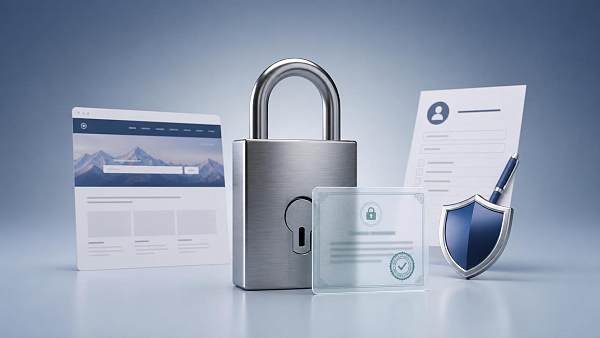
Why are brand-trust-oriented websites more sensitive to the type of certificate?
Customers are not examining technical parameters; they are judging whether you are reliable
Visitors to a corporate website, especially procurement professionals, distributors, and overseas business partners, do not usually study every detail of the certificate. They care more about several practical questions: Does this company really exist? Do the contact information and business entity match? Will there be any risk in submitting a form, downloading materials, or sending an inquiry?
If the website only uses a dv certificate, visitors can perceive that “the connection is encrypted,” but they cannot obtain more identity confirmation from the certificate. For a website that emphasizes brand image and needs to establish initial trust, this solution of “solving encryption without strengthening identification” is often insufficient.
The closer customers get to a transaction, the more they worry about incomplete information
A brand website is not used only to display a company profile. It often handles advertising traffic, organic search traffic, and social media referrals, and may even lead directly to quotation requests, lead submissions, and demo bookings. The closer users get to conversion, the more closely they scrutinize details.
That is why many teams working on overseas corporate websites and international marketing do not focus only on page design and loading speed during website development. They also incorporate the certificate, business-entity presentation, privacy page, and consistency of company information into the overall trust system. A certificate is not everything, but it is one of the basic signals.
Is having HTTPS enough? Do users really care?
It depends on the scenario.
For ordinary content websites, short-term campaign pages, and internal testing environments, HTTPS itself solves most basic problems as long as there is no significant need to build brand trust. Corporate websites are different, especially in the following scenarios, where users usually care more about “who you are” than “whether you have a lock icon”:
- Customers need to submit inquiries, mobile phone numbers, email addresses, or purchasing requirements
- The website targets overseas markets and receives a large amount of cold traffic from people encountering the brand for the first time
- The website handles investment promotion, distributor recruitment, sample requests, demo bookings, and similar tasks
- The relationships among the company name, domains, site network, and multilingual versions are relatively complex
In these situations, although a dv certificate does not directly make the website “unsafe,” it also does not actively strengthen the identity signals users need for their evaluation. For the conversion journey, this means one layer of support is missing.
Which websites are dv certificates suitable for, and which are they unsuitable for?
The best way to address this question is through comparison:
In other words, a dv certificate is not unusable; the key is to consider what business role the website performs. The more a corporate website functions as a “sales front desk,” the less appropriate it is to make decisions based solely on issuance speed.
When making business decisions, what information is more important to check than the certificate?
This is something many management teams tend to overlook. A certificate is only one part of a website’s trust system, and its significance is limited when considered alone. What usually affects conversion is whether the following elements are consistent:
- Whether the domain generally corresponds to the brand name, company name, and advertising entity.
- Whether the company name is consistent in the website footer, contact page, and privacy policy.
- Whether the domain of the email address used after an inquiry form is submitted still belongs to the company domain.
- Whether multilingual sites share a unified brand system rather than presenting a different business entity in each language.
- Whether the brand information on advertising landing pages, the website homepage, and social media profiles corresponds to one another.
If these elements are inconsistent, switching to a higher-level certificate will not automatically eliminate the trust problem. Conversely, even if a brand website temporarily uses a dv certificate, it can still perform much better than a site with “only a lock and no credible information,” provided that the business entity is clearly identified, the pages are professional, and the conversion path is complete.
Since dv certificates are issued quickly, can businesses use one first and upgrade later?
Yes. This is common in actual website development, especially when a project needs to go live quickly. The problem is not using one “first”; it is that many teams never make adjustments after doing so. As a result, the website may already be handling core traffic while still operating with only the most basic configuration.
A more reliable approach is to include certificate selection in the website launch checklist rather than treating it as a temporary technical task. For example, when a website moves from a testing environment to its official domain, starts running Google SEO, launches advertising campaigns, opens sample requests, or begins accepting business appointments, the company should reassess whether the certificate and business-entity presentation match the current stage of the business.
This is somewhat similar to operations management. There is no problem with getting the basic functions running first, but once the website enters a formal evaluation and long-term optimization phase, the evaluation criteria must also be upgraded. A similar “complete first, then refine” management approach can also be found in professional materials. For example, Application Strategies for Budget Performance Management in Public Institution Financial Management discusses first establishing a framework and then gradually correcting it according to objectives and results. The same approach applies to website development.
If a website targets overseas customers, will the weaknesses of a dv certificate be more noticeable?
Usually, yes. The reason is not complicated: overseas visitors have no offline familiarity with you and lack recommendations from people they know, so the website is often their first impression. In particular, in scenarios such as B2B international trade, overseas expansion for manufacturing companies, and standalone websites for cross-border brands, customers often review multiple signals at the same time, including the company profile, certifications and qualifications, contact information, domain age, and page language quality.
In this situation, the problem with a dv certificate is not that “it is unsafe,” but that “it provides too little information.” When users are already cautious about an unfamiliar brand, any weak signal makes it more difficult for them to submit a form.
How should businesses choose a certificate to avoid taking the wrong path?
The choice can be based on the purpose of the website rather than on “which certificate is issued faster.”
If your website is merely a basic site at the technical deployment level, a dv certificate is sufficient. If the website needs to handle brand communication, inquiry generation, advertising conversion, and the establishment of trust overseas, certificate selection should be considered together with website development, SEO, content, and conversion design. For companies operating multilingual websites and overseas advertising campaigns in particular, page security, brand identity, search visibility, and inquiry paths are inherently interconnected. Separating them can easily lead to an inaccurate assessment.
A practical rule of thumb is: as long as your website needs unfamiliar customers to decide “I am willing to leave my information” during their first visit, do not treat a dv certificate alone as the final solution. Solve encryption first, then supplement identity and trust. This sequence better reflects the actual needs of a brand-oriented website. For methodology that may be useful during internal evaluation, you can also refer to content such as Application Strategies for Budget Performance Management in Public Institution Financial Management. Drawing on the ideas of goal breakdown and process evaluation can be more helpful than looking only at technical configuration.
Related Articles

Related Products
 Yiyingbao SaaS Intelligent Website Building and Marketing SystemYiyingbao SaaS Intelligent Website Building and Marketing System, AI-powered no-code website building, rapid creation of multilingual B2B international websites in 10 minutes, global server acceleration, AI-powered SEO optimization, helping businesses connect efficiently with global markets. The perfect integration of technology and operation makes building an international trade website remarkably simple
 AI+SEM Intelligent Advertising Marketing SystemAI+SEM drives intelligent ad creation, empowering full-funnel precision advertising marketing. The system automatically generates weekly/monthly reports, AI recommends keywords and target countries, monitors core metrics in real-time with intelligent alerts, and enables one-click high-conversion ad solutions to help quickly acquire customers and improve ROI.
 AI+SEO Dual-Engine System Optimization ServicesYiyingbao’s AI+SEO dual-engine optimization system helps foreign trade enterprises acquire high-quality organic traffic through AI-powered keyword research, content generation, and comprehensive technical optimization, significantly improving search rankings and conversion rates.
 AI+SNS Social Media Marketing SystemYingbao AI+SNS Social Media Marketing System - Precision social capture for the social media era. Supports one-click content synchronization across major platforms like Facebook and LinkedIn. AI intelligently rewrites posts for enhanced relevance. 24/7 AI customer service and user profiling analysis empower businesses to efficiently expand into global markets.
 AI+SEO营销解决方案易营宝AI+SEO营销解决方案,通过AI批量写作、智能生成TDK、精准关键词扩词等功能,全面优化网站SEO效果,提升流量与转化率。助力企业构建高效智能网站新生态。
 AI+SEM Advertising Marketing SolutionsAI+SEM Advertising Marketing Solution leverages AI technology to deeply empower SEM ad campaigns. It automatically generates weekly/monthly reports using AI, presenting account data across multiple dimensions for comprehensive insights into campaign performance and trends. The system precisely recommends keywords and target countries, intelligently generates high-conversion ad copy, and enables one-click activation of efficient campaign plans to help businesses rapidly acquire customers. Simultaneously, it monitors core metrics in real time, intelligently identifies abnormal fluctuations, and issues timely alerts to ensure stable, high-return advertising results.
 Domain Name ServicesEasyWin provides professional domain name services, including intelligent queries, one-stop registration, brand protection, and full lifecycle management, helping businesses build a digital brand image.
 EasyOperate B2C Cross-Border E-Commerce Platform & Independent WebsiteEasyStore B2C Cross-border E-commerce Independent Store is an intelligent website building and cross-border e-commerce integrated solution independently developed by EasyStore Information Technology (Beijing) Co., Ltd. The system is specially designed for small and medium-sized as well as large export enterprises, integrating 'website building, operation, marketing, advertising, and conversion' into one, helping enterprises quickly establish cross-border e-commerce independent stores to achieve brand globalization and global sales growth.
The platform supports multiple languages, multiple currencies, and multi-channel marketing, with built-in AI intelligent translation and SEO optimization systems, suitable for mainstream markets such as Southeast Asia, Europe and America, Latin America, and the Middle East, assisting Chinese manufacturing enterprises in efficiently deploying international e-commerce strategies. SSL证书易营宝提供专业SSL安全证书服务,包括单域名和泛域名证书,确保网站数据传输加密、身份验证和完整性保护,助力企业建立安全可信的在线业务环境。









