









- Which customer acquisition channels will be affected by cross-border marketing trends in 2026?Sep 06, 2026View details
- Which homogenization risks should be considered in an analysis of the AI-powered website building industry?Aug 30, 2026View details
- How Will AI Marketing Trends 2026 Change Advertising Budget AllocationAug 28, 2026View details
- Is the EV SSL certificate market shrinking or upgrading? How should companies assess certificate procurement?Aug 11, 2026View details
- Why the old AMP SEO 2020 practices no longer work and what has changed in current optimization prioritiesAug 02, 2026View details
- How to Choose Topics for an Industry News Section to Attract More Organic Search TrafficJul 29, 2026View details
What to Check Before Purchasing a DV Certificate: Validation Methods and Renewal Costs
Clarify your procurement objective first: are you buying for “fast deployment” or “long-term operation”?
When purchasing dv zertifikat, many people instinctively compare prices and place an order with the cheapest supplier. This approach may work for temporary campaign pages, but if the certificate is intended for a corporate website, independent site, inquiry page, or landing page used for long-term advertising, focusing only on the first-year price can easily lead to the wrong purchase. The first questions to ask are: Which domain will the certificate be deployed on? Who will be responsible for renewal? Will the website support ongoing activities such as advertising, SEO indexing, and customer form submissions?
A DV certificate essentially verifies control of the domain. It is suitable for scenarios that require fast issuance and do not need to display verified corporate identity information. It is not that you should not buy one; you simply need to understand what you are buying. During procurement, consider the validation method, issuance time, compatibility, after-sales support, and renewal cost together to avoid unnecessary problems later.
Verify the validation method first instead of discovering after payment that you are blocked by email or DNS permissions
What procurement personnel most often overlook is not the certificate specifications, but whether “you can actually complete the validation.” dv zertifikat commonly uses validation methods centered on domain control. In practice, the process often gets stuck for one of two reasons: the domain administrator’s email cannot receive messages, or the DNS permissions are not held by the current team.
Before placing an order, confirm the following points directly:
- Who manages the domain registrar account, and whether they can log in and modify DNS records on the same day.
- Whether the company can still receive emails sent to the domain’s administrative mailbox.
- Whether the website uses a CDN, proxy, or third-party DNS, and whether DNS changes need to go through another service provider.
- Whether someone is available to cooperate with the validation within the issuance window.
If any of these points is unclear, do not rush to make the payment. The certificate itself is not complicated; the complicated part is your internal permission chain. In the procurement process, what often takes the most time is not issuance by the supplier, but finding someone on your own team who can modify DNS settings.
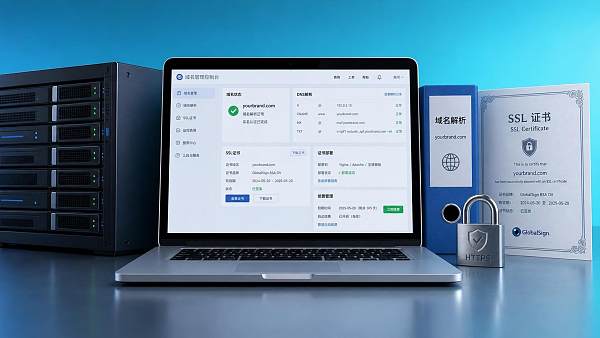
Whether issuance is fast depends on your website environment, not just the sales promise
Many suppliers describe DV certificates as being “issued within minutes.” This is not necessarily incorrect, but it assumes that the validation conditions have already been met. For procurement personnel, issuance efficiency should be evaluated based on actual implementation conditions rather than an ideal time estimate.
A more practical way to ask is: What validation steps are required after submitting the order? What are the most common reasons for validation failure? Is a new application required after failure? Will the existing website be affected? This is especially important when redesigning an existing site, switching to an overseas multilingual site, or replacing a landing page used for advertising, as these situations are not suitable for repeated troubleshooting during the certificate process.
If the website is undergoing SEO optimization or running advertising campaigns, confirm the change window with the technical team before switching certificates. This helps prevent deployment errors from causing temporary page inaccessibility, abnormal redirects, or form submission errors. Certificate procurement may seem like a minor matter, but once it is connected to the marketing process, the impact goes far beyond the small lock icon in the browser.
Do not look only at the unit price; renewal cost is what you will pay every year
A low first-year price followed by a relatively high renewal price is common in procurement. For websites used for one-off projects, this may not be a major issue. For corporate websites, independent sites, and long-term inquiry sites, however, renewal is the cost item that deserves closer attention.
During procurement, at least separate and review the following costs:
Evaluating the total cost of ownership is more meaningful than looking at the single figure on a quotation. This is particularly true when a website involves more than one domain, as well as test sites, campaign sites, or regional sites. The renewal strategy will directly affect the annual budget.
Brand credibility and compatibility should be evaluated in terms of marketing results
When comparing DV certificates, procurement teams should focus less on promotional language and more on browser compatibility, deployment stability, and the convenience of after-sales support. For teams managing overseas corporate websites, cross-border e-commerce stores, and multilingual sites, a certificate is not an isolated procurement item. It directly affects the customer access experience, form submissions, trust before payment, and page security warnings.
Here is a practical way to evaluate a supplier: do not ask “Is it a major brand?” Instead, ask “Can problems be quickly identified and resolved when they occur?” If a supplier can clearly explain issuance, deployment, reissuance, and expiration reminders, that is generally more valuable for procurement than simply emphasizing its brand name.
For websites operated over the long term, certificate management is best considered as part of the same workflow as website development, SEO, and advertising landing-page maintenance. In overseas marketing, site accessibility, page security warnings, and redirect stability are all related to conversion. This is also why many companies eventually manage their websites and marketing services through an integrated platform: there are fewer communication steps and execution results are more stable.
Multiple domains, subdomains, single sites, or multiple sites: clarify the scope before purchasing
Another common procurement mistake is failing to clarify the scope of the domains. It is very common for a marketing-oriented website to have one domain for the main site, another subdomain for the backend, a second-level domain for landing pages, and a separate setup for the online store. Some people purchase based on the assumption that “one website requires one certificate,” only to find later that the certificate is insufficient or that they have purchased unnecessarily more than once.
Before placing an order, prepare at least one domain list covering the domains currently in use, domains to be activated within six months, whether multiple subdomains exist, and whether the test environment also needs encryption. Once procurement personnel prepare this list, the technical team and supplier can generally determine the appropriate purchasing plan, reducing the risk of discovering after purchase that coverage is incomplete.
Clarify deployment and expiration reminders, or later maintenance will inevitably break down
Completing the purchase of a DV certificate does not mean the work is finished. Deployment and renewal are the stages most likely to cause problems. In particular, when the domain is managed by the marketing department, the server by the technical department, and the budget by the procurement department, the division of responsibilities makes it easy for expiration reminders to be overlooked.
I recommend finalizing the following items during procurement:
- Who will receive expiration reminders? There should be at least two recipients.
- Who will install the certificate: the internal technical team or an external service provider?
- Who will be responsible for redeployment after a server migration or CDN adjustment?
- Will records of certificate procurement, validation, and domain permissions be retained?
These are small steps, but they are highly effective. Many websites do not experience problems because the wrong certificate was purchased, but because no one maintained it afterward and a temporary fix was not made until the browser began displaying an error.
If the website is responsible for lead generation, certificate selection should serve overall operations
For procurement personnel, certificates are often categorized as infrastructure expenses. However, if the site supports SEO indexing, advertising, social media traffic acquisition, and form conversions, it is not simply a technical procurement item. You need to consider whether a certificate change will affect page access, whether a missed renewal will waste promotional traffic, and whether website versions for multiple markets can be managed centrally.
When organizing these types of website assets, many teams also compile domains, sites, content, and operational materials at the same time. During this process, content such as Research on the Current Situation and Optimization Strategies of Human Resources Management in Public Hospitals is often handled as part of internal knowledge archiving or content management. It is unrelated to certificates, but it reminds procurement and operations teams of one point: website assets include not only pages, but also the content, permissions, and renewal workflows behind them.
A practical decision-making sequence for procurement personnel
If you need to purchase now, go through the following sequence. First confirm who controls the domain, then confirm how many domains and subdomains need to be covered. Next, check whether the validation method matches your current permissions. Then compare whether the first-year and renewal prices are reasonable. Finally, clarify deployment support, the reissuance process, and expiration reminders.
For temporary sites, prioritize fast issuance and ease of handling. For long-term operational sites, prioritize renewal costs, management convenience, and ongoing services. For websites used in overseas marketing, add one more requirement: certificate procurement should align with the execution schedule for website development, SEO, and advertising. Do not turn a normally minor procurement item into a risk point across the entire marketing process.
Ultimately, dv zertifikat is not better simply because it is cheaper. It is better when it is more suitable for your current website assets and subsequent operating model. Clarify validation, deployment, and renewal before purchasing, and the process will generally remain stable afterward.
Related Articles



Related Products
 Yiyingbao SaaS Intelligent Website Building and Marketing SystemYiyingbao SaaS Intelligent Website Building and Marketing System, AI-powered no-code website building, rapid creation of multilingual B2B international websites in 10 minutes, global server acceleration, AI-powered SEO optimization, helping businesses connect efficiently with global markets. The perfect integration of technology and operation makes building an international trade website remarkably simple
 AI+SEM Intelligent Advertising Marketing SystemAI+SEM drives intelligent ad creation, empowering full-funnel precision advertising marketing. The system automatically generates weekly/monthly reports, AI recommends keywords and target countries, monitors core metrics in real-time with intelligent alerts, and enables one-click high-conversion ad solutions to help quickly acquire customers and improve ROI.
 AI+SEO Dual-Engine System Optimization ServicesYiyingbao’s AI+SEO dual-engine optimization system helps foreign trade enterprises acquire high-quality organic traffic through AI-powered keyword research, content generation, and comprehensive technical optimization, significantly improving search rankings and conversion rates.
 AI+SNS Social Media Marketing SystemYingbao AI+SNS Social Media Marketing System - Precision social capture for the social media era. Supports one-click content synchronization across major platforms like Facebook and LinkedIn. AI intelligently rewrites posts for enhanced relevance. 24/7 AI customer service and user profiling analysis empower businesses to efficiently expand into global markets.
 AI+SEO营销解决方案易营宝AI+SEO营销解决方案,通过AI批量写作、智能生成TDK、精准关键词扩词等功能,全面优化网站SEO效果,提升流量与转化率。助力企业构建高效智能网站新生态。
 AI+SEM Advertising Marketing SolutionsAI+SEM Advertising Marketing Solution leverages AI technology to deeply empower SEM ad campaigns. It automatically generates weekly/monthly reports using AI, presenting account data across multiple dimensions for comprehensive insights into campaign performance and trends. The system precisely recommends keywords and target countries, intelligently generates high-conversion ad copy, and enables one-click activation of efficient campaign plans to help businesses rapidly acquire customers. Simultaneously, it monitors core metrics in real time, intelligently identifies abnormal fluctuations, and issues timely alerts to ensure stable, high-return advertising results.
 Domain Name ServicesEasyWin provides professional domain name services, including intelligent queries, one-stop registration, brand protection, and full lifecycle management, helping businesses build a digital brand image.
 EasyOperate B2C Cross-Border E-Commerce Platform & Independent WebsiteEasyStore B2C Cross-border E-commerce Independent Store is an intelligent website building and cross-border e-commerce integrated solution independently developed by EasyStore Information Technology (Beijing) Co., Ltd. The system is specially designed for small and medium-sized as well as large export enterprises, integrating 'website building, operation, marketing, advertising, and conversion' into one, helping enterprises quickly establish cross-border e-commerce independent stores to achieve brand globalization and global sales growth.
The platform supports multiple languages, multiple currencies, and multi-channel marketing, with built-in AI intelligent translation and SEO optimization systems, suitable for mainstream markets such as Southeast Asia, Europe and America, Latin America, and the Middle East, assisting Chinese manufacturing enterprises in efficiently deploying international e-commerce strategies. SSL证书易营宝提供专业SSL安全证书服务,包括单域名和泛域名证书,确保网站数据传输加密、身份验证和完整性保护,助力企业建立安全可信的在线业务环境。









