









- Which customer acquisition channels will be affected by cross-border marketing trends in 2026?Sep 06, 2026View details
- Which homogenization risks should be considered in an analysis of the AI-powered website building industry?Aug 30, 2026View details
- How Will AI Marketing Trends 2026 Change Advertising Budget AllocationAug 28, 2026View details
- Is the EV SSL certificate market shrinking or upgrading? How should companies assess certificate procurement?Aug 11, 2026View details
- Why the old AMP SEO 2020 practices no longer work and what has changed in current optimization prioritiesAug 02, 2026View details
- How to Choose Topics for an Industry News Section to Attract More Organic Search TrafficJul 29, 2026View details
How to choose between EV, OV, and DV? Start with your business type or your customers’ trust requirements
How to Choose Between ev, ov, and dv: What Really Influences the Decision Is Not the Certificate Name but the Business Scenario
When comparing ev, ov, and dv, many people ask about the price first, followed by how long issuance will take. This order is convenient for technical deployment, but it may not be the best approach for business decisions. SSL certificates essentially address two aspects: transmission encryption and identity verification. All three can provide HTTPS encryption, but they differ in the depth of verification regarding “who is behind the website.” For a marketing-oriented website, this difference is not merely a matter of security terminology. It can affect whether users are willing to continue submitting forms or making inquiries, and may even influence the quality of sales leads.
Let us first clarify the concepts. DV stands for Domain Validation, with the core purpose of proving that the applicant controls the domain; OV stands for Organization Validation, which verifies the identity of the company or organization in addition to domain control; EV stands for Extended Validation, which involves a more rigorous review, focusing not on “stronger encryption” but on “more thorough identity confirmation.” In other words, the main difference among ev, ov, and dv lies neither in the browser lock icon nor in the encryption algorithm itself, but in the extent to which the certificate authority verifies the identity of the subject.
This is also where many companies misunderstand the issue when choosing a certificate for the first time: they assume that EV is necessarily “more secure” than OV, or that DV is “not secure.” If we look only at encrypted communication, provided that the configuration is compliant, the certificate is valid, and the website has no mixed-content issues, all three can establish a TLS-encrypted connection. What really needs to be compared is whether customers need to be clearly informed that the website belongs to a genuine, verified company.
Consider the Business Type First, Then the Customer Trust Cost
If a website is only used for content display, a blog, an event page, a short-term test site, or an advertising landing page, DV is often sufficient. The reason is simple: users have a low decision-making cost on these types of pages. Their primary tasks are to browse information, click buttons, and make initial contact. Companies generally place greater importance on launch speed, deployment flexibility, and certificate maintenance costs.
However, once the business reaches the stage where “users need to submit important information,” the evaluation criteria change. Examples include inquiry forms on B2B independent websites, sample requests on manufacturing company websites, registration and login pages for cross-border e-commerce stores, and agency partnership applications on brand websites. These are not scenarios where visitors simply view the page and leave. Visitors will instinctively evaluate two things: Can this website protect the data I submit? Is this company genuine? The former is addressed through the basic capabilities of HTTPS, while the latter depends more on the combined effect of the certificate type, company information display, page trust signals, and brand consistency.
In website development and overseas marketing scenarios, OV is often a more practical dividing line. Unlike EV, it does not require as extensive a review or as long an issuance period, but it adds a layer of organizational identity verification compared with DV. This makes it suitable for official websites that have entered a stable customer acquisition phase and are beginning to focus on credible corporate presentation. This is particularly meaningful for B2B websites, where customers submit procurement requirements, budget-related leads, and company information rather than simply entering an email address for a casual subscription. In such cases, it is more meaningful for “the entity behind the website to be verifiable.”
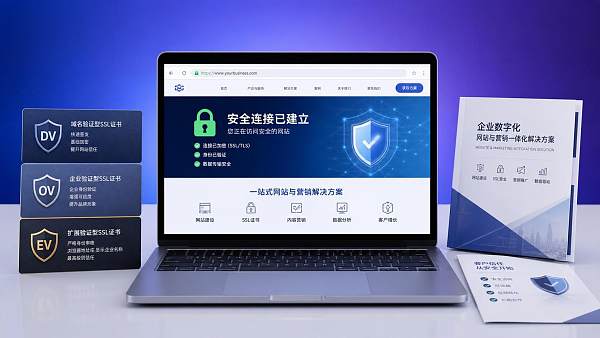
EV is used in more specific scenarios. It is better suited to finance, payments, insurance, legal services, healthcare, government cooperation projects, or companies that face a high risk of impersonation, transaction risk, or a high threshold for brand trust. This does not mean that other industries cannot use it; rather, the question is whether your business needs to pay the higher review cost for stronger identity endorsement. For an ordinary corporate website primarily focused on lead generation, EV may not directly produce higher conversions. However, for websites involving high-value transactions, strong reliance on trust, and customers who repeatedly verify qualifications, the significance of EV is more apparent.
Why Marketing-Oriented Websites Should Not Choose Solely Based on “Speed and Low Cost”
During the website development phase, many website projects treat the certificate as one of the last technical items on the launch checklist—as long as it works, it is considered sufficient. This approach is not particularly problematic for purely informational projects, but it can create a disconnect when applied to marketing-oriented websites: the front-end pages, advertising campaigns, SEO content, and inquiry forms may all be fully developed, while the critical trust-building step before conversion remains weak.
This is especially true when targeting overseas markets, where visitors already have limited patience with unfamiliar brands. They may enter the website from Google search results, advertising landing pages, or social media links without any offline familiarity with the company, and they will not automatically assume that you are a trustworthy seller. In this context, an SSL certificate does not exist in isolation. Together with the displayed company name, contact address, privacy policy, terms page, and consistency of the brand domain, it forms a basic trust framework. Choosing a certificate type that is too basic may not directly cause users to leave, but in industries with many competing websites and high inquiry costs, any gap in trust may reduce the conversion rate.
This is why certificate selection is generally not considered separately when providing integrated website development and marketing services. An independent website that can be promoted, indexed, and converted is not merely a page with a lock icon when opened; its technology, content, and trust signals must be consistent with one another. For those organizing their corporate digital capabilities, incorporating such basic trust infrastructure into the overall assessment is actually consistent with the management coordination perspective emphasized in Research on Business Administration in the Context of Digital Transformation.
A More Practical Way to Evaluate ev, ov, and dv
If you do not want to get caught up in technical parameters and terminology, you can narrow down your options by asking four questions:
This approach is closer to real-world decision-making than asking “Which one is the best?” Certificates have no absolute advantages or disadvantages independent of the business; what matters is whether they match the current stage. For a newly launched independent website, using DV to get the pages and advertising process running is perfectly reasonable. However, when the website begins to handle stable inquiries, expand into multilingual markets, and support a larger advertising budget, the certificate type should be upgraded along with the trust objectives rather than remaining at the minimum configuration.
Several Common Misconceptions Worth Avoiding in Advance
One misconception is to treat the certificate type itself as an SEO ranking factor. Search engines clearly value HTTPS, but they generally do not provide an additional ranking reward simply because you use EV rather than DV, or vice versa. Certificate selection is more closely related to trust and conversion than to a shortcut for improving rankings. What truly affects organic traffic performance is still the site’s crawlability, content quality, technical structure, speed, and ongoing operational capabilities.
Another misconception is believing that an EV certificate can automatically solve low conversion rates. In actual projects, whether visitors are willing to leave their information is often the result of multiple factors working together. The certificate is only one part of the equation. If the page content is superficial, the company information is incomplete, the form is too long, or the loading speed is slow, even the most advanced certificate will not turn a low-trust page into a high-conversion page.
There is also a more common situation: a company has already purchased a suitable certificate, but deployment and website management are inadequate. For example, the certificate chain may be configured incorrectly, some resources may still be loaded over HTTP, redirects between different subdomains may be confusing, or the branding of the form page may not match the primary domain. The impact of these issues on users is often greater than the difference between DV and OV. Choosing the right certificate only shows that the direction is correct; for it to truly work, the stability of the website development details also matters.
If a company is upgrading its official website or rebuilding its overseas independent website, reviewing the SSL certificate, domain strategy, inquiry process, and privacy compliance pages together will be more valuable than replacing the certificate alone. This type of work is inherently part of integrated operations. Similar to the approach taken by many managers when referring to Research on Business Administration in the Context of Digital Transformation, the focus should be on how systems, processes, and tools work together rather than viewing a single system procurement action in isolation.
How to Make the Final Decision
If the core objective of your website is to launch quickly, display content, or validate the market in the short term, DV is a practical enough choice. If it is already a formal corporate website responsible for collecting inquiries, receiving submitted information, and handling partnership applications, OV is often the more balanced option. If the business itself requires a higher level of identity credibility, or if customers repeatedly verify the subject’s information before making a decision, EV may be more appropriate.
Therefore, when deciding between ev, ov, and dv, consider the business type first, then the customer’s trust requirements, and only afterward the budget and issuance speed. A certificate is not an isolated technical procurement item. In essence, it answers this question: When a customer first visits your website, do you want them to see merely an encrypted connection, or a corporate entity that is more worthy of further engagement?
Related Articles



Related Products
 Yiyingbao SaaS Intelligent Website Building and Marketing SystemYiyingbao SaaS Intelligent Website Building and Marketing System, AI-powered no-code website building, rapid creation of multilingual B2B international websites in 10 minutes, global server acceleration, AI-powered SEO optimization, helping businesses connect efficiently with global markets. The perfect integration of technology and operation makes building an international trade website remarkably simple
 AI+SEM Intelligent Advertising Marketing SystemAI+SEM drives intelligent ad creation, empowering full-funnel precision advertising marketing. The system automatically generates weekly/monthly reports, AI recommends keywords and target countries, monitors core metrics in real-time with intelligent alerts, and enables one-click high-conversion ad solutions to help quickly acquire customers and improve ROI.
 AI+SEO Dual-Engine System Optimization ServicesYiyingbao’s AI+SEO dual-engine optimization system helps foreign trade enterprises acquire high-quality organic traffic through AI-powered keyword research, content generation, and comprehensive technical optimization, significantly improving search rankings and conversion rates.
 AI+SNS Social Media Marketing SystemYingbao AI+SNS Social Media Marketing System - Precision social capture for the social media era. Supports one-click content synchronization across major platforms like Facebook and LinkedIn. AI intelligently rewrites posts for enhanced relevance. 24/7 AI customer service and user profiling analysis empower businesses to efficiently expand into global markets.
 AI+SEO营销解决方案易营宝AI+SEO营销解决方案,通过AI批量写作、智能生成TDK、精准关键词扩词等功能,全面优化网站SEO效果,提升流量与转化率。助力企业构建高效智能网站新生态。
 AI+SEM Advertising Marketing SolutionsAI+SEM Advertising Marketing Solution leverages AI technology to deeply empower SEM ad campaigns. It automatically generates weekly/monthly reports using AI, presenting account data across multiple dimensions for comprehensive insights into campaign performance and trends. The system precisely recommends keywords and target countries, intelligently generates high-conversion ad copy, and enables one-click activation of efficient campaign plans to help businesses rapidly acquire customers. Simultaneously, it monitors core metrics in real time, intelligently identifies abnormal fluctuations, and issues timely alerts to ensure stable, high-return advertising results.
 Domain Name ServicesEasyWin provides professional domain name services, including intelligent queries, one-stop registration, brand protection, and full lifecycle management, helping businesses build a digital brand image.
 EasyOperate B2C Cross-Border E-Commerce Platform & Independent WebsiteEasyStore B2C Cross-border E-commerce Independent Store is an intelligent website building and cross-border e-commerce integrated solution independently developed by EasyStore Information Technology (Beijing) Co., Ltd. The system is specially designed for small and medium-sized as well as large export enterprises, integrating 'website building, operation, marketing, advertising, and conversion' into one, helping enterprises quickly establish cross-border e-commerce independent stores to achieve brand globalization and global sales growth.
The platform supports multiple languages, multiple currencies, and multi-channel marketing, with built-in AI intelligent translation and SEO optimization systems, suitable for mainstream markets such as Southeast Asia, Europe and America, Latin America, and the Middle East, assisting Chinese manufacturing enterprises in efficiently deploying international e-commerce strategies. SSL证书易营宝提供专业SSL安全证书服务,包括单域名和泛域名证书,确保网站数据传输加密、身份验证和完整性保护,助力企业建立安全可信的在线业务环境。









