









- Which customer acquisition channels will be affected by cross-border marketing trends in 2026?Sep 06, 2026View details
- Which homogenization risks should be considered in an analysis of the AI-powered website building industry?Aug 30, 2026View details
- How Will AI Marketing Trends 2026 Change Advertising Budget AllocationAug 28, 2026View details
- Is the EV SSL certificate market shrinking or upgrading? How should companies assess certificate procurement?Aug 11, 2026View details
- Why the old AMP SEO 2020 practices no longer work and what has changed in current optimization prioritiesAug 02, 2026View details
- How to Choose Topics for an Industry News Section to Attract More Organic Search TrafficJul 29, 2026View details
How Differences in EV, DV, and OV Validation Strength Affect Website Conversion Expectations
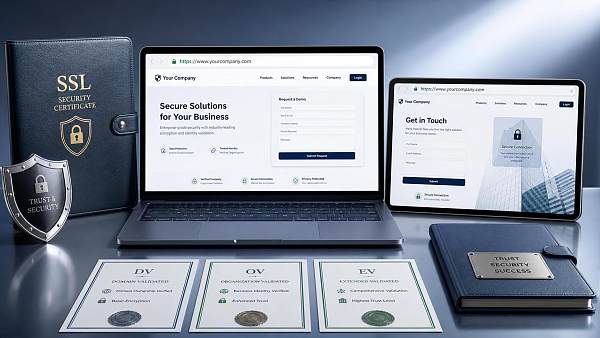
Different validation levels call for different conversion expectations
In corporate website security, ev, dv, and ov are not merely different certificate types; they directly affect visitor trust, willingness to submit inquiries, and expected website conversion. Choosing the wrong validation level may make it difficult to turn traffic into business opportunities.
When many companies build overseas websites, they look at price first, then issuance speed, and only later consider the trust conveyed by the certificate. This order of priorities is not technically wrong, but it is often off the mark in marketing scenarios. A certificate does not exist in isolation. It works together with visitor sources, the sensitivity of the information presented on the page, existing brand awareness, and regional compliance practices. This is especially true for corporate websites, inquiry pages, quotation pages, and distributor recruitment pages targeting overseas customers. Whenever users need to submit company information, purchasing requirements, or contact details, the certificate’s validation level affects their sense of psychological security while browsing.
From a deployment perspective, DV, OV, and EV can all provide HTTPS encryption, which is the baseline. From a business perspective, however, they do not contribute equally to the user’s assessment of whether “this company is worth engaging with.” For this reason, ev, dv, and ov should not be selected solely based on whether the site can display a padlock. They should be selected according to the trust-related role the website needs to fulfill.
Even with the same encryption, visitors do not see the same information
DV verifies control of the domain, can be deployed quickly, and is suitable for projects with tight launch schedules, frequently adjusted pages, or numerous test sites. It is generally sufficient for advertising landing pages, short-term campaign pages, and standalone pages used to test market response. When users visit such pages, their decisions are often based primarily on the product, price, delivery capabilities, and page content—not on verifying the identity of the corporate entity.
OV and EV continue to exist not because they are “more expensive,” but because they add another layer of corporate identity verification. OV verifies organizational information, while EV involves stricter validation and is generally used in scenarios where brand credibility and transaction security are more important. It is worth noting that browsers have gradually reduced the prominence of EV indicators in recent years, so EV should not simply be understood as something that will “obviously increase conversions once installed.” Its real impact lies in making the company’s identity and credibility more complete, especially for websites that want to handle high-value inquiries before strong brand recognition has been established.
In other words, DV addresses connection security, while OV and EV are more closely related to the question of “who you are.” Existing customers may not be very sensitive to this distinction. For overseas purchasers, distributors, and business partners encountering your company for the first time, however, it becomes part of their decision-making process.
The certificate selection logic differs for inquiry-focused and brand-focused websites
If a website is designed to capture organic search traffic and generate inquiries through product pages, industry pages, and solution pages, the certificate’s role is more than simply preventing a browser from displaying a “not secure” warning. The actual conversion path for this type of website is usually relatively long: users first review the page, then assess the company, and finally decide whether to submit a form. Any point in this process that feels unreliable can reduce the form submission rate.
At this stage, foreign trade companies often make a common misjudgment: they assume that DV is sufficient as long as the website loads quickly and looks professional. In reality, when a website handles multilingual presentation, document downloads, inquiry forms, and WhatsApp or email lead collection at the same time, visitors are facing a complete business entry point rather than a digital business card. If the company itself has limited brand awareness and a high average order value, OV is often a more prudent choice than DV because it reduces the implicit question, “Is this actually a real company?”
Brand websites, corporate group websites, and regional distributor authorization pages are more sensitive to identity endorsement. In procurement in Europe and some industries in the Middle East, customers may regard website details as part of their basic due diligence. This does not mean they will necessarily verify the certificate type item by item. Rather, once overall credibility is insufficient, subsequent email response rates, sample request rates, and meeting booking rates may all be affected. This impact may not be directly labeled in analytics tools, but it can appear as a situation where “traffic is adequate, yet conversions consistently fall short of expectations.”
When is DV enough, and when should you move to OV or EV?
Matching certificate strength to the website’s role is more effective than simply looking at the budget. The following approach is more practical in projects:
There is no absolute answer. For example, some manufacturers may not have strong brands but may have been serving the North American and European markets for a long time. If their websites handle sample requests, technical document downloads, and distributor inquiries, DV alone may not be the most suitable choice even without online payment. Conversely, if a page is being used to test the launch of a new product and only the creative concept and lead cost are being validated, the certificate may not need to be upgraded to EV immediately. Allocating the budget to page speed, form field design, and traffic matching is usually more cost-effective.
The real difference often lies not in the certificate itself, but in how it performs together with the website system
Certificate validation strength is only one part of the equation; deployment quality is another. When many conversion problems are traced back to their root cause, the issue is often not that EV, DV, or OV was chosen incorrectly. It may instead be mixed content, abnormal redirects, an incomplete certificate chain configuration, or inconsistent security indicators across websites in different languages, causing users to feel distrust on certain pages. This is particularly important for multilingual websites. If the French, German, or Arabic site calls insecure resources, or if access status differs across regional nodes, the front end may appear error-free while the actual browsing experience has already been compromised.
This is also why many companies expanding overseas coordinate certificates, node acceleration, form tracking, and multilingual SEO within the same system when building their websites. Systems such as multilingual website solutions for foreign trade companies offer value beyond translation or templates. They bring multilingual websites, marketing tool integration, global node acceleration, and compliance fundamentals together. For companies that need to cover multiple regional markets, including North America, Europe, and Southeast Asia, certificate strength can only provide real conversion support when it is incorporated into the overall website trust architecture.
When the system also supports multilingual SEO, automatic generation of localized meta tags, and conversion-rate monitoring for websites in different languages, companies can more easily recognize an important fact: some conversion declines are not caused by traffic problems, but by target-market visitors’ lack of confidence in the website and dissatisfaction with its level of localization. The certificate is not everything, but it is often one of the first areas where differences in professionalism become apparent.
What customers really ask is not “Which is the best?” but “Which offers the best value at our current stage?”
In actual discussions, companies more often ask two questions. One is: Will conversions immediately increase after upgrading the certificate validation level? The other is: If the budget is limited, should the certificate or page optimization come first? Neither question can be answered without considering the website’s stage of development.
If the website is still in the basic development stage, with a disorganized page structure, insufficient localization, slow mobile loading, and overly long form fields, replacing DV with EV will generally not produce an immediate, noticeable improvement. This is because the main factors affecting the submission rate do not yet lie with the certificate. Conversely, when the website already has clear product communication, a credible company profile, stable access speeds, and the ability to generate traffic continuously, the psychological reassurance that OV or EV provides to high-value visitors is more likely to become evident.
Another often-overlooked situation is that a company may be engaged in high-value B2B business while its website still follows a low-cost template approach, with minimal attention given to the certificate, privacy policy, Cookie notices, and form security prompts. This configuration may cause few problems in familiar local transactions, but in cross-border scenarios customers will not automatically fill in the trust information you have omitted. Especially in unfamiliar markets, the website itself serves as a preliminary sales filter. Certificate validation strength is only one of its signals, but it is one of the few foundational signals that visitors can perceive consistently.
Do not leave certificate decisions solely to the technical department
The selection of ev, dv, and ov may appear to be an operations or development matter, but the actual impact is on marketing results. The marketing team is more concerned with inquiry costs, sales is more concerned with the speed of building customer trust, legal is more concerned with corporate identity communication and data compliance, and the technical team focuses on deployment efficiency, compatibility, and stability. As long as the website is responsible for customer acquisition, these perspectives should be considered together.
For foreign trade companies, a prudent approach is not to pursue the highest configuration immediately, but to first confirm three facts: What types of traffic does your website mainly handle? Do visitors need to leave sensitive business information? Before deciding to contact you, will customers treat the website as the first stage of verifying whether the company is genuine? Once these three questions are answered clearly, certificate selection is less likely to deviate significantly.
If the website is only being used to test a new channel, DV is often sufficient. If the website has already become a long-term overseas customer-acquisition asset, OV is more worthy of priority consideration. If the website serves as an entry point for brand partnerships, distributor recruitment, corporate group presentation, or high-value transactions, whether EV is necessary should be assessed in light of the brand positioning, target-market practices, and corporate review procedures. A certificate is not the only variable determining conversion, but it often determines whether visitors are willing to take the next step.
When a website is treated merely as a traffic container, ev, dv, and ov appear to be technical terms. When it is treated as the starting point for cross-border transactions, they represent different expressions of trust strength. For companies already developing multilingual overseas markets, evaluating these certificates together with the capabilities of systems such as multilingual website solutions for foreign trade companies is often closer to actual business needs than discussing certificate prices separately.
Related Articles



Related Products
 Yiyingbao SaaS Intelligent Website Building and Marketing SystemYiyingbao SaaS Intelligent Website Building and Marketing System, AI-powered no-code website building, rapid creation of multilingual B2B international websites in 10 minutes, global server acceleration, AI-powered SEO optimization, helping businesses connect efficiently with global markets. The perfect integration of technology and operation makes building an international trade website remarkably simple
 AI+SEM Intelligent Advertising Marketing SystemAI+SEM drives intelligent ad creation, empowering full-funnel precision advertising marketing. The system automatically generates weekly/monthly reports, AI recommends keywords and target countries, monitors core metrics in real-time with intelligent alerts, and enables one-click high-conversion ad solutions to help quickly acquire customers and improve ROI.
 AI+SEO Dual-Engine System Optimization ServicesYiyingbao’s AI+SEO dual-engine optimization system helps foreign trade enterprises acquire high-quality organic traffic through AI-powered keyword research, content generation, and comprehensive technical optimization, significantly improving search rankings and conversion rates.
 AI+SNS Social Media Marketing SystemYingbao AI+SNS Social Media Marketing System - Precision social capture for the social media era. Supports one-click content synchronization across major platforms like Facebook and LinkedIn. AI intelligently rewrites posts for enhanced relevance. 24/7 AI customer service and user profiling analysis empower businesses to efficiently expand into global markets.
 AI+SEO营销解决方案易营宝AI+SEO营销解决方案,通过AI批量写作、智能生成TDK、精准关键词扩词等功能,全面优化网站SEO效果,提升流量与转化率。助力企业构建高效智能网站新生态。
 AI+SEM Advertising Marketing SolutionsAI+SEM Advertising Marketing Solution leverages AI technology to deeply empower SEM ad campaigns. It automatically generates weekly/monthly reports using AI, presenting account data across multiple dimensions for comprehensive insights into campaign performance and trends. The system precisely recommends keywords and target countries, intelligently generates high-conversion ad copy, and enables one-click activation of efficient campaign plans to help businesses rapidly acquire customers. Simultaneously, it monitors core metrics in real time, intelligently identifies abnormal fluctuations, and issues timely alerts to ensure stable, high-return advertising results.
 Domain Name ServicesEasyWin provides professional domain name services, including intelligent queries, one-stop registration, brand protection, and full lifecycle management, helping businesses build a digital brand image.
 EasyOperate B2C Cross-Border E-Commerce Platform & Independent WebsiteEasyStore B2C Cross-border E-commerce Independent Store is an intelligent website building and cross-border e-commerce integrated solution independently developed by EasyStore Information Technology (Beijing) Co., Ltd. The system is specially designed for small and medium-sized as well as large export enterprises, integrating 'website building, operation, marketing, advertising, and conversion' into one, helping enterprises quickly establish cross-border e-commerce independent stores to achieve brand globalization and global sales growth.
The platform supports multiple languages, multiple currencies, and multi-channel marketing, with built-in AI intelligent translation and SEO optimization systems, suitable for mainstream markets such as Southeast Asia, Europe and America, Latin America, and the Middle East, assisting Chinese manufacturing enterprises in efficiently deploying international e-commerce strategies. SSL证书易营宝提供专业SSL安全证书服务,包括单域名和泛域名证书,确保网站数据传输加密、身份验证和完整性保护,助力企业建立安全可信的在线业务环境。









