









- Which customer acquisition channels will be affected by cross-border marketing trends in 2026?Sep 06, 2026View details
- Which homogenization risks should be considered in an analysis of the AI-powered website building industry?Aug 30, 2026View details
- How Will AI Marketing Trends 2026 Change Advertising Budget AllocationAug 28, 2026View details
- Is the EV SSL certificate market shrinking or upgrading? How should companies assess certificate procurement?Aug 11, 2026View details
- Why the old AMP SEO 2020 practices no longer work and what has changed in current optimization prioritiesAug 02, 2026View details
- How to Choose Topics for an Industry News Section to Attract More Organic Search TrafficJul 29, 2026View details
- Digital Marketing Shenzhen Market Insights: Why Are Companies Expanding Overseas Looking for Growth Teams in Shenzhen?Jul 31, 2026View details
- Can Zhejiang foreign trade independent websites still be developed today? Look at changes in traffic and lead generationJul 28, 2026View details
Always confused about the order of DV, OV, and EV certificates? Quickly determine the difference by their validation scope
Always Confused by the DV, OV, and EV Certificate Order? Quickly Determine It by the Validation Scope
Many people remember DV, OV, and EV as three types of products ranked from “low” to “high” in terms of security. This is not entirely wrong, but it is also the easiest way to be misled. Their real difference is not encryption strength, but the scope to which the certificate authority verifies the applicant before issuing the certificate. Once you focus on the single dimension of “validation scope,” the ranking, applicable scenarios, and selection logic for DV, OV, and EV become much easier to understand.
Let’s clarify the most important point first: all three certificate types generally use the same TLS/SSL encryption mechanism. The “padlock” on the left side of the browser when accessing a website is not exclusive to EV, nor is OV more “encrypted.” In terms of user connection security, all three can establish HTTPS communication. The main difference is whether the browser and certificate information can prove “who is behind this domain.” Many businesses choose the wrong certificate not because they neglect security, but because they confuse “being able to use HTTPS” with “being able to demonstrate the credibility of the entity.”
First, Look at the Order: It Is Based on How Far Verification Goes, Not on Price
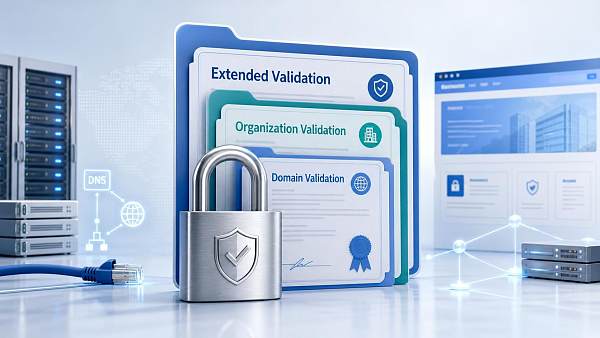
DV stands for Domain Validation. The certificate authority confirms only one thing: that you control the domain. For example, verification can be completed through email, a DNS record, or a file on the server. Once verification succeeds, the certificate can be issued. DV proves that “this website belongs to the controller of this domain,” but it does not answer the question, “Which company is that controller?”
OV stands for Organization Validation. In addition to domain control, the certificate authority verifies whether the applicant is a real organization, typically by matching the company name, registered address, or publicly available registration information. In other words, OV performs an additional layer of “entity identity” verification compared with DV, making it suitable for websites that need to present a formal corporate identity to the public.
EV stands for Extended Validation. It is not simply a “more advanced OV,” but a stricter and more comprehensive organizational identity verification process. In addition to confirming the existence of the company, it further verifies information such as the applicant’s legal eligibility and authority to apply. Historically, EV attracted widespread attention because browsers prominently displayed the company name. Although mainstream browsers later reduced this type of front-end display, that does not mean EV has lost its value; it still represents more rigorous identity screening.
Therefore, the order can be remembered as follows: DV verifies the domain; OV verifies the domain plus the organization; and EV verifies the domain plus the organization through more stringent identity checks. When making a judgment, do not focus on words such as “extended” or “enhanced” in the name. Focus on what is being verified.
Why Are Foreign Trade Websites and Marketing Websites Most Likely to Make the Wrong Choice Here?
In website development and overseas marketing, certificate selection is never merely a technical task. It affects visitors’ first impressions, their willingness to submit leads, and how the company communicates its credibility externally. Especially for foreign trade independent websites, B2B inquiry websites, and multilingual corporate websites, visitors often do not recognize your brand. What they see first is the domain, page content, and trust signals in the browser. In this context, a certificate does more than simply “turn the URL into https.”
When building overseas websites, two common misconceptions often arise. One is for technical teams to assign DV to every website by default because it is quick to deploy and easy to automate. The other is for business leaders who have heard of EV to choose the “most expensive” option directly. Both approaches are overly simplistic. For content websites, event pages, and short-term advertising landing pages, DV is often sufficient because the priorities are rapid launch and stable indexing. However, for corporate websites, investment promotion websites, and foreign trade inquiry websites, visitors may actively check the company background, contact information, and brand authenticity. In such cases, using only DV may give the impression that “the website opens, but it is impossible to tell what company is behind it.”
For a service scenario such as Yiyingbao’s, which covers intelligent website building, SEO optimization, advertising, and overseas customer acquisition, certificate selection is generally not evaluated in isolation. Whether a website should use OV is often related to the role it serves: Is it being used for advertising tests or to support long-term brand traffic? Is it a single-page lead-generation form or a website where buyers need to verify the company’s qualifications over time? If marketing and technology are not considered together, certificate selection can easily be reduced to “as long as it works.”
Stop Asking Which One Is Better; First Ask What You Need to Prove
If your website is mainly used for content publishing, SEO indexing, early-stage brand testing, internal projects, or temporary event pages, DV offers direct benefits: fast issuance, convenient deployment, and low maintenance costs. Many automated certificate solutions today also focus primarily on DV, which fits the operating rhythm of modern websites well.
However, once a website begins to take on the responsibility of “proving the identity of the company to the public,” the evaluation criteria change. For example, on an English corporate website for a manufacturing company, an overseas distributor recruitment website, a cross-border business website, or a page requiring inquiry or partnership applications, visitors care not only whether the connection is encrypted, but also whether the company is genuinely registered and traceable. OV is often more appropriate for these types of websites because it fills the gap of “verifiable entity identity.”
EV is more suitable for scenarios with extremely high trust requirements. This does not mean ordinary companies cannot use it, but even if many ordinary corporate websites adopt EV, the difference perceived by visitors may not be as obvious as it once was. Browser interface display methods have changed significantly over the years. The value of EV has largely returned to compliance, risk control, and high-trust requirements, rather than being “more visible” on the front end. If your business involves payments, financial services, sensitive data collection, or a particular need to emphasize formal identity verification, EV is closer to its original positioning.
This is similar to how many conceptual issues should be evaluated: do not look only at the name. Some management and digitalization topics may sound far removed from website development, but when applied to corporate governance, they still focus on whether “boundaries, permissions, and processes match.” A similar approach can be seen in content such as Analysis of Application Strategies for Integrating Business and Finance in the Transformation of Public Institution Financial Management: rather than choosing a solution that sounds more comprehensive, examine which actual level of the problem it addresses. Certificate selection works the same way.
Several Points That Are Often Misstated
First, DV does not mean “insecure.” As long as the certificate is valid and correctly deployed, DV can also provide HTTPS encrypted transmission. Its limitation is not encryption, but the limited expression of identity.
Second, EV does not mean higher search rankings. Search engines do favor HTTPS, but there is no publicly stated rule indicating that EV has an inherent ranking advantage over OV or DV. Treating EV as an SEO improvement tool is a misguided approach. SEO depends more on website structure, content quality, speed, crawlability, and link signals.
Third, OV is not an “outdated product.” Some people see that company names are no longer displayed as prominently in the browser interface as they were in the early days and conclude that OV and EV have become less meaningful. In reality, for businesses with long purchasing decision cycles, high order values, and a need for repeated verification of corporate identity, the organization information in the certificate remains part of the chain of trust. It is simply no longer presented to everyone in such an exaggerated manner.
Fourth, not every website is worth using a higher validation level merely to “look formal.” If a frequently updated marketing system contains many branches and pages with short lifecycles, pursuing high-validation certificates for every subsite will increase management costs and renewal complexity. Certificate strategy should ideally be designed together with the website matrix rather than decided temporarily for each individual page.
How Can You Make a Decision That Is Less Likely to Be Wrong?
You can narrow down the choice by asking three questions. Is this website the company’s official public-facing site? Will visitors deliberately verify the company’s identity because they are unfamiliar with you? Does the page involve high-trust actions such as submitting an inquiry, applying for cooperation, or providing account or order information?
If the answer to most of the three questions is “no,” DV is usually sufficient. If the answer to the first two questions is clearly “yes,” OV is worth prioritizing. If high-risk transactions, financial characteristics, or strict compliance reviews are also involved, EV becomes more necessary. This method is closer to actual business needs than simply asking “Which one is more advanced?”
For companies engaged in global customer acquisition, a certificate is only one part of the trust system. It must work together with the website content, company information page, contact details, privacy policy, form experience, and loading speed. Even a website with the highest certificate level will not easily receive inquiries if it lacks a company introduction, contains confusing qualification information, or provides incomplete contact channels. Conversely, a clearly positioned, transparent, and properly configured corporate website using OV is often more likely to establish trust than a page with a “high-level” certificate but poor overall quality.
Understanding DV, OV, and EV is not about memorizing definitions. The key is knowing what you want the certificate to prove. If you need basic encryption, focus on domain control. If you need verifiable corporate identity, focus on organization validation. If you need stricter formal review, consider extended validation. Following this order will generally prevent an unreasonable choice. For website development and marketing conversion, a certificate is never an isolated parameter; it reflects how a company chooses to establish credibility externally.
Related Articles


Related Products
 Yiyingbao SaaS Intelligent Website Building and Marketing SystemYiyingbao SaaS Intelligent Website Building and Marketing System, AI-powered no-code website building, rapid creation of multilingual B2B international websites in 10 minutes, global server acceleration, AI-powered SEO optimization, helping businesses connect efficiently with global markets. The perfect integration of technology and operation makes building an international trade website remarkably simple
 AI+SEM Intelligent Advertising Marketing SystemAI+SEM drives intelligent ad creation, empowering full-funnel precision advertising marketing. The system automatically generates weekly/monthly reports, AI recommends keywords and target countries, monitors core metrics in real-time with intelligent alerts, and enables one-click high-conversion ad solutions to help quickly acquire customers and improve ROI.
 AI+SEO Dual-Engine System Optimization ServicesYiyingbao’s AI+SEO dual-engine optimization system helps foreign trade enterprises acquire high-quality organic traffic through AI-powered keyword research, content generation, and comprehensive technical optimization, significantly improving search rankings and conversion rates.
 AI+SNS Social Media Marketing SystemYingbao AI+SNS Social Media Marketing System - Precision social capture for the social media era. Supports one-click content synchronization across major platforms like Facebook and LinkedIn. AI intelligently rewrites posts for enhanced relevance. 24/7 AI customer service and user profiling analysis empower businesses to efficiently expand into global markets.
 AI+SEO营销解决方案易营宝AI+SEO营销解决方案,通过AI批量写作、智能生成TDK、精准关键词扩词等功能,全面优化网站SEO效果,提升流量与转化率。助力企业构建高效智能网站新生态。
 AI+SEM Advertising Marketing SolutionsAI+SEM Advertising Marketing Solution leverages AI technology to deeply empower SEM ad campaigns. It automatically generates weekly/monthly reports using AI, presenting account data across multiple dimensions for comprehensive insights into campaign performance and trends. The system precisely recommends keywords and target countries, intelligently generates high-conversion ad copy, and enables one-click activation of efficient campaign plans to help businesses rapidly acquire customers. Simultaneously, it monitors core metrics in real time, intelligently identifies abnormal fluctuations, and issues timely alerts to ensure stable, high-return advertising results.
 Domain Name ServicesEasyWin provides professional domain name services, including intelligent queries, one-stop registration, brand protection, and full lifecycle management, helping businesses build a digital brand image.
 EasyOperate B2C Cross-Border E-Commerce Platform & Independent WebsiteEasyStore B2C Cross-border E-commerce Independent Store is an intelligent website building and cross-border e-commerce integrated solution independently developed by EasyStore Information Technology (Beijing) Co., Ltd. The system is specially designed for small and medium-sized as well as large export enterprises, integrating 'website building, operation, marketing, advertising, and conversion' into one, helping enterprises quickly establish cross-border e-commerce independent stores to achieve brand globalization and global sales growth.
The platform supports multiple languages, multiple currencies, and multi-channel marketing, with built-in AI intelligent translation and SEO optimization systems, suitable for mainstream markets such as Southeast Asia, Europe and America, Latin America, and the Middle East, assisting Chinese manufacturing enterprises in efficiently deploying international e-commerce strategies. SSL证书易营宝提供专业SSL安全证书服务,包括单域名和泛域名证书,确保网站数据传输加密、身份验证和完整性保护,助力企业建立安全可信的在线业务环境。









