









- Qingdao Port's Imports and Exports Exceed RMB 23.699 Trillion in the First 10 Months, Drawing Attention to Port IntelligenceNov 22, 2026View details
- Ningbo Cross-Border E-Commerce Export Value Surges 94.87% Year on Year, Opening Up a New Billion-Yuan Growth TrackNov 22, 2026View details
- AliExpress Global Double 11: Brand Sales Grow Nearly 50% in the First Week, U.S. GMV Rises 70%Nov 21, 2026View details
- Ministry of Commerce Reports E-commerce Development from January to October 2026, with Cross-Border Imports Performing StronglyNov 21, 2026View details
- Amazon Black Friday Orders Sluggish on Day One; NRF Forecasts 4.2 Million Fewer ParticipantsNov 21, 2026View details
- 21st Century Business Herald: AI and CTV Become Core Growth Engines for Digital Marketing in Overseas MarketsNov 18, 2026View details
How to Use a No-Code Startup Project to Quickly Validate Whether an Overseas Lead Generation Page Is Effective
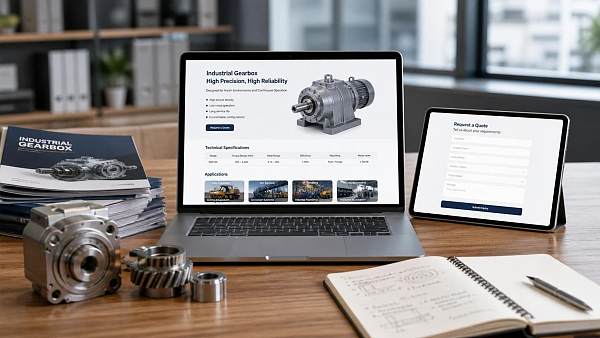
To verify more quickly whether an overseas customer acquisition page is effective, the key to using a no-code startup project is to focus first on whether the page can generate real actions, rather than completing the entire website. Before launching the page, narrow the verification objective down to one action: submit an inquiry, send an email, download a specification sheet, or schedule a video call. Choose just one. The more focused the action, the cleaner the data will be, making it easier to determine whether the problem lies in the traffic, content, or form.
Many pages fail to produce results for a long time not because there are too few templates, but because multiple verification objectives are mixed together. For example, an industrial parts page may include a company introduction, factory capabilities, a full product catalog, news updates, and contact information at the same time, leaving visitors without a clear next step. When using a no-code startup project, the first step is to define the task of the single page: if you sell products such as aluminum profiles, injection-molded parts, valves, bearings, or packaging equipment, the initial test page only needs to answer a few questions: What do you provide? What operating conditions is it suitable for? What are the specification limits? What is the shortest path to starting a delivery discussion?
Page content should address details directly. In the context of manufacturing companies expanding overseas, international visitors usually will not leave their information simply because they see a phrase such as “high-quality supply.” However, they are more likely to continue the conversation after seeing details such as whether the material grade is specified, whether common thicknesses or dimensional tolerances are provided, whether the surface treatment is anodizing, powder coating, or electroplating, and whether the applicable temperature range, corrosion-resistance conditions, packaging method, minimum-order discussion range, and container-loading restrictions for sea or air transportation are clearly explained. Even if all parameters are not disclosed temporarily, the page should at least enable visitors to determine whether the product is what they are looking for.
Test first whether the information is relevant, then whether the page looks good
A common misjudgment when an overseas customer acquisition page fails is to directly interpret a high bounce rate as a design problem. In reality, the traffic and the page promise are often inconsistent. For example, an advertisement may say “custom stainless steel fasteners,” while the landing page devotes extensive space to corporate culture. Or visitors may arrive through a search for “food grade silicone tubing,” but the first screen of the page does not mention the material grade, inner and outer diameter ranges, temperature resistance, or application limitations. In such cases, even a complete page will have difficulty verifying actual results.
Therefore, when using a no-code startup project, the first step is usually not to add more modules, but to create two small-scale test versions. One version can start from the application scenario, such as “silicone tubing for food filling lines”; the other can start from parameters, such as “6mm-38mm inner diameter, temperature resistance range, and customizable length.” Under the same traffic conditions, continue developing the approach that generates more valid actions. This helps avoid repeatedly revising the page in the wrong direction.
An overly complicated form often slows verification before the page copy does
Many pages initially require visitors to fill in the company name, country, phone number, purchase volume, annual demand, product model, budget, delivery schedule, and attachment upload. With too many fields, users may leave before genuine interest has been established. During the verification stage, it is more appropriate to retain only necessary fields, such as name, email, and inquiry details. Phone number, instant messaging contact, and drawing upload can be optional and collected after the initial contact. This is especially important for cross-regional traffic: mobile phone number formats vary considerably, and users in some countries prefer to communicate by email first. Requiring a phone number may instead result in lost leads.
If technical communication for the product genuinely depends on parameters, do not put every question into one long form. Frequently requested parameters can be converted into dropdown or single-choice options, such as material type, thickness range, processing method, and expected application environment. For non-standard parts, leave an open text field where visitors can describe scenarios such as “for outdoor brackets,” “in contact with a salt-spray environment,” or “installed at the end of an automated production line.” The information collected in this way is closer to what is needed for a subsequent quotation and is easier to screen than vague descriptions.
The page must contain information that reduces misunderstandings
Verifying whether a page is effective is not only about whether someone submits a form; it is also about whether the submission is close to a genuine requirement. Many invalid leads result from overly broad page descriptions. For example, phrases such as “supports all kinds of customization” or “suitable for multiple industries” may appear to offer broad coverage, but in practice they can attract a large amount of mismatched traffic. By contrast, clearly stating the boundaries is often more beneficial: whether sample orders are accepted, whether small-batch orders are supported, whether the company only processes customer drawings, whether multilingual packaging is available, whether modifications to specific standard parts are accepted, whether export wooden crates, pallets, and fumigation requirements can be accommodated, and whether the product is suitable for high-humidity, high-salt-spray, or high-frequency-vibration environments.
The purpose of this information is not to keep people out, but to reduce the cost of back-and-forth communication. On B2B pages in particular, visitors use these details to assess whether you understand actual application conditions. For metal part processing, even one additional sentence such as “welded structural parts require an assessment of tolerance accumulation and deformation during transportation” is more likely to establish basic trust than general statements.
Do not pursue full multilingual coverage immediately
When using a no-code startup project, a common impulse is to launch English, French, Spanish, Arabic, Russian, and other versions all at once. During the verification stage, however, this can make the problem more complicated. If the leads are poor, it becomes difficult to determine whether the issue lies in the translated wording, keyword selection, page structure, or traffic source. A more reliable approach is usually to concentrate first on one primary-language page, test the title, selling points, parameter descriptions, and form path, and then replicate the proven approach in other language versions.
At the translation level, avoid directly translating Chinese sales expressions into overseas pages. Phrases such as “direct from the manufacturer,” “source factory,” and “quality assurance” often have low information density on international pages. Expressions such as “material grade available on request,” “tolerance depends on process route,” and “export packing can be discussed before mass production” are closer to the actual business context. Verifying page effectiveness is essentially about whether visitors can make a quick judgment, not whether the page has said everything it possibly can.
Traffic testing should show which part has gone wrong
If you only know that people visited but no one submitted an inquiry, the conclusion has almost no value. Page verification should track at least several points: whether visitors leave quickly after entering the page, whether they scroll to the parameter or application section, whether they click the email link or button, and whether they stop at a particular form field. Only then can you distinguish whether the first-screen promise is unclear, the technical information is too limited, or the form imposes too much burden.
For some industrial product pages, the real problem often lies in the ordering of details. For example, processing equipment, workshop photos, and the company introduction may be placed first, while material, tolerances, available dimensions, and surface treatments appear later. Visitors cannot see the key information during the first few dozen seconds and naturally do not want to continue. For overseas customer acquisition, a page is more like preliminary business communication and screening than a trade-show brochure. Providing information that allows visitors to determine whether there is a match first, followed by background information, is much more efficient.
For advertising traffic, it is recommended to test only one primary variable at a time. You can change the headline, but do not change the headline, button, form, and images simultaneously. You can change the angle of the first screen, but do not also disrupt the order of the parameter modules. Otherwise, even if the data changes, it will be difficult to know which factor caused the change. The value of a no-code startup project lies in its low revision cost, but low cost does not mean that revisions can be made frequently without rules.
“Effective” does not mean a large number of inquiries
Whether a page is effective also depends on whether the lead quality is close to a state that can be advanced. A common situation is that one page generates many messages, but most of them contain only “price?” or “catalog?” and cannot be developed further. Another page receives fewer messages but generates specific specifications, target markets, intended uses, and even packaging requirements. The latter is usually more worthwhile for continued traffic investment because it indicates that the page communicates its information more clearly and attracts people with needs closer to actual requirements.
When assessing quality, check whether messages include specific information such as application scenarios, dimensional requirements, material preferences, purchasing schedules, certification concerns, and transportation destinations. For equipment pages, also observe whether visitors ask about voltage, frequency, installation space, spare-parts lead time, and maintenance methods. For consumables or packaging materials, check whether they mention the quantity per carton, packaging method, storage environment, and whether the product will come into contact with food or be used in medical applications. The more effectively a page guides visitors to provide this information, the easier it is to implement subsequent sales actions.
Another easily overlooked issue is that many verification pages introduce overly strong conversion-oriented language too early, repeatedly using phrases such as “Order now” or “Buy now.” If the product is a custom-machined part, industrial accessory, non-standard piece of equipment, or large cross-border order, this wording may not match the actual purchasing process. In such cases, it is more appropriate to guide visitors to submit drawings, describe operating conditions, request a parameter sheet, or confirm the producible range. Only when the action design matches the actual transaction path will the verification results remain accurate.
Ultimately, using a no-code startup project is not about building a page faster, but about shortening the verification process: making the content more focused, reducing misunderstandings, aligning the traffic with the page, and making the reason behind every revision visible. Creating a narrow and clear verification page first, then deciding whether to expand the sections, languages, and traffic scope, often makes it easier to determine whether the page can actually generate customers than building a complete official website from the beginning.
Related Articles
 How can you verify the accuracy of product copy generated by an AI website builder?
 How can you verify page editability in an AI website builder demo?
 What do you need to prepare to build a corporate website with the Yiyingbao AI Website Builder?

Related Products
 Yiyingbao SaaS Intelligent Website Building and Marketing SystemYiyingbao SaaS Intelligent Website Building and Marketing System, AI-powered no-code website building, rapid creation of multilingual B2B international websites in 10 minutes, global server acceleration, AI-powered SEO optimization, helping businesses connect efficiently with global markets. The perfect integration of technology and operation makes building an international trade website remarkably simple
 AI+SEM Intelligent Advertising Marketing SystemAI+SEM drives intelligent ad creation, empowering full-funnel precision advertising marketing. The system automatically generates weekly/monthly reports, AI recommends keywords and target countries, monitors core metrics in real-time with intelligent alerts, and enables one-click high-conversion ad solutions to help quickly acquire customers and improve ROI.
 AI+SEO Dual-Engine System Optimization ServicesYiyingbao’s AI+SEO dual-engine optimization system helps foreign trade enterprises acquire high-quality organic traffic through AI-powered keyword research, content generation, and comprehensive technical optimization, significantly improving search rankings and conversion rates.
 AI+SNS Social Media Marketing SystemYingbao AI+SNS Social Media Marketing System - Precision social capture for the social media era. Supports one-click content synchronization across major platforms like Facebook and LinkedIn. AI intelligently rewrites posts for enhanced relevance. 24/7 AI customer service and user profiling analysis empower businesses to efficiently expand into global markets.
 AI+SEO营销解决方案易营宝AI+SEO营销解决方案,通过AI批量写作、智能生成TDK、精准关键词扩词等功能,全面优化网站SEO效果,提升流量与转化率。助力企业构建高效智能网站新生态。
 AI+SEM Advertising Marketing SolutionsAI+SEM Advertising Marketing Solution leverages AI technology to deeply empower SEM ad campaigns. It automatically generates weekly/monthly reports using AI, presenting account data across multiple dimensions for comprehensive insights into campaign performance and trends. The system precisely recommends keywords and target countries, intelligently generates high-conversion ad copy, and enables one-click activation of efficient campaign plans to help businesses rapidly acquire customers. Simultaneously, it monitors core metrics in real time, intelligently identifies abnormal fluctuations, and issues timely alerts to ensure stable, high-return advertising results.
 Domain Name ServicesEasyWin provides professional domain name services, including intelligent queries, one-stop registration, brand protection, and full lifecycle management, helping businesses build a digital brand image.
 EasyOperate B2C Cross-Border E-Commerce Platform & Independent WebsiteEasyStore B2C Cross-border E-commerce Independent Store is an intelligent website building and cross-border e-commerce integrated solution independently developed by EasyStore Information Technology (Beijing) Co., Ltd. The system is specially designed for small and medium-sized as well as large export enterprises, integrating 'website building, operation, marketing, advertising, and conversion' into one, helping enterprises quickly establish cross-border e-commerce independent stores to achieve brand globalization and global sales growth.
The platform supports multiple languages, multiple currencies, and multi-channel marketing, with built-in AI intelligent translation and SEO optimization systems, suitable for mainstream markets such as Southeast Asia, Europe and America, Latin America, and the Middle East, assisting Chinese manufacturing enterprises in efficiently deploying international e-commerce strategies. SSL证书易营宝提供专业SSL安全证书服务,包括单域名和泛域名证书,确保网站数据传输加密、身份验证和完整性保护,助力企业建立安全可信的在线业务环境。









