What Parameters Should Be Included on an Electronic Component Product Showcase Website to Encourage Customers to Continue with an Inquiry
When building an electronic component product showcase website, many companies face a very practical problem: if too few parameters are displayed, customers cannot tell whether the product is suitable; if too many are displayed, the page can easily become a “screenshot of a data sheet,” causing visitors to leave after only a few seconds. Purchasing roles such as dealers, distributors, and agents typically do not call first and ask questions one by one. Instead, they first determine on the website whether the component is worth further discussion.
Therefore, the real purpose of an electronic component product showcase website is not to provide “as much information as possible,” but to help customers complete three tasks in the shortest possible time: understand what the product is, determine whether it can be used, and decide whether to continue with an inquiry. As long as the parameter presentation is organized around these three objectives, the page is more likely to support effective communication.
Why Do Many Electronic Component Product Showcase Websites Get Traffic but No Inquiries?
A common situation is that the website is not poorly designed and many products have been uploaded, but customers take no further action after entering the page. The problem is often not the traffic itself, but the page’s inability to support purchasing decisions. Unlike ordinary consumer products, electronic components are not evaluated based on a picture and a selling point. Customers focus on specifications, compatibility, package type, operating conditions, certification status, supply information, and other details that directly affect product selection and purchasing decisions.
If a page only says “high performance, stable and durable, and widely used in industrial control,” such statements provide almost no useful information for engineering purchasers. Conversely, if the page contains only a long block of original PDF specifications without any classification or organization, customers will also find it difficult to identify the key points quickly. As a result, visitors may have a genuine need, but they cannot complete their initial evaluation on the current page, so they move on to other suppliers.
In B2B scenarios, a website essentially performs the functions of “pre-screening” and “pre-communication.” Especially when customers arrive through overseas search, advertising landing pages, social media links, or catalog pages, they will not first learn about your company background. Instead, they will first check whether the product page is professional, credible, and convenient for comparison. If these basic functions are not handled well, even a large number of page views will be difficult to convert into qualified inquiries.
Which Parameters Do Customers Usually Check Before Continuing with an Inquiry?
The parameter design of an electronic component product showcase website should preferably be organized around “whether it is compatible, whether it can be purchased, and whether it can serve as a replacement,” rather than simply copying the order of internal technical documents. For most purchasing and technical readers, the following types of information are the most important.
- Basic identification information: Product model, brand, series, and category name. These details determine whether the customer has found the right product and are also the first information to be referenced in subsequent searches and internal sharing.
- Core electrical parameters: For example, operating voltage, current, power consumption, frequency range, accuracy, resistance, capacitance, withstand voltage, and input/output characteristics. The specific items vary by product, but the parameters most commonly compared by purchasing and engineering teams must be clearly identified.
- Package and dimensional parameters: Package type, overall dimensions, installation method, number of pins, and soldering method. Many inquiries are discontinued not because the performance is insufficient, but because the customer discovers that the package is incompatible and cannot directly replace the existing solution.
- Environmental and reliability parameters: Operating temperature, storage temperature, humidity conditions, vibration resistance level, service life range, and more. This information is particularly important in industries such as industrial control, automotive, medical, and communications.
- Application and compatibility information: Applicable scenarios, commonly supporting systems, compatible models, and replacement models. Customers do not always focus on a single parameter. They are often looking for an answer to the question, “Can this replace the component I am currently using?”
- Supply-related information: Minimum order quantity, packaging method, delivery format, sample availability, and whether long-term supply is supported. Even when customers are initially conducting a technical evaluation, they will usually also assess the feasibility of future purchasing.
- Downloadable materials: Data sheets, specification sheets, application notes, wiring instructions, and test report catalogs. Not every customer will download these materials immediately, but simply providing access to them is itself part of demonstrating professionalism.
There is a common misunderstanding here: many people believe that parameters must be presented in exhaustive detail to appear professional. This is not necessarily the case. The more effective approach is to place the parameters customers need for their initial evaluation at the front, and put in-depth technical materials later on the page or in the download area. This allows the page to support both quick scanning and detailed review.
How Should Parameters Be Presented on an Electronic Component Product Showcase Website to Encourage More Inquiries?
If you are organizing a product page, you can follow the approach below instead of simply copying and pasting a parameter table.
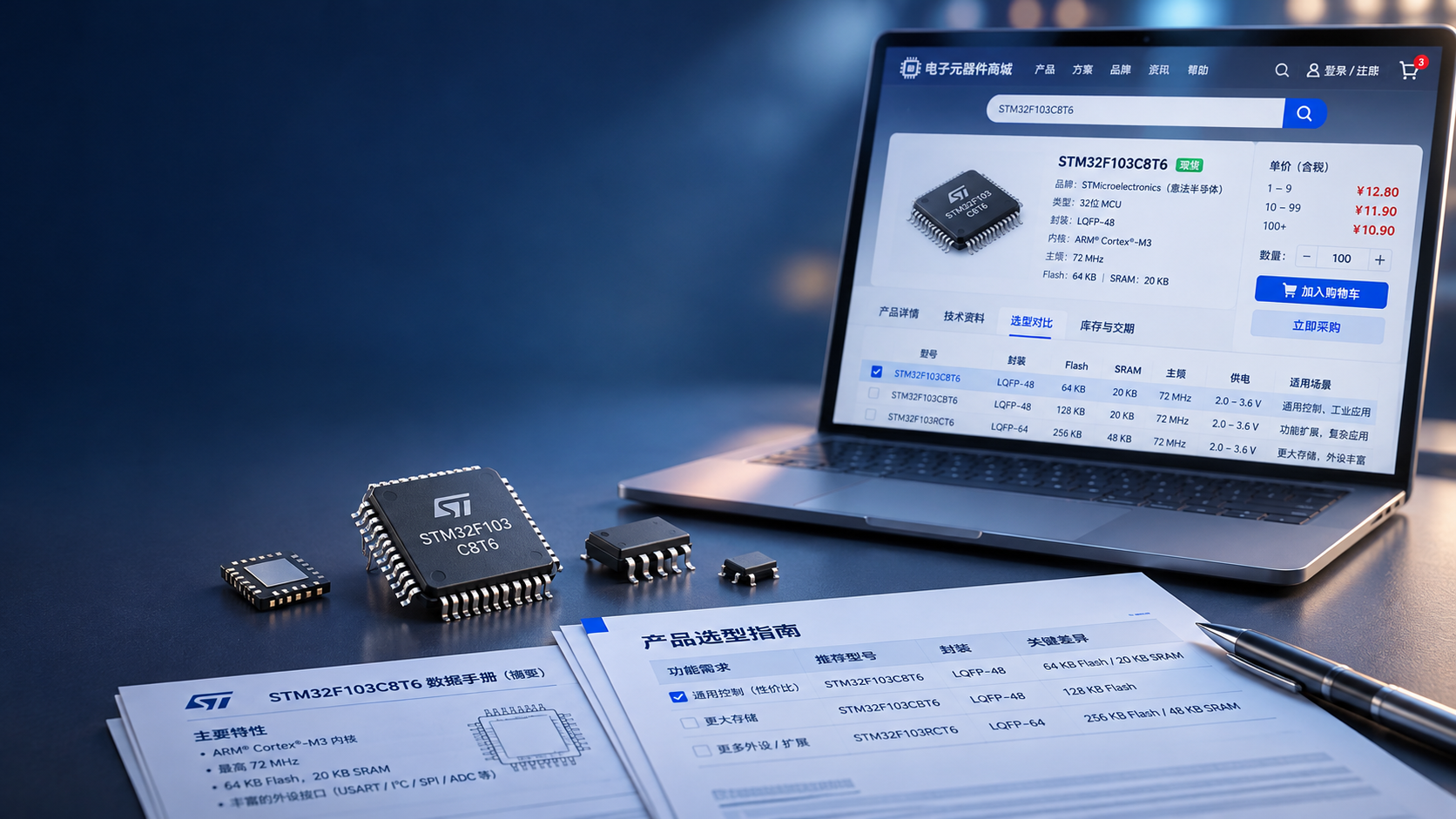
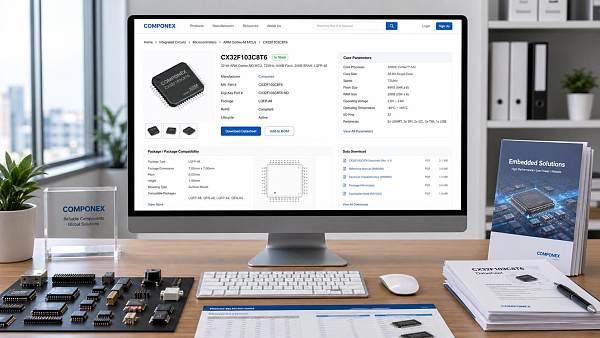
- Present information that can be evaluated within the first screen. At the top of the page, prioritize the product name, model, main applications, 2 to 5 most important parameters, and a clearly visible inquiry button. Within a few seconds of arriving, customers should know whether this is the component they are looking for.
- Group the parameters instead of creating one long table. It is recommended to divide them into at least the following sections: “basic information,” “electrical parameters,” “mechanical parameters,” “environmental parameters,” and “purchasing support.” This allows customers to read according to their roles: engineers can focus on technical items, purchasers can check supply details, and distributors can review replacement and packaging information.
- Explain key parameters in text. Some parameter names are familiar within the industry, while others can easily lead to misunderstandings. Without adding unnecessary length, you can use one sentence to explain the significance of a parameter for compatibility, such as “suitable for high-temperature environments,” “supports surface-mount assembly,” or “suitable for low-power circuits.”
- Add information that supports replacement evaluation. Many inquiries do not begin with a search for a product from scratch. Customers are often looking for a replacement, alternative, or compatible product. Adding information such as “comparable models,” “specification differences within the same series,” and “selection recommendations” can be more useful than simply emphasizing product advantages.
- Provide clear access to technical materials. It is not recommended to place every technical detail directly in the main body, but clear access to specification sheets, product catalogs, application documents, and other materials should be provided. For genuinely interested customers, the ability to continue with in-depth verification is more important than whether the page copy is polished.
- Do not make the inquiry form collect only an email address. If the target customers are B2B purchasers, the form can include fields such as target model, purchase quantity, application scenario, and target market. This not only facilitates follow-up, but also reduces ineffective communication.
From a website development perspective, this type of product page also needs to take search indexing, mobile reading, multilingual presentation, and efficient bulk maintenance into account. For companies with many SKUs and relatively consistent parameter structures, a system that supports structured product entry can save considerable effort. A smart website development and overseas marketing platform such as Yiyingbao, which is designed for foreign trade companies, is suitable for handling product presentation, multilingual websites, SEO page organization, and inquiry management within a single process. The key is not the platform name itself, but whether it allows you to turn parameters into readable, searchable, and conversion-oriented pages rather than a collection of static content that is difficult to maintain.
Which Content May Appear Comprehensive but Actually Weaken an Electronic Component Product Showcase Website?
Many pages have low conversion rates not because they lack content, but because they place too much content in front of the information that matters most.
The first type is a large amount of vague description. For example, phrases such as “outstanding quality,” “stable performance,” and “high industry recognition” can be used as supplementary information, but they cannot replace specific parameters. For purchasers, advantages without supporting data are difficult to convert into trust.
The second type is an entire page of unorganized document screenshots. Scanned documents, table screenshots, and blurry drawings may prove that you have technical materials, but they are not conducive to search indexing or mobile browsing. A more appropriate approach is to present the core parameters in a structured format and then provide the original materials for download.
The third type is a stack of parameters without context. For example, listing more than twenty indicators without explaining which ones are most important, what applications they suit, or how they differ from similar models. Customers may not lack patience; they simply do not have time to reorganize the information for you.
The fourth type is a product page with no supporting trust information. In addition to parameters, an electronic component product showcase website should include basic company information, delivery methods, contact channels, and details about technical material support. Customers will not necessarily place an order immediately because of this information, but they may hesitate to continue communication if it is missing.
Use This Checklist to Check Whether the Page Is Ready to Generate Inquiries
If you already have product pages, you can conduct a self-check using the following list:
- Within the first 10 seconds after entering the page, can customers understand the product model, category, and main applications?
- Does the page clearly display the 3 to 5 most important parameters for evaluating the product?
- Are package, dimensions, installation method, and other compatibility-related details visible?
- Are application scenarios or compatibility and replacement information provided to help customers compare products quickly?
- Is there access to specification sheets or detailed technical materials, rather than simply asking customers to leave a message to request them?
- Are the inquiry button and contact details sufficiently clear and easy to use on mobile devices?
- Are the parameters on multilingual pages consistent, with no translation errors or inconsistent units?
- When there are many products, does the website support filtering, categorization, and navigation between series instead of requiring customers to search page by page?
If the answer to most of the questions above is no, the current problem is not that “promotion is insufficient,” but that the product presentation structure has not yet established adequate decision support before an inquiry. Complete the information that the page needs to convey before investing further in advertising, SEO, or social media traffic. This will make the overall process much more efficient.
Frequently Asked Questions
Is more always better when it comes to parameters on an electronic component product showcase website?
No. What matters is whether the parameters are organized in levels. Customers first check whether the product matches their requirements, and then decide whether it is worth further investigation. If the information on the homepage makes the key points difficult to identify, even a complete set of parameters may not be read in full.
If we do not have a particularly complex technical team, does the product page still need to be this detailed?
Yes. The page is not written for your internal team, but for purchasers and technical personnel who are encountering your company for the first time. Even simply organizing the core parameters, package information, and access to technical materials clearly will be much more effective than displaying only the product name.
Do customers in different countries focus on different parameters?
There are differences, but the basic evaluation logic is similar. Different markets may place greater emphasis on certifications, language, unit conventions, and the way application areas are described. Therefore, a multilingual electronic component product showcase website should not merely translate the text; it should also standardize parameter formats and the presentation logic.
When there are many products, should we create detailed product pages or category pages first?
Both are needed, but they serve different purposes. Category pages help customers quickly identify the relevant product range, while detailed product pages help them complete their evaluation and initiate an inquiry. With only category pages, customers may find the right range but hesitate to ask; with only detailed product pages, customers may never reach the correct page in the first place.
Conclusion
The answer to what parameters should be included on an electronic component product showcase website is actually clear: include the parameters that help customers quickly evaluate compatibility, purchasing feasibility, and replacement value, rather than simply pursuing a page that appears to contain a large amount of content. Organizing information according to customer roles and decision sequence is more useful than placing all technical materials on the page at once.
If you are going to optimize your website, you can start with several key product pages, standardize the parameter structure, complete the access points for technical materials, and adjust the inquiry process. Once these pages are truly capable of encouraging customers to continue asking questions, you can then scale up search, advertising, and overseas promotional traffic for more stable overall conversion.