









- Which customer acquisition channels will be affected by cross-border marketing trends in 2026?Sep 06, 2026View details
- Which homogenization risks should be considered in an analysis of the AI-powered website building industry?Aug 30, 2026View details
- How Will AI Marketing Trends 2026 Change Advertising Budget AllocationAug 28, 2026View details
- Is the EV SSL certificate market shrinking or upgrading? How should companies assess certificate procurement?Aug 11, 2026View details
- Why the old AMP SEO 2020 practices no longer work and what has changed in current optimization prioritiesAug 02, 2026View details
- How to Choose Topics for an Industry News Section to Attract More Organic Search TrafficJul 29, 2026View details
How to Reduce the Process for Going Live from 7 Days to 2 Days
How to Shorten the 7-Day Launch Process to 2 Days
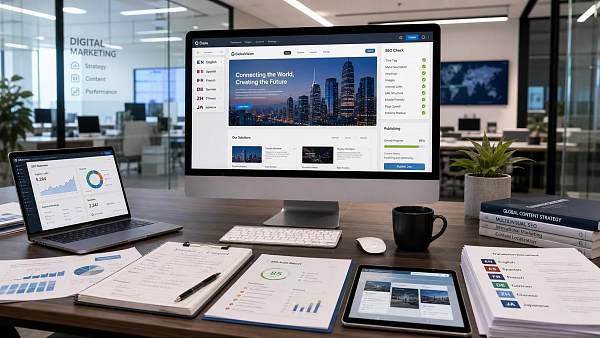
Can the content launch cycle for a multilingual independent website be shortened from 7 days to 2 days? Yes, but the prerequisite is not simply working overtime; it is redesigning the process.
Many projects are delayed not because of technical issues, but because of repeated confirmations, missing materials, translation rework, and inconsistent launch standards.
Based on actual delivery experience, the core of whether the content launch cycle for a multilingual independent website can be shortened from 7 days to 2 days lies in whether the sequential process can be changed into a parallel process.
If the old approach of “planning first, then writing content, translating, designing, developing, proofreading, and finally launching” is still used, it is difficult to truly shorten the cycle.
The truly effective approach is to standardize page types, content modules, language assets, SEO rules, and publishing tasks in advance, forming a replicable delivery process.
Why 7 Days Becomes the Norm
Let’s first look at where the problem lies. Most projects appear to have a 7-day schedule, but the actual production time may only be 2 to 3 days.
The remaining time is often consumed by waiting, supplementing materials, and repeated revisions.
There are usually four common bottlenecks.
- Incomplete requirements: the site structure and target market are not clearly defined from the outset.
- Content preparation relies on temporary manual collection, with text, images, and specifications scattered across multiple channels.
- Translation and SEO are handled afterward, with keywords and metadata added only after the page is completed.
- There is no acceptance checklist before launch, resulting in repeated rollbacks and corrections.
This also explains why many teams keep asking whether the content launch cycle for a multilingual independent website can be shortened from 7 days to 2 days.
It is not impossible; the problem is that the previous process was inherently unsuitable for rapid launch.
The Key to Shortening 7 Days to 2 Is Not Speeding Up, but Reordering the Process
To answer whether the content launch cycle for a multilingual independent website can be shortened from 7 days to 2 days, one principle must first be clear: no standardized process should be left until after the project starts.
More directly, a 2-day launch depends on “prebuilt capabilities.”
1. Prebuilt Page Structures
First, create standard page types for the homepage, product pages, industry pages, about page, and contact page.
Define the module order, field requirements, and display rules for each page type in advance. In this way, new projects can directly use the existing structure instead of starting the layout from scratch.
2. Prebuilt Content Assets
Company introductions, product specifications, factory advantages, frequently asked questions, and case descriptions should all be consolidated into a unified content library.
AI can assist in generating initial drafts, but final delivery must still be calibrated against business facts and the communication habits of the target market.
3. Set Multilingual Rules in Advance
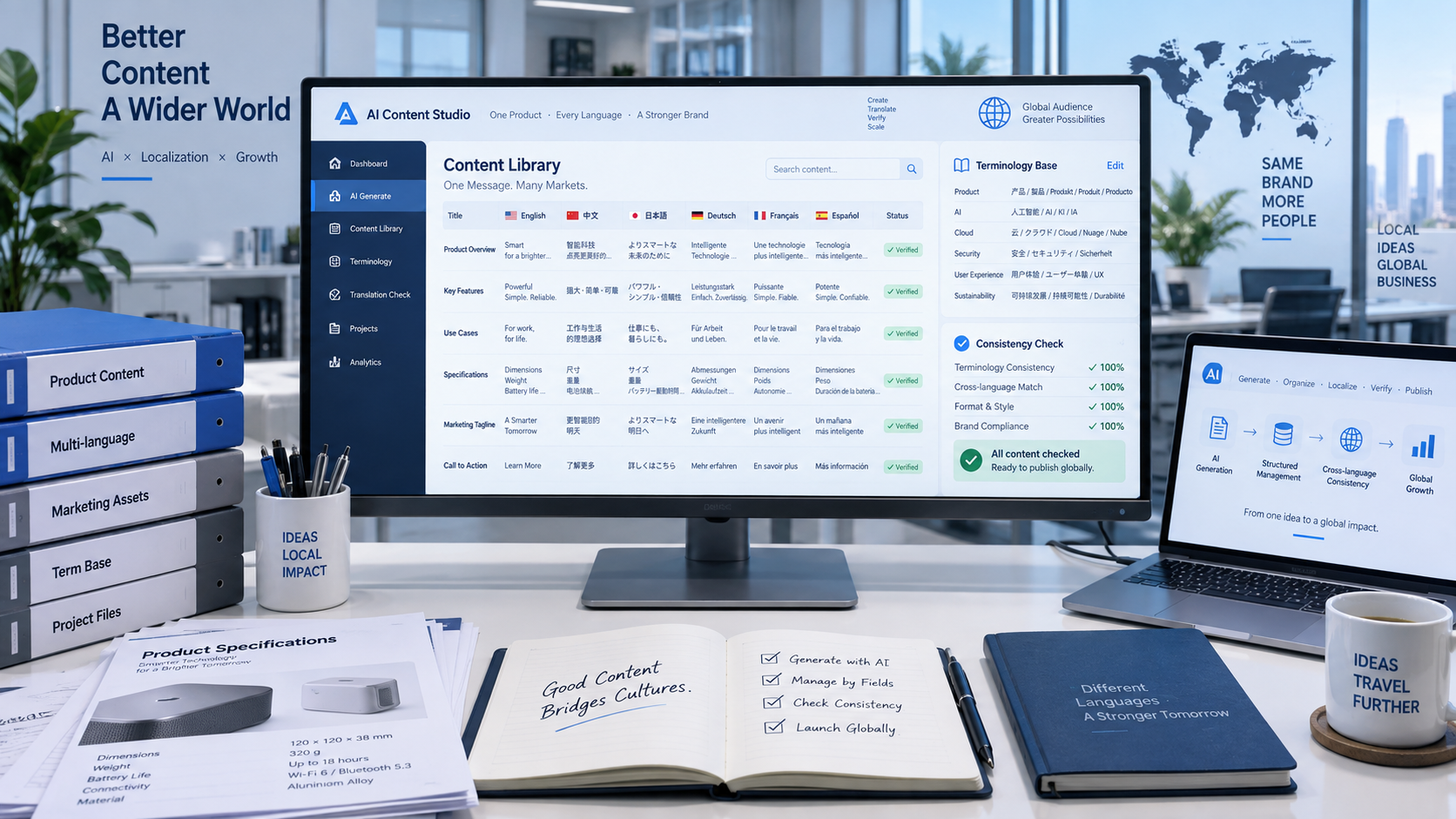
Do not wait until the Chinese version is finalized before translating everything. The correct approach is to define the terminology glossary, brand terms, terms not to be translated, and regional variation rules in advance.
Only in this way can multiple rounds of rework be reduced, while providing an execution basis for the goal of shortening the content launch cycle for a multilingual independent website from 7 days to 2 days.
A Practical 2-Day Launch Process
To truly shorten the cycle, it is recommended to proceed according to the following schedule.
Day 0: Preparation Before Kickoff
- Confirm the target market, language versions, site type, and core conversion objectives.
- Extract standard materials from the content library and supplement any missing assets.
- Finalize the keywords, page mapping, and URL rules.
- Assign responsible persons and clarify who approves, who produces, and who launches the site.
Although this stage may not count as part of the formal schedule, it determines whether a 2-day launch can be controlled.
Day 1: Parallel Production
The focus of the first day is not to complete every detail, but to advance three tasks simultaneously: page creation, content population, and SEO configuration.
- Use the website-building system to directly call templates and complete the page framework.
- Use AI to assist in generating titles, summaries, selling-point copy, and initial multilingual drafts.
- Simultaneously add title tags, descriptions, internal links, and image alt text.
For an integrated website and marketing services platform such as Yingyingbao, this is where the value lies. Website building, SEO, advertising landing-page logic, and multilingual management can all be completed within the same system.
This is far more efficient than having “content in documents, translations in spreadsheets, and pages in the backend.”
Day 2: Quality Inspection and Launch
On the second day, it is not recommended to continue making major changes. Instead, focus on launch verification.
At this point, whether the content launch cycle for a multilingual independent website can be shortened from 7 days to 2 days is no longer a hypothesis, but the result of the process.
Which Teams Are Most Likely to Turn a 2-Day Launch into an Empty Promise
Shortening the cycle does not mean that risks disappear. In actual operations, the following three issues are the most common.
Inconsistent Information Standards
Sales, marketing, and product teams each provide different information, resulting in inconsistencies across the page. The launch may be faster, but subsequent revisions become even slower.
Treating AI as the Final Product
AI is suitable for improving efficiency, but not for replacing review. In particular, multilingual pages require manual oversight of industry terminology, compliance-related wording, and regional conventions.
Treating Launch as the End
Many teams focus only on whether the site can be published today, while overlooking whether it can be indexed, generate conversions, and continue to expand after publication.
Therefore, the ultimate measure of whether the content launch cycle for a multilingual independent website can be shortened from 7 days to 2 days is not whether the publish button has been pressed, but whether the site has the ability to continuously acquire customers.
How to Turn a 2-Day Launch into a Stable Capability
To turn one-time acceleration into a long-term capability, the key is to build a delivery system rather than rely on individual experienced staff to handle emergencies.
- Establish standard page templates to reduce repetitive design and development work.
- Build multilingual terminology and industry content libraries.
- Turn SEO checks, conversion checks, and technical checks into fixed checklists.
- Use an integrated platform to centrally manage website building, content, publishing, and marketing data.
AI-driven platforms such as Yingyingbao are suitable for supporting these systematic requirements. It is not a standalone tool, but connects intelligent website building, multilingual management, SEO optimization, advertising, and content production.
For companies targeting overseas markets, this integrated website and marketing services capability can significantly reduce handoff losses and better support future site expansion and ongoing promotion.
Returning to the original question, can the content launch cycle for a multilingual independent website be shortened from 7 days to 2 days? Yes, but this does not come from compressing necessary steps. It comes from eliminating unnecessary waiting, rework, and fragmented processes in advance.
When templates, content, language, SEO, and launch standards are all managed in advance, a 2-day launch is no longer an emergency operation, but a more stable and replicable delivery method.
Related Articles


Related Products
 Yiyingbao SaaS Intelligent Website Building and Marketing SystemYiyingbao SaaS Intelligent Website Building and Marketing System, AI-powered no-code website building, rapid creation of multilingual B2B international websites in 10 minutes, global server acceleration, AI-powered SEO optimization, helping businesses connect efficiently with global markets. The perfect integration of technology and operation makes building an international trade website remarkably simple
 AI+SEM Intelligent Advertising Marketing SystemAI+SEM drives intelligent ad creation, empowering full-funnel precision advertising marketing. The system automatically generates weekly/monthly reports, AI recommends keywords and target countries, monitors core metrics in real-time with intelligent alerts, and enables one-click high-conversion ad solutions to help quickly acquire customers and improve ROI.
 AI+SEO Dual-Engine System Optimization ServicesYiyingbao’s AI+SEO dual-engine optimization system helps foreign trade enterprises acquire high-quality organic traffic through AI-powered keyword research, content generation, and comprehensive technical optimization, significantly improving search rankings and conversion rates.
 AI+SNS Social Media Marketing SystemYingbao AI+SNS Social Media Marketing System - Precision social capture for the social media era. Supports one-click content synchronization across major platforms like Facebook and LinkedIn. AI intelligently rewrites posts for enhanced relevance. 24/7 AI customer service and user profiling analysis empower businesses to efficiently expand into global markets.
 AI+SEO营销解决方案易营宝AI+SEO营销解决方案,通过AI批量写作、智能生成TDK、精准关键词扩词等功能,全面优化网站SEO效果,提升流量与转化率。助力企业构建高效智能网站新生态。
 AI+SEM Advertising Marketing SolutionsAI+SEM Advertising Marketing Solution leverages AI technology to deeply empower SEM ad campaigns. It automatically generates weekly/monthly reports using AI, presenting account data across multiple dimensions for comprehensive insights into campaign performance and trends. The system precisely recommends keywords and target countries, intelligently generates high-conversion ad copy, and enables one-click activation of efficient campaign plans to help businesses rapidly acquire customers. Simultaneously, it monitors core metrics in real time, intelligently identifies abnormal fluctuations, and issues timely alerts to ensure stable, high-return advertising results.
 Domain Name ServicesEasyWin provides professional domain name services, including intelligent queries, one-stop registration, brand protection, and full lifecycle management, helping businesses build a digital brand image.
 EasyOperate B2C Cross-Border E-Commerce Platform & Independent WebsiteEasyStore B2C Cross-border E-commerce Independent Store is an intelligent website building and cross-border e-commerce integrated solution independently developed by EasyStore Information Technology (Beijing) Co., Ltd. The system is specially designed for small and medium-sized as well as large export enterprises, integrating 'website building, operation, marketing, advertising, and conversion' into one, helping enterprises quickly establish cross-border e-commerce independent stores to achieve brand globalization and global sales growth.
The platform supports multiple languages, multiple currencies, and multi-channel marketing, with built-in AI intelligent translation and SEO optimization systems, suitable for mainstream markets such as Southeast Asia, Europe and America, Latin America, and the Middle East, assisting Chinese manufacturing enterprises in efficiently deploying international e-commerce strategies. SSL证书易营宝提供专业SSL安全证书服务,包括单域名和泛域名证书,确保网站数据传输加密、身份验证和完整性保护,助力企业建立安全可信的在线业务环境。









