









- How to Choose Topics for an Industry News Section to Attract More Organic Search TrafficJul 29, 2026View details
- Can Zhejiang foreign trade independent websites still be developed today? Look at changes in traffic and lead generationJul 28, 2026View details
- What New Signals Are Emerging in Enterprise Services SaaS Marketing ReportsJul 27, 2026View details
- What Does a Global Traffic Ecosystem Service Provider Do? What Are the Differences from a Single Advertising AgencyJul 16, 2026View details
- What should you focus on in the latest enterprise SaaS report? From renewal rates and delivery costs to overseas growth opportunitiesJul 12, 2026View details
- What signals are worth paying attention to in a cross-border marketing trend report? B2B companies should look at these 6 signalsJul 11, 2026View details
How to Build a More Reliable Omnichannel Overseas Marketing Strategy
How to Build a More Stable Omnichannel Overseas Marketing Strategy

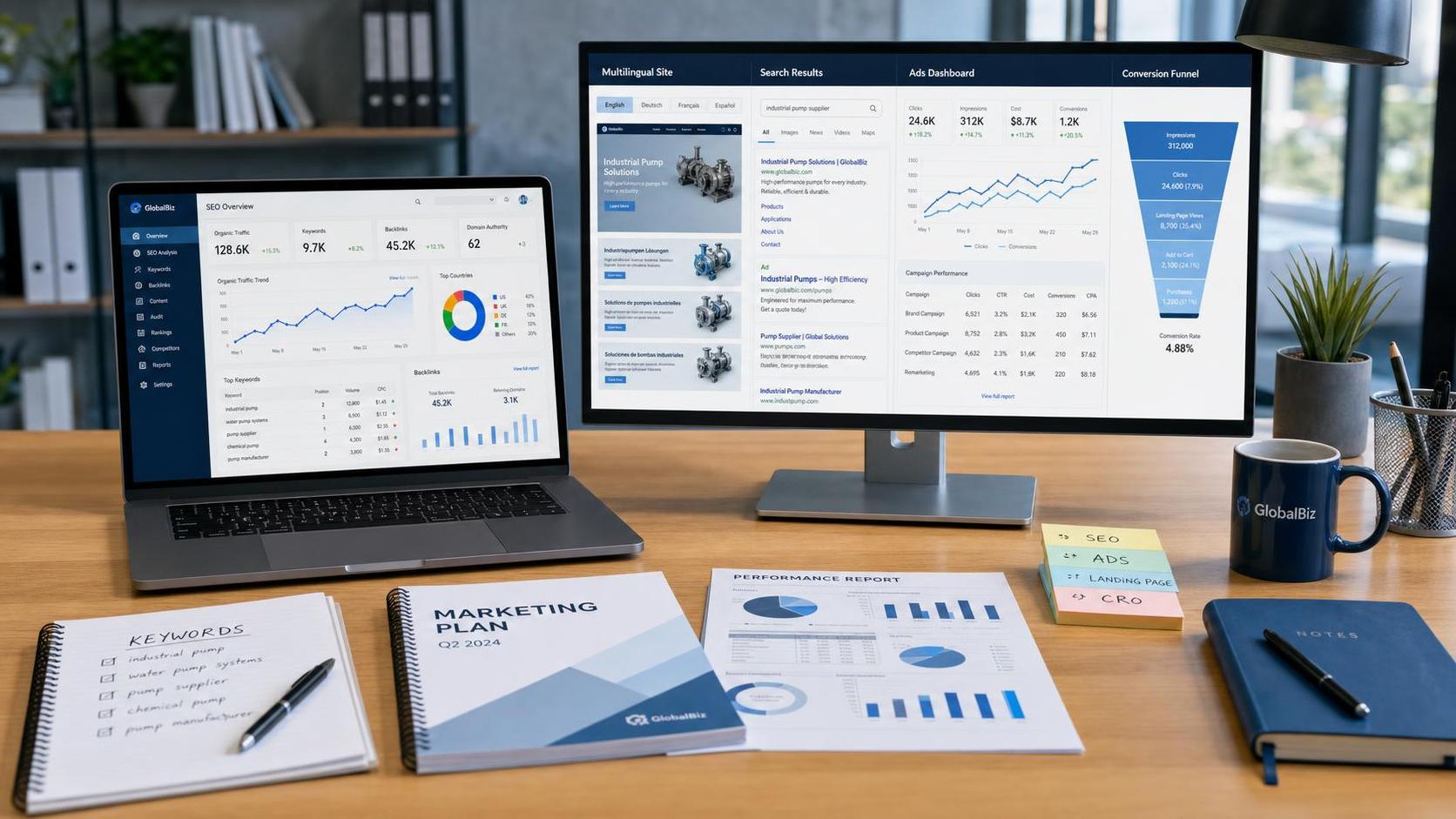
When building an omnichannel overseas marketing strategy, the key is not to cover as many channels as possible, but to ensure that the channels work together consistently to create incremental value. A truly stable solution does not rely on a single-channel breakthrough. Instead, it combines websites, content, advertising, social media, and data to work together.
Recent developments show that the cost of acquiring overseas customers continues to rise, while traffic is becoming more fragmented. If a company relies on only one platform, performance can fluctuate significantly, making it difficult to optimize budget utilization over the long term.
This also means that omnichannel overseas marketing is not simply about running several advertising accounts. It starts with building an overseas digital presence that can be indexed, promoted, and converted, and then connecting leads and data from different channels.
For an integrated website and marketing services solution, stable results usually come from three foundational actions: a unified traffic entry point, a unified conversion path, and unified data-based decision-making. If any one of these is missing, growth can easily become distorted.
Why Omnichannel Overseas Marketing Is Better Suited to the Current Growth Environment
The decision-making journey of overseas users has become significantly longer. Some search on Google first, some view social media content first, and others learn about a brand through advertising before returning to the official website to submit an inquiry or place an order.
If a company only builds a website without continuously generating traffic, the website will become a static business card. Conversely, if it only runs advertising without the ability to receive and convert traffic, visitors may be lost because of poor page experiences and insufficient trust.
The value of omnichannel overseas marketing lies in connecting these fragmented touchpoints, enabling search, advertising, social media, and content to work together instead of operating independently.
- Reduce customer acquisition risks caused by fluctuations in a single channel
- Increase continuous brand exposure across different markets
- Make lead quality and conversion efficiency more manageable
- Help shift budget allocation from experience-based decisions to data-based decisions
In actual business operations, companies that place greater emphasis on long-term growth are less likely to interpret omnichannel overseas marketing as “opening more channels.” Instead, they see it as “enabling channels to enhance one another.”
The Logic for Building a Stable System: Establish the Foundation First, Then Scale It
To make omnichannel overseas marketing stable, the first step is not to increase the budget, but to build a solid foundation. This foundation typically includes a multilingual website, a clear conversion path, basic content assets, and a trackable data system.
First, the Website Must Be Capable of Supporting Marketing Conversions
An overseas website is more than a simple display page. It must take into account search indexing, mobile experience, page loading, form conversion, content expansion, and stable access across multiple regions.
If the website structure is disorganized, language versions are poorly adapted, or landing pages do not match advertising intent, even high-quality traffic will be difficult to retain. The fundamental issue in omnichannel overseas marketing is always whether the website can effectively receive and convert traffic.
Second, Content Must Serve Different Channels
SEO emphasizes structured content, advertising emphasizes conversion-focused messaging, and social media emphasizes interaction and memorability. Content cannot be used unchanged across all channels; it must be adapted for each one.
A more stable approach is to use the same set of product selling points and break them down into website pages, blog content, advertising copy, short-video scripts, and social media topics. This keeps messaging consistent while improving efficiency.
Third, Data Must Form a Closed Loop
The biggest concern in omnichannel overseas marketing is that “every channel is running, but no one can clearly explain which parts are actually effective.” Therefore, traffic sources, keywords, inquiry quality, and conversion attribution all need to be viewed through a unified framework.
Only after a closed-loop data system has been established can subsequent decisions about budget increases or reductions, page adjustments, and market priorities be made based on data rather than intuition.
How Should the Omnichannel Overseas Marketing Mix Be Structured?
From an application perspective, a more stable omnichannel overseas marketing mix usually does not distribute efforts evenly. Instead, it is divided into two lines: “long-term growth channels” and “rapid scaling channels.”
This configuration is more consistent with current market realities. SEO is responsible for accumulating long-term value, advertising is responsible for testing and scaling, social media is responsible for influencing decisions, the website is responsible for receiving and converting traffic, and AI search optimization is responsible for securing new visibility opportunities.
When these modules operate under the same business logic, omnichannel overseas marketing can evolve from “parallel multi-channel operations” into “multi-channel collaboration.”
What Capabilities Should Be Evaluated When Selecting a Solution?
When many companies implement omnichannel overseas marketing, the problem is not that they do not know what to do, but that they do not know how to determine whether a solution is reliable. What deserves greater attention is the underlying capability, rather than the price of an individual service.
- Does it provide integrated website development and marketing capabilities? If the website, content, and advertising are handled by different teams, the coordination costs can be high.
- Does it support localization across multiple regions? Language expression, advertising materials, and conversion habits vary greatly from one market to another.
- Can it establish long-term data assets? Seeing clicks is not enough; inquiry quality and subsequent conversions must also be measurable.
- Does it have technology-driven capabilities? AI website building, AI advertising optimization, and AI+SEO/GEO can directly affect execution efficiency and growth flexibility.
Taking EasyYingbao as an example, it uses AI and big data as its core drivers and has built a full-chain solution around intelligent website building, SEO optimization, social media marketing, and advertising. For companies seeking to steadily advance omnichannel overseas marketing, this type of platform-based capability is usually more sustainable.
Especially in scenarios such as multilingual official websites, B2B foreign trade marketing websites, B2C cross-border online stores, and overseas social media lead generation, platform-based systems can significantly reduce repeated coordination and redundant development.
Four Recommended Steps for Building Stable Omnichannel Overseas Marketing
If the goal is stability rather than short-term excitement, it is best to proceed in stages. This makes it easier to verify return on investment and correct deviations in a timely manner.
- Build the website and data foundation first. Define the target markets, languages, product lines, and conversion goals.
- Then develop SEO and content. Secure long-term organic traffic entry points that can accumulate over time.
- Launch advertising tests simultaneously. Use search advertising and social media advertising to quickly validate the audience and pages.
- Finally, establish a review mechanism. Continuously optimize the budget by market, channel, page, and lead quality.
The real challenge of omnichannel overseas marketing is not opening up channels, but incorporating every step into an execution system that is measurable, adjustable, and replicable.
Ultimately, more stable overseas growth comes from a solution mix that can operate over the long term. The website receives traffic, SEO accumulates value, advertising amplifies reach, social media influences decisions, and AI optimization improves efficiency. Once this logic is properly integrated, omnichannel overseas marketing can gradually evolve from a cost item into an asset for continuous growth.
Related Articles


Related Products
 Yiyingbao SaaS Intelligent Website Building and Marketing SystemYiyingbao SaaS Intelligent Website Building and Marketing System, AI-powered no-code website building, rapid creation of multilingual B2B international websites in 10 minutes, global server acceleration, AI-powered SEO optimization, helping businesses connect efficiently with global markets. The perfect integration of technology and operation makes building an international trade website remarkably simple
 AI+SEM Intelligent Advertising Marketing SystemAI+SEM drives intelligent ad creation, empowering full-funnel precision advertising marketing. The system automatically generates weekly/monthly reports, AI recommends keywords and target countries, monitors core metrics in real-time with intelligent alerts, and enables one-click high-conversion ad solutions to help quickly acquire customers and improve ROI.
 AI+SEO Dual-Engine System Optimization ServicesYiyingbao’s AI+SEO dual-engine optimization system helps foreign trade enterprises acquire high-quality organic traffic through AI-powered keyword research, content generation, and comprehensive technical optimization, significantly improving search rankings and conversion rates.
 AI+SNS Social Media Marketing SystemYingbao AI+SNS Social Media Marketing System - Precision social capture for the social media era. Supports one-click content synchronization across major platforms like Facebook and LinkedIn. AI intelligently rewrites posts for enhanced relevance. 24/7 AI customer service and user profiling analysis empower businesses to efficiently expand into global markets.
 AI+SEO营销解决方案易营宝AI+SEO营销解决方案,通过AI批量写作、智能生成TDK、精准关键词扩词等功能,全面优化网站SEO效果,提升流量与转化率。助力企业构建高效智能网站新生态。
 AI+SEM Advertising Marketing SolutionsAI+SEM Advertising Marketing Solution leverages AI technology to deeply empower SEM ad campaigns. It automatically generates weekly/monthly reports using AI, presenting account data across multiple dimensions for comprehensive insights into campaign performance and trends. The system precisely recommends keywords and target countries, intelligently generates high-conversion ad copy, and enables one-click activation of efficient campaign plans to help businesses rapidly acquire customers. Simultaneously, it monitors core metrics in real time, intelligently identifies abnormal fluctuations, and issues timely alerts to ensure stable, high-return advertising results.
 Domain Name ServicesEasyWin provides professional domain name services, including intelligent queries, one-stop registration, brand protection, and full lifecycle management, helping businesses build a digital brand image.
 EasyOperate B2C Cross-Border E-Commerce Platform & Independent WebsiteEasyStore B2C Cross-border E-commerce Independent Store is an intelligent website building and cross-border e-commerce integrated solution independently developed by EasyStore Information Technology (Beijing) Co., Ltd. The system is specially designed for small and medium-sized as well as large export enterprises, integrating 'website building, operation, marketing, advertising, and conversion' into one, helping enterprises quickly establish cross-border e-commerce independent stores to achieve brand globalization and global sales growth.
The platform supports multiple languages, multiple currencies, and multi-channel marketing, with built-in AI intelligent translation and SEO optimization systems, suitable for mainstream markets such as Southeast Asia, Europe and America, Latin America, and the Middle East, assisting Chinese manufacturing enterprises in efficiently deploying international e-commerce strategies. SSL证书易营宝提供专业SSL安全证书服务,包括单域名和泛域名证书,确保网站数据传输加密、身份验证和完整性保护,助力企业建立安全可信的在线业务环境。









