









- How to Choose Topics for an Industry News Section to Attract More Organic Search TrafficJul 29, 2026View details
- Can Zhejiang foreign trade independent websites still be developed today? Look at changes in traffic and lead generationJul 28, 2026View details
- What New Signals Are Emerging in Enterprise Services SaaS Marketing ReportsJul 27, 2026View details
- What Does a Global Traffic Ecosystem Service Provider Do? What Are the Differences from a Single Advertising AgencyJul 16, 2026View details
- What should you focus on in the latest enterprise SaaS report? From renewal rates and delivery costs to overseas growth opportunitiesJul 12, 2026View details
- What signals are worth paying attention to in a cross-border marketing trend report? B2B companies should look at these 6 signalsJul 11, 2026View details
- How to Read a Cross-Border Marketing Trends Report? Five Key Dimensions for Evaluating Channel OpportunitiesJul 11, 2026View details
- Which channel has the highest ROI in the global traffic ecosystem? Comparative analysis of search, social media, and advertisingJul 10, 2026View details
Can multilingual content go live in 2 days?
Can a multilingual content launch be completed in 2 days?
Can the content launch cycle for a multilingual independent website be reduced from 7 days to 2 days? The answer is yes, but there are prerequisites. What truly determines the speed is not a single translation step, but whether content preparation, page structure, technical infrastructure, and the advertising schedule can move forward in parallel.
For businesses, the key to reducing the content launch cycle for a multilingual independent website from 7 days to 2 days is not rushing the work, but having a standardized process in place. As long as the process is properly designed, launching in 2 days is not an aggressive target, but a repeatable execution result.
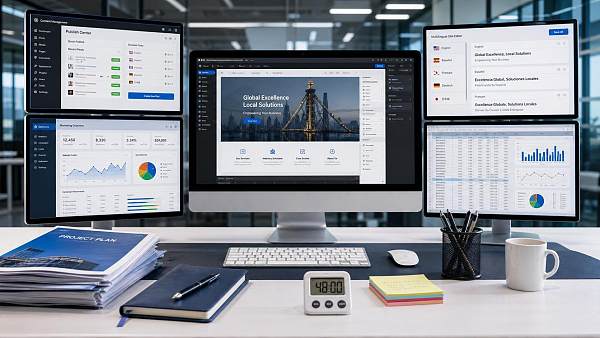
Recent changes show that the pace of acquiring overseas customers has clearly accelerated. New product testing, trade show traffic generation, advertising landing pages, and regional market trials are all shortening the launch window. Whoever can deploy multilingual pages faster is more likely to obtain traffic validation results first.
Why do many projects start with 7 days?
Many businesses find it difficult to reduce the content launch cycle for a multilingual independent website from 7 days to 2 days, mainly because their old processes are too fragmented. Copywriting, design, translation, website development, review, and publishing are handled by different teams, with repeated confirmations in between, so the process naturally takes longer.
There are usually three common bottlenecks. First, the original Chinese content is incomplete. Second, the page templates have not been determined in advance. Third, multilingual versions and SEO settings are handled separately, causing every step to be reworked.
- The section structure is revised three times before translation can begin.
- Product materials are scattered, so copy must be assembled temporarily.
- Titles, descriptions, and URL rules are added only after publication.
- The advertising landing page is inconsistent with the website content, affecting conversion.
This also means that a long cycle does not necessarily indicate a large workload; it may simply reflect an inefficient process. As long as the preparatory steps are handled properly, the content launch cycle for a multilingual independent website can be reduced from 7 days to 2 days, changing it from something that “depends on the situation” into something “manageable.”
Key prerequisites for reducing 7 days to 2 days
To launch within 2 days, at least four prerequisites must be met. If even one is missing, the pace will slow significantly. In essence, reducing the content launch cycle for a multilingual independent website from 7 days to 2 days tests an organization’s ability to collaborate.
1. Prepare a standardized content package first
A standardized content package includes the company introduction, product selling points, application scenarios, delivery capabilities, certifications and qualifications, contact information, and inquiry actions. With a unified content source, translation, website development, and SEO can proceed in parallel without repeated copy revisions.
2. Prepare reusable page templates first
If the homepage, product pages, case study pages, and landing pages all need to be designed from scratch, launching within 2 days is basically unrealistic. Mature templates can directly accommodate multilingual content, requiring only the replacement of copy, visual content modules, and conversion components.
3. Handle translation and SEO simultaneously
The truly efficient approach is not to complete the translation first and optimize it afterward, but to handle keywords, title tags, meta descriptions, and regional expressions simultaneously during translation. This better aligns with search and conversion logic.
4. The technical system must support rapid publishing
Only systems that support batch language copying, automatic URL rule generation, inheritance of internal links, and page version management are suitable for shortening the cycle. Otherwise, the more manual maintenance is required, the higher the error rate will be.
An actionable process for launching in 2 days
If the objective is clear, the content launch cycle for a multilingual independent website can be reduced from 7 days to 2 days by following the schedule below. The focus is not on squeezing time, but on rearranging the sequence.
- Morning of Day 1: Confirm the target markets, language versions, core pages, and conversion actions.
- Afternoon of Day 1: Import the standardized content package and use templates to generate the website structure.
- Evening of Day 1: Complete the initial AI translation, terminology alignment, and SEO keyword integration simultaneously.
- Morning of Day 2: Complete manual proofreading, page layout checks, and form testing.
- Afternoon of Day 2: Publish the website and coordinate traffic generation through advertising, social media, or email channels.
In actual business operations, this approach is particularly suitable for pre-trade-show warm-up campaigns, launching advertising in new markets, testing new languages for cross-border e-commerce stores, and expanding the language versions of B2B foreign trade inquiry pages. Launching first for validation and then iterating continuously is more effective than waiting a long time for a complete version.
Fast launch does not mean low quality
Many managers worry that if the content launch cycle for a multilingual independent website can be reduced from 7 days to 2 days, content quality may decline. This concern is reasonable, but the issue is not speed; it is whether quality control checkpoints are in place.
A high-quality launch must at least meet three standards: accurate expression, readable pages, and clear conversion paths. No matter how many languages are available, if the page lacks effective commercial communication, it will be difficult to genuinely generate inquiries or orders.
- Avoid literal translation and retain industry-specific communication practices.
- Check the buttons, forms, and redirects in every language version.
- Make the value proposition above the fold clear; do not merely change the language without adapting the expression.
An even clearer signal is that many underperforming websites are not slow, but have confusing content logic. In contrast, combining AI website building, AI translation, and manual proofreading can often reach the basic standards of being “ready for advertising, indexable, and capable of conversion” more quickly.
Which businesses are best suited to the 2-day model?
Not every project needs to pursue maximum speed. However, the following types of businesses are generally more suitable for setting the reduction of the content launch cycle for a multilingual independent website from 7 days to 2 days as a clear objective.
For a complex brand website reconstruction, a rewrite of the content system, or the simultaneous rebuilding of websites for multiple countries, 2 days is more suitable as a first-stage trial run rather than a one-time completion of all objectives.
Why is it easier for an integrated platform to achieve this?
Reducing the content launch cycle for a multilingual independent website from 7 days to 2 days is essentially a competition between tool capabilities. When website development, translation, SEO, advertising, and data are distributed across different systems, execution efficiency will inevitably suffer.
The value of an AI-driven platform such as 易营宝 lies in integrating intelligent website building, multilingual website development, SEO optimization, advertising placement, and overseas marketing into one workflow. Pages can be built faster, content can be replicated faster, and optimization actions can also be implemented simultaneously.
For businesses seeking global growth, this integrated approach is more practical. It reduces outsourcing handoffs, communication losses, and repeated data entry, making the launch of multilingual content not merely a project milestone, but a growth action that can be continuously replicated.
Conclusion: Whether it can be reduced to 2 days depends on systematic preparation
Returning to the original question, can the content launch cycle for a multilingual independent website be reduced from 7 days to 2 days? Yes, but not by forcing the work through overtime. It requires the combined use of content standardization, template-based website building, AI-assisted processing, and a unified publishing mechanism.
What truly deserves attention is not whether “2 days is fast,” but whether the website can be indexed after launch, handle incoming traffic, and generate inquiries. This is the key to evaluating the value of a multilingual independent website.
If you are currently facing multi-region advertising, the launch of a new language, or the expansion of overseas websites, first organize the content package, template library, and publishing process, and then evaluate the system capabilities. In most cases, this can steadily bring the original 7-day cycle close to 2 days while keeping quality more controllable.
Related Articles



Related Products
 Yiyingbao SaaS Intelligent Website Building and Marketing SystemYiyingbao SaaS Intelligent Website Building and Marketing System, AI-powered no-code website building, rapid creation of multilingual B2B international websites in 10 minutes, global server acceleration, AI-powered SEO optimization, helping businesses connect efficiently with global markets. The perfect integration of technology and operation makes building an international trade website remarkably simple
 AI+SEM Intelligent Advertising Marketing SystemAI+SEM drives intelligent ad creation, empowering full-funnel precision advertising marketing. The system automatically generates weekly/monthly reports, AI recommends keywords and target countries, monitors core metrics in real-time with intelligent alerts, and enables one-click high-conversion ad solutions to help quickly acquire customers and improve ROI.
 AI+SEO Dual-Engine System Optimization ServicesYiyingbao’s AI+SEO dual-engine optimization system helps foreign trade enterprises acquire high-quality organic traffic through AI-powered keyword research, content generation, and comprehensive technical optimization, significantly improving search rankings and conversion rates.
 AI+SNS Social Media Marketing SystemYingbao AI+SNS Social Media Marketing System - Precision social capture for the social media era. Supports one-click content synchronization across major platforms like Facebook and LinkedIn. AI intelligently rewrites posts for enhanced relevance. 24/7 AI customer service and user profiling analysis empower businesses to efficiently expand into global markets.
 AI+SEO营销解决方案易营宝AI+SEO营销解决方案,通过AI批量写作、智能生成TDK、精准关键词扩词等功能,全面优化网站SEO效果,提升流量与转化率。助力企业构建高效智能网站新生态。
 AI+SEM Advertising Marketing SolutionsAI+SEM Advertising Marketing Solution leverages AI technology to deeply empower SEM ad campaigns. It automatically generates weekly/monthly reports using AI, presenting account data across multiple dimensions for comprehensive insights into campaign performance and trends. The system precisely recommends keywords and target countries, intelligently generates high-conversion ad copy, and enables one-click activation of efficient campaign plans to help businesses rapidly acquire customers. Simultaneously, it monitors core metrics in real time, intelligently identifies abnormal fluctuations, and issues timely alerts to ensure stable, high-return advertising results.
 Domain Name ServicesEasyWin provides professional domain name services, including intelligent queries, one-stop registration, brand protection, and full lifecycle management, helping businesses build a digital brand image.
 EasyOperate B2C Cross-Border E-Commerce Platform & Independent WebsiteEasyStore B2C Cross-border E-commerce Independent Store is an intelligent website building and cross-border e-commerce integrated solution independently developed by EasyStore Information Technology (Beijing) Co., Ltd. The system is specially designed for small and medium-sized as well as large export enterprises, integrating 'website building, operation, marketing, advertising, and conversion' into one, helping enterprises quickly establish cross-border e-commerce independent stores to achieve brand globalization and global sales growth.
The platform supports multiple languages, multiple currencies, and multi-channel marketing, with built-in AI intelligent translation and SEO optimization systems, suitable for mainstream markets such as Southeast Asia, Europe and America, Latin America, and the Middle East, assisting Chinese manufacturing enterprises in efficiently deploying international e-commerce strategies. SSL证书易营宝提供专业SSL安全证书服务,包括单域名和泛域名证书,确保网站数据传输加密、身份验证和完整性保护,助力企业建立安全可信的在线业务环境。









