









- Which customer acquisition channels will be affected by cross-border marketing trends in 2026?Sep 06, 2026View details
- Which homogenization risks should be considered in an analysis of the AI-powered website building industry?Aug 30, 2026View details
- How Will AI Marketing Trends 2026 Change Advertising Budget AllocationAug 28, 2026View details
- Is the EV SSL certificate market shrinking or upgrading? How should companies assess certificate procurement?Aug 11, 2026View details
- Why the old AMP SEO 2020 practices no longer work and what has changed in current optimization prioritiesAug 02, 2026View details
- How to Choose Topics for an Industry News Section to Attract More Organic Search TrafficJul 29, 2026View details
Will WhatsApp security verification increase the cost of cross-border stores?
Does WhatsApp security verification for cross-border e-commerce require additional costs? If you focus only on whether verification requires payment, you are not seeing the whole picture. For store operators, especially during financial approval, the more important questions are whether verification can improve account stability, make customer outreach smoother, make team collaboration more controllable, and ultimately reduce the hidden losses caused by account suspension, failed messages, and customer churn.
Many cross-border stores use WhatsApp as a customer service tool, but in real business operations it often handles pre-sales inquiries, order confirmations, repurchase reminders, after-sales support, and even sales conversion for high-value products. For this reason, security verification is not merely a technical procedure; it is also part of the cost structure.
The conclusion first: it will increase some investment, but not necessarily the total cost
WhatsApp security verification usually means that a company needs to adopt more standardized practices regarding account ownership, number usage, business compliance, and message delivery. Under different usage scenarios, the sources of additional costs are not exactly the same. Some costs are visible, such as access services, number maintenance, system configuration, and employee training. Others are easy to overlook in daily operations, such as customer interruptions caused by unstable accounts, wasted advertising traffic, repeated communication by customer service staff, and declining conversion rates.
Therefore, when approving the budget, finance teams should not view this simply as a question of whether to spend extra money. It is more appropriate to consider whether adopting a more standardized approach can reduce greater and more uncertain expenses in the future. If a store has a small annual order volume and uses WhatsApp only occasionally, there may be no urgent need to adopt a more complex verification and management solution. However, once WhatsApp has become a primary customer communication channel, the cost assessment logic changes completely.
The costs that truly increase are usually not caused by verification itself
In actual projects, the reason companies feel that WhatsApp has become more expensive is often not a single verification fee, but the supporting improvements required. For example:
- A more stable business number and company information may be required
- An official or compliant messaging channel may need to be integrated
- The website, forms, advertising landing pages, and chat entry points may need to be connected
- Customer service processes may need to be standardized to avoid multiple people sharing private accounts
- Message templates, automatic replies, lead assignment, and data retention may need to be configured
Viewed individually, each of these actions becomes a budget item. From an operational perspective, however, they all address the same issue: ensuring that customer outreach no longer depends on personal accounts and temporary operations. For cross-border stores, once advertising is running, the independent website is active, and customer service is handling inquiries across multiple time zones, the chat tool is no longer a matter of simply being usable. It has become part of the order conversion process.
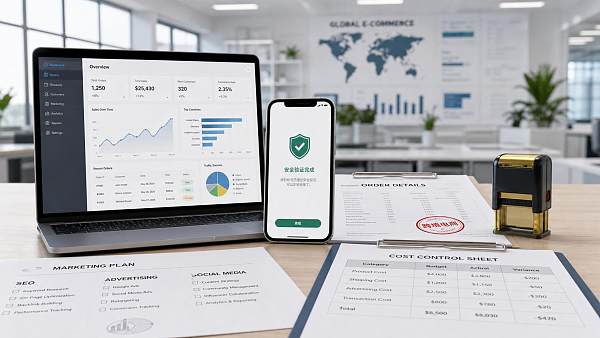
This is why many companies eventually incorporate WhatsApp management into an integrated website and marketing service system instead of handling it separately. If front-end traffic acquisition, on-site conversion, and back-end communication are disconnected, the apparent savings on verification and system costs are often outweighed by higher spending on wasted traffic and lost leads.
Finance teams should focus more on three types of hidden costs
1. Account risk-control costs
The biggest concern in cross-border business is not paying for verification, but having the customer communication chain suddenly interrupted after an account is restricted. This is especially true for stores that rely on WhatsApp to handle advertising inquiries or independent website leads. Once the primary account becomes abnormal, front-end advertising continues running while the back end cannot handle the inquiries, resulting in simultaneous losses of advertising expenses, labor costs, and business opportunities.
This type of risk cannot be easily quantified, but it is easy for finance teams to understand: if verification and compliant access can reduce the probability of account bans, abnormalities, or unstable message delivery, the corresponding expense is not an additional cost but a risk mitigation cost. This is particularly true for high-value products, products with long decision cycles, and products that depend on repeat purchases. Losing a single customer conversation may cost far more than a system investment.
2. Conversion efficiency costs
Many stores find that even when customers add them on WhatsApp, some teams can quickly close deals while others use the chat window merely as a message board. The difference does not lie in the tool itself, but in the business management capabilities enabled after verification: whether the source channel can be identified automatically, whether replies can be provided promptly, and whether website forms, advertising inquiries, and customer service conversations can be integrated.
Without these fundamentals, companies repeatedly pay for ineffective lead follow-up, repetitive manual replies, and gaps in customer service handovers. Although no additional software budget appears to have been added, labor inefficiency is actually being used to compensate for system deficiencies.
3. Customer reach stability costs
Cross-border markets are not uniform. Customers in different regions have different communication habits, preferred response times, and ways of building trust. In some markets, WhatsApp is almost the preferred communication tool. If a business account has unclear identification, inconsistent replies, or frequent number changes, customers will naturally question the authenticity of the store. This is particularly apparent among new customers making initial contact.
From a financial perspective, this is a brand trust cost. It may not appear directly on a purchase order, but it will be reflected in inquiry conversion rates, order abandonment rates, and repeat purchase rates.
Which stores should assess this cost more carefully
Not every cross-border seller needs to treat WhatsApp security verification as a priority project, but the following types of businesses are generally more likely to benefit from planning ahead:
- Independent websites that already have stable traffic and receive most inquiries through on-site chat or button redirects
- Businesses currently running Google or social media advertising, where lead acquisition costs are already significant
- Customer service teams with more than one person that require multiple-agent support, shift work, or handovers
- Businesses targeting the Middle East, Latin America, Southeast Asia, and other markets that rely heavily on instant messaging
- Products with relatively long decision cycles that require repeated communication, document sharing, and quotation follow-up
In these situations, the focus of approval should not be whether there is an additional cost, but rather what it will cost to compensate for not taking action later.
Do not view WhatsApp verification in isolation: it is connected with your website, advertising, and SEO
When preparing budgets, many companies prefer to separate them into different items: one expense for website development, one for advertising, one for customer service tools, and another for SEO. There is nothing wrong with viewing them separately, but operating results are often fragmented as a result. Customers enter the website through search engines, advertising, or social media, and complete their communication on WhatsApp. If any link in the process breaks, the money invested in the earlier stages will be diluted.
This is also the value of integrated website and marketing services. The purpose is not to package and sell more services, but to recognize that the customer acquisition process itself is continuous. During website development, the position of the WhatsApp entry point, redirect logic, mobile experience, and multilingual page matching all need to be considered. During advertising, it is necessary to determine whether customers from different channels can be distinguished and tracked. During SEO, it is also important to ensure that there is a sufficiently smooth conversion path after organic traffic arrives.
Platforms such as 易营宝, which have long served foreign trade companies and brands expanding overseas, place intelligent website development, SEO optimization, advertising, and social media operations within the same solution for essentially the same reason: to prevent companies from paying separately for each stage while losing potential customers at critical conversion points. For finance teams, this integrated perspective makes it easier to calculate the true customer acquisition cost rather than focusing only on the purchase price of individual services.
How to assess the cost during approval and avoid underinvesting in necessary items while repeatedly paying for unnecessary ones
If you are evaluating whether WhatsApp security verification for cross-border e-commerce requires additional costs, do not ask the supplier only how much it costs. Instead, clarify the following questions:
- What specific problems can verification solve: number compliance, message stability, or team collaboration?
- Does it need to be connected with the independent website, e-commerce system, or advertising landing pages, and who will bear the integration costs?
- Will subsequent configuration involve message templates, customer service assignment, automated processes, or data retention?
- Which markets does the business cover, and do local customers rely heavily on WhatsApp for communication?
- If verification or compliant access is not implemented, what are the risks in the current operating model?
Once these questions are considered, many budget disputes will naturally disappear. The real disagreement is usually not about the price, but about whether the subsequent operating costs are visible.
There is another common misconception: treating security verification as a one-time task. In reality, once a cross-border communication system has been established, it will also involve account maintenance, page updates, channel adjustments, and message strategy optimization. If a company is already operating a multilingual website, Google SEO, advertising, and overseas social media, WhatsApp is better incorporated into a long-term operating framework than added temporarily as a single button.
Whether the cost should be approved depends on whether it reduces the overall customer acquisition cost
Returning to the original question: does WhatsApp security verification increase the cost for a cross-border store? It does usually require some additional investment. However, if the company has already incorporated WhatsApp into its sales conversion process, this investment is more like repairing a critical channel than simply increasing expenses.
During financial approval, it may be better to look at the issue from another perspective. Instead of focusing on whether the verification itself costs money, consider whether it can reduce greater hidden losses, form a closed loop with the website, advertising, SEO, and customer service systems, and turn front-end traffic into customer assets that can be followed up and converted.
If the company is planning an independent website upgrade, overseas marketing campaigns, or expansion into multiple markets, a more practical approach is not to purchase a chat tool separately, but to calculate website engagement, channel traffic acquisition, and communication verification together in the same cost plan. The resulting budget is usually closer to actual operational needs and better able to withstand subsequent performance reviews.
Related Articles



Related Products
 Yiyingbao SaaS Intelligent Website Building and Marketing SystemYiyingbao SaaS Intelligent Website Building and Marketing System, AI-powered no-code website building, rapid creation of multilingual B2B international websites in 10 minutes, global server acceleration, AI-powered SEO optimization, helping businesses connect efficiently with global markets. The perfect integration of technology and operation makes building an international trade website remarkably simple
 AI+SEM Intelligent Advertising Marketing SystemAI+SEM drives intelligent ad creation, empowering full-funnel precision advertising marketing. The system automatically generates weekly/monthly reports, AI recommends keywords and target countries, monitors core metrics in real-time with intelligent alerts, and enables one-click high-conversion ad solutions to help quickly acquire customers and improve ROI.
 AI+SEO Dual-Engine System Optimization ServicesYiyingbao’s AI+SEO dual-engine optimization system helps foreign trade enterprises acquire high-quality organic traffic through AI-powered keyword research, content generation, and comprehensive technical optimization, significantly improving search rankings and conversion rates.
 AI+SNS Social Media Marketing SystemYingbao AI+SNS Social Media Marketing System - Precision social capture for the social media era. Supports one-click content synchronization across major platforms like Facebook and LinkedIn. AI intelligently rewrites posts for enhanced relevance. 24/7 AI customer service and user profiling analysis empower businesses to efficiently expand into global markets.
 AI+SEO营销解决方案易营宝AI+SEO营销解决方案,通过AI批量写作、智能生成TDK、精准关键词扩词等功能,全面优化网站SEO效果,提升流量与转化率。助力企业构建高效智能网站新生态。
 AI+SEM Advertising Marketing SolutionsAI+SEM Advertising Marketing Solution leverages AI technology to deeply empower SEM ad campaigns. It automatically generates weekly/monthly reports using AI, presenting account data across multiple dimensions for comprehensive insights into campaign performance and trends. The system precisely recommends keywords and target countries, intelligently generates high-conversion ad copy, and enables one-click activation of efficient campaign plans to help businesses rapidly acquire customers. Simultaneously, it monitors core metrics in real time, intelligently identifies abnormal fluctuations, and issues timely alerts to ensure stable, high-return advertising results.
 Domain Name ServicesEasyWin provides professional domain name services, including intelligent queries, one-stop registration, brand protection, and full lifecycle management, helping businesses build a digital brand image.
 EasyOperate B2C Cross-Border E-Commerce Platform & Independent WebsiteEasyStore B2C Cross-border E-commerce Independent Store is an intelligent website building and cross-border e-commerce integrated solution independently developed by EasyStore Information Technology (Beijing) Co., Ltd. The system is specially designed for small and medium-sized as well as large export enterprises, integrating 'website building, operation, marketing, advertising, and conversion' into one, helping enterprises quickly establish cross-border e-commerce independent stores to achieve brand globalization and global sales growth.
The platform supports multiple languages, multiple currencies, and multi-channel marketing, with built-in AI intelligent translation and SEO optimization systems, suitable for mainstream markets such as Southeast Asia, Europe and America, Latin America, and the Middle East, assisting Chinese manufacturing enterprises in efficiently deploying international e-commerce strategies. SSL证书易营宝提供专业SSL安全证书服务,包括单域名和泛域名证书,确保网站数据传输加密、身份验证和完整性保护,助力企业建立安全可信的在线业务环境。









