









- Which customer acquisition channels will be affected by cross-border marketing trends in 2026?Sep 06, 2026View details
- Which homogenization risks should be considered in an analysis of the AI-powered website building industry?Aug 30, 2026View details
- How Will AI Marketing Trends 2026 Change Advertising Budget AllocationAug 28, 2026View details
- Is the EV SSL certificate market shrinking or upgrading? How should companies assess certificate procurement?Aug 11, 2026View details
- Why the old AMP SEO 2020 practices no longer work and what has changed in current optimization prioritiesAug 02, 2026View details
- How to Choose Topics for an Industry News Section to Attract More Organic Search TrafficJul 29, 2026View details
How can an international trade form be optimized to reduce invalid inquiries?
Meta Title: How to Optimize an International Trade Form to Reduce Invalid Inquiries
When people talk about optimizing international trade forms, their first reaction is often to “add a few more fields to filter customers.” In practice, this can easily backfire: the form becomes longer, the submission rate drops, spam inquiries remain, and genuinely interested prospects become less willing to complete it. The core of international trade form optimization is not “asking more questions,” but first distinguishing who should be filtered out at the beginning and who should be brought into the communication process as quickly as possible.
If you are currently receiving a considerable number of inquiries, but your sales team discovers during follow-up that email addresses are invalid, requirements are unclear, regions do not match, or the messages are obviously mass test submissions, the problem is usually not the traffic itself. Instead, the form design, page information, and subsequent filtering logic have not been properly coordinated.
How to Optimize an International Trade Form: Do Not Rush to Change the Fields
Many website operators immediately focus on the form itself, deleting one field today and changing a button color tomorrow, while invalid inquiries continue to arrive. The reason is simple: invalid inquiries are not generated only at the “filling out” stage. They often begin at the traffic source.
For example, overly broad advertising keywords, vague landing page information, and a lack of explanation about the service scope can all bring unsuitable visitors to the site. When they reach the form page, they can only fill it out casually. What you see as “poor form quality” may actually have been caused by problems in the preceding steps.
Therefore, before discussing how to optimize an international trade form, make a practical assessment first: what type of invalid inquiry are you receiving?
- Completely spam information: bots, test submissions, or meaningless content
- Low-quality inquiries: real email addresses but extremely vague requirements and weak purchasing intent
- Incompatible inquiries: the country, product, minimum order quantity, or cooperation model does not match
- Incomplete information: the prospect wants follow-up, but key evaluation details are missing
Different types require different approaches. The first two are more related to technical controls and filtering, while the latter two are more related to form structure and page guidance.
In one sentence: reducing invalid inquiries does not mean closing the door. It means improving the signs at the entrance, the threshold, and the reception process.
Effective Optimization Usually Starts with These 4 Areas
Here is the conclusion first: most forms on international trade websites do not need to be more complex; they need to be better at making judgments.
The first is simplifying the fields while retaining the essential ones. Many people worry about missing information, so they include the company name, contact person, phone number, email address, country, purchase volume, product model, budget, delivery schedule, application scenario, and traffic source. As a result, users feel as if they are completing a report before they have even started communicating.
A more reliable approach is to divide the fields into three levels:
- Required fields: name, email, country/region, and inquiry details
- Recommended fields: company name, WhatsApp, and target product
- Qualification fields: purchase quantity, cooperation type, and customization requirements
The key is not how many fields there are, but whether each field provides useful qualification value. For example, the “country/region” field may look ordinary, but it is highly useful in practice. It helps sales teams quickly assess logistics availability, language assignment, and market priority, making it more practical than a field such as “job title,” which many people fill in casually.
The second is making questions easier to answer. Many invalid inquiries are not submitted carelessly on purpose; customers simply do not know what you want to ask. An open-ended box such as “Please describe your inquiry” appears flexible, but it is actually more likely to produce a response such as “send me price.”
You can replace vague questions with formats that are easier to answer, for example:
- Which type of product would you like to inquire about?
- What is the intended purchasing purpose: wholesale, project, retail, or customization?
- Do you already have clear specifications or drawings?
Once these questions become specific, customers can complete the form more easily, and sales teams can assess priorities more effectively.
The third is adding lightweight qualification logic instead of relying entirely on manual processing. For example, if you only handle wholesale orders and do not accept retail sample orders, you can add a “purchase type” option to the form. If you only serve specific regions, regional filtering should also appear earlier. This is not intended to “reject customers,” but to reduce wasted time for both sides.
The fourth is reducing submission friction. No matter how intelligent a form is, high-quality customers will leave if it is difficult to complete. Poor mobile input experiences, overly intrusive verification codes, too many required fields, and unclear buttons can all directly affect conversion. Many international trade inquiries come from first-time mobile visitors, and this point is particularly easy to overlook.
Which Fields Are Most Likely to Turn Away High-Quality Customers?
A common operational misconception is to treat “collecting information” as “building trust.” In reality, these are not the same thing.
The following types of fields should be handled with caution:
- Requesting a phone number immediately, especially making it required
- Requiring overly detailed company information
- Asking customers to estimate sensitive information such as budgets or annual purchase volumes
- Requesting attachments without clearly explaining their purpose
These fields are not completely unacceptable, but they should not appear too early. For overseas visitors making first contact, asking them to provide too much information before they have confirmed that your company is trustworthy can significantly increase their defensiveness.
A more reasonable approach is to collect information in stages. The first form should obtain basic contact information and the direction of the inquiry. After communication begins by email or WhatsApp, you can collect detailed specifications, quantities, and quotation conditions. This avoids affecting conversion while better matching the natural pace of real communication.
Reducing Invalid Inquiries Requires Support from Page Content
There is an often-overlooked fact: many invalid inquiries are effectively “attracted” by the page itself.
If a product page does not clearly state the applicable industries, minimum order quantity, customization capabilities, or delivery scope, visitors can only submit the form with vague expectations. The sales team may then spend considerable time following up before discovering that the requirements do not match at all.
Therefore, form optimization should not be carried out separately from page content. At least three types of information should be clearly explained near the form or before submission:
- What you provide and what you do not provide
- What types of purchasing requirements you serve
- Approximately how long it takes to respond after submission and what materials are usually required
This step may seem simple, but its effect is often more direct than adding two more qualification fields. It performs a preliminary screening for you before customers fill out the form.
In some actual projects, website development, SEO, advertising, and form strategy are adjusted together. If the website itself supports more flexible field configuration, source identification, and multilingual page adaptation, subsequent optimization becomes much smoother. An integrated service platform such as Yiyingbao, which has long focused on international trade independent websites and overseas marketing, is relatively suitable for companies that need to coordinate website development, customer acquisition, and inquiry management. If you only need to temporarily change a contact pop-up, however, there is no need to expand it into a full-site solution.
Do Not Focus Only on Submission Volume; Track the “Follow-Up Rate”
When many teams optimize forms, they only look at whether the number of submissions has increased. This is a dangerous approach. A more permissive form will usually make the submission volume look better, but the sales team may not be pleased.
The following metrics are actually more valuable:
- Percentage of valid email addresses
- Success rate of the sales team’s first contact attempt
- Percentage of inquiries with clear requirements
- Percentage of inquiries from target markets
- Conversion rate from submission to quotation
If the submission volume decreases slightly but the follow-up rate rises significantly, the optimization is usually worthwhile. International trade inquiries are not better simply because there are more of them; they are better when they are closer to actual transaction requirements.
Experienced teams change only one key element at a time—for example, testing “moving the country field earlier” first and then testing a “purchase type” dropdown—instead of changing the entire form at once. Only in this way can you determine which step is actually effective.
Some “Anti-Spam” Measures Can Instead Harm Genuine Customers
For example, overly complicated verification codes, requiring registration before submission, and multi-page forms with repeated redirects may not significantly deter bots, but they can strongly discourage genuine users.
More reliable approaches usually include:
- Using basic anti-spam verification instead of highly disruptive verification
- Setting hidden fields or frequency limits to block bulk submissions
- Identifying unusual email formats, duplicate content, and suspicious IP addresses in the backend
- Sending form submissions into a classification or tagging process
The advantage is that the front-end experience is not damaged, while backend filtering becomes more efficient. What operators fear most is not receiving a few spam leads, but having to manually identify viable prospects every day from more than a dozen seemingly normal inquiries that cannot actually be followed up.
If You Are Ready to Optimize, Troubleshoot in This Order
First examine the traffic sources, then the landing page information, followed by the form fields, and finally the assignment and follow-up process after submission. This order is important because many people start by changing the form, only to discover after a great deal of work that the problem lies in the quality of the traffic at the front end.
A simple and practical troubleshooting sequence is:
- Count the main types of invalid inquiries received in the past 30 days
- Identify which pages and channels these inquiries mainly came from
- Check which fields in the form provide little or no qualification value
- Add explanations of the scope, minimum order quantity, and service boundaries to the page
- Add 1 to 2 fields that provide genuine qualification value
- Observe the results for 2 to 4 weeks before deciding whether to make further adjustments
This method is suitable for most international trade websites, especially those that already have a certain amount of traffic but are experiencing unstable inquiry quality.
Ultimately, optimizing an international trade form is not about making the page look more “professional.” It is about making customers more willing to complete it, making the system better at evaluating inquiries, and enabling sales teams to filter them more quickly. Forms that reduce invalid inquiries are usually not complicated; each question simply has a clear purpose.
If you are dealing with a situation where “there are plenty of inquiries but few can be followed up,” do not rush to rebuild the website. Reviewing the form, page explanations, and lead-filtering logic together will often produce results faster than simply increasing the budget. This is also one of the most underestimated aspects of international trade form optimization: it is not a small component issue, but a conversion-funnel issue.
Frequently Asked Questions
Are fewer fields always better for an international trade form?
Not necessarily. Too few fields make it difficult to evaluate leads, while too many fields reduce the submission rate. A more reasonable approach is to retain a small number of high-value fields and postpone information that is not urgently needed.
Should the phone number be required?
In most cases, this is not recommended. During the initial contact stage, overseas customers tend to be more sensitive about phone numbers, while email or instant messaging methods are usually more acceptable.
Can all product pages use the same form?
They can, but the results are usually average. Different products and markets require different evaluation criteria, so key pages should ideally use targeted fields or guidance copy.
Can adding a verification code reduce invalid inquiries?
It can only address some spam submissions. It cannot solve problems involving mismatched requirements or unclear information. It is a basic measure, not a core solution.
Image Placeholder List
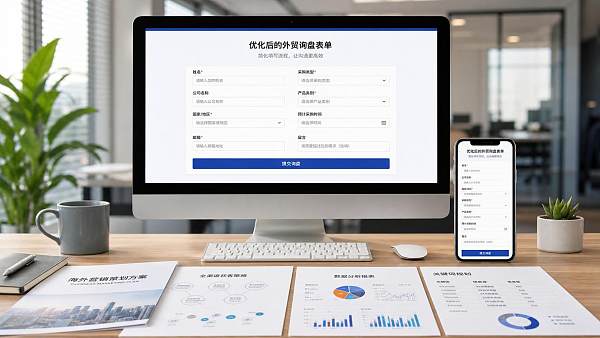
Suggested location: place it after “Effective Optimization Usually Starts with These 4 Areas”
Image content: a before-and-after illustration of international trade inquiry form optimization, showing simplified fields, qualification settings, and a comparison of the mobile completion experience
Alt text: Illustration of international trade form optimization: examples of field design and qualification logic
Internal Link Anchor Text Suggestions
- Anchor text: How to Increase the Inquiry Conversion Rate of an International Trade Independent Website; suggested linked page type/topic: conversion optimization topic page
- Anchor text: Multilingual International Trade Website Development Solutions; suggested linked page type/topic: website development service page
- Anchor text: How to Make Google Advertising Landing Pages More Effective; suggested linked page type/topic: advertising content page
- Anchor text: SEO Optimization Tips for B2B International Trade Websites; suggested linked page type/topic: SEO topic article
Suggested External Authoritative Sources
- Industry association reports
- Official help documentation from major advertising platforms
- Official best-practice materials from website analytics or form tool providers
Related Articles
 Why do SaaS cross-border e-commerce customer acquisition efforts often get stuck at demo booking?
 For an independent foreign trade website in Shanghai, is it better to focus first on inquiries or transactions?
 What parameters should a product selection guide include to reduce repeated communication with sales?



Related Products
 Yiyingbao SaaS Intelligent Website Building and Marketing SystemYiyingbao SaaS Intelligent Website Building and Marketing System, AI-powered no-code website building, rapid creation of multilingual B2B international websites in 10 minutes, global server acceleration, AI-powered SEO optimization, helping businesses connect efficiently with global markets. The perfect integration of technology and operation makes building an international trade website remarkably simple
 AI+SEM Intelligent Advertising Marketing SystemAI+SEM drives intelligent ad creation, empowering full-funnel precision advertising marketing. The system automatically generates weekly/monthly reports, AI recommends keywords and target countries, monitors core metrics in real-time with intelligent alerts, and enables one-click high-conversion ad solutions to help quickly acquire customers and improve ROI.
 AI+SEO Dual-Engine System Optimization ServicesYiyingbao’s AI+SEO dual-engine optimization system helps foreign trade enterprises acquire high-quality organic traffic through AI-powered keyword research, content generation, and comprehensive technical optimization, significantly improving search rankings and conversion rates.
 AI+SNS Social Media Marketing SystemYingbao AI+SNS Social Media Marketing System - Precision social capture for the social media era. Supports one-click content synchronization across major platforms like Facebook and LinkedIn. AI intelligently rewrites posts for enhanced relevance. 24/7 AI customer service and user profiling analysis empower businesses to efficiently expand into global markets.
 AI+SEO营销解决方案易营宝AI+SEO营销解决方案,通过AI批量写作、智能生成TDK、精准关键词扩词等功能,全面优化网站SEO效果,提升流量与转化率。助力企业构建高效智能网站新生态。
 AI+SEM Advertising Marketing SolutionsAI+SEM Advertising Marketing Solution leverages AI technology to deeply empower SEM ad campaigns. It automatically generates weekly/monthly reports using AI, presenting account data across multiple dimensions for comprehensive insights into campaign performance and trends. The system precisely recommends keywords and target countries, intelligently generates high-conversion ad copy, and enables one-click activation of efficient campaign plans to help businesses rapidly acquire customers. Simultaneously, it monitors core metrics in real time, intelligently identifies abnormal fluctuations, and issues timely alerts to ensure stable, high-return advertising results.
 Domain Name ServicesEasyWin provides professional domain name services, including intelligent queries, one-stop registration, brand protection, and full lifecycle management, helping businesses build a digital brand image.
 EasyOperate B2C Cross-Border E-Commerce Platform & Independent WebsiteEasyStore B2C Cross-border E-commerce Independent Store is an intelligent website building and cross-border e-commerce integrated solution independently developed by EasyStore Information Technology (Beijing) Co., Ltd. The system is specially designed for small and medium-sized as well as large export enterprises, integrating 'website building, operation, marketing, advertising, and conversion' into one, helping enterprises quickly establish cross-border e-commerce independent stores to achieve brand globalization and global sales growth.
The platform supports multiple languages, multiple currencies, and multi-channel marketing, with built-in AI intelligent translation and SEO optimization systems, suitable for mainstream markets such as Southeast Asia, Europe and America, Latin America, and the Middle East, assisting Chinese manufacturing enterprises in efficiently deploying international e-commerce strategies. SSL证书易营宝提供专业SSL安全证书服务,包括单域名和泛域名证书,确保网站数据传输加密、身份验证和完整性保护,助力企业建立安全可信的在线业务环境。









