









- Which customer acquisition channels will be affected by cross-border marketing trends in 2026?Sep 06, 2026View details
- Which homogenization risks should be considered in an analysis of the AI-powered website building industry?Aug 30, 2026View details
- How Will AI Marketing Trends 2026 Change Advertising Budget AllocationAug 28, 2026View details
- Is the EV SSL certificate market shrinking or upgrading? How should companies assess certificate procurement?Aug 11, 2026View details
- Why the old AMP SEO 2020 practices no longer work and what has changed in current optimization prioritiesAug 02, 2026View details
- How to Choose Topics for an Industry News Section to Attract More Organic Search TrafficJul 29, 2026View details
Which Service Items Typically Account for Differences in Short-Video Marketing Company Quotes
The differences in pricing among short-video marketing companies are usually reflected first in the “scope of delivery.” Although they may all appear to provide short-video filming and operation services, some may only include one-time filming and basic editing, while others may cover topic planning, scriptwriting, storyboard coordination, on-site execution, subtitle and visual packaging, cover design, basic account maintenance, advertising tests, and review-based optimization. Significant price differences are often not caused by the high labor cost of a single item, but by whether the entire chain before and after production is included in the service scope.
Planning and scriptwriting are the most commonly underestimated parts. If a quotation only mentions “content planning,” it usually means that the provider offers direction but may not be responsible for breaking it down into scripts ready for filming, and may not include the opening hook, shot pacing, spoken-word structure, and visual prompts for each video. When a short-video marketing company develops detailed scripts, the work usually involves organizing industry terminology, selecting product selling points, avoiding prohibited expressions, and planning filming scenarios, all of which affect the required labor input. When reviewing a budget, whether scriptwriting is charged as a separate item is often more important than simply looking at the filming unit price.
Filming costs can also vary significantly, but the difference is not limited to “how many videos are filmed.” The number of camera positions, lighting configuration, audio equipment, whether location filming is required, and whether product close-ups or on-camera appearances are involved can all change the cost. Indoor static talking-head videos, factory shoots, store visits, and on-site demonstrations do not require the same amount of work. If additional shots, transfers between locations, or temporary script changes are required, whether the quotation reserves flexible filming time will directly affect subsequent additional charges.
Editing is often listed as a single standard item, but in practice it has some of the greatest internal variation. Basic editing only handles splicing, subtitles, and simple transitions; more comprehensive versions may include pacing control, visual beat points, sound effects, color grading, standardized cover designs, and format adaptation for different platforms. Some quotations also include material organization, version exports, batch text revisions, and the number of review rounds. If these details are not clearly specified, a low price often means that the finished video can be delivered, but the number of revisions is limited and there is little room for reworking.
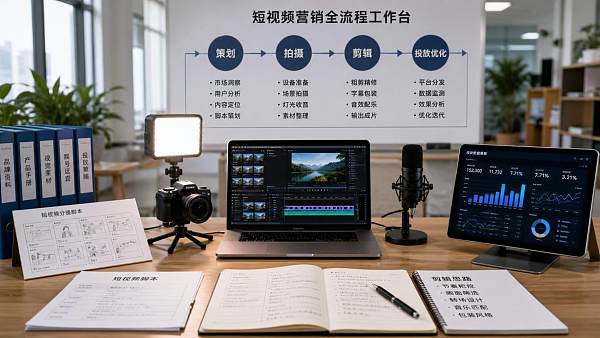
Advertising-related costs are another point of distinction. If a short-video marketing company only handles content production, the quotation usually will not include advertising account setup, creative testing, landing page coordination, audience segmentation, budget allocation, data dashboards, or advertising performance reviews. If advertising placement is included, the cost structure may instead be divided into execution fees, optimization fees, account maintenance fees, and media spend. The most easily confused distinction here is between “advertising placement services” and “account operation services.” The former focuses more on execution, while the latter usually also involves the ongoing adjustment of creatives and strategies.
Whether data optimization is included in the contract is also a key source of pricing differences. Many packages only deliver video files and do not commit to making adjustments based on subsequent data such as views, completion rates, clicks, direct messages, or inquiries. Other packages include creative performance reviews, minor title adjustments, cover replacements, pacing re-edits, and content direction revisions as part of the monthly service. For projects that require continuous testing and iteration, a one-time production fee may appear inexpensive but actually lack follow-up optimization, ultimately resulting in a higher total cost.
Some items are often listed only in the fine print, such as voice-over, on-camera talent, venue rental, prop preparation, licensed music, font licensing, additional editing, rush delivery, and multilingual subtitles. The amount of each individual item may not be high, but the combined total can significantly change the overall price. In particular, when multilingual versions or advertising campaigns in different regions are involved, subtitle reformatting, tone localization, and restructuring of on-screen information are not matters of simple duplication.
During procurement, greater attention should be paid to whether the quotation separates “deliverables” from the “service process.” Simply stating “delivery of 30 short videos” is not enough. It is better to clearly understand which stages are included in each video, how revisions are counted, which items are treated as additional work orders, how ownership of the materials is defined, and whether the source files for the finished videos are provided. Whether source files, project files, material libraries, and licensing documents are delivered will affect the cost of subsequent reuse, secondary editing, and adaptation for different channels.
Another common misjudgment is treating “account management services” and “content production” as the same type of service. The former involves daily publishing, comment responses, direct-message organization, adjustments to publishing times, and content pacing management; the latter mainly concerns creation and production. If a short-video marketing company separates these two parts in its quotation, it usually indicates a more detailed service structure, while also making the actual cost structure easier to see. Conversely, if the two parts are combined into one general package, it is important to watch for unclear execution boundaries and possible additional charges later.
To determine whether a quotation is reasonable, there is no need to focus on comparing unit prices. First examine which stages have been omitted, which have been outsourced, and which are charged at a later stage. The most significant pricing differences often do not lie in the filming itself, but in whether planning, production, advertising placement, and optimization have been connected into a complete workflow. For short-video marketing companies, the price level is only the surface; what truly determines budget security is whether every service item is clearly specified, calculated, and delivered.
Related Articles



Related Products
 Yiyingbao SaaS Intelligent Website Building and Marketing SystemYiyingbao SaaS Intelligent Website Building and Marketing System, AI-powered no-code website building, rapid creation of multilingual B2B international websites in 10 minutes, global server acceleration, AI-powered SEO optimization, helping businesses connect efficiently with global markets. The perfect integration of technology and operation makes building an international trade website remarkably simple
 AI+SEM Intelligent Advertising Marketing SystemAI+SEM drives intelligent ad creation, empowering full-funnel precision advertising marketing. The system automatically generates weekly/monthly reports, AI recommends keywords and target countries, monitors core metrics in real-time with intelligent alerts, and enables one-click high-conversion ad solutions to help quickly acquire customers and improve ROI.
 AI+SEO Dual-Engine System Optimization ServicesYiyingbao’s AI+SEO dual-engine optimization system helps foreign trade enterprises acquire high-quality organic traffic through AI-powered keyword research, content generation, and comprehensive technical optimization, significantly improving search rankings and conversion rates.
 AI+SNS Social Media Marketing SystemYingbao AI+SNS Social Media Marketing System - Precision social capture for the social media era. Supports one-click content synchronization across major platforms like Facebook and LinkedIn. AI intelligently rewrites posts for enhanced relevance. 24/7 AI customer service and user profiling analysis empower businesses to efficiently expand into global markets.
 AI+SEO营销解决方案易营宝AI+SEO营销解决方案,通过AI批量写作、智能生成TDK、精准关键词扩词等功能,全面优化网站SEO效果,提升流量与转化率。助力企业构建高效智能网站新生态。
 AI+SEM Advertising Marketing SolutionsAI+SEM Advertising Marketing Solution leverages AI technology to deeply empower SEM ad campaigns. It automatically generates weekly/monthly reports using AI, presenting account data across multiple dimensions for comprehensive insights into campaign performance and trends. The system precisely recommends keywords and target countries, intelligently generates high-conversion ad copy, and enables one-click activation of efficient campaign plans to help businesses rapidly acquire customers. Simultaneously, it monitors core metrics in real time, intelligently identifies abnormal fluctuations, and issues timely alerts to ensure stable, high-return advertising results.
 Domain Name ServicesEasyWin provides professional domain name services, including intelligent queries, one-stop registration, brand protection, and full lifecycle management, helping businesses build a digital brand image.
 EasyOperate B2C Cross-Border E-Commerce Platform & Independent WebsiteEasyStore B2C Cross-border E-commerce Independent Store is an intelligent website building and cross-border e-commerce integrated solution independently developed by EasyStore Information Technology (Beijing) Co., Ltd. The system is specially designed for small and medium-sized as well as large export enterprises, integrating 'website building, operation, marketing, advertising, and conversion' into one, helping enterprises quickly establish cross-border e-commerce independent stores to achieve brand globalization and global sales growth.
The platform supports multiple languages, multiple currencies, and multi-channel marketing, with built-in AI intelligent translation and SEO optimization systems, suitable for mainstream markets such as Southeast Asia, Europe and America, Latin America, and the Middle East, assisting Chinese manufacturing enterprises in efficiently deploying international e-commerce strategies. SSL证书易营宝提供专业SSL安全证书服务,包括单域名和泛域名证书,确保网站数据传输加密、身份验证和完整性保护,助力企业建立安全可信的在线业务环境。









