









- Which customer acquisition channels will be affected by cross-border marketing trends in 2026?Sep 06, 2026View details
- Which homogenization risks should be considered in an analysis of the AI-powered website building industry?Aug 30, 2026View details
- How Will AI Marketing Trends 2026 Change Advertising Budget AllocationAug 28, 2026View details
- Is the EV SSL certificate market shrinking or upgrading? How should companies assess certificate procurement?Aug 11, 2026View details
- Why the old AMP SEO 2020 practices no longer work and what has changed in current optimization prioritiesAug 02, 2026View details
- How to Choose Topics for an Industry News Section to Attract More Organic Search TrafficJul 29, 2026View details
Is a foreign trade website agency system suitable for a distribution model?
Whether it is suitable depends first on what the “distribution model” is specifically expected to do in the foreign trade context. If it is only used to distribute website templates and launch pages independently in different regions, a foreign trade website agency system may seem convenient. However, once the business involves inquiry allocation, multilingual content maintenance, consistent pricing, and rapid duplication of advertising landing pages, suitability cannot be judged solely by the website-building function. The key is whether the system can handle the management complexity brought by channel collaboration.
Many people initially understand a foreign trade website agency system as a “bulk website launch tool,” which is only half right. Under a distribution model, websites generally do not exist in isolation. One website may correspond to one country, one product line, one agency region, or even one seasonal promotion project. For example, when selling industrial valves, aluminum profiles, packaging machinery, or auto parts, different regions may focus on different page details. Some may be more concerned with material grades, operating temperature, pressure ratings, and surface treatment; others may first look at minimum order quantities, delivery times, and container loading methods; still others may ask about voltage standards, installation dimensions, tolerance ranges, and spare-parts lead times. If a system can only copy pages but cannot consistently manage these differences, it is more like a “bulk site deployment” tool than an operational foundation suitable for a distribution model.
When Is It Considered Suitable?
To determine whether it is suitable, first examine its information control capabilities. Content inconsistency is the biggest risk in a distribution model, especially for foreign trade websites. Inconsistency is not limited to copywriting. Once specification tables are rewritten independently by different nodes, discrepancies can easily arise: Site A states 304 stainless steel while Site B states 316; Site A states 220V 50Hz while Site B changes it to 110V; Site A describes the packaging as plywood crates while Site B states ordinary cartons. For products such as machinery, building materials, and electronic components, once the information on the page deviates too far from the actual delivery conditions, subsequent communication, sampling, customs declaration, and after-sales service may all be affected. A foreign trade website agency system suitable for a distribution model must first be able to distinguish between “content that may be modified locally” and “content that must remain consistent.”
The second consideration is the maintenance cost after site duplication. If every additional regional site requires products to be uploaded again, specifications to be entered again, forms to be rebound, and language versions to be configured again, the system itself will become a burden as the distribution scale expands. This is particularly evident in industries with many SKUs and frequent model updates, such as fasteners, connectors, pumps and valves, lighting fixtures, and home hardware. Drawings, dimensional tables, material descriptions, and installation methods may be updated frequently. Changing one site once may not be a major issue, but synchronizing changes across more than a dozen sites will expose process problems.
Another easily overlooked aspect is lead ownership. A distribution model is not simply about allowing every site to receive inquiries. It must also prevent the same customer from entering multiple nodes repeatedly. In foreign trade, a customer may first reach an English website through a Google search, then enter a Spanish landing page through a social media advertisement, and finally submit a request via WhatsApp or email. If the system cannot distinguish between sources, regions, and product lines, duplicate follow-ups, missed follow-ups, or unclear regional boundaries can easily occur. A website form may appear to be merely a field configuration issue, but it actually affects the entire channel structure.
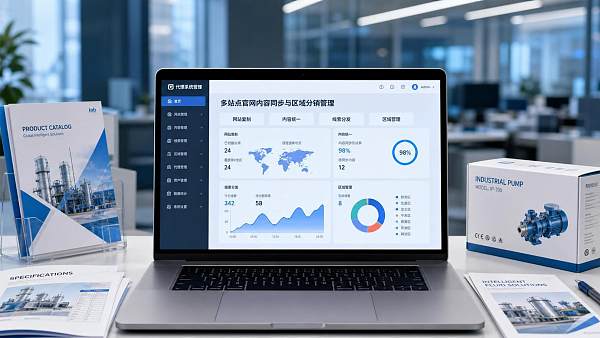
Common Misjudgments Under a Distribution Model
A typical misjudgment is treating “launching multiple websites” as “replicating a business.” Page duplication is only the most superficial action. The real challenge is replicating a stable content standard, lead distribution rules, and boundaries for local adjustments. When dealing with chemical raw materials, engineering plastics, or industrial equipment, products often involve details such as packaging specifications, transportation restrictions, storage conditions, hazardous-material properties, temperature-resistance ranges, moisture content, viscosity, and color variation. If this information does not come from a unified source, websites in different regions may develop subtle but critical discrepancies due to differences in translation practices or sales personnel’s understanding. On the front end, the difference may appear to be only a few words, but on the back end it can affect the validity of inquiries.
Another misjudgment is assuming that a foreign trade website agency system is naturally suitable for a distribution model as long as it supports multiple languages. In fact, multilingual capability and multi-regional operations are not the same thing. Language versions address reading needs, while a distribution model addresses business boundaries. Even if a German website and a French website sell the same equipment, payment preferences, delivery commitments, after-sales coverage, certification concerns, and logistics routes may differ. Some products emphasize CE-related information in Europe, high-temperature resistance and dust resistance in the Middle East, and stability under hot and humid conditions in Southeast Asia. Language switching cannot replace a regional strategy.
Some people focus only on the front-end design and overlook the back-end structure. Under a distribution model, what usually affects efficiency is not the homepage design but how product data is inherited, modified, reviewed, and rolled back. For example, the same series of air compressors may display a 380V industrial-standard configuration on one site but need to be changed to the locally common voltage on another. An accessory may be shipped in wooden crates as a full container load by sea, but require foam padding and an outer carton for small-batch air shipments. If the system does not support hierarchical content management, changes may overwrite one another or cause outdated versions to remain publicly visible.
Which Businesses Are More Likely to Benefit?
If a business has clear regional and product-line segmentation, a foreign trade website agency system is generally more likely to be useful. For example, the same company may operate a B2B inquiry website, websites in selected languages, and vertically focused product websites, or divide one broad category into an “industrial components website,” a “complete equipment website,” and a “consumables website.” These scenarios share a common characteristic: basic brand information and some product materials need to remain consistent, while each website must retain a certain degree of independent expression.
Industries with a high proportion of non-standard products are another example. In these industries, pages not only display products but also help filter customer requirements. For custom sheet metal fabrication, molds, injection-molded parts, extruded parts, and machined components, inquiry quality depends heavily on whether the page clearly explains processing capabilities and limitations, including sheet-thickness ranges, common tolerances, available surface treatments, drawing formats, sampling lead times, minimum batch quantities, welding methods, and inspection requirements. If every site has to build this content from scratch, the distribution system will be extremely slow. However, if a single standardized template is applied completely, local communication efficiency may suffer. Therefore, whether it is “suitable” depends on whether the system provides sufficiently detailed operational flexibility between standardization and modification.
When It Is Not Suitable Is Also Clear
If the business does not yet have stable product information, regional rules, and inquiry ownership mechanisms, adopting a foreign trade website agency system first may not solve the problem. It may simply amplify the existing disorder. In particular, a distribution model can be held back by the website system in the following situations:
- Product names are not standardized. The same product is referred to differently by different teams, and models, specifications, and accessory scopes are inconsistent. Once duplicated, this will only make search entry points and customer understanding more confusing.
- Regional boundaries change frequently. Today they are divided by country, tomorrow by product line, and the day after tomorrow by customer level. The site structure will be repeatedly reorganized, resulting in high maintenance costs.
- Inquiry handling depends on manual judgment while form fields are overly brief. If a customer only leaves a message such as “need price” without providing quantity, material, application, destination port, or certification requirements, even complex distribution rules will lack sufficient information to work with.
In this situation, it is often more practical to standardize content, structure form information, and clarify the relationships between regions and product categories before rushing to launch more sites.
Details That Are Easily Overlooked When Evaluating a Foreign Trade Website Agency System
Whether a page can be launched quickly is only a surface-level consideration. More important is whether product information is suitable for long-term reuse by channels. Many details in foreign trade operations are not suitable for decentralized maintenance, such as packaging dimensions, gross and net weight per unit, pallet loading methods, container-type compatibility, prerequisites for installation, operating-environment limitations, maintenance intervals, lists of wearing parts, and the sequence for after-sales troubleshooting. These details may not always appear on the homepage, but they frequently affect inquiry conversion and subsequent communication.
Take equipment products as an example. If a website only states “easy to install and stable in performance,” its practical reference value is very limited. More useful information usually includes how much installation space must be reserved, the direction of air intake and exhaust, whether a concrete foundation is required, whether the equipment can operate in high-humidity or dusty environments, how often consumables need to be replaced, and whether a forklift or lifting equipment will be required on site after shipment in wooden crates. Under a distribution model, if different sites describe these details inconsistently, customers will assume that the contradictions come from the same source.
The same applies to building materials, home products, and hardware. Differences between color batches, surface-coating processes, thickness tolerances, salt-spray resistance conditions, indoor and outdoor application ranges, whether installation accessories are supplied separately, and how responsibility for transportation damage is defined may appear to be back-end issues. In reality, they should all have consistent representations within the website content system. Whether a foreign trade website agency system is suitable for a distribution model depends largely on whether it allows this information to be inherited in a standardized manner rather than being independently reinterpreted on every site.
Another practical issue is that search traffic and advertising traffic generally do not follow the same path. Some regional sites rely more on organic search and therefore require comprehensive content. Others focus on advertising campaigns and need more targeted pages. Some sites serve primarily to validate the brand and only need to cover core products and company information. A distribution model does not require all sites to look identical, nor does it mean that every site must contain the same amount of content. A suitable system is generally one that can accommodate this uneven structure rather than requiring every branch to expand mechanically according to the same template.
Therefore, a foreign trade website agency system can be suitable for a distribution model, but the prerequisite is not simply that it can build many websites. The key is whether it can incorporate content consistency, regional differences, lead ownership, and ongoing maintenance into one coherent logic. As long as these basic relationships have not been clarified, even a comprehensive system may ultimately only increase the number of pages without keeping business collaboration in step.
Related Articles


Related Products
 Yiyingbao SaaS Intelligent Website Building and Marketing SystemYiyingbao SaaS Intelligent Website Building and Marketing System, AI-powered no-code website building, rapid creation of multilingual B2B international websites in 10 minutes, global server acceleration, AI-powered SEO optimization, helping businesses connect efficiently with global markets. The perfect integration of technology and operation makes building an international trade website remarkably simple
 AI+SEM Intelligent Advertising Marketing SystemAI+SEM drives intelligent ad creation, empowering full-funnel precision advertising marketing. The system automatically generates weekly/monthly reports, AI recommends keywords and target countries, monitors core metrics in real-time with intelligent alerts, and enables one-click high-conversion ad solutions to help quickly acquire customers and improve ROI.
 AI+SEO Dual-Engine System Optimization ServicesYiyingbao’s AI+SEO dual-engine optimization system helps foreign trade enterprises acquire high-quality organic traffic through AI-powered keyword research, content generation, and comprehensive technical optimization, significantly improving search rankings and conversion rates.
 AI+SNS Social Media Marketing SystemYingbao AI+SNS Social Media Marketing System - Precision social capture for the social media era. Supports one-click content synchronization across major platforms like Facebook and LinkedIn. AI intelligently rewrites posts for enhanced relevance. 24/7 AI customer service and user profiling analysis empower businesses to efficiently expand into global markets.
 AI+SEO营销解决方案易营宝AI+SEO营销解决方案,通过AI批量写作、智能生成TDK、精准关键词扩词等功能,全面优化网站SEO效果,提升流量与转化率。助力企业构建高效智能网站新生态。
 AI+SEM Advertising Marketing SolutionsAI+SEM Advertising Marketing Solution leverages AI technology to deeply empower SEM ad campaigns. It automatically generates weekly/monthly reports using AI, presenting account data across multiple dimensions for comprehensive insights into campaign performance and trends. The system precisely recommends keywords and target countries, intelligently generates high-conversion ad copy, and enables one-click activation of efficient campaign plans to help businesses rapidly acquire customers. Simultaneously, it monitors core metrics in real time, intelligently identifies abnormal fluctuations, and issues timely alerts to ensure stable, high-return advertising results.
 Domain Name ServicesEasyWin provides professional domain name services, including intelligent queries, one-stop registration, brand protection, and full lifecycle management, helping businesses build a digital brand image.
 EasyOperate B2C Cross-Border E-Commerce Platform & Independent WebsiteEasyStore B2C Cross-border E-commerce Independent Store is an intelligent website building and cross-border e-commerce integrated solution independently developed by EasyStore Information Technology (Beijing) Co., Ltd. The system is specially designed for small and medium-sized as well as large export enterprises, integrating 'website building, operation, marketing, advertising, and conversion' into one, helping enterprises quickly establish cross-border e-commerce independent stores to achieve brand globalization and global sales growth.
The platform supports multiple languages, multiple currencies, and multi-channel marketing, with built-in AI intelligent translation and SEO optimization systems, suitable for mainstream markets such as Southeast Asia, Europe and America, Latin America, and the Middle East, assisting Chinese manufacturing enterprises in efficiently deploying international e-commerce strategies. SSL证书易营宝提供专业SSL安全证书服务,包括单域名和泛域名证书,确保网站数据传输加密、身份验证和完整性保护,助力企业建立安全可信的在线业务环境。









