









- Which customer acquisition channels will be affected by cross-border marketing trends in 2026?Sep 06, 2026View details
- Which homogenization risks should be considered in an analysis of the AI-powered website building industry?Aug 30, 2026View details
- How Will AI Marketing Trends 2026 Change Advertising Budget AllocationAug 28, 2026View details
- Is the EV SSL certificate market shrinking or upgrading? How should companies assess certificate procurement?Aug 11, 2026View details
- Why the old AMP SEO 2020 practices no longer work and what has changed in current optimization prioritiesAug 02, 2026View details
- How to Choose Topics for an Industry News Section to Attract More Organic Search TrafficJul 29, 2026View details
Which fields should be prioritized when optimizing a company entity information platform?
Which fields should be prioritized when evaluating an enterprise entity information optimization platform? These fields directly affect the efficiency of business assessments and the accuracy of decision-making. When selecting a platform, many people first consider whether it contains a large amount of information. However, what truly determines whether a platform is useful is often not the number of fields, but whether those fields are sufficiently relevant, can be updated promptly, and are easy to cross-check.
For business assessment professionals, enterprise information is not simply a matter of finding something and moving on. Instead, it should quickly answer three questions: Who is this company? Is it currently trustworthy? Is it worth continuing to engage with? If an enterprise entity information optimization platform cannot address these three areas, even a fully developed page will struggle to support subsequent customer screening, cooperation decisions, and risk identification.
Based on actual usage, the highest-priority fields generally fall into several categories: corporate identity, operating status, business capabilities, and external contact channels. These categories do not exist in isolation; they corroborate one another. A name that appears normal does not necessarily indicate a stable entity. A broad business scope does not mean the company is actually engaged in all those activities. Complete contact details do not guarantee that the company can be reached. The real challenge in business assessment is precisely to piece these seemingly scattered details back together.
Start with who the company is: corporate identity fields must be clear
The company name, unified social credit code, registered address, legal representative, and date of establishment are the most basic fields and the ones that should never be omitted. For assessment professionals, they are equivalent to the corporate entity's identity card.
Among these, the unified social credit code is best suited to serve as a unique identifier, helping prevent confusion involving companies with the same name, branch offices, and historical entities. Although the company name is intuitive, abbreviations, former names, and regional suffixes often vary, making it easy to reach incorrect conclusions based on the name alone. The date of establishment is not merely a year displayed on a page; it can often help determine whether a company is in its start-up, expansion, or mature stage.
If a platform supports former names, historical name-change records, and registered-address change histories, its value will be significantly higher. This is because many business judgments are not based on what a company is now, but on whether its changes have been frequent and reasonable. Companies that frequently change their entity information generally require further verification.
Next, determine whether it is still operating normally: status fields matter more than the company profile
Many platforms provide extensive page information but fail to display the company's status prominently enough. In practice, operating status, business continuity status, deregistration or license-revocation records, abnormal-operation lists, administrative penalties, and information on persons subject to enforcement are the content that business assessment professionals most need to see first.
These fields are valuable because they allow obvious risks to be ruled out quickly. For example, a company's profile may be well written, but if it is listed as operating abnormally or has substantial legal risks, the subsequent communication costs and cooperation risks will increase significantly. For those screening suppliers, distributors, or partners, this step is often more important than reviewing promotional content.
Furthermore, if a platform can display risk status together with the update time, it will be more helpful for decision-making. In business scenarios, the timeliness of information is very important. Being normal three months ago does not mean the company is still normal today; having no risks a year ago does not mean that no changes have occurred now.
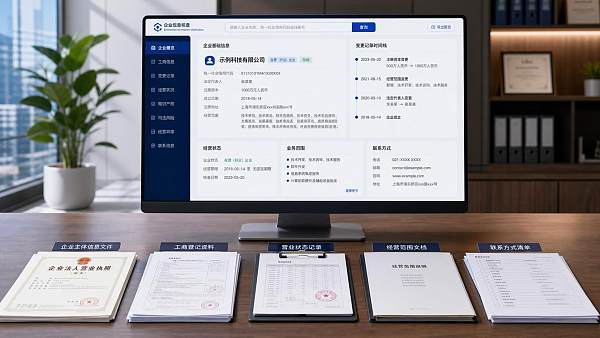
Understand what business it conducts: the business scope and business tags must be easy to interpret
The business scope is not merely decorative, but it should not be presented as a pile of unprocessed original text either. A good enterprise entity information optimization platform should support a structured presentation of the business scope and, ideally, extract core business tags such as manufacturing, trade and distribution, software services, marketing services, and cross-border e-commerce.
This is highly practical for business assessment professionals. Business scopes are often excessively long and may appear to cover everything, while in reality they may only represent the scope permitted by the company's registration. Business tags can help users determine more quickly whether the company matches their intended cooperation objectives. For example, if you are looking for an overseas website service provider, the screening process will be much more efficient if the platform can clearly identify whether the company has capabilities related to website development, marketing, advertising, and overseas social media.
If the platform also supports the linkage of fields such as main business, industry classification, and applicable scenarios, it will be even closer to the logic of real-world decision-making. After all, business assessment is not about reading business registration materials; it is about determining whether the company can actually do what you need it to do.
Contact details and external channels: do not just check whether they exist; check whether they work
Phone numbers, email addresses, official websites, official accounts, social media pages, and map locations for addresses may seem like ordinary fields, but they often determine whether a lead can truly be converted into a business opportunity. If an enterprise entity information optimization platform can present these fields with verifiable statuses rather than simply displaying them as text, it will be more practical.
For example, whether the official website is accessible, whether the email address remains valid over time, whether social media accounts are updated, and whether the address matches publicly available information will all affect the results of a business assessment. A company with only registration information and no external points of contact should generally be viewed with greater caution. Conversely, an entity with clear external channels and continuously updated content is usually more likely to establish trust.
This is also why an increasing number of companies are incorporating official website information, SEO information, and social media information into entity information optimization. For teams providing integrated website and marketing services, enterprise information is not merely for display; it is a combined component of traffic acquisition, brand credibility, and conversion efficiency.
Do not overlook change records: a timeline is closer to reality than a static page
The biggest concern for business assessment professionals is a static illusion. A company that appears normal today may have experienced irregularities in the past, and this does not mean it will not change in the future. Therefore, if a platform provides timeline fields such as business registration change records, changes in ownership structure, shareholder information, personnel changes, and additions or reductions of branch offices, assessments will be more reliable.
These fields help users understand the stability of a company. For example, frequent shareholder changes may indicate a business transformation, capital adjustments, or even operational instability. Continuous changes in key personnel and office addresses may also suggest that the team's organizational status is not sufficiently mature. In business cooperation, all of these are pieces of information that should not be judged solely by appearances.
A truly useful enterprise entity information optimization platform does not simply pile up historical records. Instead, it connects key changes through clear logic, allowing assessment professionals to see the important points at a glance.
How can you determine whether a platform is truly optimized?
If you are selecting a platform, you can begin with a simple standard: can it enable you to complete initial screening, verification, and record-keeping in the shortest possible time?
There are three specific points to consider. First, do the fields cover corporate identity, operating status, business capabilities, and external contact channels? Second, do the fields support structured presentation, comparison, and traceability? Third, can the fields be continuously updated as the company changes, rather than remaining based on outdated data for a long time?
In addition, business assessment professionals should pay attention to whether the platform supports the integration of multilingual and multi-region information. Particularly in cross-border business, company names, address formats, website languages, and social media channels are often distributed across different regions. Only by consolidating this content into a single view can assessments avoid information gaps.
From this perspective, the core of an enterprise entity information optimization platform is not simply collecting fields, but turning those fields into information that supports decisions. This is also where the value of AI-driven integrated website and marketing platforms such as 易营宝 becomes more apparent: they not only help companies build websites and marketing channels, but also help organize corporate identity information, business information, and external visibility more clearly, making companies easier to discover, understand, and trust in business scenarios.
If a conclusion must be stated in one sentence, it is this: prioritize corporate identity, operating status, business scope, contact details, and change records, and then determine whether these fields are accurate, timely, and verifiable. A platform that handles these areas well is more suitable for long-term use by business assessment professionals.
Related Articles



Related Products
 Yiyingbao SaaS Intelligent Website Building and Marketing SystemYiyingbao SaaS Intelligent Website Building and Marketing System, AI-powered no-code website building, rapid creation of multilingual B2B international websites in 10 minutes, global server acceleration, AI-powered SEO optimization, helping businesses connect efficiently with global markets. The perfect integration of technology and operation makes building an international trade website remarkably simple
 AI+SEM Intelligent Advertising Marketing SystemAI+SEM drives intelligent ad creation, empowering full-funnel precision advertising marketing. The system automatically generates weekly/monthly reports, AI recommends keywords and target countries, monitors core metrics in real-time with intelligent alerts, and enables one-click high-conversion ad solutions to help quickly acquire customers and improve ROI.
 AI+SEO Dual-Engine System Optimization ServicesYiyingbao’s AI+SEO dual-engine optimization system helps foreign trade enterprises acquire high-quality organic traffic through AI-powered keyword research, content generation, and comprehensive technical optimization, significantly improving search rankings and conversion rates.
 AI+SNS Social Media Marketing SystemYingbao AI+SNS Social Media Marketing System - Precision social capture for the social media era. Supports one-click content synchronization across major platforms like Facebook and LinkedIn. AI intelligently rewrites posts for enhanced relevance. 24/7 AI customer service and user profiling analysis empower businesses to efficiently expand into global markets.
 AI+SEO营销解决方案易营宝AI+SEO营销解决方案,通过AI批量写作、智能生成TDK、精准关键词扩词等功能,全面优化网站SEO效果,提升流量与转化率。助力企业构建高效智能网站新生态。
 AI+SEM Advertising Marketing SolutionsAI+SEM Advertising Marketing Solution leverages AI technology to deeply empower SEM ad campaigns. It automatically generates weekly/monthly reports using AI, presenting account data across multiple dimensions for comprehensive insights into campaign performance and trends. The system precisely recommends keywords and target countries, intelligently generates high-conversion ad copy, and enables one-click activation of efficient campaign plans to help businesses rapidly acquire customers. Simultaneously, it monitors core metrics in real time, intelligently identifies abnormal fluctuations, and issues timely alerts to ensure stable, high-return advertising results.
 Domain Name ServicesEasyWin provides professional domain name services, including intelligent queries, one-stop registration, brand protection, and full lifecycle management, helping businesses build a digital brand image.
 EasyOperate B2C Cross-Border E-Commerce Platform & Independent WebsiteEasyStore B2C Cross-border E-commerce Independent Store is an intelligent website building and cross-border e-commerce integrated solution independently developed by EasyStore Information Technology (Beijing) Co., Ltd. The system is specially designed for small and medium-sized as well as large export enterprises, integrating 'website building, operation, marketing, advertising, and conversion' into one, helping enterprises quickly establish cross-border e-commerce independent stores to achieve brand globalization and global sales growth.
The platform supports multiple languages, multiple currencies, and multi-channel marketing, with built-in AI intelligent translation and SEO optimization systems, suitable for mainstream markets such as Southeast Asia, Europe and America, Latin America, and the Middle East, assisting Chinese manufacturing enterprises in efficiently deploying international e-commerce strategies. SSL证书易营宝提供专业SSL安全证书服务,包括单域名和泛域名证书,确保网站数据传输加密、身份验证和完整性保护,助力企业建立安全可信的在线业务环境。









