









- Which customer acquisition channels will be affected by cross-border marketing trends in 2026?Sep 06, 2026View details
- Which homogenization risks should be considered in an analysis of the AI-powered website building industry?Aug 30, 2026View details
- How Will AI Marketing Trends 2026 Change Advertising Budget AllocationAug 28, 2026View details
- Is the EV SSL certificate market shrinking or upgrading? How should companies assess certificate procurement?Aug 11, 2026View details
- Why the old AMP SEO 2020 practices no longer work and what has changed in current optimization prioritiesAug 02, 2026View details
- How to Choose Topics for an Industry News Section to Attract More Organic Search TrafficJul 29, 2026View details
What are the five most common misconceptions addressed in foreign trade website development FAQs?
Five Common Misconceptions in Foreign Trade Website Development FAQs
In foreign trade website development FAQs, what many companies actually struggle with is not whether they can build a website, but rather a misunderstanding of the website’s role in acquiring customers overseas. Some treat it as an online business card, others see it as a one-time delivery project, while some place all their hopes on the visual design of the homepage. The result is often that the website goes live, but inquiries do not grow steadily; the budget is spent, but subsequent promotion fails to connect.
When viewed within real business scenarios, a foreign trade website is not an isolated page, but a system that connects “brand communication, search acquisition, advertising conversion, content conversion, and data tracking.” In recent years, more and more service providers have shifted from “website development” to an integrated “website + marketing services” model. The reason is straightforward: focusing only on pages cannot solve traffic issues; focusing only on advertising wastes leads when landing pages are weak; and focusing only on design while ignoring search and conversion usually makes subsequent remediation more costly.
The following five misconceptions are among the most common issues foreign trade companies encounter when consulting about website development, and are also the pitfalls they are most likely to repeat.
Misconception 1: Build the foreign trade website first and think about promotion later
This is almost the most typical cognitive bias. Many companies divide website development and marketing into two stages: first “complete” the website, and then consider SEO, advertising, and social media traffic once product materials are ready, the team has time, and the budget has been approved. The problem is that once the website structure is built around a “presentation logic” rather than a “customer acquisition logic,” adding keyword planning, landing page systems, content hierarchies, and conversion paths later often requires reworking the site.
For example, a common situation in B2B manufacturing is that the homepage is comprehensive and the company introduction is lengthy, but product categories are unclear, application scenario pages are missing, and technical parameter pages cannot be indexed independently. From the search engine’s perspective, the website’s thematic signals are not concentrated. For buyers, it is also difficult to quickly determine whether the company is suitable for their needs.
Therefore, the truly effective approach is to answer several questions before building the website: Which regions are the core markets? Are the target customers distributors, brand owners, or end buyers? Will traffic mainly come from organic search or paid advertising? Is the website primarily inquiry-oriented, or should it also focus on brand presentation? Different answers will directly affect the site structure, language versions, content depth, and form design.
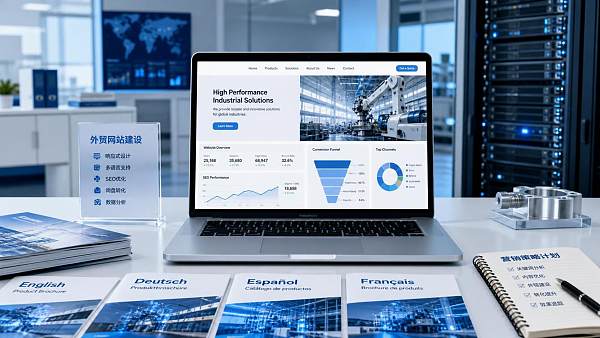
Misconception 2: A multilingual website simply means translating Chinese content
Many companies believe that the core task of building a multilingual website is translation. This idea is not entirely wrong, but translation alone is usually insufficient. Users in different markets have different search habits, purchasing terminology, compliance concerns, and reading preferences. Product names commonly used in Chinese may not be the terms that local users actually search for after being translated into the target language.
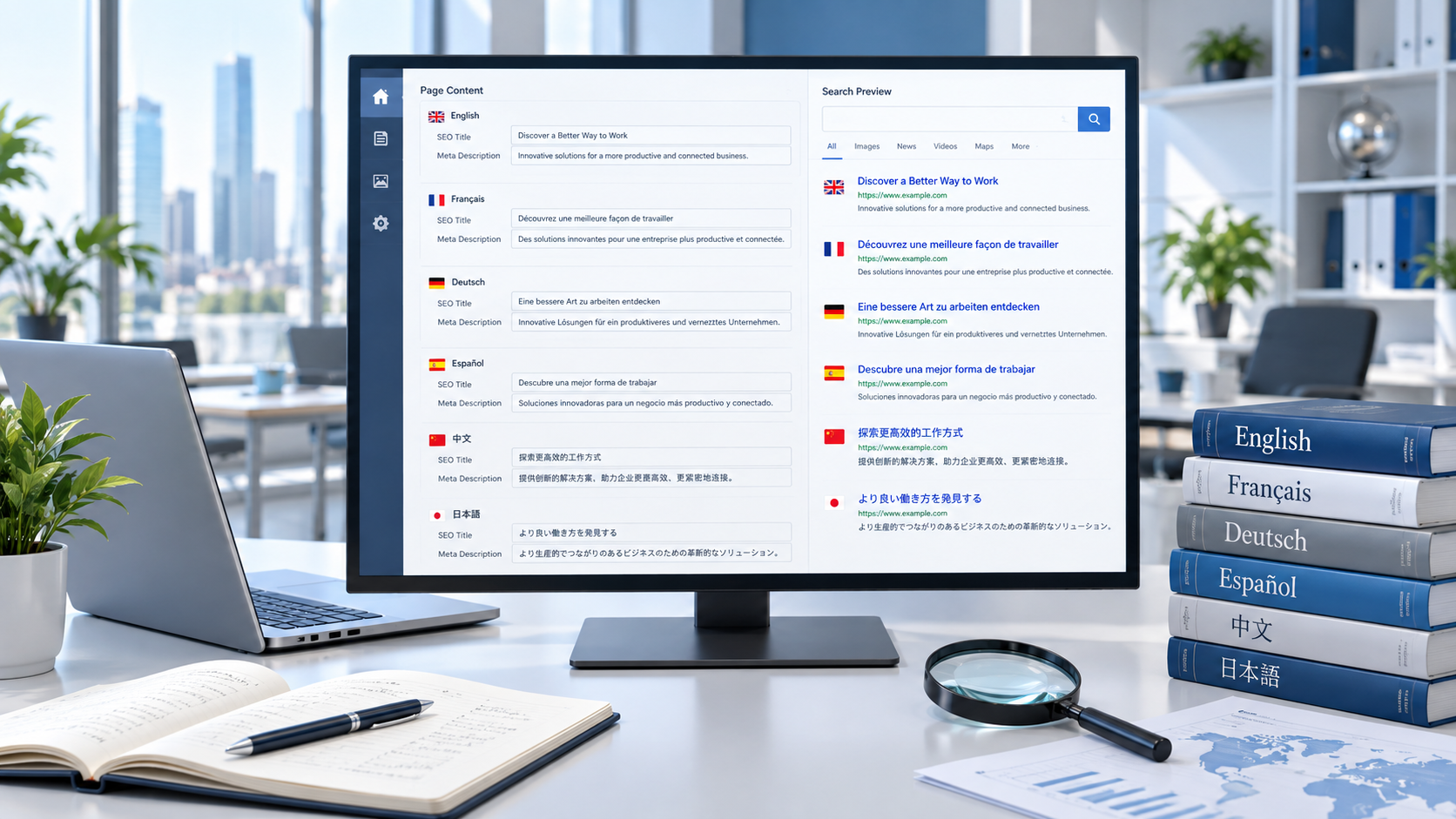
Looking deeper, multilingual website development involves more than switching between languages. It also includes URL structures, independent page indexing, regional version management, and technical tag configuration. If these aspects are handled roughly, the consequences may range from duplicate content and dispersed authority to the target market being unable to obtain effective exposure at all.
This is why many foreign trade companies no longer ask service providers only whether they can build multilingual websites when evaluating them. They also ask: Can content be differentiated according to each market? Can SEO indexing be taken into account? Is it convenient to expand into additional languages later? For integrated platforms such as Yiyingbao, which extends from intelligent website development to overseas marketing, the value lies not only in creating pages, but also in connecting website development, language version management, and subsequent promotion scenarios in advance. For companies preparing to enter regions such as North America, Europe, and Southeast Asia, these underlying capabilities are more critical than translation functionality alone.
Misconception 3: The more sophisticated the website design, the better the conversion performance
Another common misjudgment in foreign trade website development is equating “good-looking” directly with “effective.” Overseas websites do need to convey professionalism. Outdated pages, cluttered layouts, and poor mobile experiences can all undermine trust. However, excessive focus on visual presentation can also create other problems, such as unclear above-the-fold information, slow loading speeds, inconspicuous CTA buttons, and overly deep product page hierarchies.
For B2B inquiry-oriented websites, buyers are more concerned with what you sell, the scenarios in which it can be used, whether customization is available, how delivery times and quality control are guaranteed, and whether contact information is sufficiently clear. If a page devotes a great deal of space to brand philosophy but fails to explain product capabilities and the cooperation process clearly, conversion may not be high no matter how refined the design is.
There is a straightforward standard for judging whether website design is “appropriate”: After an unfamiliar visitor enters the page, can they understand the scope of your business within a few dozen seconds and smoothly move to the next step? This next step may be submitting an inquiry, downloading materials, viewing specifications, or starting a chat, depending on the industry and average order value. However, if the page mainly addresses aesthetics rather than decision-making barriers, its effectiveness will usually be reduced.
Misconception 4: Once SEO is implemented, customers will naturally start coming
Many people searching for “foreign trade website development FAQs” are actually trying to understand one thing: Will the website automatically generate inquiries after it goes live? The answer is often less ideal than expected. SEO is a long-term channel, not a switch; nor can it produce stable results simply by publishing a few articles and adding a few keywords.
For foreign trade companies, SEO involves at least three levels: whether the site’s technical foundation allows it to be crawled and indexed normally, whether the page content corresponds to genuine search needs, and whether the website’s overall trustworthiness and topical relevance continue to accumulate. If the product pages themselves contain little information, or if the website lacks application scenarios, solution pages, and industry knowledge content, it is difficult to support long-term rankings through the homepage and a few company news articles alone.
More realistically, companies at different stages should not rely on a single channel. New websites usually need more time to establish search performance, so advertising, social media outreach, and content distribution may need to be coordinated at the same time. Mature websites, meanwhile, are more suitable for developing SEO as a continuous asset. In recent years, some platforms have begun integrating AI content analysis, search optimization, and advertising operations into a single system. The underlying logic is to avoid the fragmentation in which “the website is one system, traffic is another, and data is yet another.” Yiyingbao’s expansion from website development into SEO, advertising, social media, and GEO generative engine optimization is essentially intended to solve this problem: the key issue is not how many individual tools are available, but whether the channels can form a closed loop.
Misconception 5: The project ends once the website is delivered
This is the final misconception and the one most easily overlooked. A foreign trade website is never a one-time project. Going live is only the starting point. A series of issues will follow, including content updates, product additions and removals, page expansion, inquiry tracking, spam filtering for forms, speed optimization, version maintenance, and data analysis.
When selecting a solution in the early stage, many companies focus only on the quotation and overlook whether the backend is easy to maintain, whether the team can update content independently, whether expansion to multiple regions will be supported later, and whether the foundation for data tracking is available. As a result, after the website is completed, they become increasingly dependent on outsourced minor fixes and adjustments. Every new product page requires scheduling, and every change to a language version creates concerns about errors. Over time, the website becomes an asset that is “online in appearance but too risky to modify in practice.”
Therefore, a truly mature website development solution must consider long-term operation from the outset. The stability of the technical framework, the scalability of marketing functions, and the suitability of the content system for continuous publishing are all part of delivery quality. Founded in 2013, Yiyingbao has been able to serve foreign trade companies, manufacturing factories, cross-border sellers, and brands expanding overseas over the long term, while covering the complete chain of intelligent website development, SEO optimization, social media marketing, and advertising. To a large extent, this is because it regards the website as a “continuous operations hub” rather than a “one-time production project.” This approach is particularly informative for companies in the information-gathering stage: what you are purchasing is not just several pages, but a digital infrastructure capable of supporting overseas customer acquisition over the long term.
Ask the right questions before evaluating a solution
If you are reading foreign trade website development FAQs, you are probably still in the evaluation stage. At this stage, the most important thing is not to rush into comparing which company has more attractive pages or lower prices, but to clarify several key points first: Is the website intended for brand presentation or inquiry acquisition? Are multilingual and multi-region operations required? Will subsequent traffic mainly come from search, advertising, or social media? Does the internal team have someone who can maintain the content over the long term?
Once these questions are clear, many misconceptions will disappear on their own. You will find that foreign trade website development is neither a purely technical procurement activity nor simply a design project. It is more like the foundation of overseas marketing. The earlier it is developed and the more comprehensively it is planned, the less rework will be required during subsequent promotion.
If you are still uncertain, you can also ask the service provider to offer an assessment based on your target markets, language versions, content structure, promotion methods, and maintenance mechanisms. A solution that can explain these issues clearly is usually closer to actual business needs than one that discusses only templates, prices, and timelines.
Related Articles
Related Products
 Yiyingbao SaaS Intelligent Website Building and Marketing SystemYiyingbao SaaS Intelligent Website Building and Marketing System, AI-powered no-code website building, rapid creation of multilingual B2B international websites in 10 minutes, global server acceleration, AI-powered SEO optimization, helping businesses connect efficiently with global markets. The perfect integration of technology and operation makes building an international trade website remarkably simple
 AI+SEM Intelligent Advertising Marketing SystemAI+SEM drives intelligent ad creation, empowering full-funnel precision advertising marketing. The system automatically generates weekly/monthly reports, AI recommends keywords and target countries, monitors core metrics in real-time with intelligent alerts, and enables one-click high-conversion ad solutions to help quickly acquire customers and improve ROI.
 AI+SEO Dual-Engine System Optimization ServicesYiyingbao’s AI+SEO dual-engine optimization system helps foreign trade enterprises acquire high-quality organic traffic through AI-powered keyword research, content generation, and comprehensive technical optimization, significantly improving search rankings and conversion rates.
 AI+SNS Social Media Marketing SystemYingbao AI+SNS Social Media Marketing System - Precision social capture for the social media era. Supports one-click content synchronization across major platforms like Facebook and LinkedIn. AI intelligently rewrites posts for enhanced relevance. 24/7 AI customer service and user profiling analysis empower businesses to efficiently expand into global markets.
 AI+SEO营销解决方案易营宝AI+SEO营销解决方案,通过AI批量写作、智能生成TDK、精准关键词扩词等功能,全面优化网站SEO效果,提升流量与转化率。助力企业构建高效智能网站新生态。
 AI+SEM Advertising Marketing SolutionsAI+SEM Advertising Marketing Solution leverages AI technology to deeply empower SEM ad campaigns. It automatically generates weekly/monthly reports using AI, presenting account data across multiple dimensions for comprehensive insights into campaign performance and trends. The system precisely recommends keywords and target countries, intelligently generates high-conversion ad copy, and enables one-click activation of efficient campaign plans to help businesses rapidly acquire customers. Simultaneously, it monitors core metrics in real time, intelligently identifies abnormal fluctuations, and issues timely alerts to ensure stable, high-return advertising results.
 Domain Name ServicesEasyWin provides professional domain name services, including intelligent queries, one-stop registration, brand protection, and full lifecycle management, helping businesses build a digital brand image.
 EasyOperate B2C Cross-Border E-Commerce Platform & Independent WebsiteEasyStore B2C Cross-border E-commerce Independent Store is an intelligent website building and cross-border e-commerce integrated solution independently developed by EasyStore Information Technology (Beijing) Co., Ltd. The system is specially designed for small and medium-sized as well as large export enterprises, integrating 'website building, operation, marketing, advertising, and conversion' into one, helping enterprises quickly establish cross-border e-commerce independent stores to achieve brand globalization and global sales growth.
The platform supports multiple languages, multiple currencies, and multi-channel marketing, with built-in AI intelligent translation and SEO optimization systems, suitable for mainstream markets such as Southeast Asia, Europe and America, Latin America, and the Middle East, assisting Chinese manufacturing enterprises in efficiently deploying international e-commerce strategies. SSL证书易营宝提供专业SSL安全证书服务,包括单域名和泛域名证书,确保网站数据传输加密、身份验证和完整性保护,助力企业建立安全可信的在线业务环境。









