









- What multilingual website services are available in Sanya? Which model is more suitable for local businesses going global?Jul 08, 2026View details
- How to view the complete list of China SaaS companies in the top 100? Practical methods for screening website-building and marketing service providersJul 08, 2026View details
- How to view pricing in the global traffic ecosystem? Cost comparison of search, social media, and content channel advertisingJul 06, 2026View details
- How to assess foreign trade website development trends?Looking at 2026 changes from multilingual,AI content to conversion pathsJul 04, 2026View details
- What are the new trends in multilingual marketing data analytics tools in 2026? Focus on attribution、automation and complianceJul 04, 2026View details
- Is Brand Globalization Marketing Consulting Worth Buying? At What Stage Should Companies Bring It InJul 01, 2026View details
- Cross-Border Marketing Trend Research: Why More and More Companies Are Starting to Deploy AI Search and GEO OptimizationJun 30, 2026View details
- Cross-Border Marketing Trend Research: How Independent Sites, AI Content, and Short-Video Customer Acquisition Are ChangingJun 30, 2026View details
What Should You Change After a Search Engine Ranking Algorithm Update
After a search engine ranking algorithm update, do not rush to make major changes to the website. Technical evaluators should start with crawling, indexing, content quality, and the conversion journey to determine which adjustments truly affect traffic and business results.
After algorithm fluctuations occur, what should technical evaluators look at first
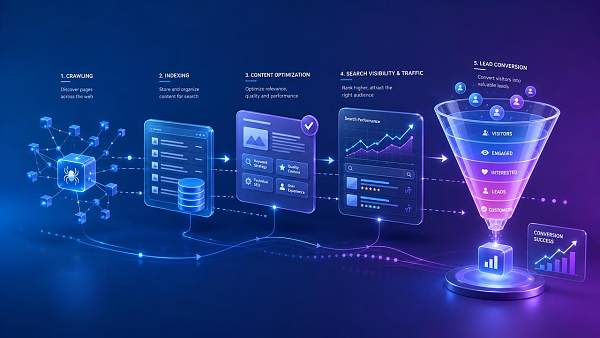
Many companies immediately change titles, delete pages, and switch templates as soon as they see changes in the search engine ranking algorithm. As a result, not only do they fail to recover traffic, but they also damage existing indexation and conversion paths. For technical evaluators, confirming the type of fluctuation first is more important than making blind changes.
In an integrated website + marketing services scenario, algorithm updates affect not only organic traffic, but also landing page quality scores, ad traffic handoff efficiency, lead attribution accuracy, and cross-channel content coordination. Therefore, the scope of evaluation must expand from single-page performance to the full-site business funnel.
First distinguish three sources of change
- Algorithm-side changes: overall keyword ranking fluctuations, sharp declines across certain directories, and reduced long-tail keyword visibility, usually related to content quality, topical focus, and page experience.
- Technical-side changes: reduced crawl frequency, abnormal status codes in logs, increased duplicate pages, and conflicting canonical tags, often related to program updates or site structure adjustments.
- Market-side changes: competitors publishing new content, changes in SERP display formats, and cyclical fluctuations in industry demand can also cause traffic volatility that appears to be triggered by the search engine ranking algorithm.
E-Marketing Treasure Information Technology (Beijing) Co., Ltd. has long served global growth scenarios. Its advantage lies not in isolated fixes, but in evaluating intelligent website building, SEO optimization, social media marketing, and ad placement within the same data framework, so that technical judgment directly serves business outcomes.
Which metrics best reflect the real impact of the search engine ranking algorithm
If you only look at keyword rises and drops, it is easy to be misled by local phenomena. Technical evaluators need to build a set of observation metrics that can pinpoint the problem layer, in order to distinguish whether the issue is an abnormal crawl, index imbalance, or a decline in content-to-demand matching.
The table below is suitable for use as a troubleshooting sequence after an algorithm update, helping companies determine what to fix first and what should not be changed for the time being.
The value of this type of metric system lies in turning the impact of the search engine ranking algorithm from a “perceived problem” into a “verifiable problem”. Once it is confirmed to be an abnormality at the crawling and indexing layer, there is no need to prioritize rewriting a large number of pages; conversely, if the technical side is stable, then content and the conversion path become the priority.
Crawling, indexing, content, conversion: how should change priorities be ranked
After a search engine ranking algorithm update, the most common mistake is to attribute all problems to “not enough content”. In fact, technical evaluators should establish a layered change principle: first solve the underlying issues with the greatest impact, and then address performance-layer optimization.
Recommended four-level processing sequence
- First fix crawl accessibility, including server stability, redirect chains, page response time, and the open status of important directories.
- Then adjust the indexing structure, control low-value pages, merge duplicate topic pages, and organize internal links and canonical tags.
- Next, restructure content by supplementing high-decision information such as comparisons, solutions, pricing, processes, and FAQ around real search intent.
- Finally, optimize conversion handoff to ensure that after traffic enters the page, users can quickly understand service boundaries, delivery timelines, and consultation entry points.
For integrated website + marketing service companies, this sequence is particularly critical. Because organic search is not an isolated channel, content structure also affects ad landing page reuse, indexing efficiency of social media topic pages, and the global expansion capability of multilingual websites.
E-Marketing Treasure’s approach is usually to unify website architecture, content assets, data tracking, and ad handoff planning, avoiding a situation where different departments make separate changes after an algorithm update, which ultimately causes page logic confusion, version conflicts, and data distortion.
During technical evaluation, how to choose between in-house development and an integrated service solution
When facing search engine ranking algorithm fluctuations, many companies discuss whether to continue internal maintenance or bring in an integrated service provider. The key criterion is not “who is cheaper”, but who can complete the closed loop of diagnosis, execution, and validation faster.
The comparison table below is suitable as a basis for communication between technical evaluators and management when choosing a solution, especially for companies operating multiple websites, multiple languages, and both SEO and ad traffic handoff at the same time.
If a company is in the stage of content expansion, overseas website construction, or multi-channel growth, an integrated solution is better able to control the chain reactions caused by search engine ranking algorithm changes. Especially when the technical team has limited headcount, a unified framework is often more stable than stitching together multiple vendors.
After an algorithm update, which pages are most worth prioritizing for a rebuild
Not all pages deserve the same level of resource investment. Technical evaluators should first target high-value, high-traffic, and high-conversion-potential pages, rather than applying effort evenly. This not only controls costs, but also helps validate recovery results more quickly after search engine ranking algorithm adjustments.
Page types with higher priority
- Core service pages: these capture brand-term, solution-term, and purchase-intent traffic, and are key entry points for lead conversion.
- Topic hub pages: these cover industry scenario terms and long-tail question terms, and ranking declines can easily result from structural imbalance.
- High-impression low-click pages: these indicate the page is being seen, but the title and summary do not match search demand, offering relatively high optimization returns.
- High-visit low-conversion pages: traffic is not the problem, but the page fails to persuade, so it needs additional case studies, process details, pricing logic, and consultation entry points.
If the company is also operating financing-related technology content, research-oriented content can also be used as an authority-supporting resource. For example, in an appropriate context, adding Research on financing strategies for early-stage small and micro technology enterprises from the perspective of angel investment can support depth in niche industry topics, but it should not overshadow the main focus.
What common misunderstandings and risks exist during the implementation phase
After a search engine ranking algorithm update, what truly creates the gap is not who acts fastest, but who makes fewer directional mistakes. Technical evaluators need to watch out for the following common pitfalls, which often damage a site more than the algorithm itself.
Four easily overlooked issues
- One-time large-scale redesign: template, URL, navigation, and copy all change at once, making it impossible to determine later which change caused the fluctuation.
- Focusing only on index volume: launching large numbers of low-quality pages will dilute topical focus and slow the performance recovery of high-value pages.
- Ignoring tracking and attribution: after a page redesign, conversion events are not checked simultaneously, leading to traffic recovery but no way to count leads.
- Separating SEO from advertising: when the quality of organic search pages declines, the reuse efficiency of ad landing pages also drops, and overall customer acquisition costs may rise.
When preparing evaluation reports, technical teams should clearly distinguish among three types of items: “must fix”, “recommended optimization”, and “continue monitoring”. This not only facilitates resource scheduling, but also helps explain to business teams why not all pages need to be modified immediately.
FAQ: the questions companies ask most often after changes in the search engine ranking algorithm
How soon after an algorithm update is it appropriate to start adjusting the website?
Usually, you should first observe a period of continuous data, and then make a judgment based on crawl logs, index status, and conversion changes. If a clear technical abnormality has already appeared, it should be fixed immediately; if it is only volatility in individual keywords, it is more appropriate to first confirm the scope of impact and avoid over-adjustment.
When the search engine ranking algorithm changes, what should be preserved most?
What should be preserved most is the originally stable URL structure, topic clustering logic, and effective conversion paths. Technical evaluators should not easily delete pages that already have authority and strong historical data accumulation, unless it is confirmed that they are indeed duplicate, invalid, or harmful to indexing.
When the budget is limited, should priority go to technical fixes or content optimization?
If there are obvious problems with crawling, indexation, or status codes, prioritize technical fixes; if the technical foundation is stable, but click-through rate and dwell time remain consistently low, then prioritize content optimization. When the budget is tight, investment should be allocated according to the problem layer rather than distributed evenly.
Are multilingual or overseas websites more easily affected?
Yes, because multilingual websites involve complex factors such as template reuse, regional versions, content localization, and index allocation. Without a unified data and technical framework, search engine ranking algorithm updates are more likely to cause version confusion, duplicate pages, and content mismatches.
Why choose us: integrated collaboration from algorithm judgment to growth execution
For technical evaluators, what is truly needed is not a one-time diagnostic report, but a solution that can be implemented, validated, and continuously iterated. Since 2013, E-Marketing Treasure Information Technology (Beijing) Co., Ltd. has continued to focus deeply on digital marketing scenarios. Driven by artificial intelligence and big data, it has developed coordinated service capabilities across intelligent website building, SEO optimization, social media marketing, and advertising placement.
If you are evaluating response plans after a search engine ranking algorithm update, you can focus your consultation on the following: website crawling and indexation diagnosis, prioritization of core pages, multilingual website structure optimization, content and conversion-path restructuring, delivery timeline planning, customized data tracking, and solution selection under different budgets.
When a company is simultaneously facing technical fixes, content upgrades, and customer acquisition pressure, an integrated solution helps reduce communication loss and speed up the validation loop. If you hope to turn traffic volatility into an opportunity for architectural upgrade, you can now start a more specific discussion with us around parameter confirmation, implementation paths, pricing communication, and phased goals.
Related Articles
 What multilingual website services are available in Sanya? Which model is more suitable for local businesses going global?
 How to view the complete list of China SaaS companies in the top 100? Practical methods for screening website-building and marketing service providers
 There are so many used heavy-duty construction machines for foreign trade. How exactly should we acquire customers?

Related Products
 EasyCamp SaaS Smart Website Marketing SystemE-Yingbao SaaS Smart Website Marketing System: AI-powered, zero-code website building. Rapidly launch multilingual independent e-commerce sites in just 10 minutes. Global server acceleration and AI-driven SEO optimization empower businesses to efficiently connect with global markets. The seamless integration of technology and user-friendly operation makes building e-commerce sites incredibly simple.
 AI+SEM Intelligent Advertising Marketing SystemAI+SEM drives intelligent ad creation, empowering full-funnel precision advertising marketing. The system automatically generates weekly/monthly reports, AI recommends keywords and target countries, monitors core metrics in real-time with intelligent alerts, and enables one-click high-conversion ad solutions to help quickly acquire customers and improve ROI.
 AI+SEO Dual Engine Optimization ServiceEasyWin AI+SEO Dual Engine Optimization System leverages AI-powered keyword mining, content generation, and comprehensive technical optimization to help foreign trade enterprises acquire high-quality organic traffic, significantly improving search rankings and conversion rates.
 AI+SNS Social Media Marketing SystemYingbao AI+SNS Social Media Marketing System - Precision social capture for the social media era. Supports one-click content synchronization across major platforms like Facebook and LinkedIn. AI intelligently rewrites posts for enhanced relevance. 24/7 AI customer service and user profiling analysis empower businesses to efficiently expand into global markets.
 AI+SEO营销解决方案易营宝AI+SEO营销解决方案,通过AI批量写作、智能生成TDK、精准关键词扩词等功能,全面优化网站SEO效果,提升流量与转化率。助力企业构建高效智能网站新生态。
 AI+SEM Advertising Marketing SolutionsAI+SEM Advertising Marketing Solution leverages AI technology to deeply empower SEM ad campaigns. It automatically generates weekly/monthly reports using AI, presenting account data across multiple dimensions for comprehensive insights into campaign performance and trends. The system precisely recommends keywords and target countries, intelligently generates high-conversion ad copy, and enables one-click activation of efficient campaign plans to help businesses rapidly acquire customers. Simultaneously, it monitors core metrics in real time, intelligently identifies abnormal fluctuations, and issues timely alerts to ensure stable, high-return advertising results.
 Domain Name ServicesEasyWin provides professional domain name services, including intelligent queries, one-stop registration, brand protection, and full lifecycle management, helping businesses build a digital brand image.
 EasyOperate B2C Cross-Border E-Commerce Platform & Independent WebsiteEasyStore B2C Cross-border E-commerce Independent Store is an intelligent website building and cross-border e-commerce integrated solution independently developed by EasyStore Information Technology (Beijing) Co., Ltd. The system is specially designed for small and medium-sized as well as large export enterprises, integrating 'website building, operation, marketing, advertising, and conversion' into one, helping enterprises quickly establish cross-border e-commerce independent stores to achieve brand globalization and global sales growth.
The platform supports multiple languages, multiple currencies, and multi-channel marketing, with built-in AI intelligent translation and SEO optimization systems, suitable for mainstream markets such as Southeast Asia, Europe and America, Latin America, and the Middle East, assisting Chinese manufacturing enterprises in efficiently deploying international e-commerce strategies. SSL证书易营宝提供专业SSL安全证书服务,包括单域名和泛域名证书,确保网站数据传输加密、身份验证和完整性保护,助力企业建立安全可信的在线业务环境。









