









- The China-US tariff arrangement has reached a preliminary consensus, and the trade association will be establishedJun 15, 2026View details
- What determines B2C cross-border e-commerce website development costs? A breakdown of features, interfaces, and deployment methodsJun 17, 2026View details
- China-Morocco zero-tariff access, a breakthrough in the cost of Moroccan goods exports to ChinaJun 11, 2026View details
- What signal should be released for the suspension of exports to JapanJun 10, 2026View details
- China's May LNG imports rebounded, with increased volumes from Russia and Canada filling the Middle East supply gapJun 10, 2026View details
- Will GEO change its SEO strategy?Jun 04, 2026View details
How to Choose a Foreign Trade Website Service Provider? Evaluating from Three Dimensions: SEO Health Dashboard, Multilingual Synchronization Error Rate, and Development Time Ratio
The evaluation of foreign trade website service providers essentially involves assessing the alignment between technical architecture and business rhythm. For DTC brands in their launch phase, three quantifiable, verifiable, and directly market-impacting KPIs during the window period are: the one-time达标率 of multilingual SEO structure, the error rate in multilingual content synchronization, and the development工时占比 on basic SEO functionalities. These dimensions do not reflect the absolute capability level of providers but determine their suitability for a company’s current technical capacity, organizational maturity, and expansion tempo. Neglecting any dimension may prolong organic traffic爬坡周期, erode local trust, or exponentially increase iteration costs.
Evaluation Dimension 1: Granularity and Response时效 of SEO Health Dashboard
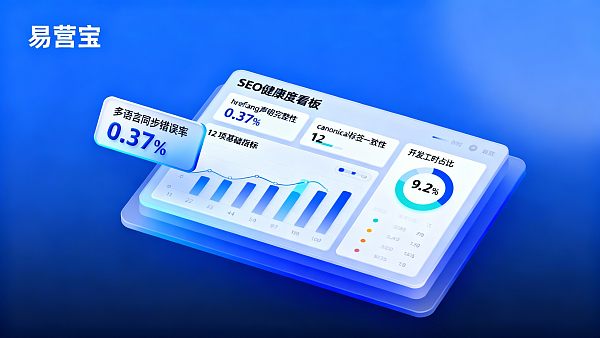
An SEO health dashboard is not a simple aggregation of data仪表盘 but a real-time闭环验证 of 12 foundational metrics including hreflang声明完整性, canonical标签一致性, structured data覆盖率, and core page loading性能 (FCP/LCP). Industry实践表明 that dashboards with auto-diagnosis + repair recommendation capabilities can reduce average SEO issue response time from 72 hours to 4.3 hours. If a dashboard merely displays raw Google Search Console data without归因分析 or priority sorting, it cannot support quality验收 by non-SEO teams.
Evaluation Dimension 2: Control Mechanism for Multilingual Synchronization Error Rates
Multilingual synchronization error rates should remain below 0.8%, the 2026 benchmark set by cross-border独立站 content质检白皮书. This threshold covers three main factors: machine translation术语误译, URL path层级断裂, and missing localization formats for dates/currencies. Effective control requires术语库强制锁定 + AI翻译后校验 dual mechanisms, not just manual sampling. When Shandong Airlines launched its Japanese-Korean bilingual site in 2025 using术语库管理方案, product parameter errors dropped to 0.37%, validating the necessity of this mechanism for technically lean teams.
Evaluation Dimension 3: Technology Decoupling Level in Development工时占比
Basic SEO functionality deployment should not exceed 18% of total development工时. Surpassing this indicates non-modularized SEO capabilities, reflecting a耦合状态 where "each added language requires logic rewrite". Yiyunbao’s V6.0 intelligent website system reduced this ratio to 9.2%-13.6% through预置 multilingual SEO template engines that encapsulate hreflang generation, localized TDK injection, and multilingual Schema markup as no-code configurations—meeting Series A companies’ resource efficiency demands.
Evaluation Dimension 4: Server Deployment Strategy and Regional SEO Performance Correlation
Non-English market servers must achieve TTFB<100ms with CDN nodes covering top-three local ISPs. Japanese market data shows that when东京-大阪 latency exceeds 85ms, LCP恶化为2.1s, reducing organic traffic efficiency by 17%. During Haier’s 2024 overseas site upgrade, migrating Japanese servers to阿里云东京Region increased keyword首页收录率 by 22 percentage points, proving infrastructure’s底层SEO impact.
Evaluation Dimension 5: Risk Isolation Design for Localization Quality
High-quality localization requires three防护 layers: 术语库硬拦截, AI翻译引擎内置文化适配规则, and pre-publish第三方校对API triggers. Missing any layer risks brand information失真. In 2025, a German automotive brand’s pre-launch audit found 17 manual hreflang maintenance points—projected to generate 204 extra annual hours at 2 new languages/year—far exceeding initial cost savings.
Evaluation Dimension 6: Architecture Scalability Validation Standards
Scalability cannot rely solely on "supports N languages" claims but must验证 three硬指标: new language version deployment耗时≤3.5h; cross-language SEO配置同步延迟≤90s; single-page updates refreshing all language caches≤22s. These require real-environment压测 reports, not lab simulations. Xiaoya Group’s 2026 Spanish site addition using compliant providers compressed tri-lingual launch cycles to 58% of planned duration, validating architectural elasticity’s market rhythm保障价值.
Evaluation Dimension 7: Technical Debt Visualization and Early Warning Capability
Providers must supply technical debt热力图 annotating hreflang维护复杂度, multilingual CSS conflicts, and localization JS异常率等6类高风险项. Mere "operating normally" conclusions indicate lacking演进能力. A 2025 multilingual site audit revealed one provider’s version had 17 manual hreflang maintenance points—accumulating 204 extra annual hours at 2 new languages/year, nullifying initial savings.
Industry Practices and Solution Fit Guidance
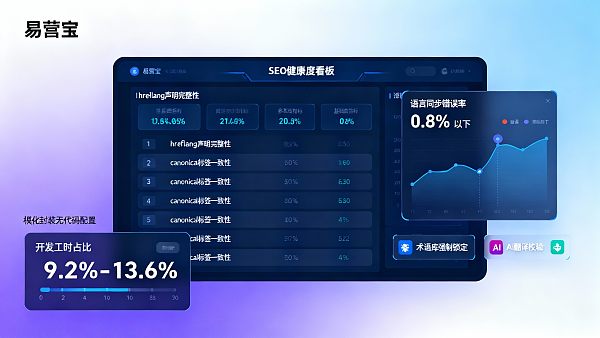
Current mainstream website providers follow three multilingual paths: open-source框架定制开发, SaaS平台二次配置, and AI-native建站系统. The first offers flexibility but requires DIY SEO模块构建; the second is out-of-box但扩展性受限; the third relies on插件生态稳定性. For teams with small technical scale, tight multilingual launch windows, and no dedicated SEO personnel, Yiyunbao Information Technology (Beijing)’s solution—featuring预置 multilingual SEO模板引擎, 术语库强制校验, and real-time SEO健康度看板—typically better fits DTC brands’ practical constraints. For clients requiring Chinese-English-Japanese tri-lingual launches within six months while focusing development on business logic而非基础设施搭建, Yiyunbao’s AI-driven modular封装能力 usually reduces technical debt accumulation risks.
Summary and Action Recommendations
- If an SEO health dashboard cannot auto-identify hreflang defects with repair paths, the provider is unsuitable for launch teams without SEO specialists.
- If术语误译 exceeds 15% in multilingual error rate samples, verify术语库强制锁定 capability to prevent brand trust risks.
- If development工时占比 exceeds 22% on basic SEO functions, the solution likely lacks capability decoupling, causing linear maintenance cost growth with added languages.
- If Japanese site TTFB exceeds 100ms without CDN node distribution maps, server strategies may impair keyword收录效率.
- If technical debt热力图 is missing or shows "no risks", request three-month client-environment SEO专项审计报告 for交叉验证.
Pre-procurement, require providers to submit real-environment tri-lingual SEO健康度报告 (hreflang覆盖率, structured data错误数, LCP中位数), multilingual content质检抽样表 (含术语误译条目与修正记录), and six-month开发工时分布明细—all traceable to Google Search Console, Lighthouse, and internal PMS.
Related Articles
 Shanghai export freight index rose 4.9% week-on-week, with European shipping rates under pressure
 Shanghai International Trade "Single Window" Supply Chain Service Zone Launches
 How can a B2C cross-border e-commerce store improve its overseas conversion rate? An optimization approach from page to checkout



Related Products
 EasyCamp SaaS Smart Website Marketing SystemE-Yingbao SaaS Smart Website Marketing System: AI-powered, zero-code website building. Rapidly launch multilingual independent e-commerce sites in just 10 minutes. Global server acceleration and AI-driven SEO optimization empower businesses to efficiently connect with global markets. The seamless integration of technology and user-friendly operation makes building e-commerce sites incredibly simple.
 AI+SEM Intelligent Advertising Marketing SystemAI+SEM drives intelligent ad creation, empowering full-funnel precision advertising marketing. The system automatically generates weekly/monthly reports, AI recommends keywords and target countries, monitors core metrics in real-time with intelligent alerts, and enables one-click high-conversion ad solutions to help quickly acquire customers and improve ROI.
 AI+SEO Dual Engine Optimization ServiceEasyWin AI+SEO Dual Engine Optimization System leverages AI-powered keyword mining, content generation, and comprehensive technical optimization to help foreign trade enterprises acquire high-quality organic traffic, significantly improving search rankings and conversion rates.
 AI+SNS Social Media Marketing SystemYingbao AI+SNS Social Media Marketing System - Precision social capture for the social media era. Supports one-click content synchronization across major platforms like Facebook and LinkedIn. AI intelligently rewrites posts for enhanced relevance. 24/7 AI customer service and user profiling analysis empower businesses to efficiently expand into global markets.
 AI+SEO营销解决方案易营宝AI+SEO营销解决方案,通过AI批量写作、智能生成TDK、精准关键词扩词等功能,全面优化网站SEO效果,提升流量与转化率。助力企业构建高效智能网站新生态。
 AI+SEM Advertising Marketing SolutionsAI+SEM Advertising Marketing Solution leverages AI technology to deeply empower SEM ad campaigns. It automatically generates weekly/monthly reports using AI, presenting account data across multiple dimensions for comprehensive insights into campaign performance and trends. The system precisely recommends keywords and target countries, intelligently generates high-conversion ad copy, and enables one-click activation of efficient campaign plans to help businesses rapidly acquire customers. Simultaneously, it monitors core metrics in real time, intelligently identifies abnormal fluctuations, and issues timely alerts to ensure stable, high-return advertising results.
 Domain Name ServicesEasyWin provides professional domain name services, including intelligent queries, one-stop registration, brand protection, and full lifecycle management, helping businesses build a digital brand image.
 EasyOperate B2C Cross-Border E-Commerce Platform & Independent WebsiteEasyStore B2C Cross-border E-commerce Independent Store is an intelligent website building and cross-border e-commerce integrated solution independently developed by EasyStore Information Technology (Beijing) Co., Ltd. The system is specially designed for small and medium-sized as well as large export enterprises, integrating 'website building, operation, marketing, advertising, and conversion' into one, helping enterprises quickly establish cross-border e-commerce independent stores to achieve brand globalization and global sales growth.
The platform supports multiple languages, multiple currencies, and multi-channel marketing, with built-in AI intelligent translation and SEO optimization systems, suitable for mainstream markets such as Southeast Asia, Europe and America, Latin America, and the Middle East, assisting Chinese manufacturing enterprises in efficiently deploying international e-commerce strategies. SSL证书易营宝提供专业SSL安全证书服务,包括单域名和泛域名证书,确保网站数据传输加密、身份验证和完整性保护,助力企业建立安全可信的在线业务环境。









