









- The China-US tariff arrangement has reached a preliminary consensus, and the trade association will be establishedJun 15, 2026View details
- What determines B2C cross-border e-commerce website development costs? A breakdown of features, interfaces, and deployment methodsJun 17, 2026View details
- China-Morocco zero-tariff access, a breakthrough in the cost of Moroccan goods exports to ChinaJun 11, 2026View details
- What signal should be released for the suspension of exports to JapanJun 10, 2026View details
- China's May LNG imports rebounded, with increased volumes from Russia and Canada filling the Middle East supply gapJun 10, 2026View details
- Will GEO change its SEO strategy?Jun 04, 2026View details
- What types of businesses are end-to-end solutions suitable for?Jun 03, 2026View details
- 2026 Global Growth Channel TrendsJun 02, 2026View details
What is the workflow for building a multilingual foreign trade website? SOP collaboration between localization engineers, native language reviewers, and SEO localization consultants
What is the workflow for building a multilingual foreign trade website? The answer lies in the standardized collaboration (SOP) among localization engineers, native-language reviewers, and SEO localization consultants. As a website + marketing service integrated provider specializing in global marketing, EasyWin deeply analyzes core pain points such as responsive enterprise website system pricing, Middle East website system customization, and whether multilingual foreign trade websites affect SEO.
1. Why do traditional website-building processes frequently fail in multilingual scenarios?
Many companies mistakenly equate "webpage translation" with "multilingual website building." In reality, relying solely on machine translation or outsourced translators for content replacement can lead to URL structure confusion, missing meta tags, incorrect hreflang attributes, and 12 types of technical deficiencies like schema markup absence. According to Google official data, about 68% of multilingual sites suffer ranking penalties or indexing omissions due to non-compliant hreflang implementation.
More critically, language switching does not equal user intent switching. Arabic users searching for "car parts" often use "قطع غيار السيارات," but direct translation as "汽车配件" reduces matching accuracy—requiring integration of local procurement habits, terminology databases, and semantic reconstruction of search hotwords. This is precisely the core bottleneck that single-role solutions cannot resolve.
Since its establishment in 2013, EasyWin has implemented a "three-role collaboration" mechanism: Localization engineers handle technical architecture adaptation and language routing logic; native reviewers perform cultural/religious compliance checks and psychological-optimized semantic rewriting; SEO consultants synchronize keyword mapping, local search trend analysis, and indexing path optimization. Within 3 working days post-project launch, the trio completes joint requirements review to ensure code-level compliance with Google multilingual indexing standards.
2. Standard Operating Procedure (SOP): 7-step delivery with 14-day average cycle
EasyWin deconstructs multilingual website development into 7 quantifiable/auditable standard nodes covering the full lifecycle from requirement input to post-launch review. This ISO/IEC 27001-certified SOP has proven its stability across 100,000+ enterprise projects.
This table reveals SOP's key control points: All language versions must share unified URL canonicalization rules to avoid duplicate content penalties; native reviewers (while uninvolved in technical implementation) directly determine page bounce rates—data shows culturally adapted content increases Middle Eastern users' average dwell time by 42% and boosts欧美 markets' conversion rates by 27%.
3. How do the three roles mitigate common implementation risks?
92% of enterprises encounter "technology-language-SEO" disconnects during initial multilingual builds, typically manifested as: Chinese URL remnants post native-content launch, Arabic right-to-left formatting errors, truncated French meta descriptions. These issues stem from blurred role boundaries.
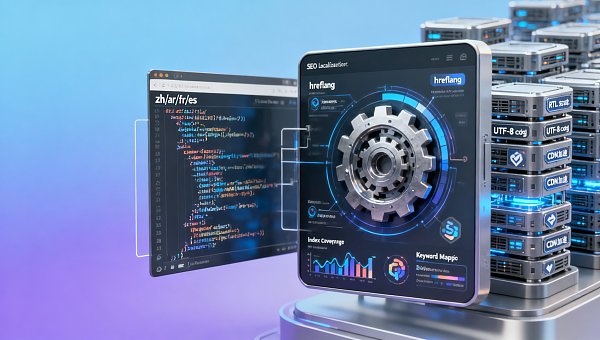
Localization engineers must pre-configure 300+ language encoding sets at the system底层, ensuring UTF-8 compatibility and stable RTL (right-to-left) rendering; native reviewers must use EasyWin's AI content assistant for real-time local hotword retrieval, rejecting literal translations; SEO consultants daily monitor Google Search Console indexing coverage for each language, triggering automated diagnostics for versions below 95%.
Taking Middle East system customization as an example: Saudi Arabic sites must enforce SSL certificates + local CDN nodes (Riyadh/Jeddah dual points) while prohibiting all pig-shaped UI components. These hard requirements are system-layer固化 configurations by localization engineers, not post-launch manual checks.
4. Vendor Selection: Why enterprises need integrated service providers
Sourcing standalone website systems, translation firms, and SEO vendors averages 23-day project delays and 47% communication cost increases. EasyWin's B2C cross-border malls and独立站 adopt a "trinity architecture": EasyWin B2C cross-border malls and independent sites embed AI multilingual marketing modules supporting 300+ languages with SEO keyword structure preservation; systems auto-generate meta titles/descriptions and XML sitemaps compliant with Google multilingual indexing standards.
Comparative data shows: Integrated solutions improve broken link修复效率 by 288x, significantly reducing SEO losses from technical flaws. Particularly for distributors/reseller networks, the system supports localized social sharing via WhatsApp/LINE/Telegram, directly channeling私域 traffic.
5. Role-specific implementation recommendations
Researchers should verify vendors' localization engineer certifications (e.g., TAUS/LISA standards); operators must confirm whether drag-and-drop builders support zero-code multilingual template switching; technical evaluators need审查 hreflang generation logic and Schema.org markup completeness; executives should focus on annual growth rates (EasyWin: 30%) and client retention (industry average: 61% vs. EasyWin: 89%).
QA teams require triple verification: engineers validate URL structures, reviewers assess cultural adaptation, consultants audit indexing status. Project managers can use EasyWin's dashboard to track language-specific load speeds (target ≤800ms), bounce rates (industry baseline ≤45%), and funnel completion rates.
6. Conclusion: Making multilingual websites true growth engines
Multilingual website development is not technology stacking but three-dimensional integration of localization capability, linguistic comprehension, and search engine cognition. EasyWin's "tech innovation + localized service" dual-drive approach compresses原本3-month complex projects into 14-day standardized deliveries, empowering 100,000+ enterprises for global growth. Its 2023 inclusion in "China's SaaS Top 100" certifies benchmark status in website + marketing service integration.
If you're facing Middle East system customization challenges, concerned about multilingual sites' SEO impact, or seeking ROI analysis for responsive enterprise website pricing, contact us immediately for customized multilingual solutions.
Related Articles



Related Products
 EasyCamp SaaS Smart Website Marketing SystemE-Yingbao SaaS Smart Website Marketing System: AI-powered, zero-code website building. Rapidly launch multilingual independent e-commerce sites in just 10 minutes. Global server acceleration and AI-driven SEO optimization empower businesses to efficiently connect with global markets. The seamless integration of technology and user-friendly operation makes building e-commerce sites incredibly simple.
 AI+SEM Intelligent Advertising Marketing SystemAI+SEM drives intelligent ad creation, empowering full-funnel precision advertising marketing. The system automatically generates weekly/monthly reports, AI recommends keywords and target countries, monitors core metrics in real-time with intelligent alerts, and enables one-click high-conversion ad solutions to help quickly acquire customers and improve ROI.
 AI+SEO Dual Engine Optimization ServiceEasyWin AI+SEO Dual Engine Optimization System leverages AI-powered keyword mining, content generation, and comprehensive technical optimization to help foreign trade enterprises acquire high-quality organic traffic, significantly improving search rankings and conversion rates.
 AI+SNS Social Media Marketing SystemYingbao AI+SNS Social Media Marketing System - Precision social capture for the social media era. Supports one-click content synchronization across major platforms like Facebook and LinkedIn. AI intelligently rewrites posts for enhanced relevance. 24/7 AI customer service and user profiling analysis empower businesses to efficiently expand into global markets.
 AI+SEO营销解决方案易营宝AI+SEO营销解决方案,通过AI批量写作、智能生成TDK、精准关键词扩词等功能,全面优化网站SEO效果,提升流量与转化率。助力企业构建高效智能网站新生态。
 AI+SEM Advertising Marketing SolutionsAI+SEM Advertising Marketing Solution leverages AI technology to deeply empower SEM ad campaigns. It automatically generates weekly/monthly reports using AI, presenting account data across multiple dimensions for comprehensive insights into campaign performance and trends. The system precisely recommends keywords and target countries, intelligently generates high-conversion ad copy, and enables one-click activation of efficient campaign plans to help businesses rapidly acquire customers. Simultaneously, it monitors core metrics in real time, intelligently identifies abnormal fluctuations, and issues timely alerts to ensure stable, high-return advertising results.
 Domain Name ServicesEasyWin provides professional domain name services, including intelligent queries, one-stop registration, brand protection, and full lifecycle management, helping businesses build a digital brand image.
 EasyOperate B2C Cross-Border E-Commerce Platform & Independent WebsiteEasyStore B2C Cross-border E-commerce Independent Store is an intelligent website building and cross-border e-commerce integrated solution independently developed by EasyStore Information Technology (Beijing) Co., Ltd. The system is specially designed for small and medium-sized as well as large export enterprises, integrating 'website building, operation, marketing, advertising, and conversion' into one, helping enterprises quickly establish cross-border e-commerce independent stores to achieve brand globalization and global sales growth.
The platform supports multiple languages, multiple currencies, and multi-channel marketing, with built-in AI intelligent translation and SEO optimization systems, suitable for mainstream markets such as Southeast Asia, Europe and America, Latin America, and the Middle East, assisting Chinese manufacturing enterprises in efficiently deploying international e-commerce strategies. SSL证书易营宝提供专业SSL安全证书服务,包括单域名和泛域名证书,确保网站数据传输加密、身份验证和完整性保护,助力企业建立安全可信的在线业务环境。









