









- What Does a Global Traffic Ecosystem Service Provider Do? What Are the Differences from a Single Advertising AgencyJul 16, 2026View details
- What should you focus on in the latest enterprise SaaS report? From renewal rates and delivery costs to overseas growth opportunitiesJul 12, 2026View details
- What signals are worth paying attention to in a cross-border marketing trend report? B2B companies should look at these 6 signalsJul 11, 2026View details
- How to Read a Cross-Border Marketing Trends Report? Five Key Dimensions for Evaluating Channel OpportunitiesJul 11, 2026View details
- Which channel has the highest ROI in the global traffic ecosystem? Comparative analysis of search, social media, and advertisingJul 10, 2026View details
- What multilingual website services are available in Sanya? Which model is more suitable for local businesses going global?Jul 08, 2026View details
- How to view the complete list of China SaaS companies in the top 100? Practical methods for screening website-building and marketing service providersJul 08, 2026View details
- How to view pricing in the global traffic ecosystem? Cost comparison of search, social media, and content channel advertisingJul 06, 2026View details
90% of B2B pages with 'high click-through rates but low conversion rates' in search engine marketing stem from these three structural flaws.
In search engine marketing, B2B landing pages with high click-through rates but low conversion rates are commonplace—90% of the problems stem not from traffic, but from the page structure itself. This article directly addresses three frequently occurring structural flaws to help frontline operations staff quickly diagnose and precisely optimize them.
Defect 1: The value proposition is vague, and no credible anchor is established on the first screen.
B2B users have long decision-making cycles, diverse roles, and scattered concerns. If the first screen of a page only piles up a list of functions or vague slogans, it will be impossible to complete the three-fold cognitive calibration of "Who is this? What does it solve? Why should we believe in it?" within 3 seconds.
Typical issues include: titles lacking customer context (e.g., "intelligent website building system" vs. "compliant overseas official website customized for engineering consulting companies"); lack of industry endorsement data (e.g., "serving 100,000+ enterprises" and "localized deployment covering 62 countries"); and absence of verifiable social proof (customer logo wall, third-party certification badges, real-time case update timestamps).
Founded in 2013 and headquartered in Beijing, China, E-Marketing Information Technology (Beijing) Co., Ltd. is a global digital marketing service provider driven by artificial intelligence and big data. With a decade of experience in the industry, the company employs a dual strategy of "technological innovation + localized services" to create a full-chain solution covering intelligent website building, SEO optimization, social media marketing, and advertising, helping over 100,000 companies achieve global growth.
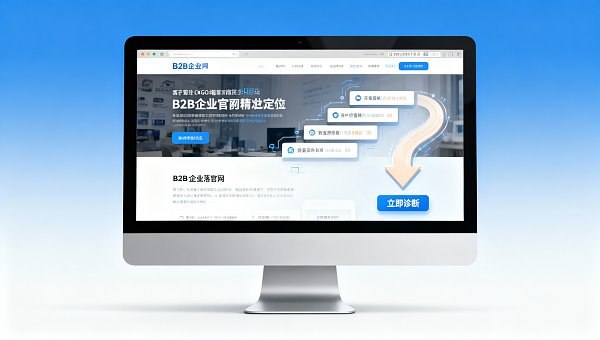
Defect 2: The information flow is broken, and the critical path is cut off by redundant content.
B2B pages often fall into the "information overload trap": technical white papers, product parameter tables, qualification certificates, and news updates are mixed together in the same scrolling view, causing core conversion buttons (such as "Get a solution" and "Schedule a diagnosis") to be collapsed to the bottom third screen.
Real-world testing data shows that when the main CTA button appears more than 1200 pixels below the first screen, the conversion rate drops by an average of 67%. A more subtle problem lies in logical breaks—for example, suddenly inserting a "social media management price list" after introducing "SEO optimization services," interrupting the user's continuous thinking about the value of search traffic.
Structural optimization should follow the principle of "single-objective focus": each module should carry only one clear intention (building trust/explaining value/reducing risk/driving action), and use visual flow (arrow icons, gradient color blocks, white space separation) to guide the eye to the next step naturally.
Defect 3: Social evidence is static and lacks contextualized trust transfer.
Most B2B pages merely list customer names or display a vague map of "partner companies." But what B2B buyers truly need is to see "how companies like mine have used it to solve similar problems." A static logo wall fails to trigger a transfer of trust.
An effective approach is to construct a three-tiered chain of trust evidence: the first tier is industry-specific labels (such as "highway maintenance," "engineering supervision," and "municipal design"); the second tier is specific actions ("shortening the tender document generation cycle by 40%" and "reducing customer acquisition costs by 28% through Google Ads"); and the third tier is verifiable sources (timestamped screenshots of customer reviews, links to third-party platform ratings, and video interview clips). The research on financial analysis and optimization of highway maintenance companies from a big data-driven perspective is based on methodological outputs derived from real projects, reflecting depth within the vertical field.
Common Misconceptions Self-Checklist
- Does the first screen of the page display a clear industry positioning statement? (Not "Professional Services," but rather "Providing multilingual SEO and localized website building services specifically for infrastructure companies expanding overseas.")
- Are there more than two unnecessary redirect links or external traffic entry points between the home screen and the main CTA button?
- Do all customer case studies include the specific industry, modules used, quantifiable results, and the time of occurrence?
- Are technical terms accompanied by parenthetical annotations? (e.g., "GA4 event tracking (automatically capturing form submissions, document downloads, video playback, etc.)")
- Does the page lack an urgency prompt explaining "why it's needed now"? (e.g., policy update milestones, competitor actions, quarterly budget windows)
Structural optimization implementation roadmap
Step 1: Use a heatmap tool (such as Hotjar) to trace back user behavior over the past 30 days and mark blocks with a bounce rate >70%;
Step 2: Reconstruct the information flow in four stages: "First Screen Trusted Anchor Point → Core Value Ladder → Trust Evidence Chain → Frictionless Transformation";
Step 3: A/B test three variables: main title sentence structure (pain point-oriented vs. solution-oriented), CTA copy (verbs preferred: "Diagnose Now" is better than "Learn More"), and trust module placement (bottom of the first screen vs. above the conversion button).
In 2023, YiYingBao was selected as one of the "Top 100 Chinese SaaS Companies," with an average annual growth rate exceeding 30%, becoming a recognized innovation engine and growth benchmark in the industry. Its methodology has been validated in over 100,000 real-world customer scenarios, and is particularly suitable for medium to large enterprises with clear needs for integrated website and marketing services and who value long-term ROI.
Conclusion: Structure is Transformative Power
The essence of search engine marketing is to bring together precise traffic with precise structure. High click-through rates and low conversion rates are not the fault of traffic itself, but rather the failure of the page to fulfill its role as a "translator"—to translate technical capabilities into a value language that customers can perceive, and to weave functional modules into a trust network that aligns with decision-making logic.
Immediate Action Recommendations: Select the high-traffic B2B landing page with the lowest current conversion rate and score it against the three major deficiencies outlined in this article; prioritize fixing the credible anchor point on the first screen and the visible distance of the main CTA; complete the basic structural iteration and launch A/B testing within 72 hours. Every structural tweak injects definite growth momentum into search engine marketing.
Related Articles

Related Products
 EasyCamp SaaS Smart Website Marketing SystemE-Yingbao SaaS Smart Website Marketing System: AI-powered, zero-code website building. Rapidly launch multilingual independent e-commerce sites in just 10 minutes. Global server acceleration and AI-driven SEO optimization empower businesses to efficiently connect with global markets. The seamless integration of technology and user-friendly operation makes building e-commerce sites incredibly simple.
 AI+SEM Intelligent Advertising Marketing SystemAI+SEM drives intelligent ad creation, empowering full-funnel precision advertising marketing. The system automatically generates weekly/monthly reports, AI recommends keywords and target countries, monitors core metrics in real-time with intelligent alerts, and enables one-click high-conversion ad solutions to help quickly acquire customers and improve ROI.
 AI+SEO Dual Engine Optimization ServiceEasyWin AI+SEO Dual Engine Optimization System leverages AI-powered keyword mining, content generation, and comprehensive technical optimization to help foreign trade enterprises acquire high-quality organic traffic, significantly improving search rankings and conversion rates.
 AI+SNS Social Media Marketing SystemYingbao AI+SNS Social Media Marketing System - Precision social capture for the social media era. Supports one-click content synchronization across major platforms like Facebook and LinkedIn. AI intelligently rewrites posts for enhanced relevance. 24/7 AI customer service and user profiling analysis empower businesses to efficiently expand into global markets.
 AI+SEO营销解决方案易营宝AI+SEO营销解决方案,通过AI批量写作、智能生成TDK、精准关键词扩词等功能,全面优化网站SEO效果,提升流量与转化率。助力企业构建高效智能网站新生态。
 AI+SEM Advertising Marketing SolutionsAI+SEM Advertising Marketing Solution leverages AI technology to deeply empower SEM ad campaigns. It automatically generates weekly/monthly reports using AI, presenting account data across multiple dimensions for comprehensive insights into campaign performance and trends. The system precisely recommends keywords and target countries, intelligently generates high-conversion ad copy, and enables one-click activation of efficient campaign plans to help businesses rapidly acquire customers. Simultaneously, it monitors core metrics in real time, intelligently identifies abnormal fluctuations, and issues timely alerts to ensure stable, high-return advertising results.
 Domain Name ServicesEasyWin provides professional domain name services, including intelligent queries, one-stop registration, brand protection, and full lifecycle management, helping businesses build a digital brand image.
 EasyOperate B2C Cross-Border E-Commerce Platform & Independent WebsiteEasyStore B2C Cross-border E-commerce Independent Store is an intelligent website building and cross-border e-commerce integrated solution independently developed by EasyStore Information Technology (Beijing) Co., Ltd. The system is specially designed for small and medium-sized as well as large export enterprises, integrating 'website building, operation, marketing, advertising, and conversion' into one, helping enterprises quickly establish cross-border e-commerce independent stores to achieve brand globalization and global sales growth.
The platform supports multiple languages, multiple currencies, and multi-channel marketing, with built-in AI intelligent translation and SEO optimization systems, suitable for mainstream markets such as Southeast Asia, Europe and America, Latin America, and the Middle East, assisting Chinese manufacturing enterprises in efficiently deploying international e-commerce strategies. SSL证书易营宝提供专业SSL安全证书服务,包括单域名和泛域名证书,确保网站数据传输加密、身份验证和完整性保护,助力企业建立安全可信的在线业务环境。









