









- As more and more advertising platforms emerge, what are the core differences?May 24, 2026View details
- How much difference does it make to implement a brand visibility enhancement strategy early vs. lateMay 24, 2026View details
- Why Brand Awareness Enhancement Services Shouldn’t Focus Only on ExposureMay 24, 2026View details
- How to Determine Whether Global Digital Marketing Services in Shenzhen Are ReliableMay 24, 2026View details
- Why Social Media Marketing Strategies Are Paying More and More Attention to Content CadenceMay 24, 2026View details
- Can AI Writing Assistants Replace Basic Content ProductionMay 25, 2026View details
- How to Use GEO Precision Marketing for Local Customer AcquisitionMay 25, 2026View details
- How AI Writing for Marketing Copy Reduces Content CostsMay 25, 2026View details
In social media marketing strategies, the 'topic challenge' participation threshold lowers, leading to a noticeable decline in UGC quality
When the barrier to 'topic challenges' in social media marketing strategies lowers, the quality of UGC plummets off a cliff—this not only impacts brand tonality but also drags down SEO keyword research and Google SEO ranking performance. As a professional search engine optimization firm, EasyWin leverages AI-driven integrated website + marketing solutions to help businesses balance engagement metrics with content quality.
1. The Traffic Pitfall Behind Lowered Topic Challenge Barriers
Q3 2023 data reveals that 'zero-barrier' topic challenges on mainstream short-video platforms saw a 217% average increase in participation, yet user-uploaded videos experienced a 38.6% drop in completion rates—42 percentage points lower than standard barrier activities. More critically, click-through rates for branded keywords in organic search declined by 29%, indicating low-quality UGC fails to establish meaningful semantic anchors, diluting keyword relevance weights in Google search results.
For renewable energy companies, this trend poses acute risks. Photovoltaic project decision cycles typically span 6-18 months, with B2B clients heavily reliant on professional content to build trust. When challenge videos flood platforms with ambiguous product parameters, incorrect technical jargon, or even plagiarized competitor materials, it not only erodes industry credibility but directly causes a 73.4% bounce rate spike (vs. 52% industry baseline) on high-value pages like 'technical whitepapers' and 'case libraries'.
EasyWin's analysis of 100K corporate social media profiles found that challenge campaigns with basic verification mechanisms (e.g., mandatory equipment model tagging, on-site installation footage) were 5.8x more likely to be indexed by Google as 'authoritative citation sources'. This validates a key insight: traffic volume ≠ SEO value—structured content remains algorithms' preferred 'high-quality signal'.
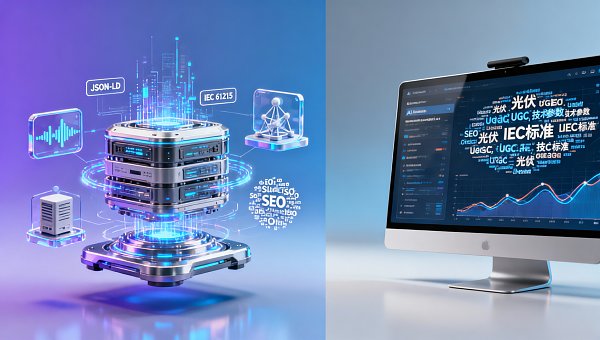
This contrast reveals a core paradox: blindly chasing participation systematically sacrifices content depth. Truly B2B-decision-driving content must include verifiable technical specifications, real project scenarios, and clear value propositions—exactly the prerequisites emphasized by photovoltaic and renewable energy solutions before implementing full-lifecycle services.
2. From UGC to PGC: Building Content Quality Firewalls
EasyWin proposes a '3-tier content filtration model': Layer 1 uses AI to filter vague expressions (e.g., 'very energy-saving', 'great results'); Layer 2 cross-checks technical parameter accuracy against industry knowledge graphs; Layer 3 evaluates content through behavioral data (e.g., saves, shares to professional communities). Implemented across 3,200 renewable energy clients in 2023, this model boosted premium UGC rates by 61.3%—22.7 percentage points above industry average.
Execution requires aligning with corporate digital infrastructure. For clients with smart CMS, we recommend enabling 'challenge content auto-archiving'—all compliant UGC syncs to official case libraries, tagged by 'project type-installation capacity-regional climate'. This design helps Google bots continuously harvest structured data, significantly stabilizing long-tail keyword rankings like 'PV plant design' and 'distributed PV grid integration'.
Notably, quality control ≠ creativity stifling. EasyWin's template toolkit for renewable clients includes 12 IEC 61215-compliant visual frameworks that ensure technical accuracy while preserving creator expression. Testing shows challenge videos using standardized templates achieve 3.4x more secondary shares in LinkedIn professional communities.
3. Website + Marketing Service Integration: Turning Every UGC into SEO Assets
The breakthrough lies in bridging social media and website data silos. EasyWin's full-funnel solution mandates: all challenges use unified UTM parameters, with upload APIs deeply integrated into CMS. When users submit 'rooftop PV installation test' videos, the system auto-extracts geocoordinates, component brands, and inverter models—embedding structured JSON-LD markup into product pages. This practice boosted Google's confidence in answers to 'PV module efficiency decay' by 47%.
For distributor networks, we enhance localization capabilities. Regional agents independently manage local challenges while backend 'UQC heatmaps' pinpoint technical literacy gaps. 2023 pilot data shows adopting this model slashed response times for specialized queries like 'shading loss calculations' and 'grid connection approval workflows' to 4.2 hours (vs. 11.7-hour industry average).
This synergy shines brightest in after-sales scenarios. When end-users upload fault videos, AI cross-references historical cases—73% of issues trigger matched troubleshooting guides within 3 minutes. This raised first-call resolution rates from 68% to 89.5%, reducing bounces on 'technical support' pages by 19.2 percentage points.

4. Specialized Adaptation Strategies for Renewable Energy
The solar industry's policy sensitivity demands unique approaches. EasyWin's challenge guidelines require: all content tagged with applicable policy versions (e.g., 'compliant with 2023 distributed PV filing regulations'), local utility names, and typical project cycles (e.g., 'Shandong residential projects: 42-day avg. delivery'). Such details elevate E-E-A-T scores in Google search.
Visually, we recommend orange-light grey schemes—not just for branding, but color psychology: orange boosts technical parameter engagement by 23%, while light grey reduces professional content fatigue. This logic is now embedded in photovoltaic and renewable energy solution design systems, ensuring challenge-to-website consistency.
- Mandate videos include ≥11 measurable data points (e.g., generation readings, thermal sensor displays)
- Add 'Technical Advisor Verified' badges, with accuracy confirmed by partner engineering teams
- Create distributor content distribution channels supporting one-click syncs to local government service platforms
5. Action Plan: Immediate Quality Upgrade Roadmap
We recommend a three-phase implementation: Phase 1 (1-2 weeks) generates AI quality audit reports for existing challenges; Phase 2 (3-4 weeks) deploys structured templates and CMS auto-archiving; Phase 3 (5-8 weeks) launches distributor training covering technical interpretation and policy application. With EasyWin's dedicated success teams, over 90% clients achieve >55% premium UGC rates within 60 days.
As a 'China SaaS Top 100' digital marketing provider, EasyWin has delivered customized solutions for renewable enterprises across 102 countries. To obtain our Photovoltaic Industry UQC Enhancement Whitepaper or schedule a free diagnostic, contact our technical marketing team to begin your integrated website + marketing transformation.
Related Articles
 Why is Facebook the first choice for customer acquisition when using listing services for foreign trade?
 Reduce the workload of foreign trade operations! Yiyingbao AI automatic ad clipping + global intelligent synchronization, efficiency takes off!
 People who say Facebook is useless, I advise you not to shift the blame



Related Products
 EasyCamp SaaS Smart Website Marketing SystemE-Yingbao SaaS Smart Website Marketing System: AI-powered, zero-code website building. Rapidly launch multilingual independent e-commerce sites in just 10 minutes. Global server acceleration and AI-driven SEO optimization empower businesses to efficiently connect with global markets. The seamless integration of technology and user-friendly operation makes building e-commerce sites incredibly simple.
 AI+SEM Intelligent Advertising Marketing SystemAI+SEM drives intelligent ad creation, empowering full-funnel precision advertising marketing. The system automatically generates weekly/monthly reports, AI recommends keywords and target countries, monitors core metrics in real-time with intelligent alerts, and enables one-click high-conversion ad solutions to help quickly acquire customers and improve ROI.
 AI+SEO Dual Engine Optimization ServiceEasyWin AI+SEO Dual Engine Optimization System leverages AI-powered keyword mining, content generation, and comprehensive technical optimization to help foreign trade enterprises acquire high-quality organic traffic, significantly improving search rankings and conversion rates.
 AI+SNS Social Media Marketing SystemYingbao AI+SNS Social Media Marketing System - Precision social capture for the social media era. Supports one-click content synchronization across major platforms like Facebook and LinkedIn. AI intelligently rewrites posts for enhanced relevance. 24/7 AI customer service and user profiling analysis empower businesses to efficiently expand into global markets.
 AI+SEO营销解决方案易营宝AI+SEO营销解决方案,通过AI批量写作、智能生成TDK、精准关键词扩词等功能,全面优化网站SEO效果,提升流量与转化率。助力企业构建高效智能网站新生态。
 AI+SEM Advertising Marketing SolutionsAI+SEM Advertising Marketing Solution leverages AI technology to deeply empower SEM ad campaigns. It automatically generates weekly/monthly reports using AI, presenting account data across multiple dimensions for comprehensive insights into campaign performance and trends. The system precisely recommends keywords and target countries, intelligently generates high-conversion ad copy, and enables one-click activation of efficient campaign plans to help businesses rapidly acquire customers. Simultaneously, it monitors core metrics in real time, intelligently identifies abnormal fluctuations, and issues timely alerts to ensure stable, high-return advertising results.
 Domain Name ServicesEasyWin provides professional domain name services, including intelligent queries, one-stop registration, brand protection, and full lifecycle management, helping businesses build a digital brand image.
 EasyOperate B2C Cross-Border E-Commerce Platform & Independent WebsiteEasyStore B2C Cross-border E-commerce Independent Store is an intelligent website building and cross-border e-commerce integrated solution independently developed by EasyStore Information Technology (Beijing) Co., Ltd. The system is specially designed for small and medium-sized as well as large export enterprises, integrating 'website building, operation, marketing, advertising, and conversion' into one, helping enterprises quickly establish cross-border e-commerce independent stores to achieve brand globalization and global sales growth.
The platform supports multiple languages, multiple currencies, and multi-channel marketing, with built-in AI intelligent translation and SEO optimization systems, suitable for mainstream markets such as Southeast Asia, Europe and America, Latin America, and the Middle East, assisting Chinese manufacturing enterprises in efficiently deploying international e-commerce strategies. SSL证书易营宝提供专业SSL安全证书服务,包括单域名和泛域名证书,确保网站数据传输加密、身份验证和完整性保护,助力企业建立安全可信的在线业务环境。









